Why Provincial Parks Turn Quads Away
A provincial park can look like a natural extension of a nearby ATV trail, but the entrance sign may say otherwise. Ontario riders often have registration, insurance and a trail permit and still cannot ride inside. The key is that these documents meet different requirements; none automatically grants permission to use a provincial park. Here’s why parks restrict quads and how to plan a legal route.
Why provincial parks restrict quad riding
Ontario provincial parks are managed to protect natural and cultural features while providing recreation that fits each park’s plan. Unrestricted ATV and UTV riding can conflict with those goals. A vehicle can compact soil, damage vegetation, disturb wildlife, increase erosion and create noise in places where visitors expect a quieter experience.
The effect is not limited to a machine’s tire tracks. A route that seems harmless when the ground is dry can become deeply rutted when it is wet. Riders may widen a narrow track to get around mud, or leave the marked route to avoid an obstacle. Repeated traffic can turn a small disturbance into lasting damage, especially in wetlands, sensitive habitat and areas with fragile soils.
Safety and visitor experience matter too. Provincial parks can have hikers, cyclists, campers and other visitors using paths and shared spaces. Mixing fast-moving recreational vehicles with those activities can create hazards. Noise and exhaust can also affect visitors and wildlife well beyond the immediate trail.
These concerns explain why quad access is generally not treated like ordinary road access. A park may have roads used by park staff or by visitors travelling to a campground, beach or other facility. That does not mean those roads are open for recreational ATV riding, or that a rider may leave them to explore side routes. Check the rules for the specific park and route rather than assuming that any visible track is open.
The restriction is also a land-management decision, not a judgment about a particular rider. A careful rider with a well-maintained machine can still be prohibited from using a route if the park has not authorized that use. The same principle applies whether the vehicle is a quad, a side-by-side or another off-road vehicle.
For a quick overview of the general restriction, see Provincial Parks Closed to Ontario ORVs. For more specific riding considerations, Ontario ATV Rules for Riding a Provincial Park is a useful related read.
Why registration and trail permits do not get you in
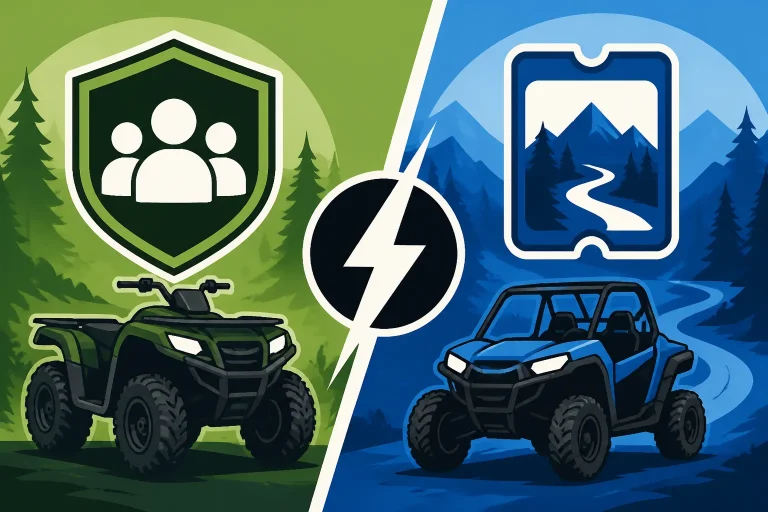
One common source of confusion is that Ontario has several separate systems for machines and riding access. A registration permit, insurance policy and trail permit each serve a different purpose. None should be treated as a general pass for every trail or piece of public land.
| Item | What it generally addresses | What it does not automatically allow |
|---|---|---|
| Ontario vehicle registration | Identifies the vehicle for registration purposes and provides its permit and plate | Recreational riding inside a provincial park |
| Insurance | Provides required coverage for eligible riding, subject to the policy | Entry onto land where ORVs are prohibited |
| Club or trail permit | Provides access to participating trails under the permit system’s rules | Access to every park, road, private property or public-land route |
| Public-land access rules | Govern whether and where riding may be allowed on certain public lands | An exception to a park’s own restrictions |
Registration and permission to ride are not the same thing. A registered ATV may be legal to own and still be prohibited on a particular route. Likewise, insurance is important, but having a valid policy does not turn a closed route into an authorized one. Review Ontario ATV Insurance Requirement if you need to separate insurance rules from access rules.
A trail permit also has boundaries. Club trails are managed under their own access arrangements, which may include specific routes, seasons, conditions and permit requirements. A trail that approaches a provincial park does not necessarily continue through it. Even when a route appears to connect on a map, a change in land ownership or management can mean the rules change at the boundary.
This is why it is worth checking whether a route is actually part of the trail network you intend to ride. Ontario ATV Trail Maps can help with route planning, but a map is not a substitute for current access information, closure notices or signs on the ground. Confirm that the specific segment is open to your vehicle and covered by the permit you hold.
The same distinction applies to provincial land. Riders sometimes hear that off-road use is allowed in some places under Ontario’s public-land rules and assume that public land includes provincial parks. It does not work that way. Parks have their own management rules, and a general public-land policy does not override a park restriction. For the separate rules that apply outside parks, see Do You Need a Trail Permit on Ontario Crown Land? and What Free Use Means on Crown Land.
A route can also change status as it crosses different land. It may run on a club-managed trail, then approach a park, private property, a conservation area or a road controlled by a municipality. Do not assume permission carries over across a boundary. Find out who manages each part of the route and what that manager allows.
When access may be allowed and what to verify
“Quads are turned away” describes the general rule riders should plan around, but it does not mean every motorized vehicle is banned from every part of every park in every circumstance. Park management may authorize specific uses or activities under particular conditions. Staff, contractors and emergency responders may use vehicles for their work. A specific route or event may also have its own authorization.
Those situations are not a general invitation for recreational riders to enter. Permission for park operations, a work project or a managed event does not establish public access for an individual ride. If you have heard that a particular route is open, verify the details directly with the park or the responsible authority before setting out.
Check these points before planning a ride near a provincial park:
- Identify the exact route. A nearby trail name or a pin on a map may not show where park boundaries begin. Confirm the route and its land manager.
- Read the park’s current rules. Look for information about off-road vehicles, vehicle access, designated roads, closures and any special authorization.
- Ask about the specific machine and purpose. If access is described as an exception, confirm which vehicle types, route, dates and uses it covers.
- Check signs at the entrance and along the route. A sign or gate may indicate a restriction that is not obvious from a general map.
- Confirm the rest of your ride separately. A legal route outside the park does not mean the connecting section inside it is open.
If information is unclear or seems to conflict, do not rely on hearsay, an old online post or the fact that another rider used the route. Contact park staff or the relevant land manager and ask a direct question: “Is this specific route open to a privately operated ATV or UTV for recreational riding?” If the answer depends on a permit or authorization, find out exactly what it covers and whether you need written confirmation.
Also pay attention to seasonal and temporary closures. A route that has been available in the past may close for maintenance, habitat protection, unsafe conditions or another management reason. Ontario Trail Closures to Check First can help with trail-side planning, but park-specific rules still need to be checked with the park.
A park boundary may not be easy to recognize from the seat of a machine. Download or carry route information before leaving an area with good reception, and stop to check a map rather than guessing at a junction. If the marked trail ends, a gate is closed or signs prohibit access, do not try to find a way around the restriction.
How to plan a ride without entering a closed park
The simplest way to avoid a frustrating stop is to plan your route around confirmed, open trails instead of treating a park as a shortcut. Start with the trail system you want to ride, then check every connection that could cross into another type of land or jurisdiction.
Use a current map from the trail organization or land manager, and confirm the trail’s status close to your ride date. Find out whether your permit covers the club area and route you plan to use. If you are connecting two trail systems, verify that the link is open for your vehicle and that you meet each system’s requirements. A route line on a map does not, by itself, prove that you have permission to ride it.
Then build a backup plan. If a trail closes or a park boundary blocks the route, know where you can turn around and how to return to a legal staging area. Avoid relying on an unverified side road or a route suggested by another rider at the trailhead. If a legal route cannot be confirmed, choose another ride rather than risk trespassing or damaging a sensitive area.
Before departure, check:
- The route is open to your kind of machine and is within the trail system’s access rules.
- Your permit applies to the trails you plan to ride.
- You have checked for recent closures, seasonal restrictions and local signs.
- The plan does not rely on crossing park land without confirmed permission.
- You have a clear way to turn back if a trail is blocked or access rules change.
If your goal is to ride close to a park, look for an authorized trail network nearby rather than assuming the park itself is part of it. The Ontario’s OFATV Trail Network may help you identify club-managed options, but check the chosen club’s current route and access information. A trail association’s permit and a park’s permission remain separate matters.
Respecting a closure also protects the riding opportunities that are available elsewhere. Riding around a gate or taking an unofficial track can damage land, put other visitors at risk and create conflict with land managers. It can also lead to enforcement consequences. When a route is closed, turn around and use a confirmed alternative.
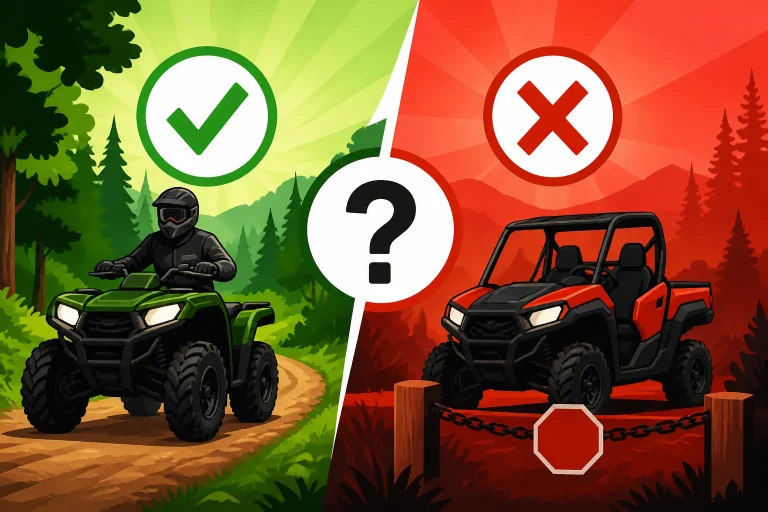
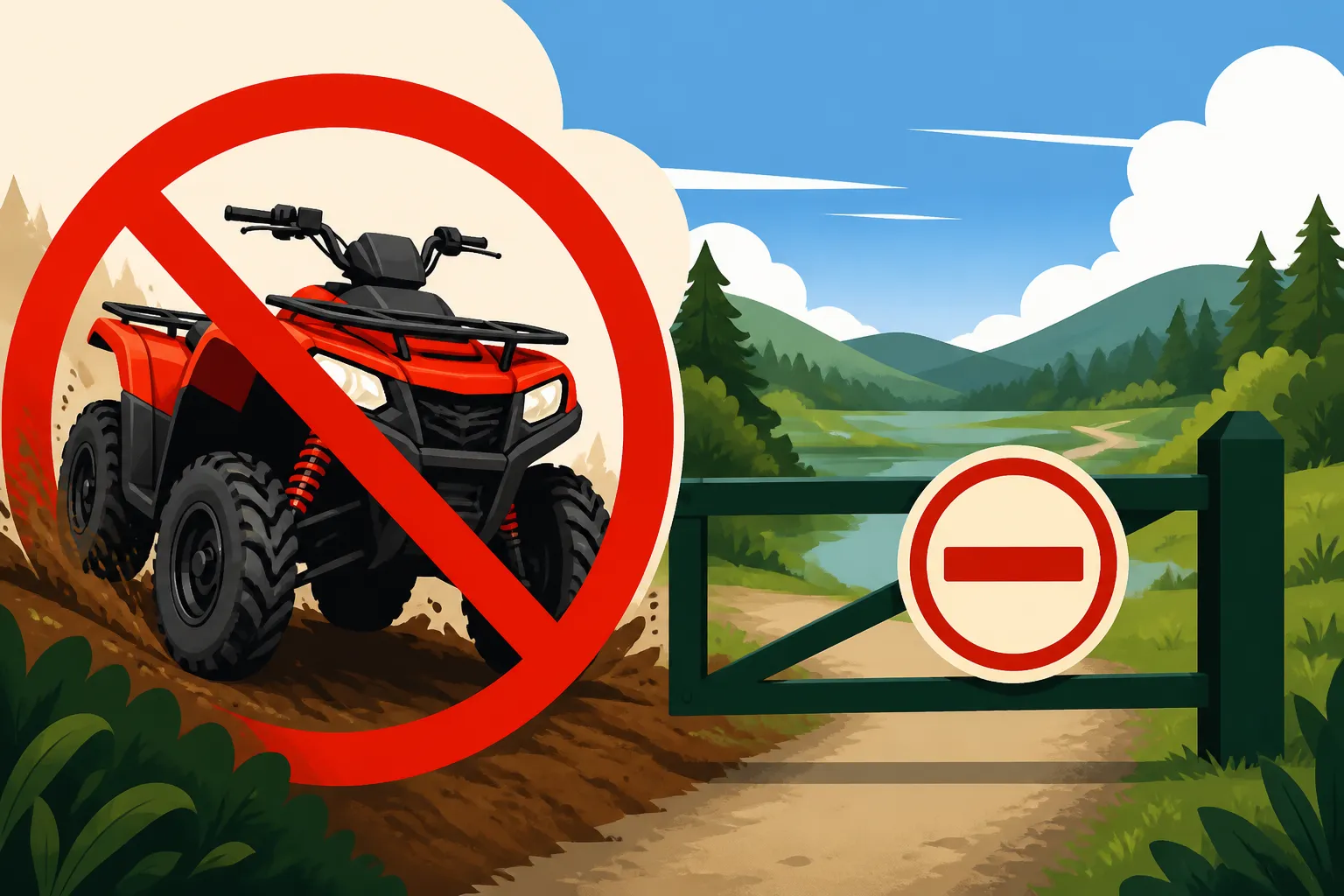
The practical rule is straightforward: treat a provincial park as closed to recreational quad and UTV riding unless the park’s current rules clearly authorize the exact route and use. Registration, insurance and a trail permit are important for their own purposes, but they do not replace that permission.
Disclaimer
This article is for general informational purposes only and does not constitute professional advice. Laws, prices and regulations vary by location and change over time. Consult a qualified professional for guidance on your specific situation.