Where 75 Cents of Every Dollar Goes
Ontario trail permits do more than let you ride eligible club trails: they help fund the organizations that maintain them. The often-quoted split says 75 cents of each dollar goes to a rider’s chosen club. Here’s what that share means, what the rest supports, and how to choose a club area.
What 75 cents of every dollar means
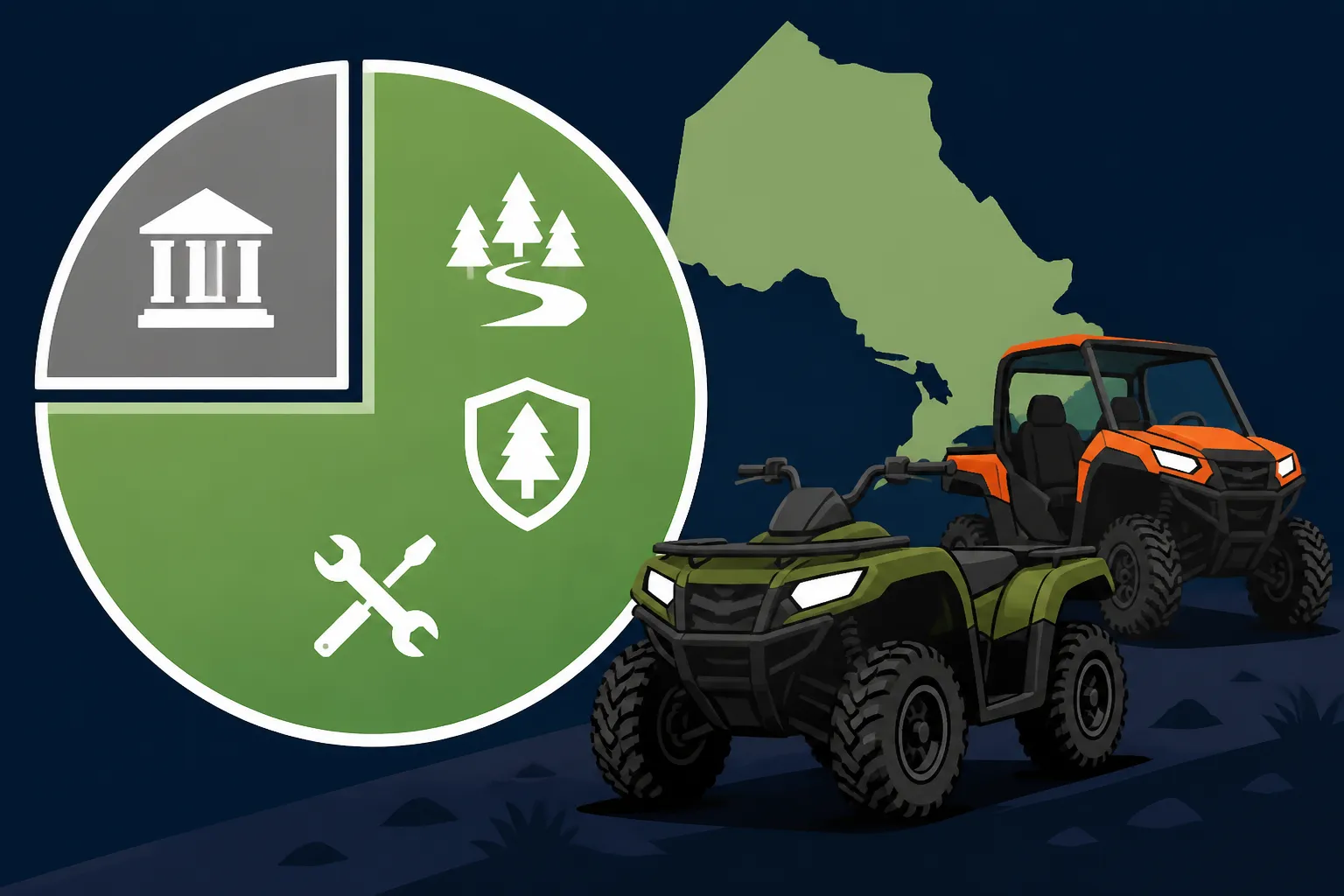
The 75-cent figure describes how permit revenue is allocated: most of each dollar is directed to the club selected by the permit buyer. It is a useful way to understand the connection between buying a permit and supporting trail work in a particular area.
That does not necessarily mean a club receives a literal coin for every dollar a rider pays. Permit sales involve administration and shared services, so the split is best understood as an allocation of revenue rather than a description of how each transaction is physically handled.
The distinction matters because riders may buy through a central permit system while choosing a local club. The system can collect and process the sale centrally, then direct the club share to the organization associated with the buyer’s selection. The central purchase point and the local destination of much of the revenue are not the same thing.
The basic idea is:
| Part of each dollar | General destination | Why it matters |
|---|---|---|
| 75 cents | The rider’s selected club | Helps fund local trail work and club operations |
| 25 cents | Shared services and system costs | Supports functions that individual clubs may not provide on their own |
The table gives a simple overview, not a line-by-line accounting statement. The exact use of funds can depend on the organizations and services involved. For details about the overall system, see Where Ontario Permit Money Goes and 75 Percent to Your Chosen Club.
A trail permit also has a different purpose from an Ontario vehicle registration permit. Registration relates to the machine and its legal identification; a trail permit relates to access under a trail organization’s rules. Buying one does not automatically provide road access, permission to ride private property, or access to every trail in the province. Ontario ATV Trail Permits Explained covers the distinction between a trail permit and other riding requirements.
What the club share can support
Local clubs are the organizations closest to many of the trails riders use. Their work can include maintaining routes, checking and improving signage, coordinating volunteers, responding to trail damage, and communicating closures or conditions. The work is not always visible from the seat of a machine, but it can affect whether a route is passable, clearly marked, and ready for riders.
Trail maintenance is not just clearing a path. Depending on the route and the problem, work may involve dealing with drainage, fallen trees, damaged signs, washed-out sections, or structures that need attention. Clubs may also need to coordinate with landowners and other groups before work can happen. The terrain, access arrangements, and seasonal conditions differ between areas, so a club’s priorities are local.
Permit revenue can help a club plan this work and meet routine operating needs. But it should not be treated as a guarantee that every trail will be open or in ideal condition. Trails can close because of weather, soft ground, logging, land access changes, maintenance, or other constraints. A permit supports the trail system; it does not override a closure or guarantee access to a particular route.
Volunteers are another important part of the picture. Money can help cover costs, but it does not replace the people who inspect routes, work on signs, share local information, and help organize trail operations. A club can benefit from permit sales while still relying on volunteer time and cooperation with others.
This is one reason the selected club matters. A rider who spends most of their time in one area may want to direct the club share there, even if they occasionally ride elsewhere. The club that receives the allocation is not necessarily the only club whose trails the rider may use; access depends on the permit’s rules and any local requirements.
If you are choosing among clubs, think about where you are most likely to ride, not only where the permit is sold. A useful starting point is Picking a Club Area for Your Permit. You can then compare the area’s trail network, club information, and the conditions that affect your usual riding plans.
What the remaining quarter supports
The remaining 25 cents is associated with shared costs and services that support the broader permit system. The point of a shared portion is that some functions are handled centrally or across multiple clubs, rather than each local organization having to arrange them independently.
Those functions can include administration and permit-system operations. Shared costs can also relate to services that support participating clubs or permit holders across a wider network. One example identified in the permit information is liability insurance connected with the permit. Riders should check the current terms to understand what that insurance does and does not cover; a permit is not a substitute for reading the applicable policy details.
It is tempting to assume that the entire remaining quarter pays for one specific service, but that is too simple. A shared portion can support several kinds of work, and allocations can be described differently depending on the accounting or program information being presented. For the broad categories, see What the Other Quarter Covers in Ontario and Liability Insurance Inside the Permit Price.
The shared portion can also help explain why the permit system is not simply a direct payment from each rider to one local club. A connected network may need common administration, information, and services that serve more than one riding area. This can be useful for a rider travelling across club boundaries, but it also means the dollar split should not be interpreted as a club’s full operating budget.
A trail club may receive permit revenue along with other support, and its costs may not match the permit allocation exactly. Some clubs face more demanding maintenance needs than others. A route with more structures, longer distances, difficult access, or frequent weather damage can create costs that are different from those in another area. The 75-cent figure describes a revenue share, not a promise that every club receives enough to cover every expense.
Permit funding is not permission for every place
A trail permit applies under the conditions set by the permit provider and participating trail organizations. It does not automatically grant permission to ride on every trail, road, private property, conservation area, or public land. Local restrictions and closures still matter.
For example, Ontario’s free-use policy for some Crown land does not mean a rider can ignore signage, restrictions, land-use rules, or municipal by-laws. Likewise, a permit accepted by one trail network does not necessarily cover a separate organization’s trails. Check the route and the relevant permit conditions before setting out. Ontario’s Separate Club Passes explains why riders may encounter separate passes, while Ontario Trail Permit Reciprocity With the Maritimes covers a different question: whether an Ontario permit is honoured outside the province.
How to choose the club connected to your permit
Choosing a club is partly a practical decision and partly a way to direct support. Start with the areas you expect to ride most often. If you plan to spend the season in a particular region, selecting the club associated with that area can align the local share with where you are most likely to use the network.
Before buying, confirm which club selection options are available and how the permit works across participating areas. Do not assume that choosing one club restricts you to only its routes, or that it grants access to every other area. The specific permit and the participating organizations determine the details.
A quick decision process can help:
- List the trail areas you expect to visit most often.
- Check which club maintains or serves those areas.
- Review whether your intended routes require another club’s pass or a separate access payment.
- Read the permit conditions, including any limits on vehicle, rider, or trail use.
- Check trail status before each ride, even after you have purchased a permit.
The first two steps help you decide where your club share may be most useful. The next steps prevent a common misunderstanding: paying for one permit does not mean that every trail, parking area, or adjoining network is included. Does Your Permit Cover the Next Club’s District? is useful if your route crosses club boundaries.
If you ride several areas equally, the best choice may be less obvious. Compare the networks you use most, the clubs’ current information, and any separate access requirements. A permit directory or seller can explain available club choices, but the club itself is often the best place to confirm local trail access and current closures.
You can also support trail organizations in ways that do not depend on the permit allocation alone. Following closures, riding within marked routes, respecting land access, and volunteering where appropriate help reduce avoidable damage and maintenance pressure. A permit contributes funding; responsible riding helps protect the trails that funding supports.
Ultimately, the 75-cent figure is a simple way to show that most permit revenue is directed toward a chosen local club, while the remaining share supports common services and system costs. It is useful context when deciding where to buy, but it is not a guarantee about an individual club’s budget, trail condition, or access rules. Check current permit information and local requirements before riding.
Disclaimer
This article is for general informational purposes only and does not constitute professional advice. Laws, prices and regulations vary by location and change over time. Consult a qualified professional for guidance on your specific situation.