Ontario ATV Registration for a Farm Machine
It's a common assumption among Ontario farmers: if an ATV or UTV is used exclusively for farm work, it must be exempt from all the usual registration hassles, right? Unfortunately, that's a myth that can lead to unexpected fines and confusion down the road. This guide is here to cut through the noise, clarify the specific registration requirements for your farm machines, and show you how to navigate the system, including a valuable tax exemption many farmers miss out on.
Is Your Farm ATV Exempt from Registration in Ontario? Understanding the Rules
Many farmers understandably believe that their hard-working ATVs and UTVs, essential tools for daily operations, are somehow separate from the recreational machines ridden on trails. It feels intuitive, doesn't it? If it's on your land, doing farm work, why should it be treated like a weekend toy? This misconception often stems from the fact that other dedicated agricultural equipment does have specific exemptions. However, when it comes to ATVs, side-by-sides, and dirt bikes, the rules are often different than you might expect, especially if your machine ever touches public property, even momentarily.
The Common Misconception About Farm Machine Exemptions
The biggest misunderstanding circulating in rural Ontario is that if a machine is performing "farm duties," it's automatically exempt from registration, plates, and even insurance. I hear it all the time: "My quad never leaves the back forty, so why bother?" While some farm equipment, like tractors or specific implements, do have unique classifications or exemptions under different acts, your ATV or UTV generally falls under the Off-Road Vehicles Act. This means that, for the most part, the moment it leaves your private property and enters any public land – whether that's crossing a concession road, travelling on a road allowance, or even being transported on a trailer on a public highway – it's subject to the same registration requirements as any other ORV.
Think about it this way: Farmer Bob diligently uses his quad to check fences across his vast property, never venturing onto a public road. He might genuinely believe he's operating fully within the law without registration. But what happens if he needs to access a detached parcel of land across a municipal road? Or if a part of his property requires him to use a short stretch of unopened road allowance? Without proper registration and a visible plate, he could face a hefty fine if stopped by a by-law officer or OPP. The frustration is real; you're just trying to get work done, and bureaucracy feels like it's getting in the way. But understanding these nuances can save you a lot of headache.
Why Your Farm ORV Still Needs an Ontario Vehicle Permit and Plate
An Ontario Vehicle Permit and a visible licence plate serve several crucial functions, even for a machine primarily used for farming. First and foremost, they provide official proof of ownership and identification for the vehicle. This is vital for law enforcement, making it much easier to trace a machine if it's stolen, or to identify the owner in case of an accident. The permit is the official document from the province confirming that the machine belongs to you, and the plate is its unique identifier. You can learn more about this by reading [The Ontario Vehicle Permit Explained].
Beyond basic identification, having your farm ORV registered and plated is a layer of protection for you, the owner. Imagine your machine is spotted being trailered down a highway, or even temporarily parked on the shoulder of a road. Without a plate, it immediately raises questions for authorities. Is it stolen? Is it properly insured? Having a valid permit and plate, affixed according to rules like those described in [Ontario ORV Plates and Where They Mount], clears up these questions immediately. It’s also important if you ever decide to sell the machine. A properly registered machine is far easier to transfer to a new owner. While it might seem like an extra step, getting your farm ATV registered in Ontario means you’re compliant and protected, even if you rarely leave your fields. It's really no different than registering any other ATV in the province; the process begins similarly for everyone.
Defining "Farm Use" Beyond the Barnyard
Here's where the waters often get muddied: the term "farm use" often holds more weight in discussions around tax exemptions than it does for registration exemptions. An ATV or UTV used exclusively for tasks like hauling feed, checking livestock, spraying fields, or transporting tools from one barn to another is undeniably engaged in "farm use." However, from a provincial registration standpoint, it is still classified as an off-road vehicle.
The key distinction lies in where and how the machine is operated. If your ATV or UTV never, ever leaves private property, theoretically, you might avoid certain requirements. But how realistic is that? Many farm operations involve crossing roads, moving machinery between properties, or even taking a quick trip down a road allowance to get to a distant pasture. These activities instantly bring your machine under the purview of the Off-Road Vehicles Act and associated regulations. For instance, if you need to take your UTV to the local veterinarian for a sick animal, or if you're transporting specialized farming supplies that require a brief stint on a municipal road, your machine must be registered and plated to do so legally. While the government acknowledges the essential role these machines play in agriculture, the general rule of thumb is that if it's an ORV, and it's leaving private land, it needs to be registered.
The Nitty-Gritty of Registering a Farm ATV or UTV in Ontario
Registering any off-road vehicle in Ontario can feel like navigating a bureaucratic maze, and a farm machine is no exception. While the general process is similar to registering a recreational quad, there are often unique challenges that come with farm equipment, especially older machines or those acquired through less formal channels. The key is to be prepared and understand what ServiceOntario expects from you.
Gathering Your Paperwork for a Smooth Registration
To register your farm ATV or UTV, you'll generally need a few key pieces of documentation. The most critical is proof of ownership, usually in the form of a Bill of Sale. This document needs to clearly identify the machine (VIN, make, model, year), the buyer, the seller, the date of sale, and the purchase price. Along with this, you'll need your own proof of identity, such as a valid driver's license.
Now, this is where farm machines can present a unique challenge. Many older farm quads might have been bought privately, sometimes with nothing more than a handwritten note or even a verbal agreement. This isn't ideal. If you're buying a used machine for your farm and want to ensure your bill of sale is legally sound and accepted by ServiceOntario, consider using a reputable online service like LawDepot for a customizable template. A clear and comprehensive [Ontario ATV Bill of Sale Requirements] will be your best friend here. It outlines exactly what needs to be on that document to avoid issues. Without proper paperwork, you might find yourself in a tricky situation at the ServiceOntario counter.
What to Do if You Lack Traditional Proof of Ownership
It's a common story in agricultural communities: an older farm machine is passed down through generations, or bought from a neighbour years ago with no formal paperwork exchanged. Now, suddenly, you need to register it, and you're staring at an empty folder where a bill of sale should be. Don't panic, but understand you'll need to work a little harder to prove ownership.
In situations where a traditional bill of sale is missing, ServiceOntario may accept alternative forms of proof. This often involves providing a sworn statement or affidavit of ownership. This legal document essentially has you formally declare that you are the rightful owner of the machine, detailing how and when you acquired it, and why original paperwork is unavailable. You'll need to have this document notarized or commissioned. For older machines where the original bill of sale is long gone, services like LawDepot offer templates for statutory declarations or affidavits that can help you formalize your claim of ownership for ServiceOntario. This helps legitimize the ownership chain and can be a vital step in registering a machine that has a less-than-perfect paper trail. It's all about providing as much verifiable information as possible to establish your legal claim. For more detailed guidance on this, you might find [Proving Ownership of an Ontario ATV] helpful.
The ServiceOntario Visit: What to Expect
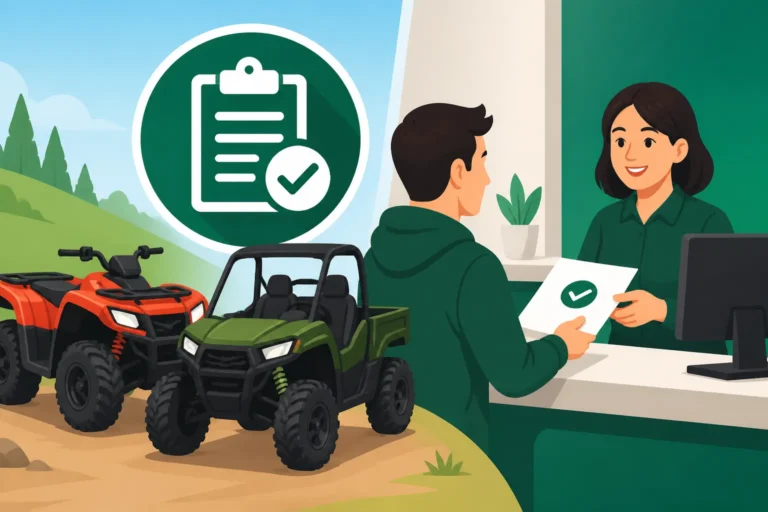
Once you've gathered all your documents, the next step is a visit to a ServiceOntario Centre. It's often best to call ahead or check their website for current operating procedures or to book an appointment, especially in busier rural areas. When you arrive, you'll present your proof of ownership (bill of sale or affidavit), your personal identification, and the completed application forms. The agent will review your documents, process the registration fee (which is a one-time fee for ORVs in Ontario), and issue you an Ontario Vehicle Permit and a licence plate.
Remember the [Six Days From Purchase in Ontario] rule: you generally have a short window after acquiring an ORV to get it registered. While enforcement might be less strict for a machine that genuinely hasn't left your property, it's always best to comply within that timeframe. Make sure you have all your [Ontario ATV Registration Paperwork] organized and easily accessible. The agents are there to help, but having everything in order makes their job, and your experience, much smoother. They will process the permit, collect any applicable sales tax (unless you qualify for an exemption, which we'll discuss next), and hand you your new plate.
Unlocking the Retail Sales Tax Exemption for Your Farm Machine
Here's the silver lining for farmers in Ontario: while your ATV or UTV generally needs to be registered and plated like any other ORV, you might be eligible for a significant exemption from the Retail Sales Tax (RST). This can save you a substantial amount of money, as the RST on ATV purchases in Ontario is 13% of the purchase price. This exemption acknowledges the essential role these machines play in commercial agricultural operations.
The Specifics of the Farm-Use Retail Sales Tax Exemption
Ontario provides a specific exemption from Retail Sales Tax (RST) for ATVs and UTVs purchased by qualified farmers for direct use in their farming operations. This means you could potentially avoid paying the 13% provincial portion of the sales tax on your purchase. It's a huge financial benefit for genuine farm businesses. However, this isn't a blanket exemption for anyone who lives in a rural area and owns a few chickens. There are strict criteria to meet, ensuring that the exemption benefits legitimate commercial agricultural ventures.
The key conditions revolve around the nature of your farm operation and the intended use of the ATV. It must be for "farm purposes" as defined by the Ministry of Finance. This typically means the machine is integral to the production of agricultural products, such as crops or livestock, intended for sale. It's not for personal recreation, cottage use, or even light hobby farming if there's no commercial aspect. Understanding [Ontario RST Exemptions for an ATV] can provide a broader context, but specifically, the [Ontario ATV Tax for a Farm Purchase] outlines these rules. This exemption is crucial because it significantly reduces the initial cost of acquiring an essential piece of farm equipment.
What Qualifies as an Eligible Farm Operation?
To qualify for the farm-use RST exemption, your farming operation needs to meet certain criteria, primarily indicating that you are an active and legitimate farmer engaged in the business of agriculture. This isn't just for large-scale operations; small and medium-sized commercial farms can also qualify. Generally, you need to be producing agricultural products for sale, such as:
- Field crops (corn, wheat, soybeans)
- Vegetables, fruits, and berries
- Livestock (cattle, pigs, sheep, poultry)
- Dairy products
- Maple products
- Nursery stock or Christmas trees
- Greenhouse production
The key is that your activities must constitute a "business of farming." A hobby farm with a few backyard chickens might not qualify if the produce is solely for personal consumption, and there's no intent to sell. However, a small farm selling eggs and produce at a local farmer's market, with a clear business plan and income, would likely be eligible. ServiceOntario or the Ministry of Finance might require proof of your farming business, such as farm registration numbers, previous tax filings as a farmer, or documentation of sales. This ensures the exemption is not abused for recreational purchases.
Declaring Your Exemption at the Counter
When you go to ServiceOntario to register your farm ATV or UTV, you'll need to explicitly declare your eligibility for the farm-use RST exemption. This isn't something that happens automatically; you need to inform the agent and provide the necessary documentation. You'll typically be asked to complete a specific form or statutory declaration provided by ServiceOntario, affirming that the machine is being purchased for bona fide farm use.
It's absolutely critical to have all your paperwork in order when claiming this exemption. This includes your valid Bill of Sale (which should clearly indicate the purchase price), your identification, and any supporting documentation that proves your status as an active farmer (if requested). Having all your ducks in a row, including a clear and comprehensive purchase agreement (which you can draft using a service like LawDepot if it's a private sale), can smooth the process of claiming the farm-use exemption. The ServiceOntario agent will review your declaration and, if everything is in order, they will waive the 13% RST on the purchase price. It's important to remember that this exemption applies only to the retail sales tax; you will still pay the standard, one-time registration fee for the Ontario Vehicle Permit and licence plate itself.
Here’s a quick comparison to help clarify the differences:
| Requirement | Regular ATV Registration | Farm ATV Registration (with RST exemption) |
|---|---|---|
| Ontario Permit | Mandatory | Mandatory |
| Licence Plate | Mandatory | Mandatory |
| Insurance | Mandatory if operating on public land or for trail use | Mandatory if operating on public land or for trail use |
| Retail Sales Tax | 13% on the purchase price | Exempt, if qualified for farm use |
| Ownership Proof | Bill of Sale, NVIS, etc. | Bill of Sale (strongly recommended), or affidavit for older machines |
| Primary Use | Recreational, utility, personal transportation | Integral to a commercial agricultural operation |
This article is for general informational purposes only and does not constitute professional advice. Laws, prices and regulations vary by location and change over time. Consult a qualified professional for guidance on your specific situation.