Ontario ATV Insurance Requirements
It's incredibly frustrating when you just want to get out and enjoy the trails, but the paperwork and regulations feel like a bog you can't get out of. One of the biggest areas of confusion for many Ontario ATV and UTV owners revolves around insurance – what do you really need? Do the rules change if you're on your own property versus a club trail or even a municipal road? This guide will cut through the uncertainty, explaining exactly what type of off-road vehicle (ORV) insurance is mandatory in Ontario, why it’s so important, and how it applies to different riding scenarios.
Why ATV Insurance Isn't Optional in Ontario
Let's be blunt: in Ontario, riding an ATV or UTV without insurance isn't just risky, it's illegal in most common riding situations, and the penalties can be severe. Many folks mistakenly think that if they're not on a public road, insurance isn't necessary, or that their home insurance might cover it. While there are very specific, narrow exceptions, the general rule of thumb you should always operate under is that insurance is a non-negotiable part of responsible ORV ownership here.
The Province of Ontario mandates specific insurance coverage for off-road vehicles. This isn't some minor suggestion; it's enshrined in the law to protect you, other riders, and the public. Imagine hitting a patch of hidden ice on a frozen lake or misjudging a turn on a winding trail and causing significant damage to someone else's property, or worse, injuring another person. Without proper insurance, you'd be looking at a financial catastrophe that could easily wipe out your savings and then some. It's not just about protecting your quad; it's fundamentally about protecting your financial future and fulfilling your legal obligations. This is why it’s crucial to have [The Motor Vehicle Liability Policy Ontario Wants] in place before you even think about starting your engine.
The Legal Requirement: Liability Insurance
When we talk about mandatory ATV insurance in Ontario, we're primarily talking about third-party liability coverage. This type of insurance is designed to protect you financially if you're found legally responsible for bodily injury to another person or damage to someone else's property. Think about it: if you accidentally collide with another rider on a trail, or if your machine veers off course and damages a fence on private land, your liability insurance steps in. Without it, the costs associated with medical bills, property repairs, or even legal defence could fall entirely on your shoulders. It's a huge burden, and one that is entirely avoidable by simply getting the required coverage.
This isn't just for accidents involving other ORVs; it extends to interactions with pedestrians, cyclists, or even stationary objects that aren't yours. The minimum amount of liability coverage required by law is substantial, because accidents can be incredibly expensive. It’s always a good idea to speak with an insurance broker who specializes in ORVs to ensure you have adequate coverage, as the minimum might not always be enough for every situation. You should also check out [Insurance Before You Leave the Yard] to ensure you're covered from day one.
Penalties for Riding Uninsured
I've heard the stories, and sadly, sometimes even witnessed the consequences. People think they can get away with it, or they just don't understand the rules. But riding an ORV without the legally mandated insurance in Ontario can lead to some truly staggering penalties. We're not just talking about a slap on the wrist here. You could face hefty fines that can run into the thousands of dollars. And it's not just the immediate financial hit.
If you're involved in an accident while uninsured, the situation gets exponentially worse. Not only will you be personally responsible for all damages and injuries, but your driving privileges could also be suspended. This means not only losing your right to ride your ATV, but potentially your car as well. Imagine the impact on your daily life, your job, your ability to run errands. It's a massive disruption. Furthermore, being caught without insurance can make it incredibly difficult and expensive to obtain coverage in the future, as you'll be considered a high-risk driver. This is why ignoring [Ontario Fines for No ATV Insurance] is a gamble not worth taking.
What Kind of Coverage You Need
Understanding the nuances of ATV insurance can feel like navigating a maze, but breaking it down makes it much clearer. Beyond the mandatory liability coverage, there are several other types of insurance that, while not always legally required, offer crucial protection and peace of mind. These additional coverages can be a lifesaver if your machine is damaged or stolen, preventing significant out-of-pocket expenses.
Mandatory: Third-Party Liability
As we've discussed, third-party liability is the bedrock of ATV insurance in Ontario. It's the bare minimum you need to operate your machine legally in most places. This coverage is there to protect you from financial ruin if you're found responsible for causing injury to another person or damaging their property. This applies whether you're on a designated trail, crossing a municipal road where permitted, or even on private property if the damage involves someone else's person or assets. It's often bundled into what's referred to as a [Motor Vehicle Liability Policy Ontario Wants], similar to what you'd carry for your car.
It’s easy to think, "I'm a careful rider, I won't cause an accident." But even the most cautious riders can encounter unforeseen circumstances: a deer jumping out, a sudden mechanical failure, or another rider making an unexpected move. Accidents happen, and when they involve other people or their property, the financial implications can be devastating without this essential coverage. Always ensure your policy meets or exceeds the provincial minimums for liability, and consider higher limits if you have significant assets to protect.
Optional (But Highly Recommended) Coverages
While liability is the legal must-have, savvy ATV and UTV owners often opt for additional coverages to truly protect their investment and personal finances. These aren't just "nice-to-haves"; they address real-world risks that many riders face.
- Collision Coverage: This pays for damages to your own ATV or UTV if it collides with another vehicle or object, or if it rolls over. Think about hitting a tree on a tight turn, or rolling your side-by-side on a steep incline. Repairs can be incredibly expensive, and without collision, you're on the hook for every penny.
- Comprehensive Coverage: This covers damages to your ATV or UTV from non-collision incidents. This includes theft, vandalism, fire, natural disasters, and even impacts with animals. Picture your quad being stolen from your garage or vandalized while parked at a staging area. [Replacing a Lost Ontario ORV Plate] is one thing, but replacing the entire machine is another. Comprehensive coverage offers protection against these common, unfortunate events.
- Uninsured/Underinsured Motorist Coverage: This is a crucial one, as it protects you if you're involved in an accident with another rider who doesn't have insurance or doesn't have enough insurance to cover your damages and injuries. While we all hope others are responsible, the reality is that some aren't, and this coverage acts as a safety net for you.
- Specified Perils: Sometimes, you can opt for coverage against specific, named perils like fire or theft, which can be a more affordable alternative to full comprehensive coverage if you have particular concerns.
Choosing which optional coverages to add depends on your budget, the value of your machine, and your personal risk tolerance. However, for most riders, investing in a robust policy that includes collision and comprehensive is a smart decision. It's worth talking to an expert at [Finding an Insurance Broker Who Writes ORV Policies] to discuss your options.
Common Scenarios and Your Insurance
The landscape of ATV and UTV riding in Ontario is diverse, ranging from private property to extensive trail networks and even certain municipal roads. It's vital to understand how your insurance requirements might shift depending on where you're riding. This is where a lot of the confusion comes in, and frankly, where many riders get into trouble.
Riding on Private Property
You might think that if you're just riding on your own land, or a friend's farm with permission, you don't need insurance. And this is where a subtle but critical distinction lies. While the provincial Off-Road Vehicles Act itself might not strictly mandate specific ORV liability insurance for operation exclusively on your own private property, that doesn't mean you're off the hook.
If you cause injury to a visitor, a trespasser, or damage to someone else's property (even a neighbour's fence that you accidentally clip), your personal liability could be enormous. Your homeowner's insurance might offer some limited coverage for off-road vehicle incidents on your own property, but this is highly dependent on your specific policy and its exclusions. It's not a given, and often, ORVs are explicitly excluded. The safest course of action, even for private property riding, is to have a dedicated ORV liability policy or at least confirm with your home insurance provider that ORV incidents are covered to an adequate level. This is definitely one of those areas where you want to be proactive and not assume. If you're documenting permissions or agreements for riding on private land, services like LawDepot can assist with creating clear, legally sound documents that outline responsibilities, which indirectly supports your insurance protection by clarifying the terms of use.
Riding on Designated Trails (OFATV, HATVA, etc.)
Ontario boasts an incredible network of managed trails, largely maintained by the Ontario Federation of ATV Clubs (OFATV) and independent organizations like HATVA. These trails are a huge draw for riders, offering hundreds of kilometres of adventure. However, access to these trails almost invariably comes with specific requirements, and insurance is at the top of the list.
When you purchase an OFATV annual permit or a day pass, part of what you're agreeing to is that you will operate your machine legally and responsibly. This always includes having valid liability insurance. Club trails are often on a mix of private land, Crown land, and sometimes even road allowances. Operating on these trails is considered "public" use in the eyes of the law, even if it's not a paved highway. A trail system is a shared space, and the risk of interaction with other users or potential property damage is always present. Many clubs require proof of insurance to purchase a permit, and trail patrols can ask to see it. So, yes, [Does Your ATV Policy Cover Riding on Club Trails?] is a question you should confirm with your insurer.
Riding on Municipal Roads and Road Allowances
This is probably the most complex area for ORV riders in Ontario. While the general rule has historically been that ATVs and UTVs are not permitted on provincial highways or most municipal roads, many municipalities across the province are now opting in to allow ORVs on certain roads. This is a game-changer for connecting trails and accessing services.
However, if you're riding your ATV or UTV on a municipal road that has been opened for ORV use, you are essentially operating a motor vehicle on a public roadway. This means you absolutely must have the same minimum level of third-party liability insurance as any other road-going vehicle. This is non-negotiable. Furthermore, your ATV must be properly registered and plated with [Ontario ORV Plates and Where They Mount], and you need the appropriate driver's licence. The rules regarding road use are specific to each municipality (e.g., [Greater Napanee By-law 2022-0062]), and it's your responsibility to know them. If you're involved in an accident on a municipal road without the proper insurance, the penalties will be severe, mirroring those for an uninsured car accident.
Finding the Right Insurance for Your Machine
Securing the right insurance policy for your ATV or UTV doesn't have to be a headache, but it does require a bit of due diligence. It's about finding a provider that understands the unique needs of ORV owners and can offer comprehensive coverage tailored to your riding habits.
Choosing an Insurance Provider
Not all insurance companies are created equal when it comes to ATVs and UTVs. Some providers specialize in recreational vehicles, while others may offer ORV coverage as an add-on to existing auto or home policies. It's generally a good idea to seek out an insurance broker who has experience with ATVs and UTVs. These brokers can shop around various providers to find you the best rates and the most suitable coverage options, sometimes even combining your ORV policy with other vehicles for a multi-policy discount.
When you're comparing quotes, don't just look at the price. Pay close attention to:
- Liability Limits: Ensure they meet the provincial minimum and consider higher limits for greater protection.
- Deductibles: How much will you have to pay out-of-pocket before your insurance kicks in for collision or comprehensive claims?
- Exclusions: Are there any specific activities or conditions under which your policy won't cover you? For example, some policies might have limits on competitive riding or modifications.
- Additional Benefits: Does the policy include things like roadside assistance, coverage for accessories, or agreed-upon value for your machine?
Asking detailed questions will help you ensure there are no surprises down the road. Services like LawDepot can be useful if you need to generate any general legal documents related to your ATV ownership, such as a bill of sale or power of attorney, which can sometimes be requested by insurers or buyers.
Required Documents for Insurance
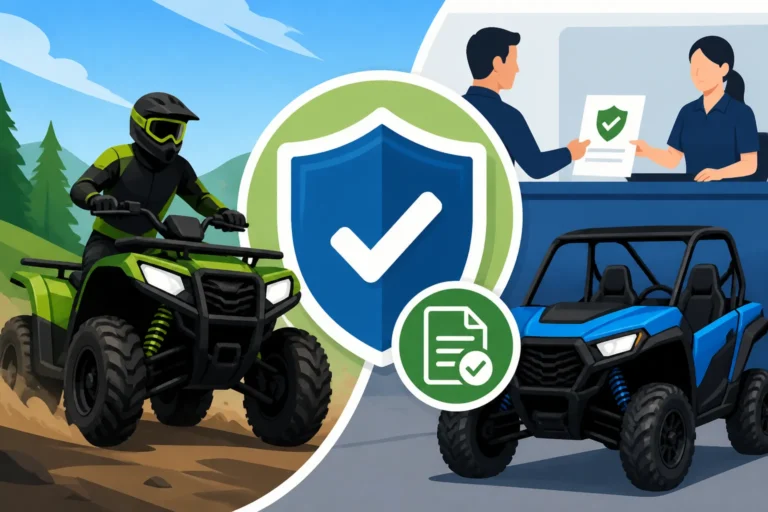
When you're ready to get an insurance quote or purchase a policy, you'll need to have certain information and documents handy. This streamlines the process and ensures your policy is accurate. Typically, you'll need:
- Your Personal Information: Name, address, driver's licence number, and sometimes your driving history.
- ATV/UTV Information: Make, model, year, Vehicle Identification Number (VIN), engine size, and any significant modifications. You'll often find this on your [The Ontario Vehicle Permit Explained].
- Purchase Details: If recently purchased, the date of purchase and the purchase price.
- Intended Use: Where do you plan to ride? (e.g., private land, club trails, municipal roads). This helps the insurer assess risk.
Having this information readily available will make the process much smoother and ensure you get accurate quotes. Remember, the insurer needs to know what they're covering, so be as transparent as possible about your machine and your riding habits. The more information you provide, the better they can tailor a policy to your specific needs. It's also a good idea to consider [Adding a Quad to an Existing Policy] you might have to see if there are any bundled savings.
| Coverage Type | What It Covers | Is It Mandatory in Ontario? | Why You Need It |
|---|---|---|---|
| Third-Party Liability | Injury to others, damage to others' property | Yes (for most public use) | Protects you from financial ruin if you cause an accident. |
| Collision | Damage to your ATV/UTV from a collision/rollover | No | Covers costly repairs to your own machine after an impact. |
| Comprehensive | Damage to your ATV/UTV from non-collision events | No | Protects against theft, fire, vandalism, animal strikes, natural disasters. |
| Uninsured Motorist | Damage/injury if other party is uninsured/underinsured | No | Protects you if the at-fault party can't cover your costs. |
Ultimately, getting your ATV or UTV insured in Ontario isn't just about ticking a box; it's a fundamental part of being a responsible rider and protecting yourself from potentially devastating financial consequences. Don't let the paperwork deter you from getting out and enjoying the incredible trails and riding opportunities our province has to offer. Just make sure you're properly covered before you do.
Disclaimer
This article is for general informational purposes only and does not constitute professional advice. Laws, prices and regulations vary by location and change over time. Consult a qualified professional for guidance on your specific situation.