Ontario Trails for Beginners
A first ATV or UTV trail ride can feel intimidating when the map shows a web of routes but says little about mud, rocks, hills, or tight turns. This guide explains how to choose a manageable Ontario riding area, assess a route before setting out, and prepare so your first day feels enjoyable rather than overwhelming.
What makes an Ontario trail beginner-friendly
“Beginner-friendly” does not always mean flat, smooth, or free of obstacles. Trail conditions change with rain, thaw, maintenance, and traffic, and a route that feels easy to one rider may be stressful to another. For a first outing, look for a short route with clear signage, straightforward navigation, room to stop safely, and a way to turn back if you need to.
Start with the trail, not the distance
A long ride is not necessarily a difficult ride, and a short loop can still include steep climbs, deep ruts, rocks, or muddy sections. Instead of judging a route by kilometres alone, check what the trail surface is like and whether the terrain suits your experience and machine.
A sensible first ride might be a short out-and-back route or a simple loop near a staging area. That gives you a chance to practise braking, steering, and navigating without committing to a long trip. It also makes it easier to return to your vehicle if someone in your group gets tired or uncomfortable.
Look for current local information about closures and trail conditions before choosing a route. A trail that was easy last weekend may be rougher after heavy rain, while a route that looks intimidating on a map may be straightforward in dry conditions. Start with [Ontario Trail Conditions Before You Ride] and [Ontario Trail Maps] when planning.
Choose a ride that fits your machine and confidence
ATVs and UTVs handle differently. A side-by-side may feel stable and comfortable for its occupants, but its width can make narrow trails and tight turns challenging. A smaller quad may be easier to manoeuvre in confined areas, yet still require careful control over loose rocks, ruts, or slippery ground.
Before you go, check that the route allows your type of machine and that its width and other dimensions are suitable. Do not assume a trail is suitable for every ATV or UTV just because it appears on a map. If you ride a wider machine, [Ontario Trails for a Wide Side-by-Side] can help you think through the fit between your vehicle and the route.
It is also worth being honest about your comfort level. If steep descents make you nervous, choose a route with gentler terrain. If you are new to operating a machine, build in time to practise in an appropriate, permitted area before joining a longer trail ride.
Compare areas before committing to a full day
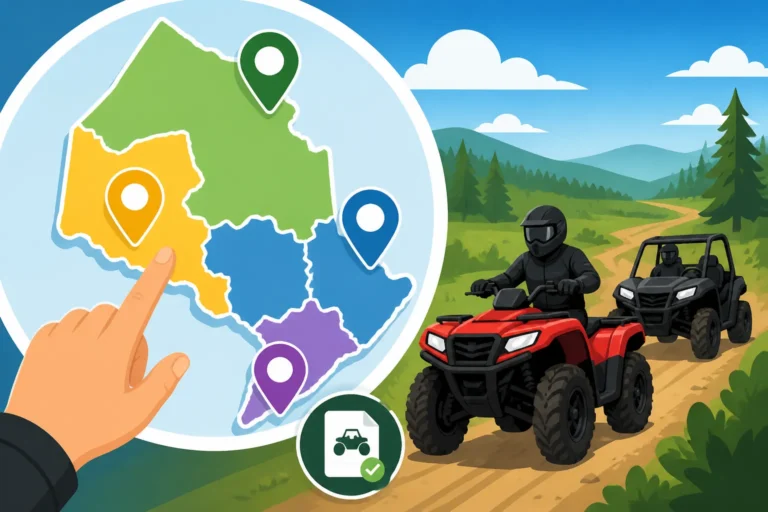
Ontario has several trail networks, but no one area is the perfect first ride for every person. Distance from home, trail access, permit requirements, machine suitability, current conditions, and nearby services all matter. The table below is a starting point, not a guarantee that every trail in an area will be easy.
| Riding area | Why a beginner might consider it | What to check before going |
|---|---|---|
| Ganaraska area | A known riding destination within reach of parts of southern Ontario | Which routes are open, what the terrain is like, and the area’s access and pass requirements |
| Haliburton area | A large trail region that can offer options for riders planning different outings | Route difficulty, connections between trail systems, and whether your planned route suits your experience |
| Eastern Ontario Trails Alliance area | A network that can suit riders planning a regional outing or a longer trip | Current route access, local rules, and whether the route stays within the area covered by your permit |
| Ottawa-area trails | A possible choice for riders looking for a trip closer to the city | Which trails are open to your machine and whether access requires a club or trail pass |
For a broader look at how connected trail areas work, read [Ontario's OFATV Trail Network]. If you are choosing a starting point near a major city, [Ontario ATV Trails Near Toronto] and [Ontario ATV Trails Near Ottawa] may help you narrow down the search. In every area, confirm the specific route rather than relying on a general description of the region.
How to plan a first ATV or UTV ride
Good planning does not mean mapping every minute of the day. It means knowing where you can ride, what rules apply, and what you will do if the route is harder or slower than expected. That preparation can prevent a simple outing from turning into a stressful search for the right trailhead or a route you are not equipped to handle.
Confirm the trail is open and permitted
Before leaving home, check the trail organization or land manager responsible for the route. Look for closures, seasonal restrictions, trail-condition updates, and any instructions for staging or parking. A route shown on an older map may be closed or changed, and access rules can differ between nearby properties.
Make sure you understand what kind of permission you need. Registration for an off-road vehicle and permission to ride a particular trail network are not necessarily the same thing. Review [Ontario ATV Trail Permits Explained] and check the current requirements for the area you plan to visit.
Also confirm that your insurance and vehicle documents are in order. Rules may differ depending on where you ride, and road use has separate requirements from riding on a private or club trail. Do not ride onto a road, private property, or a closed trail simply because it appears to connect two sections on a map.
Plan a short route with an easy exit
For a first ride, pick a route that lets you stop or turn around without a complicated backtrack. Tell someone where you are going and when you expect to be back. Keep your first outing short enough that you can finish comfortably, even if the trail is slower than expected.
A good plan might include a staging area, a short route, a turnaround point, and a backup option if the trail is too rough. If you are riding with a group, agree on a pace before starting. Experienced riders may be tempted to push ahead, but a beginner should never feel rushed into a hill, mud hole, or narrow passage they do not want to attempt.
Mapping tools can help you understand the area and keep track of your intended route. For example, onX Offroad can be useful for reviewing routes and saving map information for a ride. Treat any app as a planning aid, not permission to ride: confirm access, current conditions, and restrictions with the trail organization or land manager.
Pack for delays and changing conditions
A beginner’s first ride can take longer than expected because you are learning the machine and stopping to check directions. Bring water, weather-appropriate clothing, a charged phone, and basic supplies for the group. On a remote route, think carefully about communication and what you would do if a machine became disabled or someone needed help.
Before you set out, check that your machine is in good condition. Look over the tires, brakes, lights, fuel level, and controls. If you are using a rented machine, ask the operator to explain how it works, what to do if it gets stuck, and who to contact if you have a problem.
Keep your plan flexible. If the weather changes, the trail becomes rough, or anyone in the group is uncomfortable, turning back is a sensible riding decision. The goal of a first day is to build confidence, not to complete a route at any cost.
Riding techniques that help new riders feel in control
A beginner-friendly route is only part of the experience. Smooth, deliberate riding helps you respond to changing ground and gives you more time to make decisions. You do not need to ride quickly to enjoy a trail; in fact, a slower pace is often more comfortable while you are learning.
Practise smooth control on straightforward ground
Start at a pace that lets you look ahead and notice changes in the trail. Avoid sudden acceleration, braking, or steering inputs, especially on loose gravel or wet ground. Keep both hands on the controls and focus on the path you want to follow rather than staring at the nearest obstacle.
When approaching a bump or rut, slow down early and decide how you want to cross it. Do not follow another rider blindly if their line does not look safe for your machine. If you are unsure, stop somewhere safe and assess the obstacle before proceeding.
For UTV drivers, take extra care with corners and uneven ground. A side-by-side’s size and handling can feel very different from a car, particularly on narrow trails or slopes. Follow the manufacturer’s guidance and use any occupant protection provided by the machine.
Handle mud, hills, and obstacles conservatively
Mud can be difficult to judge from a distance. A shallow-looking patch may conceal soft ground, ruts, or water, while a visible muddy section may have a firm route around it. If you cannot see the ground clearly, avoid charging into it. Find a safe place to stop, look at the route, and choose a line only if you are confident it is manageable.
Treat steep hills with similar caution. Make sure you understand the safest approach for your machine and the conditions, and do not attempt a climb or descent simply because someone else has done it. A route may have a bypass, but do not leave the marked trail to find one unless the trail organization specifically permits it.
If you get stuck or feel uncomfortable, pause and communicate with your group. Rushing can make the situation worse. It is perfectly reasonable to turn around, wait for help, or choose another route.
Ride considerately around other trail users
Ontario trails may be shared by ATVs, UTVs, snowmobilers, hikers, cyclists, and other permitted users. Slow down when visibility is limited, approach other users carefully, and follow signs and local instructions. Give people space and avoid throwing mud or gravel toward anyone.
Stay on the marked route. Riding around a wet or damaged section can widen the trail and harm surrounding land. If you see a closure, barrier, or sign that changes how the route can be used, follow it rather than assuming it does not apply to your group.
Before heading out, review [Ontario Trail Etiquette With Snowmobilers] and information about local trail use. Conditions and permitted users vary, so a respectful approach helps keep trails safer and more enjoyable for everyone.
Common first-ride mistakes to avoid
Most first-day problems are preventable. The usual trouble is not a lack of enthusiasm; it is choosing too ambitious a route, overlooking access rules, or assuming that a phone map alone tells the whole story. A little preparation makes it easier to adapt when the trail does not match expectations.
Do not assume every trail shown on a map is open
A map can be useful for route planning, but it may not show every temporary closure, private-property boundary, seasonal restriction, or local rule. Use onX Offroad or another mapping tool to get oriented, then verify the route with the relevant club or land manager. Never treat a marked line on a screen as automatic permission to ride.
If the route crosses between trail areas, check whether your pass or permit applies on both sides. A connection on a map does not always mean that access is continuous or that the same rules apply. Leave time to confirm details before you reach a junction.
Do not let a more experienced rider set your pace
It can be awkward to ask a group to slow down, especially when everyone else seems comfortable. Say what you need before starting: a steady pace, regular regrouping stops, and no pressure to attempt difficult obstacles. A good riding group will make room for that.
Agree on what to do if someone gets separated. Set simple regrouping points, keep the group together at junctions, and make sure everyone knows the route. If one rider is struggling, stop and reassess rather than leaving them to catch up alone.
Do not overlook rules that apply beyond the trail
Riding rules can depend on the location and the type of route. Requirements for road riding, for example, may differ from requirements on a trail, and not every road is open to off-road vehicles. If your plan includes riding on a road or crossing one, check the specific rules first. [Ontario ATV Rules for Riding at Night] is another useful topic to review if your outing could run late.
For family rides, check the rules and suitability for every rider, including passengers. A machine that is comfortable for one person may not be designed to carry another. For more planning ideas, explore [Ontario Trails Good for Kids], but still confirm that the chosen route suits the age, experience, and equipment in your group.
The best first trail ride is one that leaves you wanting to come back. Choose an area with clear access information, start with a manageable route, and give yourself permission to turn around. As your confidence grows, you can gradually try longer rides and more varied terrain.
Disclaimer
This article is for general informational purposes only and does not constitute professional advice. Laws, prices and regulations vary by location and change over time. Consult a qualified professional for guidance on your specific situation.