Ontario’s Separate Club Passes
Ontario Club Passes and Trail Access
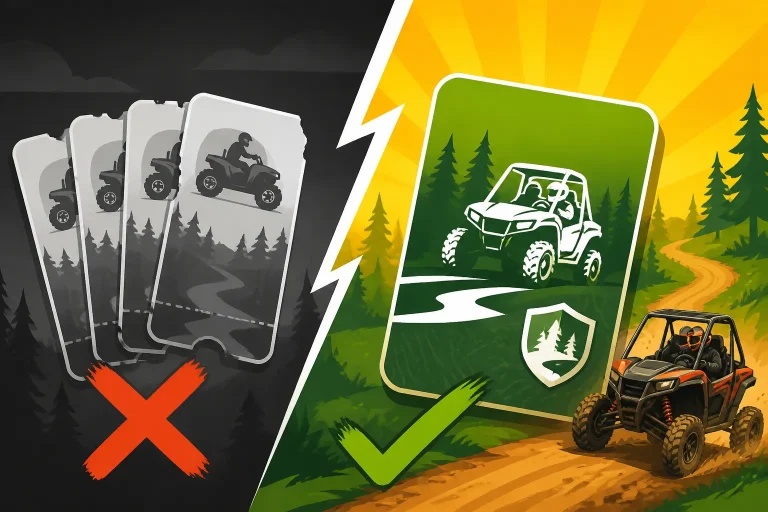
A rider can buy a trail pass, load the machine, and still discover at the trailhead that the pass does not cover that particular network. Ontario’s ATV and UTV trails are managed by different clubs and landowners, so access rules are not always universal. This guide explains why separate passes exist, how to check coverage, and how to plan a ride without paying for the wrong access.
Why Ontario Has Separate ATV and UTV Club Passes
A trail permit is not the same as vehicle registration
It helps to separate two documents that are easy to confuse. A vehicle permit and plate deal with registering the machine for use under Ontario’s off-road vehicle rules. A trail permit, pass, or club authorization deals with access to particular trails or land. Having one does not automatically give you the other.
Think of a rider who has completed the registration paperwork for a side-by-side and mounted its plate correctly. That does not, by itself, mean the rider can use every marked ATV trail in the province. The trail may be managed by a club that requires a separate permit, or it may be on land where motorized use is restricted. For registration details, see Ontario ORV Registration for a Side-by-Side.
This distinction matters even for riders who rarely use public roads. Registration and insurance requirements can still apply to off-road riding, while trail access depends on the route and its managing organization. A trail pass is not a substitute for your registration permit, insurance, or any other document you need to carry.
Different clubs manage different land and trail systems
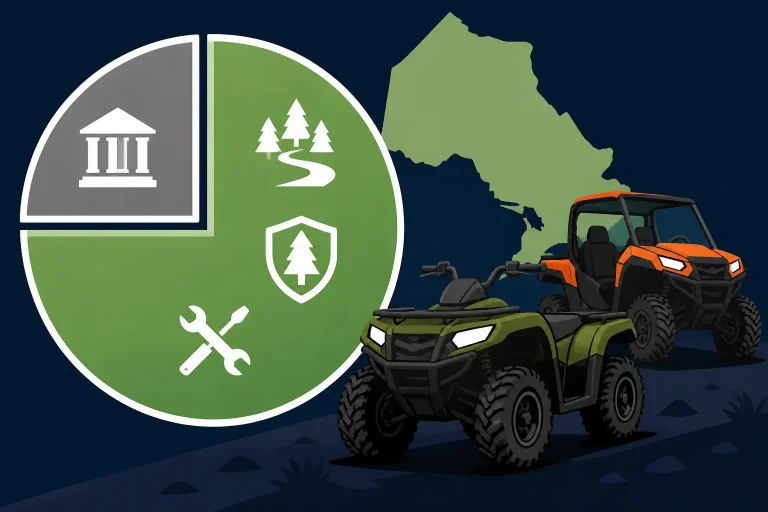
Ontario’s trail network is not one continuous province-wide system owned and managed by a single organization. Local clubs may build and maintain trails, arrange land access, post closures, and coordinate with municipalities or private landowners. Some trails connect between areas; others end at a boundary where a different club or land manager takes over.
That local responsibility is one reason passes do not always work everywhere. A club may rely on permit revenue to support its own trail work and access agreements. Another organization may manage a separate network under its own access terms. Even when routes connect on a map, riders should not assume the permit for one section automatically covers the next.
You can get a broader picture of the participating club network in Ontario’s OFATV Trail Network. The practical takeaway is simple: check the permit and the trail area together. A familiar sticker, an online map, or a friend’s past experience is not enough to confirm that your particular pass covers the route you intend to ride.
What “separate pass” means in practice
A separate pass might be required for a distinct trail network, a managed forest, a club’s own trail system, or a specific activity area. It might be a replacement for another permit in that location, or an additional pass needed alongside a broader permit. Those arrangements are not interchangeable, so the exact wording from the trail manager matters.
For example, a rider planning a weekend in Eastern Ontario might have access to one network through one pass, then find that a neighboring system has its own purchasing process. In another area, a club may participate in a broader permit program but still have special local requirements. Always check whether a pass is accepted, required, or additional for your destination.
| Access situation | What to check before riding |
|---|---|
| Club-operated trail network | Whether your permit covers that club and the route you plan to use |
| Separate regional network | Whether it sells or requires its own pass |
| Managed forest or recreation area | Whether a separate site pass, day pass, or vehicle pass applies |
| Trail crossing a boundary | Which permit is required on each side |
| Crown land route | Whether motorized use is permitted and whether restrictions or closures apply |
| Ride outside Ontario | Whether the destination recognizes your Ontario permit |
How to Check Whether Your Pass Covers a Trail
Start with the exact trail area, not a province-wide assumption
Before buying a permit, name the place you want to ride. “Northern Ontario,” “near Haliburton,” or “an OFATV trail” may be too broad to answer the access question. Narrow it down to the club, trail system, forest, staging area, or towns along the route. Then look up the pass requirements for that specific area.
This is especially important when planning a longer ride. A route may leave one club district, follow a shared corridor, and enter another network. A trail line on an app may make the ride look continuous, but the app’s route display does not necessarily tell you whether your permit is valid on every segment.
Use the club or land manager’s official information to confirm the current rules before you leave. Look for the area covered, which machines are permitted, whether there are seasonal closures, and whether the permit must be displayed or available digitally. For a broader explanation of how permit coverage can change at a district boundary, read Does Your Permit Cover the Next Club’s District?.
Check maps, boundaries, and closures together
A map is useful, but it is only one part of trip planning. Check that the map is for the correct trail network and that it is current enough to reflect closures, detours, seasonal restrictions, or access changes. A route shown as a line does not necessarily mean every rider can use it under every permit.
Pay close attention to the start and finish of your ride. A staging area can be managed separately from the trails, and parking rules may differ from riding rules. A route could also pass through municipal roads, private property, or Crown land, each of which may have separate restrictions. For Crown land details, see What Free Use Means on Crown Land.
When a route crosses a boundary, plan as if the rules may change there until you confirm otherwise. Keep a note of the club names and pass requirements for each section. That small bit of preparation can prevent the frustrating situation of reaching a trail junction and realizing you have no valid access for the next leg.
Ask a precise question when information is unclear
If a website’s wording leaves you uncertain, contact the club or land manager and describe the ride you are planning. Instead of asking, “Does my permit work in Ontario?” ask, “Does this permit cover the trail from this staging area to this destination, including the section maintained by this club?” Include the machine type if the rules distinguish between ATVs, UTVs, motorcycles, or other vehicles.
Ask whether the pass is needed per rider, per machine, or per vehicle, and whether an additional site or parking pass applies. Also ask about digital proof, display requirements, and whether a day-use option exists if you are visiting briefly. Keep the answer with your trip notes so everyone in the group is working from the same information.
If you ride with a group, do not rely on the most experienced person’s memory as the only source of truth. Pass rules can differ by destination, and the person who last rode there may have used another access arrangement. Sharing the relevant club page or written confirmation is a simple way to keep the whole group on the same plan.
Common Ontario Pass Arrangements
Broader network permits and participating clubs
Some Ontario permits are designed to provide access across a network of participating clubs. That can be convenient for riders who want to explore more than one local area, but “network” does not mean every motorized trail or property in Ontario. The participating area and any exclusions still matter.
Before buying, identify the club or region you want to ride and check that it participates in the permit program. Then confirm that the particular trail is open to your vehicle type and that no additional local pass is needed. The club may have local rules about operating hours, parking, route direction, or seasonal access even when the broader permit is accepted.
If you mainly ride one area, compare the network permit’s coverage with the local club’s own options. A broad permit may suit a rider who travels between participating districts, while a local option may be more relevant for a visitor making a single trip. The right choice is based on actual coverage and use, not on the name or apparent size of the program.
The Eastern Ontario Trails Alliance and other independent arrangements
The Eastern Ontario Trails Alliance has its own trail-pass information and access arrangements. Riders planning around this network should check the EOTA requirements directly rather than assume another organization’s permit will cover every section. The details can matter for a route that connects to trails managed by other clubs or partners.
For trip planning, note where the EOTA route begins and ends, then identify any connecting trails outside that network. If your ride crosses into another managed area, verify that area’s permit separately. [The Eastern Ontario Trails Alliance Pass] is a useful starting point for understanding that particular arrangement.
Similar care applies to other destinations with their own management model. The Ganaraska Forest, for example, has specific access and fee rules that riders should check with the forest before travelling. A general trail permit should not be treated as permission to ride in a managed forest unless the forest’s own terms say it is accepted. See [Ganaraska Forest Fees for Ontario Riders] for the separate forest-access context.
Haliburton, Ganaraska, and location-specific requirements
Haliburton riders should check the requirements for the specific trails they plan to use, including any local club pass or membership arrangement. A pass that works in another Ontario district may not automatically meet the requirements for a Haliburton route. For an overview of the local issue, see Why Haliburton Riders Need a HATVA Pass Too.
Ganaraska Forest access is another example of why riders need to read the rules for the destination itself. The forest’s access arrangements may involve site-specific permits, parking requirements, or conditions that differ from those on club trails elsewhere. A rider trailering in from outside the region should confirm what is needed before setting out, not after arriving at the entrance.
These examples are not a substitute for checking current local terms. Pass programs and access agreements can change, and the same geographic area can include more than one trail manager. To choose a club area that matches your plans, Picking a Club Area for Your Permit can help you think through the trade-offs between local riding and broader exploration.
Planning a Ride Across More Than One Club Area
Build your route around permit boundaries
For a short loop within one club’s area, permit planning may be straightforward. Multi-day rides take more care because a route can cross multiple club districts, private land, municipal roads, or managed recreation areas. Before deciding that a route is continuous, identify who manages each part and what access applies there.
A practical method is to break the route into sections. Write down the staging point, the trail network, the boundary or connection point, and the next area’s manager. Confirm the required permit for every section. If one segment uses a road, check the local road rules as well; a trail permit does not make a road open to ORVs. See Ontario ATV Rules on a Municipal Road.
This planning is worthwhile even if you have ridden nearby before. A familiar connector may have changed status, a seasonal closure may affect the route, or the adjacent land manager may require a different pass. A little checking at home is much less stressful than trying to sort out access while your group waits at a junction.
Coordinate passes for everyone in the group
Do not assume that a group can share one pass. The permit terms may specify whether access is tied to a rider, machine, household, or another arrangement. Check the conditions before buying, particularly if your group includes multiple machines, passengers, visiting friends, or riders who will take turns operating.
A good pre-ride check is to ask each rider to confirm their own documents and pass status. One person can keep a simple list of the trail areas and requirements, but each rider should understand what they need to carry or display. This avoids the common last-minute discovery that one machine or one rider is missing the required proof.
For visitors, the most convenient choice may be a short-term pass if the area offers one, but do not assume that every club sells the same options. Verify the available duration and coverage directly. Riders comparing a day trip with a longer stay can also review [Ontario ATV Day Permit Cost] and Ontario ATV Annual Permit Cost, then confirm the details with the relevant permit seller.
Keep proof available and protect it from trail conditions
Once you have the correct pass, make sure you can show it in the way the club requires. Some permits may involve a physical sticker or display; others may use digital proof or an account record. The method can differ, so check before riding rather than relying on a screenshot if the terms call for something else.
Mud, rain, vibration, and repeated handling can make trail documents hard to read or easy to lose. Keep paper documents in a sealed pouch, and save digital records where you can reach them without depending on a strong cellular signal. If you shop for a waterproof document sleeve or phone mount on Amazon, check that it fits your machine and does not interfere with steering, visibility, or controls.
For remote rides, it is sensible to carry an offline map and keep the permit information accessible on the device or paper copy you bring. A phone mount purchased through Amazon may help with navigation, but it is not a replacement for checking the route beforehand or following posted signs. Keep any physical permit display clean and visible as the local rules require.
Choosing Between a Local Pass and a Broader Permit
Match the pass to how often and where you ride
A local pass can make sense if you regularly ride one area and its terms are a good fit. A broader network permit may be more practical if you visit several participating club areas. Neither option is automatically better; the deciding factor is whether it provides the access you will actually use.
Start by listing your likely riding destinations. Include the places you visit often, the areas you might explore once, and any trail connections you want to use. Then compare the pass coverage against that list. If most of your riding is concentrated in one independent network, a separate local pass may be necessary even if you already hold another permit.
Be honest about your habits. Riders sometimes buy a broad pass because it sounds flexible, then spend most of the season on one local route. Others buy only a local pass, then plan an ambitious multi-club trip and discover that they need another. A realistic trip list helps avoid both overbuying and arriving without access.
Think through the cost without guessing at the terms
Pass fees and included access can vary by organization and may change. Rather than relying on an old forum post or a friend’s receipt, review the pass seller’s own information before purchasing. Look for what is included, what is excluded, how long the pass is valid, and whether any separate club or site charge applies.
A cheaper-looking pass may cover fewer trails, while a broader option may not include a particular independent area. Compare the full cost of the ride you want, not just the first permit you see. Include any required day-use, parking, or local access charges, and check whether a pass is transferable or tied to a specific machine or person.
For repeat riders, renewal terms may also influence the decision. If you already hold a permit, check whether renewing early or choosing a different option affects your access. The details for a network permit may be different from those of an independent club, so use the relevant seller’s official terms rather than applying one program’s rules to another.
Consider your vehicle and the kind of riding you want
An ATV and a UTV may not have identical access across every trail system. Width, vehicle classification, trail condition, and local restrictions can affect whether a particular route is suitable or permitted. A pass that grants access to an area does not necessarily mean every machine can use every trail within it.
Before committing to a destination, confirm that the trail network accepts your vehicle type and check any limits that may apply. Side-by-sides can be wider and heavier than many quads, and narrow bridges, gates, or trail features may make some routes inappropriate even when access is otherwise allowed. See Ontario Trails for a Wide Side-by-Side when evaluating route suitability.
Also match the trail to the experience level of your group. New riders may be more comfortable with a familiar local loop and clearly marked staging area, while experienced riders might plan a longer route through connected districts. In either case, access permission and trail suitability are separate questions: confirm both.
Riding Outside Ontario and Reciprocity
Reciprocity does not mean universal access
Some permit arrangements may be recognized across provincial boundaries or by partner organizations. That recognition is often specific to named jurisdictions and participating trails. It does not mean an Ontario permit gives you automatic access to every trail in another province, nor does it erase local rules or registration requirements.
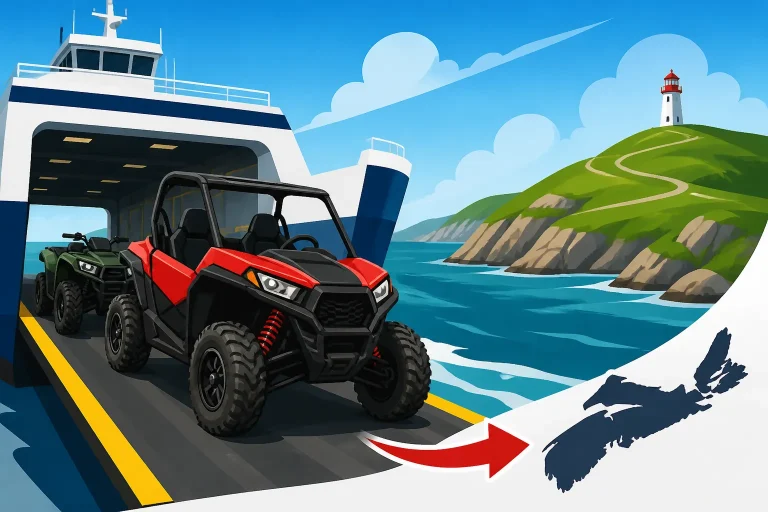
Check the destination’s rules before crossing the border. Confirm which permit is recognized, whether the recognition applies to your machine, and whether you need to meet any local registration, insurance, equipment, or display requirements. For Ontario’s known regional context, see Ontario Trail Permit Reciprocity With the Maritimes.
Do not assume that reciprocity works in both directions. A pass accepted by one organization may not be accepted by another, and recognition can be limited to certain networks. The destination club or trail authority is the best place to confirm what your particular permit covers.
Check Quebec separately
Ontario and Quebec have had changes in their trail-permit relationship, so riders should not rely on an old understanding of cross-border access. Before riding in Quebec, confirm the current permit requirements with the Quebec trail organization and any local clubs you plan to visit. Why Ontario and Quebec No Longer Share Permits gives background on why riders should check this separately.
The same advice applies when a Quebec rider comes to Ontario. A familiar permit from home may not satisfy the access requirements for an Ontario trail system. Confirm Ontario registration and insurance obligations as well as trail access; these are different matters and may be handled by different authorities.
Cross-border rides add practical details too. Check whether your insurance covers the trip, whether your documents are accepted, and whether the route is open to your vehicle. Keep the relevant permit confirmations handy, especially if your planned ride crosses several local systems.
Treat border and permit rules as a pre-trip checklist item
Add permit reciprocity to your trip checklist well before departure. Write down the trail network, the organization responsible for it, the permit required, and any separate local rules. If you are travelling with friends, share the information so no one is relying on an assumption that another rider’s permit covers the whole group.
If the rules are unclear, ask the destination organization directly and keep its reply with your trip details. This is particularly useful for a multi-day trip, a route that crosses a provincial boundary, or a visit to an independent trail system. A quick confirmation can prevent a long detour or a ride that has to be cut short.
Finally, remember that a valid permit does not override a closure, landowner restriction, or posted sign. Respect access limits even when your permit is valid for the wider network. Where the route enters Crown land, private property, a conservation area, or a park, check the separate rules for that land as well.
Common Mistakes and a Simple Pre-Ride Check
Mistaking a permit sticker for province-wide permission
A sticker or permit document can look official and still apply only to a defined network or set of participating trails. The most common mistake is treating the pass as a universal Ontario trail licence. It is better to read the coverage as a list of places and conditions, not as a general promise of access everywhere.
The same goes for maps and trail apps. A route may appear connected even though it crosses a boundary or uses a segment with different rules. Use the map to plan, then verify the pass coverage with the organization responsible for the trail.
If you are unsure whether your pass covers the next section, stop and check before proceeding. Riding beyond permitted access can create problems for you and jeopardize the relationship between clubs, landowners, and the wider riding community. When in doubt, take the route you have confirmed.
Assuming a friend’s pass or previous season’s advice still applies
A friend may have a different pass, vehicle, or destination than you do. Their experience can be a useful starting point, but it does not establish your access rights. Ask what organization sold their pass and which trail area it covered, then verify your own requirements.
Old advice can also become stale. A club may change a permit arrangement, adjust an access boundary, or close trails for maintenance, weather, or landowner reasons. Use current information from the organization responsible for the area rather than relying solely on a past visit or an older online discussion.
Keep a note of the date you checked the rules and save relevant confirmation. That is not a guarantee that nothing will change before your ride, but it gives you a clear reference point and makes it easier to recheck the right source before departure.
Use this pre-ride checklist
Before you trailer the ATV or UTV, run through these questions:
- Which specific club, trail system, or land manager controls the route?
- Does my permit cover that exact area and the vehicle I plan to ride?
- Does the route cross into a separate network with its own pass?
- Are any site, parking, day-use, or local club requirements additional?
- Is the route open, and are there seasonal closures or restrictions?
- Do I have the required registration, insurance, and trail-pass proof?
- Can I access the map and permit information if cellular service is unavailable?
- Have all riders in the group confirmed their own access requirements?
A waterproof sleeve or storage pouch can help keep paper documents readable; a phone mount or case found through Amazon may help with navigation when used safely. Neither one makes an unsuitable route legal or replaces checking the managing club’s rules. Keep your attention on the trail, follow signs, and stop somewhere safe if you need to review your map.
When you plan around the actual trail manager, pass boundaries become much easier to handle. You can choose the right permit for a local day ride, prepare for a multi-club trip, and avoid assuming that one pass opens every trail in Ontario. That careful approach supports both a smoother ride and the clubs and landowners who make trail access possible.
Disclaimer
This article is for general informational purposes only and does not constitute professional advice. Laws, prices and regulations vary by location and change over time. Consult a qualified professional for guidance on your specific situation.