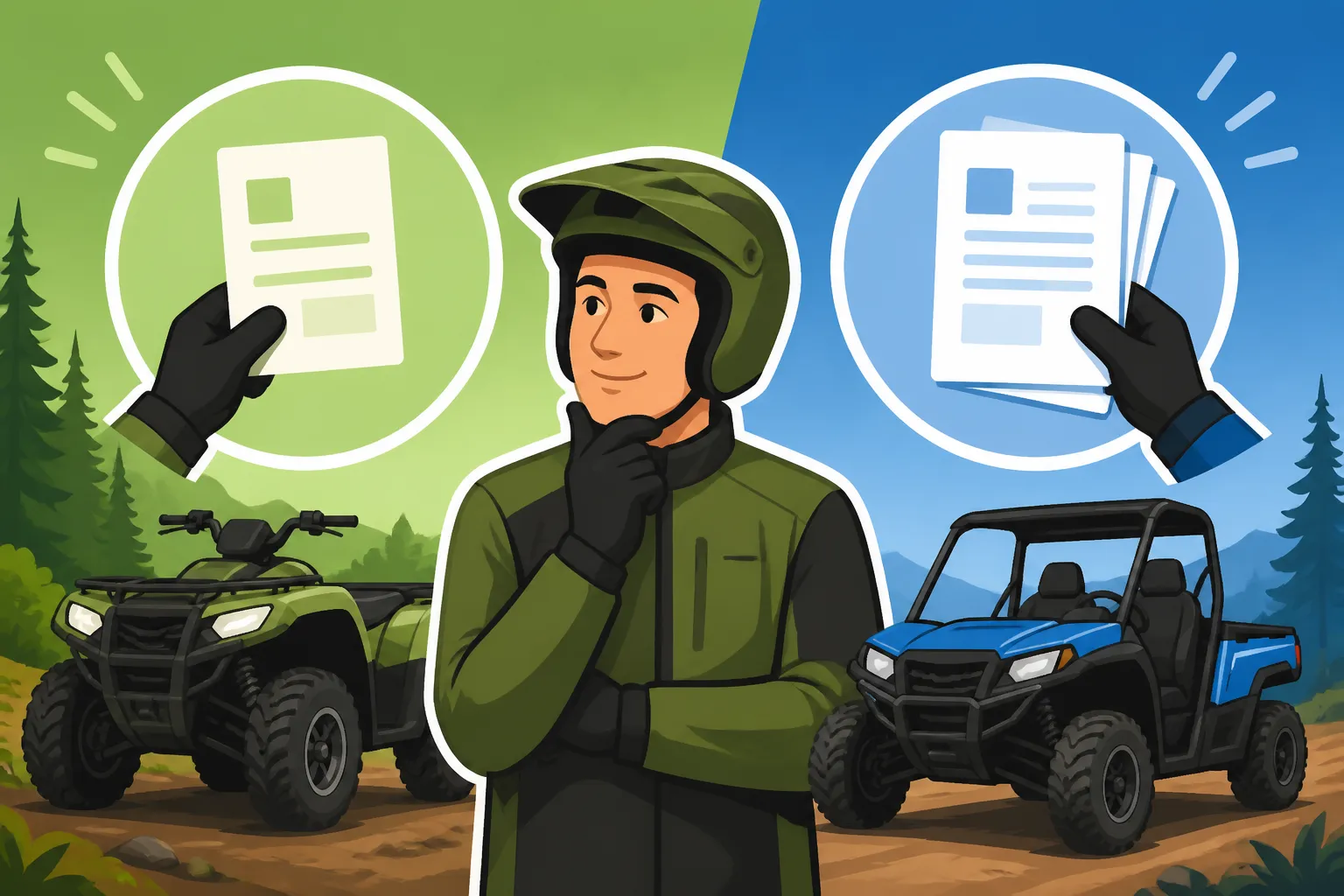
Carrying the Permit or a True Copy
We've all been there: out on the trails, the engine purring, dust flying, feeling that incredible freedom that only an ATV or UTV ride in Ontario can bring. Then, a thought pops into your head, "Do I have my registration permit with me? And is a photocopy actually good enough?" It's a question that can quickly bring down the mood, causing a ripple of anxiety about potential fines or roadside hassles. This guide is here to clear up that confusion, diving deep into the nuances of carrying your Ontario ORV permit, whether in original form or as a true copy, so you can ride with peace of mind.
The Importance of Having Your ORV Permit Handy in Ontario
Imagine you’re enjoying a beautiful ride along the [Voyageur Multi-Use Trail] near Mattawa or exploring the vast [Haliburton's 1,000 Kilometres]. You’re having a blast, but then you encounter a conservation officer or a local police officer. Their primary job is to ensure everyone is riding safely and legally. Part of that means verifying that your Off-Road Vehicle (ORV) is properly registered and that you are the legal operator. This isn't about ruining your day; it's about maintaining order, safety, and accountability on our shared trails and permissible road allowances.
Why Enforcement Officers Care
When an enforcement officer pulls you over on your quad or side-by-side, one of the first things they'll ask for, after your driver's licence and proof of insurance, is your ORV permit. This permit, officially known as the Ontario Vehicle Permit, is the provincial government’s way of documenting who owns the machine and that it has met the necessary registration requirements. It’s akin to the ownership papers for your car, just tailored for your off-road machine.
Officers need to confirm that the machine hasn't been reported stolen, that it's registered to the person operating it (or that the operator has permission), and that all fees, including any applicable [13 Percent RST on an Ontario ATV], have been paid. If you can't produce this document, it creates a significant roadblock in their verification process. It raises immediate questions about the legality of your machine and your right to operate it. This can lead to lengthy delays, requests for you to follow them to a ServiceOntario centre later, or, in the worst-case scenario, fines. Nobody wants their adventure cut short by a paperwork issue, especially when you're far from home or a Wi-Fi signal.
What Exactly is a "Permit" in Ontario?
In Ontario, what most riders colloquially refer to as "registration" is formally known as the Ontario Vehicle Permit. Unlike some jurisdictions that might issue a separate "title" document, Ontario uses this single permit to serve both purposes: proof of registration and proof of ownership. This document contains crucial information about your ATV or UTV, including its Vehicle Identification Number (VIN), make, model, year, and the name and address of the registered owner. It also shows the date of issuance and, importantly, that the machine is officially "plated" for use. You can dive deeper into this topic by reading [The Ontario Vehicle Permit Explained].
It's a physical piece of paper, often printed on a specific security paper, that needs to be kept in good condition. The back of the permit also includes a section for transfers of ownership, which is incredibly important when you're [Selling an ATV in Ontario] or [Buying a Used ATV in Ontario]. Understanding that this single document is your primary proof of legal ownership and registration is key to appreciating why carrying it, or a proper copy, is so vital. It’s not just a formality; it’s the cornerstone of your machine’s legal standing in the province.
Original vs. True Copy: What Ontario Law Says
So, you understand why you need to have your permit. But what’s the deal with carrying the original versus a copy? It’s a common dilemma. You want to protect the original document from damage or loss while riding through mud, water, or rough terrain. However, you also need to satisfy the legal requirement for proof of registration. It’s a delicate balance that often leaves riders scratching their heads.
The Legal Stance on "True Copies"
Ontario’s Off-Road Vehicles Act, like many pieces of provincial legislation, generally refers to the "permit" itself. This traditionally implies the original, physical document. However, enforcement practices have evolved. While the original is always the preferred and most unambiguous form of identification, a "true copy" can often suffice, provided it is clear, legible, and complete.
What constitutes a "true copy" in practice? It means a photocopy that shows all pages of the original permit, front and back, in their entirety, with all information perfectly readable. It should be a faithful reproduction, not just a photo of part of it. Some riders even go a step further, having their photocopies notarized for extra assurance, although this isn't strictly mandated for everyday trail riding. A digital image on your phone, while convenient, can be problematic. Connectivity issues in remote areas, battery life, or the officer’s discretion might make it less reliable than a physical copy. The concern is that a digital image could be easily altered or be incomplete. When considering any crucial legal document, whether it’s your ORV permit or a bill of sale, services like LawDepot can provide standardized templates for other related agreements, giving you an idea of the rigor expected for official paperwork.
It's important to differentiate this from needing to carry a title. As we discussed, Ontario combines registration and ownership into the single Ontario Vehicle Permit. Therefore, worrying about a separate title is generally not an issue for Ontario-registered ORVs. For a deeper understanding, you might find [The Permit Versus a Title in Ontario] helpful.
Practical Considerations for Carrying Your Permit
Let’s be realistic: carrying a crisp, original paper document on an off-road adventure can be a recipe for disaster. Mud splashes, unexpected downpours, a tumble into a creek, or even just the constant vibration can quickly turn your precious permit into an unreadable pulp.
Pros of carrying the original:
- Undeniable Authenticity: No questions about whether it's genuine.
- Immediate Verification: Officers can quickly see all security features.
Cons of carrying the original:
- Risk of Damage: Water, mud, tears, and general wear and tear are high.
- Risk of Loss: If it falls out, it's gone. Replacing a lost permit can be a hassle, as outlined in [Replacing a Lost Ontario ORV Plate] (which, while about plates, touches on the administrative process).
- Security Concerns: Some riders are hesitant to carry original sensitive documents for fear of theft if the machine is left unattended.
Pros of carrying a true copy:
- Protection for Original: Your original stays safe and sound at home.
- Cost-Effective Replacement: If a copy gets damaged or lost, it's easy and cheap to print another.
- Ease of Mind: Less worry about the original getting ruined.
Cons of carrying a true copy:
- Potential for Scrutiny: An officer might question its authenticity, though this is rare if it’s a clear, full copy.
- Not Always Universally Accepted: While generally fine, some officers might still prefer the original.
The best practice for many experienced riders is to keep the original permit in a safe, dry place at home and carry a high-quality, clear photocopy. This copy should then be placed in a waterproof bag or container, such as a zip-lock bag within a secure, waterproof compartment on your ATV or UTV. Some machines even have small, dry storage areas specifically for this purpose. Just make sure the copy is always accessible and not buried under a pile of tools and spare parts. Remember, if you ever need to prepare a bill of sale or other documentation for your machine, using a reliable template, perhaps from a service like LawDepot, ensures you have all the necessary legal clauses.
What Happens If You Don't Have It?
So, you're out on the trail, feeling the sun on your face, and an officer stops you. You reach into your waterproof pouch, but – oh no! – the permit isn't there. Maybe you forgot to transfer it from your last jacket, or perhaps it simply slipped out somewhere along the way. It's a frustrating situation, and it can definitely put a damper on your day. While an officer might be understanding, they still have a job to do, and that job often involves ensuring compliance with the law.
Potential Fines and Consequences
Riding an ORV in Ontario without the required documentation – including your permit and proof of insurance – can lead to real consequences. While the exact fine amounts can vary and are subject to change, you could be looking at a significant ticket. It’s not just a slap on the wrist. Enforcement officers have the authority to issue fines for various infractions, including operating an unregistered vehicle or failing to produce documents. For instance, being caught riding an unregistered ORV could lead to penalties outlined in [Riding an Unregistered ATV in Ontario]. Even if your machine is registered, simply not having the permit to prove it can still result in a fine for failing to produce documents.
Beyond the immediate financial penalty, there’s the inconvenience. An officer might detain you until they can verify the machine's registration status through their dispatch, which can take a significant amount of time, especially in remote areas where communication might be spotty. In some cases, if there’s serious doubt about ownership or registration, the vehicle could even be impounded until proper documentation is provided. This is precisely why it’s so important to have your permit, or a clearly legible true copy, readily available. It streamlines the interaction and allows everyone to get back to their day quickly.
Best Practices for Ontario Riders
To avoid any headaches or heartaches on your next adventure, here are some best practices for managing your ORV permit:
- Keep the Original Safe: Store your original Ontario Vehicle Permit in a secure, dry place at home, away from direct sunlight or moisture. Consider a fireproof safe or a dedicated document folder.
- Make High-Quality Copies: Create several clear, full-page photocopies of your permit. Ensure both the front and back are copied, as the transfer section on the back is also vital. You might even consider scanning the document and printing a high-resolution colour copy for maximum clarity.
- Protect Your Copies: Place one or two of these copies in a sturdy, waterproof, and tear-resistant pouch or a heavy-duty zip-lock bag.
- Secure Storage on the Machine: Store the protected copy in a dedicated, secure compartment on your ATV or UTV. This could be a glove box, a small storage bin, or even a specialized map case. Avoid keeping it loose in your pocket where it could fall out or get soaked.
- Carry Other ID: Always carry your valid driver's licence (or appropriate ORV licence) and proof of insurance. These are just as crucial as your permit. You can learn more about this by checking out [Carrying an Insurance Card on a Ride] and [Insurance and Ontario ORV Registration].
- Review Before You Ride: Before every major outing, especially if you switch jackets or gear bags, do a quick check: Licence? Insurance? ORV Permit (or copy)? This simple routine can save you a world of trouble.
- Consider Digital Backup (with caution): While not legally sufficient on its own, having a clear photo of your permit on your phone can act as an emergency backup or a quick reference if needed, but never rely solely on it.
- Understand Transfer Rules: If you sell your machine, remember that the original permit is transferred to the new owner. If you're documenting other agreements related to your ORV, like a loan or a shared ownership agreement, services like LawDepot can provide templates to ensure everything is properly recorded.
By taking these proactive steps, you can focus on the thrill of the ride, the beauty of Ontario’s landscapes, and the camaraderie of fellow riders, rather than worrying about paperwork. A little preparation goes a long way in ensuring a smooth and enjoyable off-road experience.
Here’s a quick comparison to help you decide on your approach:
| Feature | Carrying Original Permit | Carrying True Copy of Permit |
|---|---|---|
| Legal Standing | Undeniably compliant with all requirements. | Generally accepted, but may face minor scrutiny. |
| Risk of Damage/Loss | High risk due to environmental factors and vibrations. | Low risk to the original; copies easily replaced. |
| Ease of Replacement | Requires formal application to ServiceOntario. | Can be reprinted at home or office instantly. |
| Security of Information | Full personal and vehicle details exposed if lost. | Reduced concern as the original is safely stored. |
| Officer Interaction | Quick and straightforward verification. | Might require a brief explanation or extra review. |
| Peace of Mind | Worry about original's condition/loss on trail. | Confidence that original is safe; copies are expendable. |
This article is for general informational purposes only and does not constitute professional advice. Laws, prices and regulations vary by location and change over time. Consult a qualified professional for guidance on your specific situation.