Why the Two Regimes Differ
It can be incredibly confusing for anyone new to the world of off-road vehicles in Ontario – or even long-time riders who own both – to understand why the provincial government treats ATVs and snowmobiles so differently when it comes to registration and permits. You've got a quad with a permanent plate, and your buddy's sled needs an annual sticker. It feels arbitrary, and frankly, it often leads to head-scratching moments and sometimes even unintended fines. This guide will walk you through the distinct histories, funding models, and legal frameworks that explain why these two popular recreational activities operate under entirely separate regimes in Ontario.
A Tale of Two Histories: How Each Regime Evolved
The differing registration systems for ATVs and snowmobiles in Ontario aren't just random bureaucratic decisions; they're deeply rooted in how each sport developed, how riders organized themselves, and what infrastructure they needed to thrive. Understanding this historical context is key to seeing why things are the way they are today.
Snowmobiles: Early Trail Development and User Fees
Snowmobiling truly exploded in popularity in Ontario decades ago, well before ATVs became a common sight. As more and more people hit the trails, there was a growing need for organized, maintained routes, proper signage, and formal agreements with landowners to ensure access. This wasn't something the provincial government initially stepped in to manage directly. Instead, the snowmobile community took the reins. Enthusiastic riders formed local clubs, which then banded together under a larger provincial umbrella, the Ontario Federation of Snowmobile Clubs (OFSC).
To fund the extensive trail network they envisioned, these clubs, with the support of the provincial government, implemented a user-pay system. It made perfect sense: if you wanted to ride the trails, you contributed to their upkeep. This system relies on annual trail permits – that recognizable sticker you see on the front of every sled. This model created a direct link between the riders' fees and the infrastructure they used, fostering a strong sense of ownership and community within the sport. It's a system that has been in place for a long time, evolving but maintaining its core principle of dedicated user funding for dedicated trails. This also explains why [Snowmobiles Pay Yearly and Quads Do Not].
ATVs: Later Entry and Different Road Access Needs
ATVs, or All-Terrain Vehicles, came into widespread recreational use a bit later than snowmobiles. Initially, many ATVs were purchased for utility purposes on farms, cottages, or private properties. Recreational riding often happened on private land, gravel pits, or informal trails, without the immediate demand for a vast, interconnected, and organized public trail system in the same way snowmobiles had. When organized ATV riding did start to gain traction, it often involved different types of terrain and, crucially, a greater need for connecting trails via municipal roads.
The development of a formal ATV trail network, led by organizations like the Ontario Federation of ATV Clubs (OFATV), followed a different path. While OFATV does sell annual trail permits, the initial provincial registration for an ATV itself is a one-time affair. The focus of the provincial ATV registration wasn't solely on funding a trail network, but rather on legalizing the machine for operation on any permitted road or trail, and for identification purposes. The demand for road access for ATVs also became a significant factor, leading to different legislative considerations than those applied to snowmobiles, which typically have more direct allowances for road use to access trails in winter. The journey for ATVs has been more about gradually integrating these machines into existing road and trail frameworks, rather than creating an entirely new, self-funded system from the ground up right away. This difference also applies to [Ontario ORV Registration for a Side-by-Side].
Funding Models: Where Your Dollars Go
The biggest practical difference between the two regimes boils down to money: how it's collected, and more importantly, where it goes. This is often the source of most confusion for riders, as both involve a permit or registration, but their financial structures are worlds apart.
Snowmobile Permits: Direct Investment in Trails
When you purchase an annual snowmobile permit in Ontario, that money doesn't simply disappear into a general government fund. Instead, the vast majority of those funds are channeled directly back into the provincial snowmobile trail system through the OFSC and its member clubs. This direct funding model is why snowmobile trails are typically well-maintained, signed, and managed. The permit fees cover everything from grooming equipment and fuel to landowner agreements, insurance, and volunteer support. Riders see a tangible return on their investment in the form of thousands of kilometres of accessible, quality trails.
Think of it this way: your snowmobile permit acts like a membership fee for a massive, province-wide trail club. Each time you renew your permit, you're directly contributing to the very trails you ride, ensuring their continuity and quality for the next season. This dedicated revenue stream is fundamental to the entire snowmobiling infrastructure in Ontario. You can see how this system works when you look at [What the OFSC Permit Pays For] or even [Why Snowmobiles Pay a Trail Sticker and ORVs Do Not].
ATV Permits: Broader Provincial Services
For ATVs in Ontario, the actual provincial "permit" you receive upon registration is a one-time, perpetual document. It's not renewed annually, and the fee you pay for it goes into the provincial general revenue fund, not directly into an ATV trail system. This means that the provincial government isn't using your one-time registration fee to build or maintain ATV trails directly. Instead, this initial registration serves primarily to formally record your ownership and register the vehicle for legal operation on designated roads and trails. This also helps with law enforcement and identification.
If you want to ride on organized ATV trails in Ontario, such as those maintained by OFATV clubs, you'll need to purchase a separate OFATV trail permit, which is an annual fee. So, for ATV riders, there are two distinct financial transactions: a one-time provincial registration fee for the machine itself, and then an annual trail permit fee if you wish to access organized club trails. This dual-layer system often confuses new riders who expect the provincial registration to cover everything, similar to the snowmobile model. It's important to understand this distinction so you're not caught off guard by [Ontario ATV Registration Cost] versus the cost of a trail permit.
Operational Differences: Permits, Plates, and Renewals
Beyond the historical and funding disparities, there are very practical operational differences that riders encounter regularly when dealing with ServiceOntario and out on the trail. These distinctions impact everything from how often you visit the counter to where your license plate is mounted.
Annual Renewals for Snowmobiles
One of the most obvious operational differences is the annual renewal requirement for snowmobiles. Every year, before the snowmobile season kicks into full gear, owners must renew their snowmobile registration and purchase a new trail permit. This involves a trip to ServiceOntario or an online renewal process to ensure the vehicle's provincial registration is current and to obtain the new annual trail sticker that must be affixed to the snowmobile. If you miss this, you're riding an unregistered sled, which can lead to fines and complications. This annual cycle is deeply ingrained in the snowmobiling culture and is directly tied to the yearly funding model for trail maintenance. It's a reminder each fall that winter is coming, and it's time to get ready to ride. This renewal process also generates the funds that keep the [OFATV Trail Network] going.
One-Time Registration for ATVs
In stark contrast, once you've registered your ATV or UTV in Ontario, that's generally it for the provincial paperwork. You pay a one-time fee, receive your [The Ontario Vehicle Permit Explained] and your license plate, and you're good to go for as long as you own that specific machine. There's no annual renewal of the provincial registration, and you won't be paying ServiceOntario again for that particular vehicle unless you lose your permit or plate, or sell the machine. This one-time registration reflects the different funding model we discussed earlier – it's a permanent record of ownership rather than an annual contribution to a dedicated trail fund. This means you won't be looking for [Ontario ATV Registration Renewal] notices in your mailbox, though you will need to keep your insurance up to date.
Plate Display and Enforcement
Even the physical display of the license plate differs. Snowmobile plates, typically smaller, are often mounted in specific locations, usually on the front cowling or tunnel, and are designed to be visible in snowy conditions. They are also accompanied by the annual trail permit sticker, which is a key visual cue for trail patrollers and law enforcement.
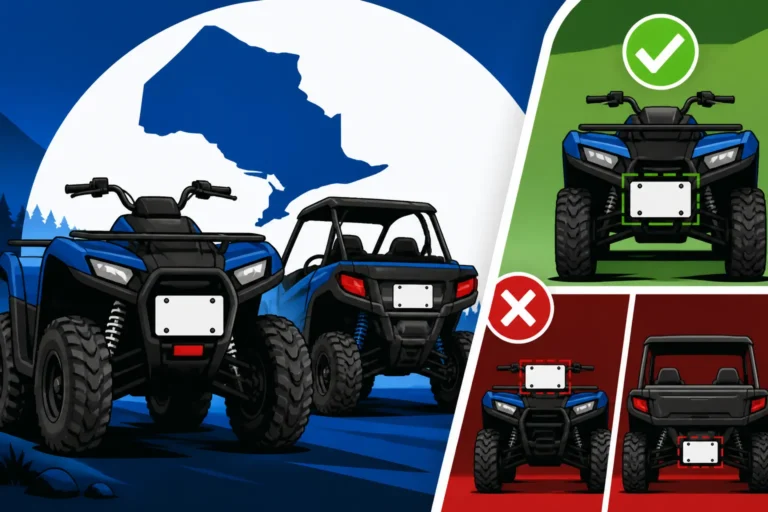
For ATVs and UTVs, the provincial license plate has specific mounting requirements that dictate visibility and placement, usually on the rear of the machine, as detailed in [Ontario ORV Plates and Where They Mount]. While some jurisdictions might allow front plates in certain scenarios, the rear plate is generally mandatory. Enforcement for both types of vehicles checks for valid registration and, if applicable, the appropriate trail permit. However, because snowmobile permits are annual, patrollers are always looking for the current year's sticker, whereas for ATVs, they're simply confirming the presence of a valid, permanent provincial plate and the [Ontario ATV Insurance Requirements].
Legal Frameworks and Road Access
The foundational laws governing ATVs and snowmobiles also differ significantly, leading to distinct rules regarding where and how these vehicles can be operated, especially concerning access on public roads.
The Off-Road Vehicles Act (ORVA) for ATVs
ATVs and UTVs in Ontario fall under the Off-Road Vehicles Act (ORVA). This legislation outlines the requirements for registering an ORV, defines vehicle types, sets rules for operator age, helmet use, and crucially, governs where and how ORVs can access public roads. The ORVA empowers municipalities to pass by-laws that open or close local roads to ORV traffic, leading to a patchwork of rules across the province. This means an ATV might be perfectly legal on a municipal road in one township, but strictly prohibited just across the border in the next. The ORVA is constantly being interpreted and updated to address the evolving landscape of ATV use, including the increasing popularity of side-by-sides. When considering legal documents like a bill of sale or ownership transfer, it's wise to ensure all details are clearly stated. Services like LawDepot can provide templates for these kinds of documents, helping ensure you have the proper paperwork in order, whether you're buying or selling a machine. Understanding the nuances of the ORVA is essential for any ATV rider planning to use their machine beyond private property, particularly for [Riding an ATV on Ontario Roads].
The Motorized Snow Vehicles Act (MSVA) for Snowmobiles
Snowmobiles, on the other hand, are governed by the Motorized Snow Vehicles Act (MSVA). This act is specifically tailored to snowmobiles and addresses their unique operational characteristics and winter-specific needs. The MSVA generally provides more direct and consistent allowances for snowmobiles to operate on or alongside certain public roads, particularly to access trails or cross highways, often without the same municipal by-law dependency as ATVs. This is largely because the entire snowmobile trail system frequently uses shoulders, ditches, and road allowances to connect segments.
The MSVA also sets out rules for snowmobile operators, including age restrictions, helmet requirements, and equipment standards. The legislative frameworks reflect the different historical development of each sport and their inherent operational environments. While both acts aim to ensure safety and responsible use, their specific provisions and interpretations diverge significantly, creating the "two regimes" that often puzzle riders. Knowing which act applies to your machine is the first step in understanding [Ontario ATV Rules on a Municipal Road] versus how a snowmobile might navigate the same area.
Summary of Key Differences
To help visualize these distinctions, here’s a quick overview:
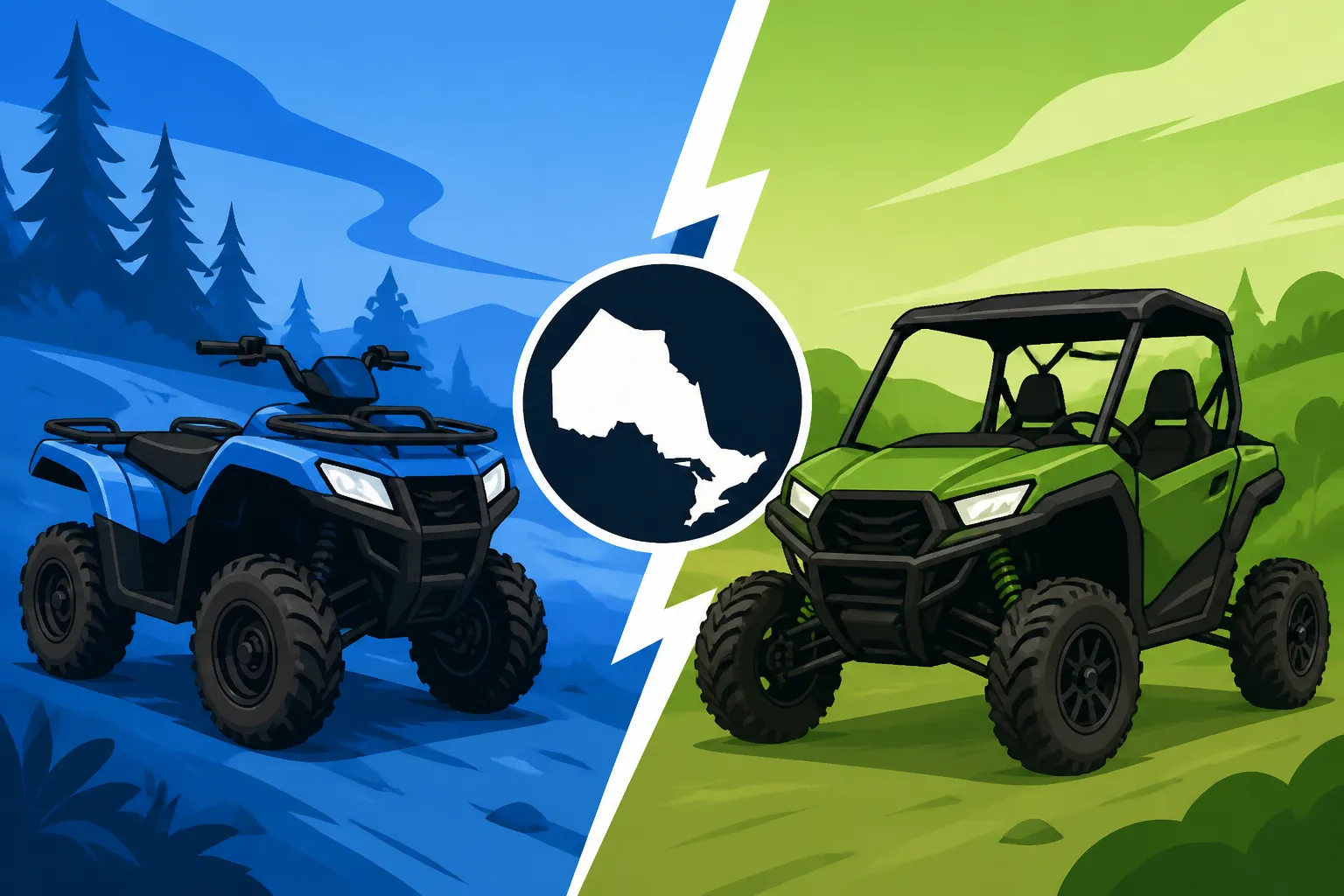
| Feature | All-Terrain Vehicle (ATV/UTV) Regime | Snowmobile Regime |
|---|---|---|
| Primary Legislation | Off-Road Vehicles Act (ORVA) | Motorized Snow Vehicles Act (MSVA) |
| Provincial Registration | One-time fee, perpetual permit and plate | Annual permit and plate renewal |
| Funding Destination | Provincial general revenue (for initial registration) | Primarily OFSC/clubs for direct trail funding |
| Trail Access Funding | Separate annual OFATV trail permit required for club trails | Provincial permit often includes trail access (OFSC system) |
| Annual Renewal | No provincial permit renewal | Yes, annual renewal of permit and plate |
| Road Access | Generally restricted, often requires municipal by-laws to open roads | More consistent allowances for accessing and crossing roads |
| Primary Use Focus | Utility, recreational off-roading, increasing road connectivity | Recreational trail riding in winter |
| Identification | Permanent rear license plate | Annual sticker on sled, often smaller plate |
As you can see, the differences are far more than superficial. They reflect deeply entrenched historical, logistical, and financial realities of two distinct off-road communities in Ontario. So, the next time you wonder why your ATV registration is permanent while your friend's snowmobile needs an annual sticker, remember it's not arbitrary; it's a testament to how these sports grew up. If you're looking to formalize ownership transfers or create clear sales agreements, LawDepot can be a helpful resource for various legal forms, including those relevant to buying or [Selling an ATV in Ontario].
This article is for general informational purposes only and does not constitute professional advice. Laws, prices and regulations vary by location and change over time. Consult a qualified professional for guidance on your specific situation.