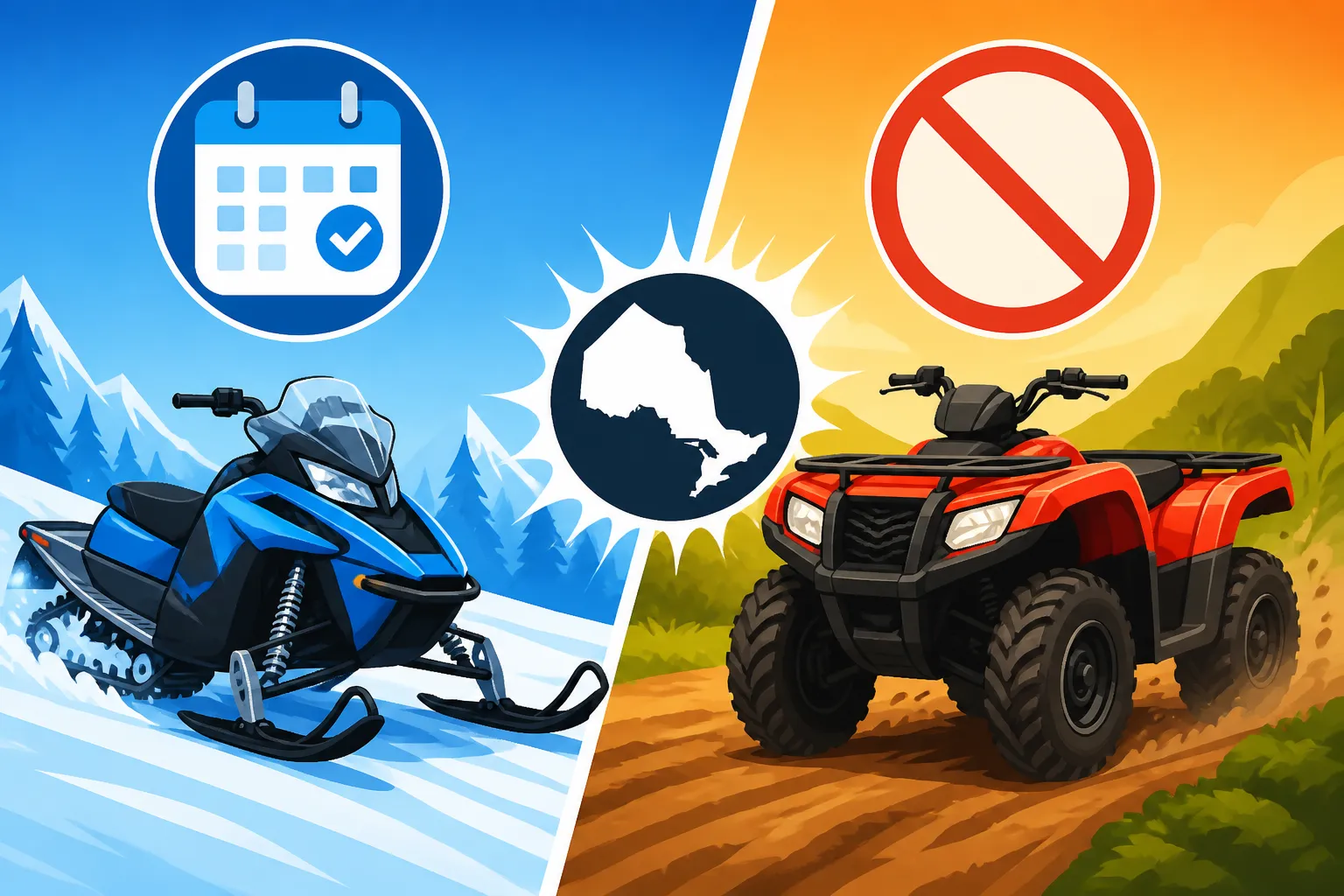
Snowmobiles Pay Yearly and Quads Do Not
It can be incredibly confusing, can't it? You buy an ATV or a side-by-side, go through the process of getting it registered and plated, and then… nothing. No annual renewal notice in the mail, no yearly trip back to ServiceOntario. But your buddy with a snowmobile is constantly reminding you about their annual registration and permit renewal dates. It feels like an unfair advantage, or maybe just a head-scratcher. Why does Ontario treat these two motorized recreational vehicles so differently when it comes to yearly payments? This guide will dive deep into the distinct legislative frameworks and funding models that explain why snowmobiles require annual fees while quads get a one-time registration and don't need to be renewed yearly.
The Fundamental Differences in Ontario's ORV Legislation
The core reason behind the differing registration requirements for ATVs and snowmobiles in Ontario lies not in the vehicles themselves, but in the separate pieces of provincial legislation that govern them. It's not a matter of one being inherently more "expensive" to maintain from a government perspective, but rather how each activity has been historically structured and regulated within the province. Understanding these foundational laws is key to unravelling the mystery of the one-time versus annual fee.
The Off-Road Vehicles Act and Its Scope for ATVs
For most off-road vehicles like ATVs, side-by-sides (SxSs or UTVs), and dirt bikes, the primary legislation in Ontario is the Off-Road Vehicles Act (ORVA). This act outlines everything from how these machines must be operated to their basic registration requirements. A cornerstone of the ORVA, and something that brings a sigh of relief to many riders, is the concept of a "one-time registration." Once you've purchased your quad, completed the paperwork at ServiceOntario, and received your [Ontario ORV Plates and Where They Mount] and your [The Ontario Vehicle Permit Explained], you're generally set for the entire lifespan of that particular machine in Ontario, as long as it remains in your ownership.
This "no annual renewal" aspect for ATVs under the ORVA means that the provincial government doesn't require you to re-register your vehicle every year. It’s a permanent administrative record of your ownership for that specific vehicle identification number (VIN). This system significantly reduces the recurring bureaucratic burden on ATV owners, allowing them to focus on riding rather than remembering annual deadlines for the provincial registration itself. Many appreciate this straightforward approach, as it means fewer forms to fill out and fewer fees directly to the province once that initial step is done.
The Motorized Snow Vehicles Act and Its Annual Approach
In stark contrast to the ORVA, snowmobiles in Ontario are governed by the Motorized Snow Vehicles Act (MSVA). This legislation operates under a fundamentally different philosophy, particularly when it comes to registration and its associated fees. Under the MSVA, snowmobiles are treated more like traditional road vehicles in the sense that they require an annual renewal of their registration. This means that every year, before you hit the snow, you’ll need to ensure your snowmobile's permit is up to date and that the associated fees have been paid.
This annual renewal for snowmobiles is deeply intertwined with the organized trail system that defines much of the snowmobiling experience in Ontario. The expectation is that snowmobiles will be used seasonally, and the annual fee ensures a consistent contribution to the infrastructure that supports that specific season. It creates a recurring financial cycle that directly funds the maintenance and operation of the vast network of snowmobile trails across the province. This annual commitment is a core part of the snowmobiling culture and infrastructure in Ontario, setting it apart from the ATV model.
Why the Discrepancy? Understanding the Funding Models and Trail Networks
The differing legislative frameworks are just one piece of the puzzle. The true "why" behind the one-time versus annual payment lies in the distinct funding models and operational structures of the trail networks that each type of vehicle predominantly uses. These models have evolved over decades, shaped by the communities and federations that support these recreational activities. It's a tale of two different approaches to managing and sustaining outdoor adventure.
How ATV Trail Systems Are Funded and Maintained
For ATVs and side-by-sides, the primary organized trail systems in Ontario are largely managed by the [OFATV] (Ontario Federation of ATV Clubs) and its various member clubs across the province. These organizations are responsible for securing land-use agreements, maintaining trails, installing signage, and providing liability insurance for riders on their designated routes. Crucially, the funding for these extensive trail systems comes almost entirely from the sale of annual ATV trail permits. When you purchase an [Ontario ATV Trail Permits Explained], that money directly supports the club whose trails you intend to ride, covering operational costs and ensuring the trails remain open and safe for the season.
This separation means that the initial, one-time [Registering an ATV in Ontario] and the associated fee primarily cover the administrative costs of recording your ownership at ServiceOntario. It’s about creating a legal record for your machine, not about funding the trails directly. While there might be some broader provincial funds that benefit from these fees, they are not earmarked in the same direct way for trail maintenance as snowmobile fees are. This distinction is often a point of confusion for new riders, who might assume their one-time registration covers everything, only to learn later about the separate, annual trail permit requirement for organized riding. This is why you'll often hear us talk about [Why Snowmobiles Pay a Trail Sticker and ORVs Do Not] – it's all about how the funds are collected and disbursed.
The Snowmobile System: Integrated Funding and Annual Renewal
The snowmobile system in Ontario, primarily coordinated by the Ontario Federation of Snowmobile Clubs (OFSC), operates on a much more integrated funding model. For snowmobiles, the annual registration renewal at ServiceOntario is directly tied to, or at least closely linked with, the purchase of an OFSC trail permit. In many cases, it's a streamlined process where the annual fee you pay is seen as a contribution that supports both the provincial registration and the extensive network of groomed snowmobile trails. This integrated approach means that a significant portion of the annual payment directly feeds into the maintenance, grooming, signage, and land-use agreements for the vast and intricate snowmobile trail system.
This annual cycle ensures a consistent and predictable funding stream for the seasonal nature of snowmobiling. Snowmobile trails, especially groomed routes, require substantial annual investment in equipment, fuel, and volunteer hours. The annual renewal system ensures that every snowmobiler contributes to this collective effort year after year, fostering a strong sense of community support and shared responsibility for the trails. Without this annual commitment, the quality and accessibility of Ontario's snowmobile trails would be severely impacted. The annual permit is not just a sticker; it's a direct investment in the season's riding experience.
Practical Implications for Riders
Understanding the 'why' is one thing, but knowing how these differences impact your day-to-day as an ATV or snowmobile owner is crucial. Each system comes with its own set of benefits, responsibilities, and points of interaction with ServiceOntario or trail organizations. Navigating these requires a clear understanding of what’s expected of you, whether you’re tearing up dirt trails or gliding over fresh snow.
The Benefits and Responsibilities for ATV Owners
One of the biggest benefits for ATV owners in Ontario is the simplicity of the provincial registration: it's a one-time payment. Once you’ve gone through the process of [Registering an ATV in Ontario] and paid the initial fee, you won't receive annual renewal notices from ServiceOntario for that specific vehicle. This eliminates a recurring administrative task and a yearly expense directly to the province, which many riders appreciate. You get your plate, your [The Ontario Vehicle Permit Explained], and you’re good to go from a provincial registration standpoint, with [No Annual Renewal for an One Ontario ORV]. This means fewer trips to the counter and less paperwork to track year after year.
However, this benefit comes with a significant responsibility and a common point of misunderstanding: the one-time registration does not exempt you from buying an annual trail permit if you plan to ride on organized club trails. It's a critical distinction. Many new riders mistakenly believe that their initial registration covers all riding, only to learn they still need to purchase an annual OFATV permit to legally access club trails. It’s also important to retain your Ontario Vehicle Permit for your ATV, as it serves as your primary proof of ownership. If it ever gets lost or damaged, you’ll need to replace it at ServiceOntario. For changes of ownership, a proper [Ontario ATV Bill of Sale Requirements] is paramount; templates for such documents can often be found through services like LawDepot, ensuring all legal bases are covered for both buyer and seller. Remember, while the registration doesn't expire, other vital aspects like your [Ontario ATV Insurance Requirement] certainly do and must be kept current for legal riding.
The Annual Commitment for Snowmobile Owners
For snowmobile owners, the system demands an annual commitment, which, while recurring, also offers a streamlined process in many respects. The annual renewal of your snowmobile's registration is often integrated with the purchase of your OFSC trail permit, making it a single, albeit yearly, transaction. This ensures that you’re not only keeping your provincial registration current but also directly contributing to the vast and well-maintained network of snowmobile trails across Ontario. Many snowmobilers see this annual fee as a direct investment in their sport, fostering a strong sense of community and shared responsibility for the trails they enjoy.
The responsibility, however, lies in remembering to renew annually. Missing the deadline means you could be riding illegally on organized trails, potentially facing fines and impacting your insurance coverage. The annual renewal ensures snowmobilers are directly supporting the season's trail upkeep, from grooming to signage, which is crucial for safety and enjoyment across such an extensive network. This regular contribution helps to maintain the high standards of Ontario's snowmobile trails, which are a major draw for both local riders and visitors. For both types of vehicles, keeping all your documentation in order is key; should you ever need to sell, a clear bill of sale, perhaps generated using an online resource like LawDepot, can make the process much smoother.
Addressing Common Misconceptions and Planning Your Rides
The differences between ATV and snowmobile registration in Ontario often lead to lingering questions and common misconceptions. It’s easy to get confused when the rules for two similar recreational activities diverge so significantly. Clearing up these points can help riders make informed decisions, stay compliant with the law, and fully enjoy their time outdoors.
Dispelling the "Free Riding" Myth for ATVs
Perhaps the most persistent misconception among ATV owners, especially new ones, is that once their machine is registered with the province, they can ride anywhere freely without additional costs. This is absolutely not the case. Just because the provincial registration for your ATV is a one-time affair, it does not mean that all riding is "free." As we’ve discussed, if you intend to ride on organized club trails — those maintained by the OFATV and its member clubs — you absolutely need to purchase an [Ontario ATV Trail Permits Explained]. This annual permit is your key to accessing these managed trail systems and is vital for their continued operation.
Beyond organized trails, there are options for riding on Crown Land in Ontario, which often falls under a "free use" policy. However, even on Crown Land, your ATV must still be properly [Registering an ATV in Ontario] and insured, and you must adhere to all other regulations specific to Crown Land use, such as fire bans or environmental restrictions. This concept of [Free Use of Crown Land Explained] means you don't pay a specific permit fee to access the land itself, but it doesn't waive your responsibility to have a legally registered and insured machine. Always do your homework before riding on any land, whether private, club-managed, or Crown, to ensure you have the necessary permissions and documentation.
When You Do Interact with ServiceOntario for Your ATV Again
While you won't be heading to ServiceOntario every year to renew your ATV's registration, there are definitely other circumstances that will bring you back to the counter. The one-time registration is for the vehicle itself and its initial entry into the provincial system. However, life happens, and with it come administrative needs. For instance, if you decide to sell your quad, you'll need to go through the process of [Transferring a Permit to a Buyer in Ontario] at ServiceOntario. This ensures the new owner is properly recorded and assumes legal responsibility for the machine. A clear and comprehensive bill of sale, which you can easily draft using platforms like LawDepot, is crucial for this transfer to be smooth and legally sound.
Other reasons to visit ServiceOntario include situations like needing to [Replacing a Lost Ontario ORV Plate] or if your Ontario Vehicle Permit goes missing. You’ll also need to update your records if you move and require a [Changing an Address on a Permit] or if you legally change your name. These are all critical updates to ensure your records are accurate and you remain compliant with provincial regulations. So, while the absence of annual renewal is a blessing, don't forget that ServiceOntario is still your go-to for these essential administrative tasks related to your off-road machine.
The Future Outlook: Will Things Change?
It's natural to wonder if these systems, which have been in place for a long time, might ever change. Legislation is rarely static, and provinces periodically review their acts and regulations to adapt to new technologies, changing demographics, or evolving recreational patterns. However, the current distinct frameworks for ATVs and snowmobiles in Ontario are deeply embedded in how these sports are funded, managed, and enjoyed. The snowmobile system's reliance on annual renewals for trail funding, and the ATV system's reliance on separate annual trail permits, are integral to their respective operations.
For now, the two regimes remain distinct, primarily because they serve different seasonal needs and financial models. Any significant change would require a complete overhaul of how trails are funded and maintained for one or both types of vehicles. While it's always possible for adjustments to be made to specific rules or fees, the fundamental difference in annual versus one-time registration is likely to persist for the foreseeable future due to the established infrastructure and funding mechanisms of each community.
| Feature | Ontario ATV/UTV Registration | Ontario Snowmobile Registration |
|---|---|---|
| Governing Act | Off-Road Vehicles Act (ORVA) | Motorized Snow Vehicles Act (MSVA) |
| Registration Frequency | One-time fee, no annual renewal | Annual renewal required |
| Purpose of Provincial Fee | Primarily administrative, proof of ownership, general revenue | Linked to trail permit, direct trail funding support |
| Trail Use Permit | Separate annual OFATV permit required for organized trails | Often integrated with annual registration/OFSC permit |
| Proof of Ownership | Ontario Vehicle Permit | Ontario Vehicle Permit |
| Triggers for ServiceOntario | Purchase, sale, lost documents, address change, name change | Annual renewal, purchase, sale, lost documents, address change, name change |
| Direct Trail Funding | Primarily through OFATV trail permits | Directly through annual registration/OFSC permit |
| Typical Cost Structure | [Ontario ATV Registration Cost] (one-time) + annual trail permit (if used) | Annual registration/permit fee |
Disclaimer
This article is for general informational purposes only and does not constitute professional advice. Laws, prices and regulations vary by location and change over time. Consult a qualified professional for guidance on your specific situation.