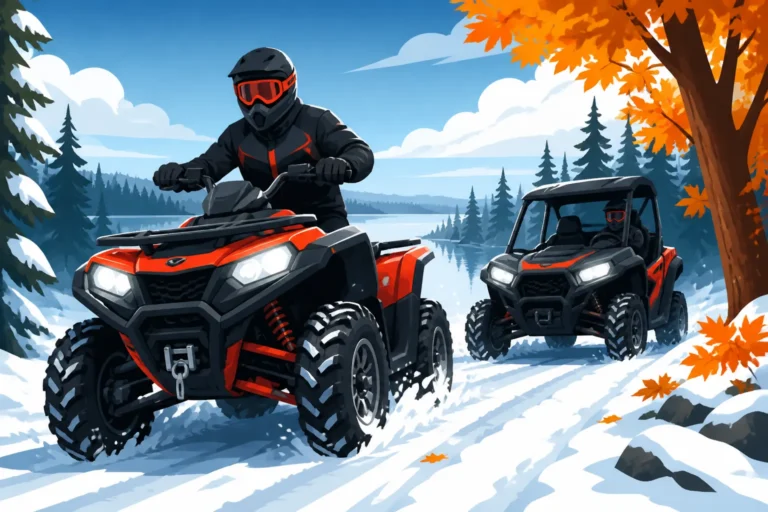
Dawn to Dusk in the Ganaraska Forest
A ride in the Ganaraska Forest can feel deceptively simple to plan: pick a trail, unload the machines and head out. The challenge is that permitted riding is limited to daylight, and daylight changes with the season. This guide explains how to plan around the dawn-to-dusk rule, choose a sensible route and avoid getting caught far from your vehicle when the riding day ends.
What dawn to dusk means in the Ganaraska Forest
Plan around natural daylight, not a fixed ride schedule
“Dawn to dusk” is not a promise that the trails are open for the same number of hours every day. In summer, you may have a generous stretch of daylight; in autumn, the useful riding window gets shorter. A route that feels comfortable in July can be too ambitious later in the season, especially if your group rides slowly, stops often or is unfamiliar with the trail system.
Think of the permitted riding window as the outer boundary, not as a target to fill completely. You still need time to unload, prepare, ride to and from your chosen loop, and load up again. A mechanical issue, a wrong turn or a muddy section can make the return take longer than you expected. Building in a buffer is much less stressful than trying to squeeze in one last trail before sunset.
For a date-specific plan, check local sunrise and sunset times and then confirm the forest’s access rules before you go. Do not rely on a remembered clock time from another visit or a generic “open until evening” assumption. The details that matter are the rules for the area you plan to use, the conditions on the day and whether the access point you are using has its own restrictions.
Leave the trail before the light becomes a problem
The hardest part of a late ride is often not deciding to head back; it is turning around early enough. A group can lose time while gathering at a junction, helping a rider through a difficult section or checking a map. If the ride leader waits until sunset is close to call it, everyone may feel rushed on the return.
Set a turnaround time before you unload. For example, agree that the group will start heading back when it has used roughly half of its planned riding window, rather than judging the decision by how much daylight appears to remain. Adjust that plan for the season, trail conditions, group size and how far you are from the vehicle. A shorter, familiar loop is usually the better choice when the available daylight is limited.
It also helps to make the turnaround time a group rule rather than a suggestion. Riders who want to continue can put pressure on less experienced people to keep going. Agreeing in advance avoids that awkward moment and keeps the whole group focused on getting back with time to spare. For more detail on the rule itself, see [Ganaraska's Dawn to Dusk Rule].
Choose the right part of the forest and route
Know which forest area you are planning to ride
The Ganaraska Forest is a large area, and not every part should be treated as a motorized riding area. Riders commonly need to distinguish between the West and East Forest areas and the Central Forest. Access and permitted uses can differ, so check the area-specific rules before choosing a starting point or plotting a route. A map pin that appears to be inside the forest does not, by itself, mean that motorized riding is allowed there.
This matters when you are looking at a route shared by a friend, an app or an older screenshot. A line on a map can be useful for orientation, but it may not show a current closure or explain whether a trail is open to your vehicle type. Confirm the intended riding area using the forest’s official information and trail materials. The overview in [Ontario's Ganaraska West and East Forests] can help clarify why choosing the right forest section is part of the plan, not a minor detail.
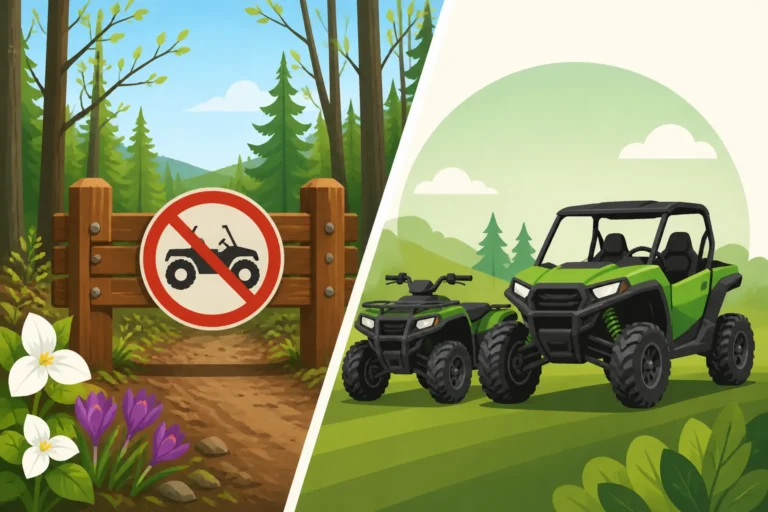
Do not assume that nearby trails connect just because they appear close together on a screen. Boundaries, non-motorized areas and closed sections can interrupt what looks like a straightforward loop. In particular, make sure your planned ride does not wander into an area where motorized vehicles are not permitted; [Why Ganaraska's Central Forest Is Closed to Motors] explains why that distinction matters.
Match the loop to your group and the day
A good route is not necessarily the longest route. It is one your least experienced rider can finish comfortably within the available daylight. Consider how many machines are in the group, whether anyone is riding a new vehicle, how often you expect to stop and how confident everyone feels on uneven or muddy ground. A route that is easy for a regular local rider may feel very different to someone who has only ridden a few times.
Before leaving, identify the route’s decision points: junctions where you can shorten the ride, places where the group might pause and the point at which you should turn around regardless of how close the next trail looks. Keep the plan simple enough that everyone can remember it. If your group splits, a familiar, clearly agreed return plan is safer than hoping to reconnect by phone.
A navigation app such as onX Offroad can help you organize a route and keep track of where your group is in relation to its starting point. Use it as a planning aid, not as permission to ride a mapped line. Check the forest’s official map and access rules as well, and do not continue onto a trail simply because an app displays it. A short review of [Reading a Club Trail Map] and [Following Club Trail Markers] can also help everyone understand the route before the machines are moving.
Prepare for changing daylight and trail conditions
Check the riding season and closures before leaving home
A daylight window does not mean a trail is open every day of the year. Seasonal rules, maintenance, weather and local conditions can affect whether a route is available. Spring deserves particular care: soft ground can be damaged by early riding, and a trail that was passable on a dry visit may be wet or rutted after rain. Autumn brings its own planning challenges, including shorter daylight and changing surfaces.
Check the applicable season dates and any updates before loading the machines. Do not rely only on a social post from a previous week or a trip report from another rider. A closure can apply to one section while other areas remain accessible, so look for information that identifies the specific location. [The Ganaraska Motorized Season in Ontario] is a useful companion when you are checking whether your planned visit falls within the riding season.
Conditions can also change between the time you leave home and the time you reach the forest. If rain has made the route slower, scale back the plan rather than trying to complete the original loop at a faster pace. Mud can conceal ruts and make a familiar trail take longer to ride. A quick look at [Ontario Trail Conditions After Rain] and [Ontario Trail Closures to Check First] can help you think through what to check before setting out.
Prepare for a ride that ends on time
The basics matter more when you have a firm daylight boundary. Arrive with enough time to unload, check equipment and review the route without eating into the riding window. Carry water, weather-appropriate clothing, a charged phone and any supplies your group needs for a delay. Keep your fuel plan conservative; running low near the end of the day can turn a manageable ride into a stressful one.
Take a paper or offline navigation backup if practical, and make sure riders know the agreed starting point and return plan. A phone may lose signal, run out of battery or become difficult to use in poor weather. If you use onX Offroad or another mapping tool, prepare it before you leave the parking area rather than trying to troubleshoot settings at a trail junction. Keep the map available to more than one rider if your group is large.
| Planning factor | Why it matters | Practical approach |
|---|---|---|
| Season and sunset | The usable daylight window changes | Check local sunset and plan a return buffer |
| Route length | Slow sections and stops add time | Choose a shorter loop if conditions or experience are uncertain |
| Trail status | Closures and conditions can change | Review official forest information before travel |
| Navigation | A wrong turn can consume daylight | Review the map together and agree on a turnaround point |
| Group readiness | Mechanical or rider issues can delay everyone | Carry essentials and keep the group together |
Permits, parking and arrival planning
Confirm access requirements before you unload
Do not assume that arriving at a forest entrance automatically gives you permission to ride. Check the current access and permit requirements for the riding area and the type of visit you have planned. Make sure every rider understands what is required, and have the relevant proof ready before starting. This is easier to sort out at home than at the trailhead when the rest of the group is waiting.
If you are visiting for only one day, read the details of the applicable day-use option and confirm what it covers. A pass for one part of a riding experience may not automatically cover every parking or vehicle-related requirement. [Why Every Rider Needs a Ganaraska Forest Day Pass] is a helpful next read when you are sorting out the day-pass question. For longer-range access planning, it is also worth understanding how forest access differs from broader trail networks and permits.
Keep your permit or proof of access in the form required by the operator, and check that the machine or rider details are correct. Do not leave that check until you are already on the trail. If you are bringing several machines, make sure you understand whether the requirements apply per rider, per machine or in another way. The specific details can depend on the access option, so verify them with the forest’s own information.
Give yourself enough time at the staging area
The riding day starts before the first trail. You may need to park, unload, secure the trailer, check machines and help newer riders get comfortable. A late arrival can create pressure to skip those steps or start riding without a clear route plan. That pressure is exactly what makes people push too close to the end of the daylight window.
Check where you are permitted to park and stage. Do not block a gate, access road or another vehicle’s route while unloading. If you are using the Ganaraska Forest Centre area, confirm the relevant parking and access instructions rather than assuming every lot has the same rules. [Where ORVs Park at the Ganaraska Forest Centre] and [Ganaraska Forest Parking Passes for Tow Vehicles] address the practical details that can otherwise catch visitors off guard.
Once the group is ready, pause for a final check: everyone has the route, the turnaround time is understood, and the group knows what to do if a machine has trouble. If you are behind schedule, shorten the ride. Starting late does not make the daylight last longer, and trying to recover the lost time by rushing is a poor trade.
Ride responsibly and make the return part of the plan
Stay on permitted routes and respect other forest users
A forest trail system is not just a set of lines to follow. It is a shared outdoor space with rules that help protect the land and manage different activities. Stay on permitted routes, follow posted instructions and do not use a closed trail as a shortcut. If a route is blocked or marked closed, turn around and use a legal alternative rather than riding around a barrier.
Keep your group together at junctions and give other users room. Slow down when visibility is limited, around blind corners and where trail surfaces are uneven. A fast approach can leave little time to react to another rider, a person on foot or an unexpected obstacle. The best pace is one that lets the group travel predictably and still leave enough time to return before the daylight limit.
Navigation tools should support, not replace, good judgment. onX Offroad may help you orient yourself, but a digital map cannot tell you that a trail is temporarily closed unless that information is reflected in the map. Compare your route with official trail information and pay attention to signs on the ground. If the map and signage appear to conflict, stop and confirm the route instead of guessing.
Use a simple turnaround and return routine
Choose a clear point at which the group will turn back, then stick to it. If the ride is taking longer than expected, turn around earlier. Do not let the distance already travelled convince you to continue toward a more distant destination when the return leg still has to be completed. This is especially important for mixed-experience groups, where one rider’s slower pace may be the sensible pace for everyone.
At junctions, pause long enough for the group to regroup and confirm the next direction. If a rider is missing, do not send everyone in different directions; follow the group’s agreed plan and use the last known location to decide what to do. Keep phones and navigation tools protected from weather, and avoid relying on a single person’s device or memory to get the group back.
When you reach the staging area, make sure every machine and rider is accounted for before loading. A little care at the end of the ride—checking for damage, packing out what you brought and leaving the parking area orderly—helps keep the experience pleasant for the next group. The aim is not to use every possible minute of daylight. It is to finish the ride safely, with enough time to load and head home without rushing.
Disclaimer
This article is for general informational purposes only and does not constitute professional advice. Laws, prices and regulations vary by location and change over time. Consult a qualified professional for guidance on your specific situation.