Where ORVs Park at the Ganaraska Forest Centre
If you’re driving to the Ganaraska Forest with an ATV or UTV, finding somewhere to leave your truck and trailer is part of the ride plan—not an afterthought. At the Forest Centre, use the designated ORV parking area north of the centre driveway, and follow posted signs when you arrive. This guide explains where to park, what to check before unloading, and how to avoid common staging mistakes.
Where to park at the Ganaraska Forest Centre
Use the designated lot north of the driveway
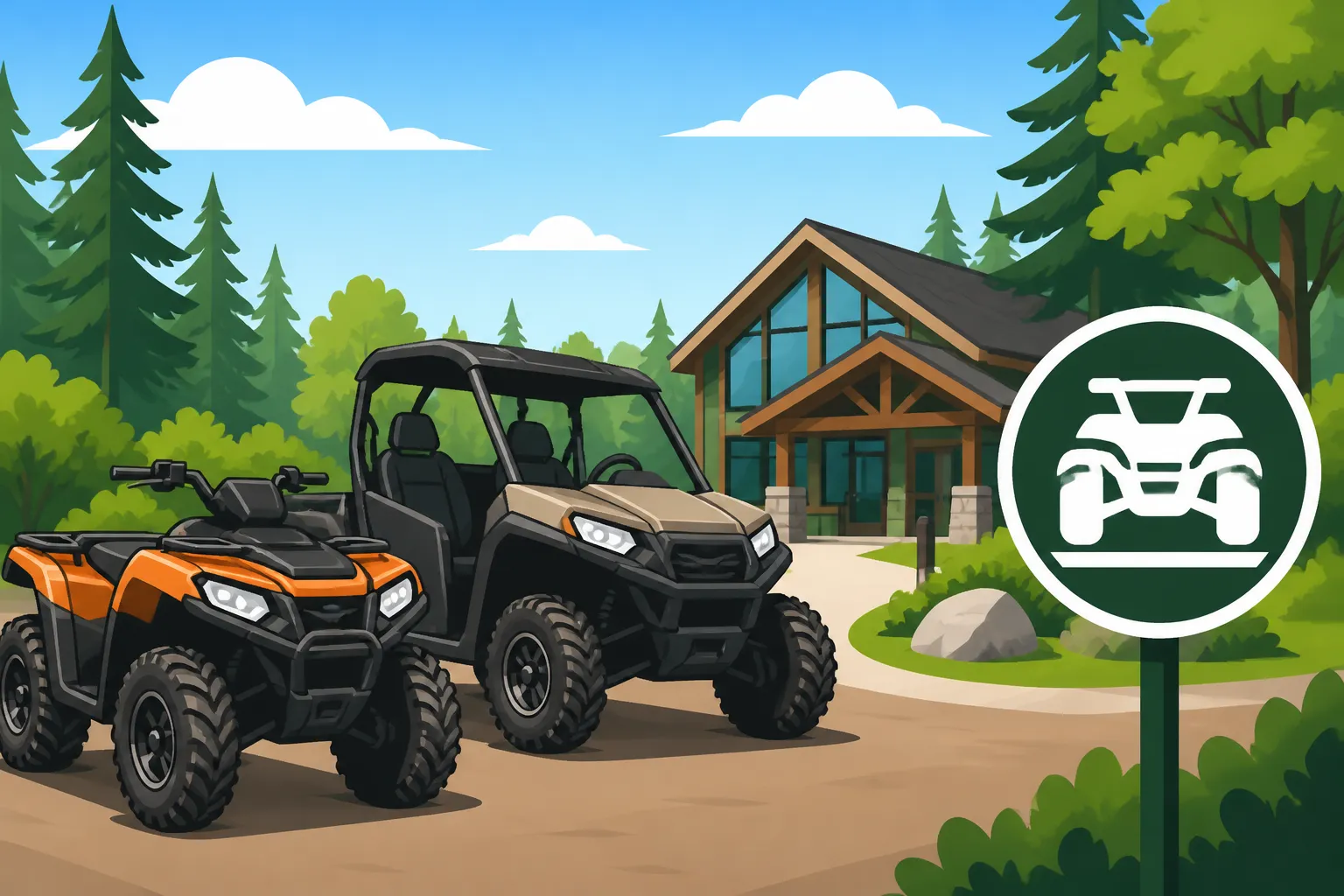
For motorized recreation, look for the designated parking area north of the Ganaraska Forest Centre driveway. It is the key detail to remember when you arrive: do not assume that any open space near the centre, entrance, or road is an approved place to park an ORV trailer. Follow the signs and any directions given on site.
The Forest Centre driveway is an access point, not a place to stop and sort out your gear. Pulling over across it, leaving a truck on the shoulder, or unloading beside the entrance can interfere with other visitors and forest operations. If you miss the parking area, keep moving safely and use the signed directions rather than turning around or backing up in a busy entrance.
The Ganaraska is a large forest with different areas and rules for different activities. Before you set out, it can help to understand [The Ganaraska Forest for Ontario Riders] and how the motorized areas relate to the rest of the forest. Parking in the right place gets you started, but it does not by itself confirm that a particular trail is open to motorized riding.
Check signs before unloading
When you arrive, take a moment to read the current signs at the entrance and parking area. Look for directions about where trucks and trailers belong, how parking passes are displayed, and whether any sections are temporarily closed or reserved. Signs on site should take priority over an old screenshot, a memory from a previous visit, or a pin on a mapping app.
If the marked parking area is full, do not create a new space by blocking another vehicle, parking across access routes, or leaving a trailer where it narrows the entrance. Ask staff or follow posted overflow instructions if they are available. If there is no clear overflow direction, it is safer to pause and confirm what is permitted than to assume a nearby shoulder or lot is acceptable.
It is also worth checking which part of the forest you intend to ride. The west and east areas do not mean that every nearby entrance or trail is interchangeable. [Ontario's Ganaraska West and East Forests] offers useful context for planning where you want to spend your day. Start with the location and access information for your intended riding area, then use the signed route from the parking area.
Plan for the truck, trailer, and ORV
Leave room for other users
Parking a truck and trailer takes more space than parking a car, and a busy staging area can feel tight when several groups arrive at once. Choose a space that fits your full setup without encroaching on another parking space or blocking a route through the lot. If you are travelling with friends, coordinate before arrival so everyone is not trying to unload in the same narrow area.
Unloading can take longer than expected, especially if you need to remove tie-downs, check equipment, organize helmets, and get everyone ready. Keep your gear close to your vehicle rather than spreading it across the lane. Before moving your ATV or UTV, make sure you have enough room to do so without crossing through another group’s loading area.
A simple arrival routine helps: park fully within the marked space, secure the truck and trailer, check that the area around your machine is clear, and only then unload. If the lot is busy, one person can watch for moving vehicles while another handles the ramp. Small courtesies like these make a real difference in a shared staging area.
Understand the difference between riding access and parking
A common source of confusion is treating a parking pass and a riding permit as if they were the same thing. They serve different purposes. Parking arrangements apply to the vehicle or tow setup, while access to ride depends on the applicable forest requirements and the motorized area you plan to use. Confirm what you need for both before you leave home.
The details can vary by pass type and visit, so check the forest’s current information rather than relying on an old receipt or a friend’s description of a previous trip. [Ganaraska Forest Parking Passes for Tow Vehicles] is a useful topic to review when you are sorting out the vehicle side of the visit. For riding access, see [Why Every Rider Needs a Ganaraska Forest Day Pass] and confirm the requirements that apply to your plans.
| Before you leave | What to confirm | Why it matters |
|---|---|---|
| Truck and trailer parking | Which designated area to use and whether a tow-vehicle pass applies | Parking permission is not the same as trail access |
| ORV riding access | The pass or day-use requirement for each rider or machine | Arriving at the lot does not automatically authorize riding |
| Riding area | Whether your planned area is open to motorized use | Forest areas can have different rules |
| Trail conditions | Closures, seasonal limits, and current notices | A route shown on an older map may not be open |
| Equipment | Tie-downs, helmets, required documents, and recovery basics | A rushed unload is a poor start to a ride |
For a larger group, designate one person to check the current requirements and share them before departure. That prevents the awkward situation where one truck has the right parking arrangement but a rider is missing the access information needed for the day.
Know which areas and trails are open
Do not assume every part of the forest allows ORVs
The Ganaraska Forest includes areas used for different activities, and motorized riding is not permitted everywhere. A trail or forest road that appears close to your parking location may still be closed to ORVs or intended for another use. Keep to routes that are clearly designated for your type of riding, and respect barriers and closure signs even if a route looks passable.
The central forest is an especially important example of why it pays to check the area rules before unloading. [Why Ganaraska's Central Forest Is Closed to Motors] explains the distinction riders need to keep in mind: being within the broader forest does not mean a route is open to motorized traffic. Do not ride into a closed area to “just have a look” or follow another group through a barrier.
If you are new to the forest, choose your intended riding area before the day of your visit. Use a current forest map and confirm that the map identifies motorized routes, not simply general trails. A map that shows a trail line does not necessarily establish that the trail is open to your ORV. That distinction matters when trail networks are shared or change over time.
Check seasonal and day-of-ride conditions
Even a route that is normally open can be affected by seasonal restrictions, weather, trail work, or temporary closures. Spring thaw and heavy rain can leave soft ground that is easily damaged by tires. A closed or unsuitable trail is not just an inconvenience; riding it can deepen ruts and create repair work for forest staff and volunteers.
Check the forest’s current notices before setting out and again when you arrive. The general riding season and local access rules are worth reviewing in [The Ganaraska Motorized Season in Ontario]. For weather-related planning, [Ontario Trail Conditions Before You Ride] can help you think through the conditions that may affect traction, visibility, and trail quality.
Mapping tools can support your preparation, but they should not replace official access information. For example, onX Offroad may be useful for reviewing routes or preparing a navigation plan, but do not treat a third-party map as permission to ride a trail. Compare any route you plan to use with the current forest information and obey closures and on-site signs.
Get ready before you reach the parking area
Prepare your navigation and arrival plan
Save the forest’s official information before leaving home, especially if you expect to have limited cell service. Identify the entrance, parking area, and riding zone you intend to use. If you are relying on a phone for navigation, download what you need in advance instead of assuming you will have a reliable connection in the parking lot or on the trail.
You can use onX Offroad as one part of a navigation setup, but check that the route you plan to follow matches the current permitted riding area. Keep a second reference available, such as an official forest map or a saved set of directions. This is particularly helpful if you are riding with a group and not everyone has the same app or map layer.
Agree on a meeting point and a plan for delays before the group spreads out. If a rider arrives late, they should know where to park and how to find the group without improvising a route through restricted areas. A clear meeting plan also helps if someone needs to return to the truck early.
Load and secure gear with the parking lot in mind
Pack so that the items you need first are easy to reach. Helmets, gloves, permits or passes, water, and basic tools should not be buried under a full load of riding gear. Keep loose items from blowing or rolling into the traffic lane, and make sure ramps and tie-downs are put away once unloading is complete.
Before you leave the vehicle, do a quick walk-around. Check that the trailer is stable, ramps are secure, and nothing remains in a position where another driver might hit it. Look behind and around the ORV before starting it. A parking area can have pedestrians, children, pets, and vehicles moving in different directions, so low-speed awareness matters as much here as it does on the trail.
If you need to adjust a machine, move it to a safe spot within your parking space rather than working in a lane. Keep fuel and maintenance tasks tidy and follow any site rules. The goal is to leave the staging area as orderly as you found it, without creating hazards for the next group.
Common parking mistakes to avoid
Do not use a convenient-looking spot as overflow
When the designated area appears crowded, it can be tempting to park beside the driveway or pull onto a nearby shoulder. That may block access, create a roadside hazard, or put your vehicle somewhere that is not approved for forest use. A convenient-looking patch of ground is not automatically a legal or safe parking space.
Do not block gates, signs, service access, or the path other visitors need to use. Avoid parking in a way that forces another truck and trailer to make a difficult turn or back up into moving traffic. If you cannot find a suitable space, stop and check the posted instructions rather than making your own overflow arrangement.
The same caution applies to following another rider’s example. Someone else may have permission for a particular space, may be using a different access point, or may simply be parked incorrectly. Use the official directions for your visit, not the assumption that a vehicle already there proves the spot is available to everyone.
Do not rely on an old visit or an unverified map pin
Forest access details, parking arrangements, trail conditions, and seasonal rules can change. A parking spot you used on a previous trip may not be the right choice today, and a map pin can be inaccurate or outdated. Before leaving, check current information and confirm the entrance and parking directions for the riding area you intend to use.
onX Offroad can be a helpful planning aid for understanding your route, but map layers and user-marked points should be treated as supplementary. Do not use a pin alone to decide that a road or trail is open, or to choose an unmarked place to leave your truck. Cross-check with the current forest information and follow signs when you arrive.
If you are unsure about a sign or access point, pause and ask before riding. It is much easier to confirm a route while you are still at the staging area than to discover later that your group has entered a closed section. That small check protects the trail, avoids unnecessary backtracking, and makes the day less stressful.
A simple arrival checklist
Before leaving home
Use this short checklist to avoid the most common last-minute problems:
- Confirm the designated ORV parking area north of the Forest Centre driveway.
- Check the current parking and tow-vehicle requirements.
- Confirm the riding access requirements for your group.
- Choose a motorized riding area that is open to your machine.
- Review current trail notices, closures, and seasonal conditions.
- Save an official map and any navigation information you need offline.
- Secure the trailer, ramps, tie-downs, and riding gear.
- Tell your group where to meet if anyone arrives separately.
You can also use [Ontario ATV Trail Maps] as a broader planning reference, while remembering that the forest’s own current directions and signs govern access at the site. For a more detailed understanding of the forest layout, the information in [The Ganaraska Forest for Ontario Riders] can help you plan the day before you turn into the parking area.
At the parking area
Once you arrive, stay within the designated parking area and follow the posted instructions. Keep the entrance and travel lanes clear, unload carefully, and make sure your whole group understands which routes are open. If the lot is busy, take your time rather than rushing through setup.
Before heading out, check that each rider has the required access information and that your group knows its meeting plan. Confirm that your route stays within the motorized area and that your machine is ready for the conditions. A few minutes spent checking these details can prevent an avoidable turn-around—or a much more serious problem on the trail.
The practical rule is straightforward: park in the signed ORV area north of the Forest Centre driveway, confirm your parking and riding requirements separately, and ride only on routes currently open to motorized use. That gives you a safer, more considerate start to the day.
Disclaimer
This article is for general informational purposes only and does not constitute professional advice. Laws, prices and regulations vary by location and change over time. Consult a qualified professional for guidance on your specific situation.