Ontario Trail Permit Reciprocity With the Maritimes
An Ontario trail permit can make a Maritime ATV trip simpler, but it does not automatically open every trail in New Brunswick, Prince Edward Island, or Nova Scotia. Riders often discover that “accepted” still comes with local club rules, machine requirements, and proof-of-permit expectations. This guide explains what reciprocity generally covers, what it does not, and how to check your route before unloading.
What Ontario trail permit reciprocity means
The basic idea behind reciprocity
Trail permit reciprocity is an arrangement between trail organizations that allows a permit issued in one province to be recognized on certain trails in another. For Ontario riders, the practical benefit is that an eligible Ontario permit may be accepted on participating ATV trail networks in New Brunswick, Prince Edward Island, and Nova Scotia. That can save you from buying another full permit simply because your trip crosses a provincial boundary.
The key word is participating. Reciprocity is not a single permit that grants access to every ATV route in the Maritimes. Trail systems may be maintained by different clubs, landowners, or organizations, and they may have specific access rules. An accepted permit is best understood as permission to use designated trails within the arrangement, subject to the local rules that apply there.
It also helps to separate a trail permit from the vehicle documents you need to operate your machine. A trail permit does not replace registration, a licence plate, insurance, a driver’s licence, or any safety equipment required by law. Those requirements can differ by province and by whether you are riding on a trail, a road, or a private property route.
Which Maritime provinces may recognize an Ontario permit
Ontario permit reciprocity is commonly associated with organized ATV trail networks in New Brunswick, Prince Edward Island, and Nova Scotia. A rider planning a trip might, for example, take an Ontario-permitted machine to a participating club trail in New Brunswick, then continue to a participating network on Prince Edward Island or in Nova Scotia. The exact access depends on the permit type and the trails involved.
Do not assume that recognition by a provincial organization automatically means every local trail is open to you. A club may operate a separate system, a trail may be temporarily closed, or a route may have additional conditions. Some destinations also have access arrangements that differ from the main provincial trail network. Before you ride, confirm both that your permit is recognized and that your intended trail belongs to the covered network.
This is why it is worth checking the relevant provincial and local trail information shortly before travelling. Ask whether your specific Ontario permit is accepted, whether the machine needs a visible sticker or other proof, and whether any route-specific pass or club permission is required. For a broader explanation of how these arrangements work, see Ontario Trail Permit Reciprocity With the Maritimes.
What reciprocity does and does not cover
Trail access is not the same as blanket permission
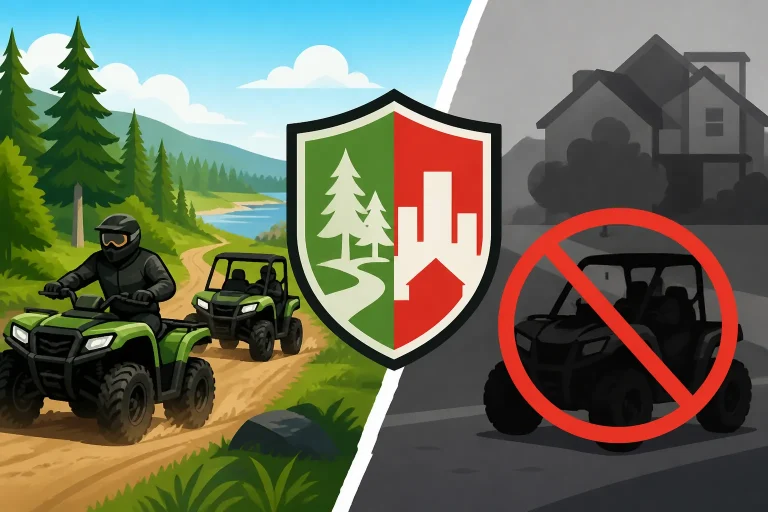
A recognized permit generally relates to access to participating trails, not a free pass to ride anywhere in another province. It does not give permission to cross private land outside an authorized trail, ride on a closed route, use a road that prohibits ATVs, or ignore local trail signs. A marked route can pass near land that is not part of the trail, so staying on the designated route matters.
This distinction can feel frustrating when a map shows a continuous line or a trail marker seems to point toward an obvious shortcut. A line on a downloaded map is not necessarily proof that the route is currently open or that your permit covers it. Use current club maps and closures, follow posted directions, and turn around when the trail is clearly marked closed.
Reciprocity also does not guarantee that every service or privilege associated with your home permit transfers. A local club membership, access to a staging area, event entry, or special use permission may be separate from basic trail access. If your itinerary includes a club event or a non-standard route, ask the organizer directly rather than relying on a general reciprocity statement.
Permit reciprocity does not replace legal documents
Your Ontario trail permit and your vehicle registration serve different purposes. The permit is for access to covered trails; registration identifies the machine under the applicable vehicle rules. Before travelling, check that your registration and plate are valid for the use you plan to make of the ATV or UTV, and that you can present any required documents when asked.
Insurance deserves the same attention. A trail permit does not itself prove that your policy covers riding outside Ontario. Contact your insurer and ask specifically about recreational use in each province on your itinerary, including whether the policy applies to organized trails and any road portions you may use. Keep the insurer’s contact details available in case you need to clarify coverage while away.
Carry your permit proof, registration information, and insurance documents in a way that keeps them readable and accessible. A phone can be useful for storing copies, but do not assume a digital image will satisfy every local requirement. If the permit program provides a sticker or other physical identifier, display it as directed and bring any supporting documentation that explains what you purchased.
| Item | What it generally relates to | What to check before a Maritime ride |
|---|---|---|
| Ontario trail permit | Access to participating trails under a reciprocity arrangement | Whether the specific network and permit type are covered |
| Vehicle registration | Legal identification and registration of the machine | Whether your documents and plate meet the province’s requirements |
| Insurance | Liability or other coverage under your policy | Whether coverage applies in each province and on the planned routes |
| Local club rules | Trail access conditions, closures, and route requirements | Whether a local pass, membership, or permission is also needed |
| Road-use requirements | Riding on roads or crossing them where permitted | Local rules for licences, equipment, speed, and approved roads |
How to confirm that your permit will be accepted
Check the permit type, not just the province name
“Ontario permit” can sound like one universal product, but Ontario has different trail systems and permit arrangements. A permit associated with one network may not cover a separately operated trail system. Before you plan around reciprocity, identify the actual permit printed on your confirmation or displayed on your machine, then compare it with the destination network’s acceptance rules.
This matters particularly if your Ontario riding usually takes place in a region with its own pass structure. A rider who buys a permit for one trail network should not assume it also covers another Ontario organization, let alone a separate province. For example, an itinerary involving Eastern Ontario or Haliburton may require its own local checks before you even reach the Maritimes. The related guides Ontario’s Separate Club Passes and [The Eastern Ontario Trails Alliance Pass] explain why a single province can have distinct trail-access arrangements.
Look at the permit’s terms and the destination organization’s reciprocity information together. Confirm whether the arrangement applies to an annual permit, a day permit, or another permit category. If the wording is unclear, send the organization a short, specific question: “I hold this named Ontario permit and plan to ride these trails on these dates. Is it accepted, and do I need anything else?” A precise question is more useful than asking generally whether Ontario permits are honoured.
Confirm with the trail organization you will actually use
Once you have identified the relevant network, check the organization that manages or maintains the trails you intend to ride. Provincial-level information can establish the broad reciprocity arrangement, while a local club can tell you whether a particular route is open, whether a special access condition applies, or whether the trail has changed since a map was produced.
It is sensible to verify the route close to departure, especially after heavy rain, seasonal closures, logging activity, or maintenance work. A permit may be accepted in principle while the specific trail you planned to ride is closed. Keep a backup route in mind, and do not treat an old social media post or a saved map as confirmation that access is still available.
Save useful details in more than one place. Keep the permit receipt or confirmation, the destination organization’s contact information, a map of your planned route, and any relevant closure notices on your phone. If reception is unreliable, download maps and instructions before leaving town. For a wider look at permit categories and how they work, read Ontario ATV Trail Permits Explained.
Planning an Ontario-to-Maritimes ATV trip
Decide whether you will ride across provinces or trailer between them
Some riders imagine following trails from Ontario all the way to the Maritimes. In practice, a trail-permit arrangement does not create a continuous cross-country trail corridor. You may need to trailer the machine for substantial portions of the journey, use approved roads where lawful, or transport the ATV between separate trail destinations. Plan your travel route and your riding route as two related but different things.
If your route passes through Quebec, do not assume Ontario reciprocity with the Maritimes covers riding there. Agreements and local access requirements can differ between provinces, and a permit recognized in New Brunswick, Prince Edward Island, or Nova Scotia does not automatically authorize Quebec trail use. Riders who plan to ride in Quebec should check that province’s current permit requirements separately; those who only transport their machine through Quebec should confirm the rules for the trailer and towing vehicle.
Build the trip around confirmed riding areas rather than drawing a long line on a map and expecting every segment to be rideable. A practical itinerary might include trail days in a participating New Brunswick network, a travel day by road or trailer, and a separate riding area on Prince Edward Island or in Nova Scotia. This approach makes it easier to confirm access, fuel, accommodation, staging, and weather contingencies for each stop.
Match your route to your machine and riding group
A route that works for a narrow ATV may not be suitable for every UTV. Check trail-width restrictions, bridge limitations, seasonal conditions, and any vehicle-class rules before committing to a route. A large side-by-side, especially one with accessories that add width, may be restricted from trails that appear suitable on a general map. Measure the machine as it will actually be ridden, including mirrors or other permanent additions where relevant.
Think about the group’s experience and the time available. A route that looks manageable on a map can become a demanding day when it includes unfamiliar trail markings, slower technical sections, stops for navigation, or weather that changes the surface. For a mixed group, plan a realistic turnaround point and avoid making the final fuel stop or accommodation arrival depend on perfect trail conditions.
Also check whether every rider understands the permit and vehicle requirements. If one person is bringing a second machine, borrowed ATV, or UTV, confirm that the permit applies to that machine and that the documents are in order. Do not assume a permit attached to one vehicle automatically covers another. The practical details in Ontario Trail Permit for a Second Machine can help clarify why machine-specific permit rules need attention.
The rules that still apply once you arrive
Learn the local rules for trails and roads
Trail reciprocity does not make provincial laws identical. Rules for operating an ATV or UTV, including age, licence, helmet, passenger, lighting, and insurance requirements, can depend on where and how you ride. A machine that is permitted on a trail may not be permitted on a nearby road, and a road connection shown on a map is not necessarily open to off-road vehicles.
Before the trip, check the rules in each province and in any municipality where your route uses a road. Pay particular attention to road crossings, public-road travel, and connections between trail sections. If the route requires a road segment, confirm that the road is open to your vehicle type and that the rider has the required licence and equipment. When you cannot establish that a road is legal for your machine, do not use it as a convenient shortcut.
Passengers need careful planning too. A two-up ATV and a side-by-side may be subject to different requirements, and seating capacity is not the same thing as permission to carry any passenger under any circumstances. Make sure each passenger has an appropriate seat and protective gear, and check the destination rules rather than relying on what is allowed at home.
Respect club closures and landowner conditions
Many organized trails depend on landowner permission and volunteer maintenance. That means a route can be closed temporarily to protect soft ground, accommodate work, or respect a land-use agreement. Riding around a gate, creating a bypass, or continuing past a closure sign can jeopardize access for other riders, even if your permit is valid and the trail was open when you first checked.
Local trail markings also deserve attention. A marked route may have a junction, detour, or warning that is unfamiliar to an Ontario rider. Stop when directions are unclear instead of following another vehicle through a questionable turn. If trail markers and your map appear to conflict, contact the local club or choose a route you can confirm.
Good trail etiquette is especially important when riding in a new region. Keep speeds appropriate, give other trail users room, avoid spinning tires on soft sections, and leave gates and access points as you found them. If you encounter a landowner or local volunteer, a calm, respectful conversation is more helpful than arguing from the assumption that your permit guarantees access to every nearby track.
A practical pre-trip checklist
Prepare documents and permit proof
Start by confirming the exact name and type of your Ontario trail permit, then check acceptance with the relevant destination network. Save the confirmation and any conditions that apply. If your permit uses a sticker, attach it as instructed and make sure it is visible, secure, and not hidden behind mud or accessories.
Gather your vehicle registration, insurance information, and any other documents required for the way you intend to ride. Verify that the information matches the machine you are taking. If the ATV or UTV is borrowed, rented, or registered to someone else, make sure you have permission to use it and know what documentation the owner expects you to carry.
Prepare offline access to maps and contact details. Cell service can be limited away from towns, and a permit question that is easy to resolve at home can be harder to answer on a trailhead parking lot. Save the relevant trail map, local rules, closure notices, accommodation details, and emergency contacts before leaving. Keep a paper copy of key information if your group is travelling in an area where devices may lose power.
Confirm practical details for each riding day
Make a short plan for each day rather than treating the entire trip as one ride. Note the trailhead, expected route, fuel options, likely turnaround time, and the next place where the group can safely stop. Share the plan with someone who is not riding with you, particularly if you will be travelling in a remote area.
Check the machine before departure and again at the start of each riding day. Confirm that tires, brakes, lights, belts, and basic recovery equipment are in suitable condition. Pack tools and supplies appropriate to your machine and route, but avoid overloading a vehicle or blocking required safety equipment. A breakdown far from a road can turn a pleasant outing into a difficult recovery.
Discuss a simple group plan before setting off. Decide who leads, who rides last, what to do if someone loses sight of the group, and where to stop if conditions worsen. A rider who is new to the area may need more time for navigation, and a UTV group may travel at a different pace from smaller ATVs. Building in that flexibility reduces the temptation to rush when the trail gets rough or the day runs late.
Common misconceptions and avoidable mistakes
Assuming one permit covers every trail
One of the most common misunderstandings is treating reciprocity as province-wide, all-access permission. In reality, acceptance is tied to the arrangements and networks involved. A permit can be recognized on a participating trail system while a separate club, private destination, or special-use area still requires different permission.
The same mistake happens within Ontario. Riders sometimes assume a permit they use regularly covers every nearby trail, then discover that a separate organization operates the next section. The safest habit is to identify each trail network in the itinerary and check its rules individually. If a route crosses from one club area to another, confirm that both are covered.
Another easy mistake is planning around a route that is technically shown but not currently open. Maps can be useful for orientation, but they are not a substitute for current trail notices. Before riding, check for seasonal restrictions, maintenance, landowner closures, and detours. If access information is uncertain, choose a confirmed alternative rather than risking a trespass or a costly recovery.
Assuming a trail permit covers insurance and registration
A valid trail permit can create a false sense that the machine is “all set.” It is only one part of trip preparation. It does not register the vehicle, insure it, authorize road use, or guarantee that the rider satisfies the laws of the province where they are travelling. Keep these categories separate when you check your documents.
Do not rely on a casual conversation or an old policy summary to answer whether insurance applies outside Ontario. Ask your insurer about the specific provinces and uses you have planned, and get clear on what proof you should carry. If you change the trip from trail riding to a road connection, ask whether that affects coverage or requires anything additional.
Finally, do not wait until the last fuel stop to find out that a permit sticker is missing, a document is unreadable, or the group has misunderstood the route rules. A quick review before loading the trailer can prevent a wasted drive and a frustrating first day. For questions about keeping permit documentation available while riding, see Carrying the Permit or a True Copy and Showing a Permit on a Phone.
Frequently asked questions about Maritime reciprocity
Can I use my Ontario permit in all three Maritime provinces?
An eligible Ontario trail permit may be recognized on participating trail networks in New Brunswick, Prince Edward Island, and Nova Scotia. That does not mean every route, club trail, private riding area, or event is automatically included. Verify the specific permit and destination network before travelling.
If you are visiting only one province, check its trail organization and the local club responsible for the route. If you are visiting more than one, repeat the check for each province and each distinct network. Do not assume that confirmation from one club answers the question for another.
Do I need to buy a local permit anyway?
Possibly. You may need a local pass or permission if the place you want to ride is outside the reciprocity arrangement, is operated separately, or has a special access rule. A local permit may also be required for an event or a particular destination even when an Ontario permit is otherwise accepted on participating trails.
Ask the organization directly whether your Ontario permit is sufficient for the exact dates and routes you have in mind. If you need a local permit, check whether it covers a machine, a rider, or a particular period, and whether it needs to be displayed. Do not purchase based only on an assumption that “all trails” use the same system.
Does reciprocity let me ride through Quebec on the way east?
No. Recognition in the Maritimes does not establish permission to ride in Quebec. If your plan includes riding trails there, check Quebec’s permit and access requirements separately. If you are only transporting the ATV or UTV through Quebec, distinguish that travel from riding and make sure your towing setup and route are lawful.
A common practical option is to trailer between confirmed riding areas rather than attempting to ride a continuous route through multiple provinces. That can involve extra planning, but it avoids relying on an imagined corridor where trail access, land permission, and permit recognition may not align.
Is my side-by-side covered in the same way as my ATV?
Do not assume that all permits and trails treat every ATV and UTV identically. Check whether the permit applies to the specific machine and whether the destination trails have requirements for vehicle width, weight, or type. A side-by-side that fits one trail system may be too wide for another route or subject to different operating rules.
When asking a club, identify your machine’s make and model and provide its actual width if you know it. Mention any accessories that change its dimensions. This gives the trail organization a better chance of answering your question accurately and helps you avoid discovering a restriction at the trail entrance.
What should I do if a trail sign conflicts with my map?
Follow the posted closure or warning and stop to confirm the route. A map may be outdated, a trail may have changed, or a local notice may describe a temporary closure that has not been reflected in your saved copy. Do not ride around a gate or create a new route to reconnect with the line on your screen.
Check the local club’s current updates or contact its representative when possible. If you cannot confirm that the trail is open, use an alternative route you know is permitted. Protecting access for future riders is more important than completing one planned loop.
Disclaimer
This article is for general informational purposes only and does not constitute professional advice. Laws, prices and regulations vary by location and change over time. Consult a qualified professional for guidance on your specific situation.