When a Municipal By-law Overrides Crown Land Free Use
A Crown land map can make a route look open, but that does not mean every road leading to it is open to ATVs or UTVs. Ontario’s free-use policy is not blanket permission to ride anywhere, and municipal rules can limit access on roads and other places under local control. The key is knowing which rule applies to each part of your route.
What Crown Land Free Use Actually Allows
Ontario’s Crown land free-use policy generally allows certain recreational activities on eligible public land without requiring a separate land-use permit. It is not a general ORV permit, a trail pass, or permission to cross any land that appears public on a map. Riders still have to follow land-use restrictions, closures, applicable provincial laws, and rules about access.
The phrase “free use” can be misleading. It describes a policy for using eligible Crown land; it does not automatically make every road, trail, shoreline, or connecting route available to motorized vehicles. Some Crown land areas have restrictions, and some activities require authorization. Read What Free Use Means on Crown Land and Crown Land Ontario Riders May Use before treating a mapped Crown parcel as an open riding area.
A useful way to think about a ride is to divide it into sections:
- The Crown land parcel: Is motorized use allowed there, and is the area open?
- The trail or access route: Is it an authorized route, or does it cross land with separate restrictions?
- The road to the land: Is it a municipal road, provincial highway, or private road, and are ORVs allowed on it?
- The trail system: Does it require a club or trail permit, even if the nearby land is Crown land?
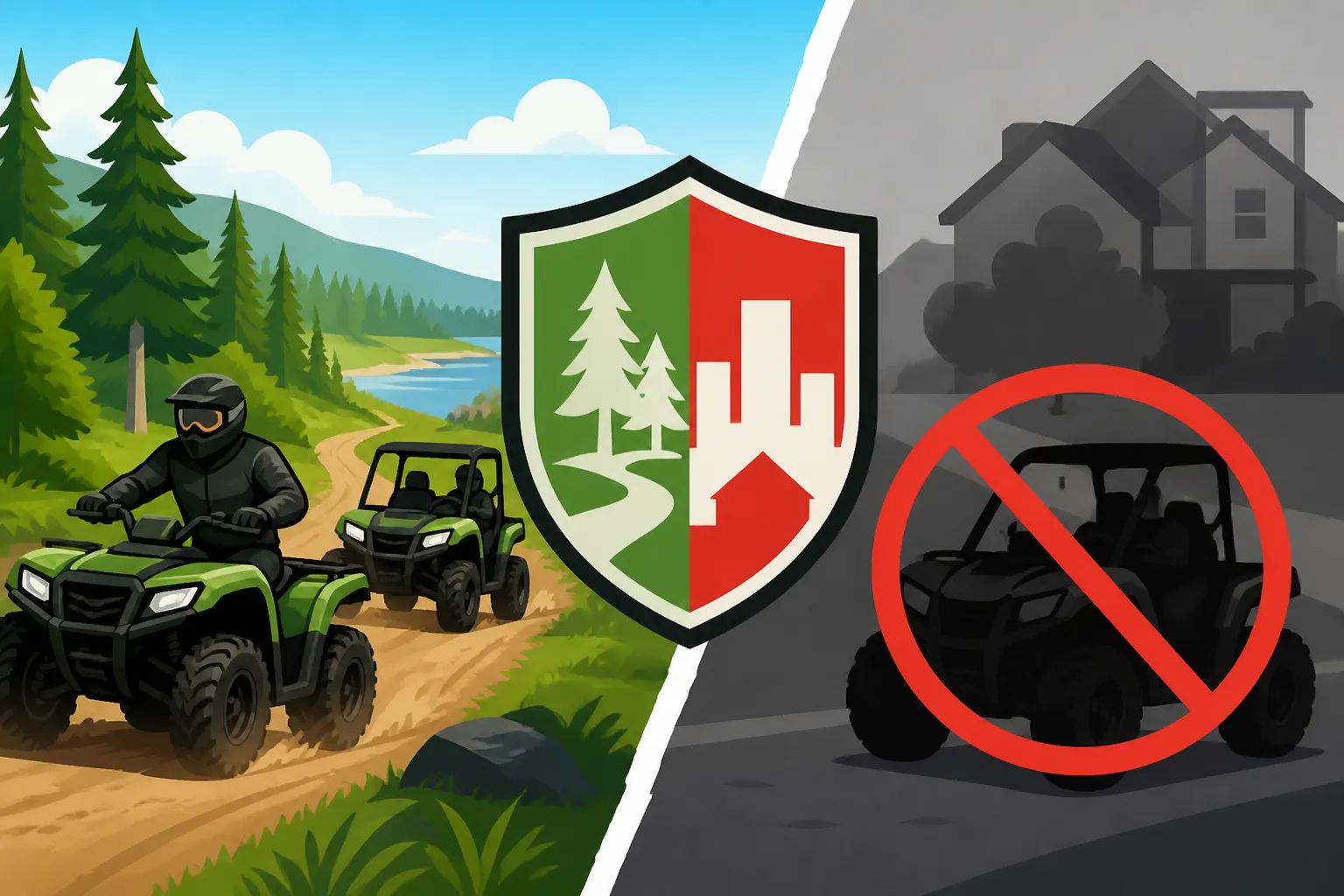
Each section can be governed by a different rule. A rider could be allowed to use an eligible part of Crown land but still be prohibited from riding the municipal road needed to reach it. Likewise, a municipal road may be open to ORVs while the Crown land at its end is closed or restricted.
A trail permit is another separate issue. It may be required to ride a club-maintained trail, but it does not grant permission to use every road or Crown land parcel along the route. Conversely, being allowed to ride on Crown land does not necessarily mean a club trail permit is unnecessary. Ontario ATV Trail Permits Explained covers the difference between a trail permit and other kinds of permission.
When a Municipal By-law Changes the Route
A municipal by-law does not automatically cancel Ontario’s Crown land free-use policy across all Crown land within a municipality. The province’s policy and local rules operate in different areas of authority. The practical effect is that a by-law can restrict riding on a municipal road or another place the municipality regulates, even when that road is the route a rider hoped to use to reach Crown land.
That is the most common situation behind the question of whether a local by-law “overrides” free use. It may not take away the general ability to use eligible Crown land, but it can make a particular route inaccessible by ATV or UTV. If the only approach crosses a road where ORV use is prohibited, free use of the destination does not make the road legal.
Municipal rules can also define where and when an ORV may be used on roads that are open to it. A by-law may identify specific roads, limit hours, or set other conditions. Do not assume that an open road in one township remains open after crossing into the next municipality. See How an Ontario Municipality Opens a Road and Checking a Township’s ORV By-law for a closer look at how local road access is established and verified.
The distinction is important:
| Situation | What to check |
|---|---|
| Riding on eligible Crown land | Provincial land-use restrictions, closures, signs, and any required authorization |
| Riding on a municipal road to reach Crown land | The municipality’s ORV by-law and road list |
| Riding on a club trail | Trail status, club rules, and the required trail permit |
| Crossing private land | The owner’s permission and any applicable access restrictions |
| Riding near a park or conservation area | The rules for that protected area and adjoining land |
A route can also pass through more than one authority’s territory. A municipality may open some roads to ORVs but not others. Provincial highways have their own rules, and a local by-law does not make a closed provincial highway available for riding. For road-specific requirements, see Ontario ATV Rules on a Municipal Road.
How to Check a Route Before You Ride
Do not rely on a single map layer or a trail line shown in an app. Maps can help with planning, but they may not show current closures, local road restrictions, land access limits, or seasonal conditions. Check the source responsible for each part of your route.
- Identify the land and route. Mark the Crown land destination, the access trail, and every road you need to travel. Note where the route crosses a municipal boundary or approaches a park, conservation area, private property, or other restricted area.
- Check provincial land information. Confirm that the land is Crown land and look for restrictions, notices, closures, or requirements that affect motorized use. Where Crown Land Riding Is Restricted explains why public ownership alone does not guarantee access.
- Check each municipality’s current by-law. Look for the official by-law and any schedule or map listing roads where ORVs are permitted. Confirm that the specific road is included, rather than assuming that a general statement about the township applies everywhere.
- Confirm the trail’s status. If the route uses a club trail, check with the relevant club or trail operator. A trail can be closed even when surrounding Crown land is open, and a provincial land-use permission does not replace a required trail pass.
- Look for signs and temporary closures. On the day of the ride, obey posted restrictions and closures. Conditions or access can change after you have planned the route.
- Plan a legal alternative. If a road or access route is closed to ORVs, do not ride it just to reach land where riding is otherwise allowed. Choose another lawful route or a different riding area.
If the municipal by-law is unclear, ask the municipality to confirm whether the specific road is open to the class of ORV you plan to use. Provide the road name and the relevant section of your route. If the uncertainty concerns Crown land, check with the provincial land-management authority responsible for the area. A verbal guess from someone familiar with the area is not a substitute for confirming the applicable rule.
For road riding, land access is only one part of the checklist. The machine and rider must also meet the rules that apply to that road, including requirements for registration, insurance, equipment, licence, and speed. Ontario ATV Rules for Riding Crown Land and Riding an ATV on Ontario Roads address those separate responsibilities.
Why “The Land Is Public” Is Not Enough
The most common mistake is treating ownership as the only question. Public ownership does not mean every public road is open to ORVs, and free use does not mean every form of access is allowed. A Crown land parcel can be subject to restrictions, while a road beside it can be controlled by a municipality or another authority.
A second mistake is treating a trail on a map as proof of permission. It could be a hiking route, an inactive trail, a route across private land, or a trail subject to a separate permit. Even a route that has been used by riders in the past may have changed status. Check current rules rather than relying on customary use.
A third mistake is assuming a permit solves access questions. A permit may satisfy a trail operator’s requirement, but it does not override a municipal road restriction or a Crown land closure. The reverse is also true: permission to ride eligible Crown land does not grant access to a club trail that requires a pass.
Before setting out, use the strictest rule that applies to each part of the route. If you cannot confirm that a road or trail is open, do not treat uncertainty as permission. A short call or a route change is preferable to discovering at a gate or roadside stop that the link to your destination was not legal.
Disclaimer
This article is for general informational purposes only and does not constitute professional advice. Laws, prices and regulations vary by location and change over time. Consult a qualified professional for guidance on your specific situation.