Ontario ATV Camping Along the Trail
Planning an ATV camping trip in Ontario can get confusing fast: a trail permit does not automatically give you permission to camp beside a trail, and a line on a map is not proof that a campsite is open. This guide explains how to choose a legal overnight base, connect it with your ride, and avoid common problems with access, fires, supplies, and trail closures.
Choose a legal place to camp before planning the route
Understand what trail access does and does not allow
A marked ATV trail is a route for riding, not a promise that you can camp along it. Trails may cross private property, Crown land, municipal land, or land managed by a club or other organization. Permission to ride a section does not necessarily include permission to pull off, pitch a tent, park overnight, or build a fire.
That distinction matters when a tempting clearing appears beside the trail. It may look remote and unused, but it could be private land, a managed trail corridor, a sensitive wetland, or an area closed to overnight use. Stop and verify who manages the land before setting up camp. If it is private property, get clear permission from the landowner rather than assuming that a trail permit covers the stop.
An OFATV or club trail permit also serves a different purpose from permission to camp. Review [Ontario ATV Trail Permits Explained](Ontario ATV Trail Permits Explained) and check the rules for the specific club area you plan to ride. If your route crosses different trail systems, confirm that your permit applies to each one. A route can be open for riding while nearby land remains off-limits for camping.
Compare the main overnight options
For many riders, the simplest plan is to sleep at an established campground, lodge, or private campsite and ride from a nearby staging point. That gives you a known place to park, access to facilities, and a person to contact if you arrive late or weather changes your plans. Before booking, ask whether ATV parking is allowed, whether trailers can stay on site, and whether there is a legal route from the property to the trail.
Crown land camping may be an option in some places, but the rules and restrictions depend on the location and circumstances. Do not assume all Crown land is available, or that a place you can camp is also a place you can ride. Read [Ontario Crown Land Camping for Riders](Ontario Crown Land Camping for Riders) and [Where Crown Land Riding Is Restricted](Where Crown Land Riding Is Restricted), then confirm local conditions and restrictions before leaving home.
| Overnight option | Why riders choose it | What to confirm before you go |
|---|---|---|
| Private campground | Facilities, designated sites, and a clear place to return to | ATV access, trailer parking, quiet hours, and booking rules |
| Lodge or trail-town accommodation | Convenient base for multi-day rides and supplies | Whether machines can be parked securely and where the trail can be joined legally |
| Designated Crown land campsite | A more remote experience where camping is permitted | Land status, current restrictions, fire rules, access route, and waste plan |
| Unplanned roadside or trail-side spot | It may look convenient after a long ride | Do not use unless you have verified land status and permission |
A campground that appears close on a road map can still be awkward to reach by ATV. The connecting route may use a road where ORVs are not permitted, cross private land, or require trail access that is not included in your pass. Call the campground or land manager and describe your intended route instead of relying only on distance.
For background on where riding is allowed, see [Crown Land Ontario Riders May Use](Crown Land Ontario Riders May Use). It is a useful starting point, not a substitute for checking the particular parcel, trail, and local rules you plan to use.
Match your campsite to the trail system
Pick a base that makes the ride manageable
Ontario’s trail regions can be spread out, and a campsite that looks central on a small map may leave you with a long ride to fuel, food, or the next trail connection. Choose a base according to the kind of trip you want: a short weekend loop, a multi-day ride between communities, or a remote outing where you carry most of what you need.
Haliburton, Bancroft, Mattawa, and parts of Algoma are examples of areas riders may explore when planning trail-based trips. Each has a different mix of trail connections, services, terrain, and accommodation choices. Do not assume every campground in a popular riding region sits on an open ATV route. Ask the local club or accommodation provider which staging areas and connections are currently suitable for your machine.
A trail town can make a trip more forgiving. If a tire problem, heavy rain, or a tired rider changes the plan, nearby lodging, repair help, fuel, and food can matter more than an especially remote campsite. Use [Ontario Trail Towns Worth a Weekend](Ontario Trail Towns Worth a Weekend) to think about the broader trip, then check what services are available along your chosen route.
Check maps, closures, and land boundaries
Look at your route as a set of separate questions: Is the trail open? Is your machine allowed? Does your permit cover that trail system? Is the proposed campsite legal? And can you travel between the two without using a prohibited road or crossing land without permission? Answering each question separately helps avoid the common mistake of treating a route shown on one map as complete authorization.
Club maps, municipal information, campground directions, and land-management notices may not show the same details. Check [Ontario Trail Closures to Check First](Ontario Trail Closures to Check First) and [Ontario Trail Conditions Before You Ride](Ontario Trail Conditions Before You Ride) close to departure. Spring thaw, heavy rain, logging activity, maintenance work, or a temporary land-access issue can change what is practical.
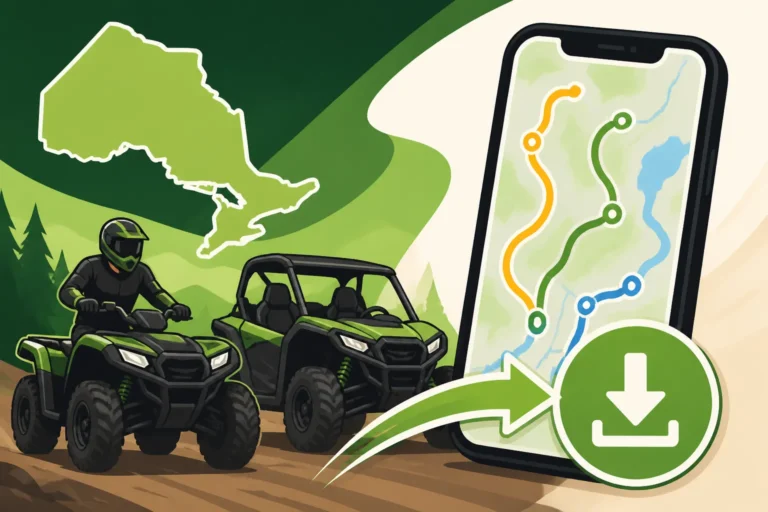
A mapping app such as onX Offroad can help you review a route and save map information for areas where mobile service is unreliable. Treat it as a planning aid, not as proof that a trail is open or that camping is allowed. Verify the route with the relevant trail club or land manager, and keep a separate offline copy of essential directions. If a boundary or access point is unclear, turn around and ask rather than testing it by riding in.
Prepare for an overnight ride, not just a day trip
Plan fuel, food, water, and communications
Camping changes how much you need to carry and how far you can reasonably ride. A machine loaded with camping gear may handle differently, consume fuel differently, or be less comfortable on rough terrain. Keep weight secure and balanced, and avoid stacking gear where it blocks lights, controls, mirrors, or your view of the trail.
Plan fuel stops before setting out, especially in northern or less-populated areas. A gas station that is easy to reach by road may not be accessible from your trail, and its hours may not match your riding schedule. Bring enough water and food to cover delays, not only the expected ride time. If your group is delayed by a breakdown or a closed crossing, those extra supplies can turn a stressful situation into a manageable one.
Cell service can be inconsistent away from communities. Download maps or save route details before you leave, agree on meeting points, and tell someone who is not riding with you where you expect to be and when you plan to check in. onX Offroad may help with offline route reference where its map coverage supports your trip, but do not rely on a phone as your only navigation or emergency plan. A charged power bank, a paper map, and a satellite communication device may be worth considering for remote routes.
Leave room for weather and mechanical problems
A planned loop should have a shorter alternative. Rain can make a route slower, a small repair can take longer than expected, and a rider who felt fine at breakfast may be ready to stop well before the campsite. Set a turnaround time and make sure everyone in the group knows that reaching camp safely is more important than completing every kilometre on the map.
Pack basic tools suited to your machines, a tire-repair kit, first-aid supplies, warm and waterproof layers, and a way to keep sleeping gear dry. Keep essential items accessible rather than buried under everything else. If a machine becomes unreliable, avoid pushing it farther from help just because the campsite is close on the map.
Before the trip, inspect tires, lights, brakes, fluids, and tie-downs. Confirm that registration and insurance are in order and that each rider knows what documents they need to carry. For a broader preparation checklist, see [Ontario ATV Rules for Riding Crown Land](Ontario ATV Rules for Riding Crown Land) and review your route with the applicable club. Rules for a trail, road, or land parcel can differ, so a quick check is better than relying on what worked on another trip.
Camp responsibly and protect your access to ride
Follow fire, waste, and wildlife precautions
Fire rules are not one-size-fits-all. Restrictions may depend on the location, conditions, or current notices from the land manager. Before lighting a fire, check whether fires are permitted, use only an approved area when one is provided, and make sure the fire is fully out before leaving. If conditions are dry or restrictions are in force, choose a no-fire meal plan rather than improvising.
Pack out everything you bring in, including food scraps and packaging. Do not leave waste beside a trail, bury rubbish, or assume that someone else will clean the site. Use toilets where provided; where facilities are absent, follow the land manager’s guidance for human waste and keep it well away from water, campsites, and trails.
Store food and scented items securely, particularly in areas where wildlife is present. Never feed animals, and do not leave food or rubbish where it can attract them to camp. Keep the campsite compact and avoid damaging vegetation or creating new tracks. Those small habits help keep a site usable for other visitors and reduce friction with landowners and local communities.
Ask permission and respect quiet hours
If you are camping on private land, get permission before the trip and be specific about what you are asking to do. Confirm where you may park, whether you can ride to or from the property, how many people are coming, and whether a fire is allowed. A friendly conversation can prevent an uncomfortable arrival after dark, when there may be no easy way to find another place to stay.
Be considerate at camp and on the way in. Keep noise down, observe posted quiet hours, and avoid unnecessary idling or revving near cabins and homes. On a group trip, agree that the last rider will not be left alone, and that the group will stop if a machine or rider needs help. Respecting people who live near trails is part of keeping access relationships healthy.
For a final route check, use a practical checklist:
- Confirm that the trail is open and appropriate for your machine.
- Verify that your permit or club pass covers each trail system on the route.
- Confirm that the campsite is legal and that you have permission where needed.
- Check road connections, parking, trailer storage, and campground rules.
- Review current trail conditions, closures, fire restrictions, and weather.
- Save maps and key contacts offline, and tell someone your itinerary.
- Pack for delays and leave the site clean when you depart.
Using onX Offroad alongside club and land-manager information can make it easier to keep your route organized, especially when you are comparing trail connections with possible overnight stops. Still, the most reliable camping plan is one that has been confirmed directly with the people responsible for the trail or campsite. A little checking before you leave is much easier than discovering at dusk that the last convenient-looking clearing is not yours to use.
Disclaimer
This article is for general informational purposes only and does not constitute professional advice. Laws, prices and regulations vary by location and change over time. Consult a qualified professional for guidance on your specific situation.