Ontario ATV Trail Opening Dates
Ontario ATV trail opening dates are not set by one province-wide calendar, so a trail shown as open on a map may still be closed after a wet spring or for local maintenance. This guide explains when Ontario riding areas typically reopen, why dates vary, and how to check the club or land manager’s latest status before loading your ATV or UTV.
How Ontario ATV trail opening dates work
There is no single opening day for every trail
Ontario’s trail network is managed by different clubs, landowners, municipalities, and public agencies. Each area can set its own schedule, so a date that applies around one trail system may not apply to another. Even trails close to one another can have different rules or reopening plans.
Many organized trail systems aim to reopen in spring, and some clubs commonly target May 1. Treat that as a planning reference, not a province-wide guarantee. Opening can be delayed if trails are saturated, damaged, or unsafe to maintain. Some areas also have separate restrictions for particular routes, forests, or connecting links.
If you are planning a trip, start with the specific riding area rather than searching only for “Ontario ATV trail opening date.” For example, check the relevant club’s trail-status notices for HATVA, EOTA, or the Ganaraska Forest, depending on where you intend to ride. The broader guide [Ontario ATV Trail Opening Dates] can help frame the seasonal question, but the local operator’s notice is what matters for a particular ride.
Opening dates can change with spring conditions
A posted opening date is often a target that depends on conditions. During spring thaw, snowmelt and rain can leave a trail soft enough for tires to dig deep ruts. Those ruts can channel water, widen over time, and make later repairs harder. Closing temporarily can protect the route and reduce the amount of work volunteers need to do before the main riding season.
The timing can differ even within one area. A well-drained gravel section may be ready before a low-lying trail, a wetland crossing, or a shaded stretch where snow and ice linger. A trail network may open in stages, or a club may keep certain sections closed while repairs are completed.
That is why last year’s opening date is useful only as a rough clue. Before departure, check for notices about spring closures, temporary detours, and trail damage. The guide [Ontario Riding After Spring Thaw] explains why a trail can look rideable while still being vulnerable to damage.
What affects the date a trail reopens
Thaw, rain, and trail surface
The condition of the ground matters as much as the calendar. Clay-heavy soil can remain soft after the surface appears dry, while a sandy or gravelly route may drain more quickly. Low sections, creek crossings, and areas with poor drainage often need extra time. A few days of rain can also change conditions quickly, especially early in the season.
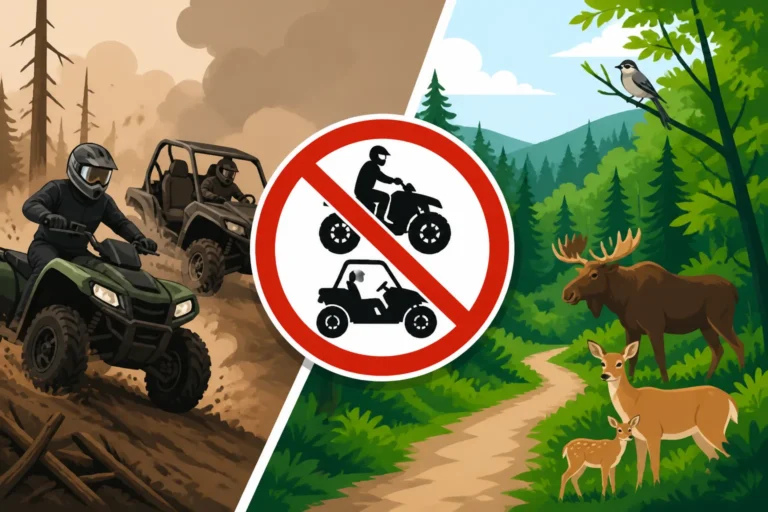
Riding a soft trail can leave deep tire marks that collect water and make the route rougher for everyone. It can also push riders toward the edges, widening the trail and disturbing vegetation. If a club closes an area after a wet spell, that closure is not an invitation to find another entrance or go around a barrier. Use a route that is clearly open and authorized.
Check the forecast and trail notices close to your ride date, not just when you begin planning. A map app such as onX Offroad can help with route planning and orientation, but it should not replace current information from the club or land manager. A mapped trail line does not necessarily mean that the route is open, passable, or permitted for motorized use.
Maintenance, events, and local restrictions
Spring maintenance can include clearing fallen branches, repairing signs, inspecting bridges, and addressing washouts. A section may remain closed while volunteers or land managers complete that work. Closures can also happen later in the season for logging, construction, special events, or damage caused by weather.
Some riding areas have seasonal limits that do not match the opening calendar of a nearby club trail. The Ganaraska Forest, for example, has its own access rules and operating schedule. A club trail, a forest access road, and public land near the same community may each be governed differently. Confirm the rules for the exact place you plan to ride rather than assuming a nearby route has the same status.
The table below is a practical way to think about spring planning. These are common factors to check, not universal opening rules.
| What to check | Why it matters | Where to confirm |
|---|---|---|
| Official opening notice | The club may set a target date or announce a staged reopening | Trail club or land manager |
| Spring thaw and recent rain | Soft ground can lead to rutting or temporary closures | Local trail-status updates and weather |
| Specific route or segment | One section may be closed while others are open | Club map, alerts, or posted signs |
| Special restrictions | Forests, public lands, and municipal routes may have separate rules | Relevant agency or municipality |
| Permit and access requirements | An open trail may still require the correct permit | Trail operator or club |
For a wider seasonal picture, see [Ontario Trails Rest in Spring] and [Ontario Trail Conditions After Rain]. They help explain why a trail’s status can change even after the first announced opening.
How to check whether your Ontario trail is open
Start with the club or land manager
Use the official source for the area you intend to ride. Look for a trail-status page, recent social updates, a club bulletin, or a direct notice from the land manager. Pay attention to the date of the notice and whether it applies to the full network or only named sections. An old post saying “trails open” may not reflect a closure announced after heavy rain.
If the notice is unclear, contact the club before you travel. Ask which sections are open, whether access is limited to certain routes, and whether any connecting trails remain closed. This matters especially when a ride crosses between club areas, because one permit or local notice may not cover every section of the planned route. The guide [Ontario Trail Conditions Before You Ride] offers a useful checklist for checking conditions ahead of time.
Mapping tools can help you understand where a route goes, but treat them as secondary to official status updates. onX Offroad may be useful for reviewing a planned route and keeping orientation in unfamiliar areas; still, verify closures and permissions directly with the organization responsible for the trail. If a map and a posted closure disagree, follow the closure and seek clarification before riding.
Check access rules, not just the trail line
“Open” can mean different things depending on the location. A route may be physically passable but closed to motorized use, restricted to permit holders, or subject to specific seasonal conditions. Public land access rules can also differ from those on a club-managed trail. Do not assume that a trail line on a phone app is permission to ride it.
If your route connects to Crown land, check applicable access limits and any posted signs. Free-use policies do not override a closure, a municipal restriction, or a land manager’s specific direction. The related guides [Do You Need a Trail Permit on Ontario Crown Land?] and [Where Crown Land Riding Is Restricted] explain why the location and its restrictions matter.
A simple pre-ride check can prevent a long, frustrating drive to a closed staging area:
- Identify the club, forest, or land manager responsible for each part of your route.
- Check its latest trail-status notice and look for segment-specific closures.
- Confirm permits, access rules, and any seasonal limits.
- Check the weather and recent rain, especially during spring thaw.
- Recheck the notices before leaving, and obey signs or barriers at the trailhead.
Planning a ride around Ontario trail openings
Build flexibility into your first trip
For an early-season outing, choose a destination with more than one authorized route or a nearby alternative. That way, if a particular section is closed, you can adjust without trespassing or trying to ride around a barrier. Keep the day’s route modest until you know how the trails are holding up after winter and spring rain.
Tell your group that the plan may change. It is frustrating to arrive with a trailer full of machines and discover the route is closed, but pushing into a closed section can create damage and put your group at odds with the people maintaining the network. Have a backup activity or riding area that you have independently confirmed is open and accessible.
A navigation app such as onX Offroad can support route planning, especially when you are unfamiliar with the area. Save the route before heading out and make sure everyone knows the agreed plan. But use the club’s information for current access and closures; a digital map is a planning aid, not a substitute for permission.
Respect closures and changing conditions
A trail can close after it has opened. Heavy rain, a washout, logging work, or a safety concern may prompt a temporary restriction. If you encounter a closure sign or barrier, turn around and use an authorized alternative. Do not move a barrier, ride around it through the bush, or assume that an unmarked side route is acceptable.
The best approach is to keep checking official updates throughout the season, not only in May. Be particularly attentive after major storms and during periods of wet weather. If you see a damaged bridge, a blocked route, or unsafe conditions, report it to the responsible club or land manager rather than attempting a repair yourself.
For broader seasonal planning, [Ontario Riding Seasons and Club Closures] and [Ontario Trail Closures to Check First] are useful next reads. A little checking before you leave helps protect the trails, avoids unnecessary detours, and makes it easier to enjoy the ride once your chosen area is genuinely open.
Disclaimer
This article is for general informational purposes only and does not constitute professional advice. Laws, prices and regulations vary by location and change over time. Consult a qualified professional for guidance on your specific situation.