Do You Need a Trail Permit on Ontario Crown Land?
Planning a ride on Ontario Crown land and unsure whether you need to buy a trail permit? In many cases, recreational riding on eligible Crown land does not require a club trail pass. But “Crown land” is not a blanket permission to ride anywhere: closures, land-use rules, access routes and other riding requirements still matter.
The short answer: usually no trail pass, but check the land
Ontario’s public-lands free-use policy generally allows the public to use eligible Crown land for certain activities, including recreational riding, without buying an ATV trail permit. That differs from riding on a managed club trail, where a trail pass may be required even if part of the route crosses public land.
The distinction is about where you ride and who manages the trail, not just who owns the ground beneath it. A route can cross Crown land but still form part of a club trail system with its own permit conditions. Conversely, riding on eligible Crown land away from a managed trail may not require that trail pass.
This is the practical rule of thumb:
- Eligible Crown land, outside a managed trail system: a trail pass is generally not required just because you are riding there.
- A signed or mapped club trail: check the managing club’s permit requirements. You may need a pass even where the route crosses Crown land.
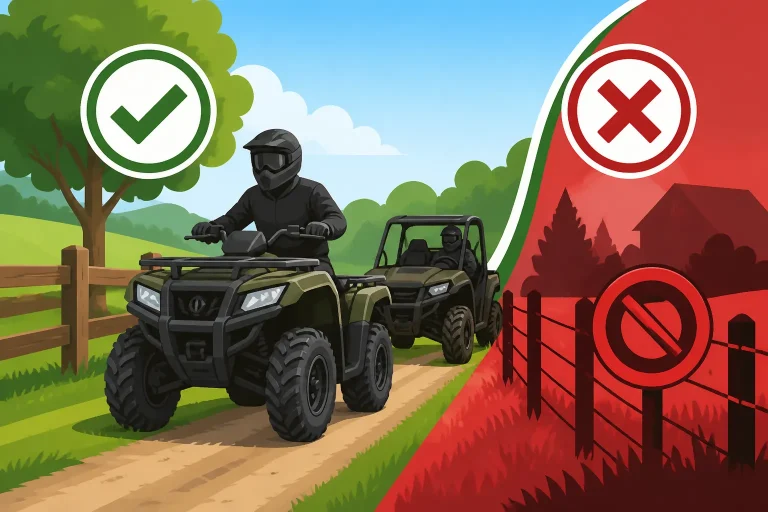
- Restricted land, closed routes or protected areas: riding may be prohibited or require separate permission, regardless of whether you have a trail pass.
The details of the free-use policy are covered in Ontario’s Public Lands Act Free Use Policy and What Free Use Means on Crown Land. Treat “free use” as a starting point, not as proof that every road, trail, shoreline or clearing is open.
A trail permit is also not the same as the vehicle’s registration or insurance. An ATV or UTV may still need the required registration, plate and insurance for the type of riding you plan to do. A trail pass, where needed, does not replace those obligations. See Ontario ATV Trail Permits Explained for how trail permits differ from other requirements.
| Where you plan to ride | Is a trail pass generally needed? | What else to check |
|---|---|---|
| Eligible Crown land away from a managed club trail | Usually no | Land status, closures, access and vehicle requirements |
| A club-managed trail crossing Crown land | Often yes; check the club’s rules | Permit coverage, trail conditions and permitted vehicle types |
| A local trail system with its own pass | The system’s pass may be required | Whether another permit is accepted or required as well |
| A provincial park, conservation area or restricted Crown parcel | Do not assume riding is allowed | The area’s specific rules and any required authorization |
| A road or route affected by municipal rules | A trail pass does not grant road access | Local bylaws and road-use requirements |
Why the Crown land label does not settle access
Crown land includes many different kinds of public land and can sit beside private property, protected areas and land managed for particular purposes. A map showing public land does not necessarily tell you whether a particular trail is open to motorized use, whether you can legally reach it, or whether a temporary closure is in effect.
For example, the land may be Crown land while the route is:
- Closed to motor vehicles by a sign, order or land-use restriction.
- Part of a club trail where the club requires a permit.
- Inside or beside a protected area with its own restrictions.
- A road or access route governed by different rules from the surrounding land.
- Accessible only by crossing private land, where permission may be needed.
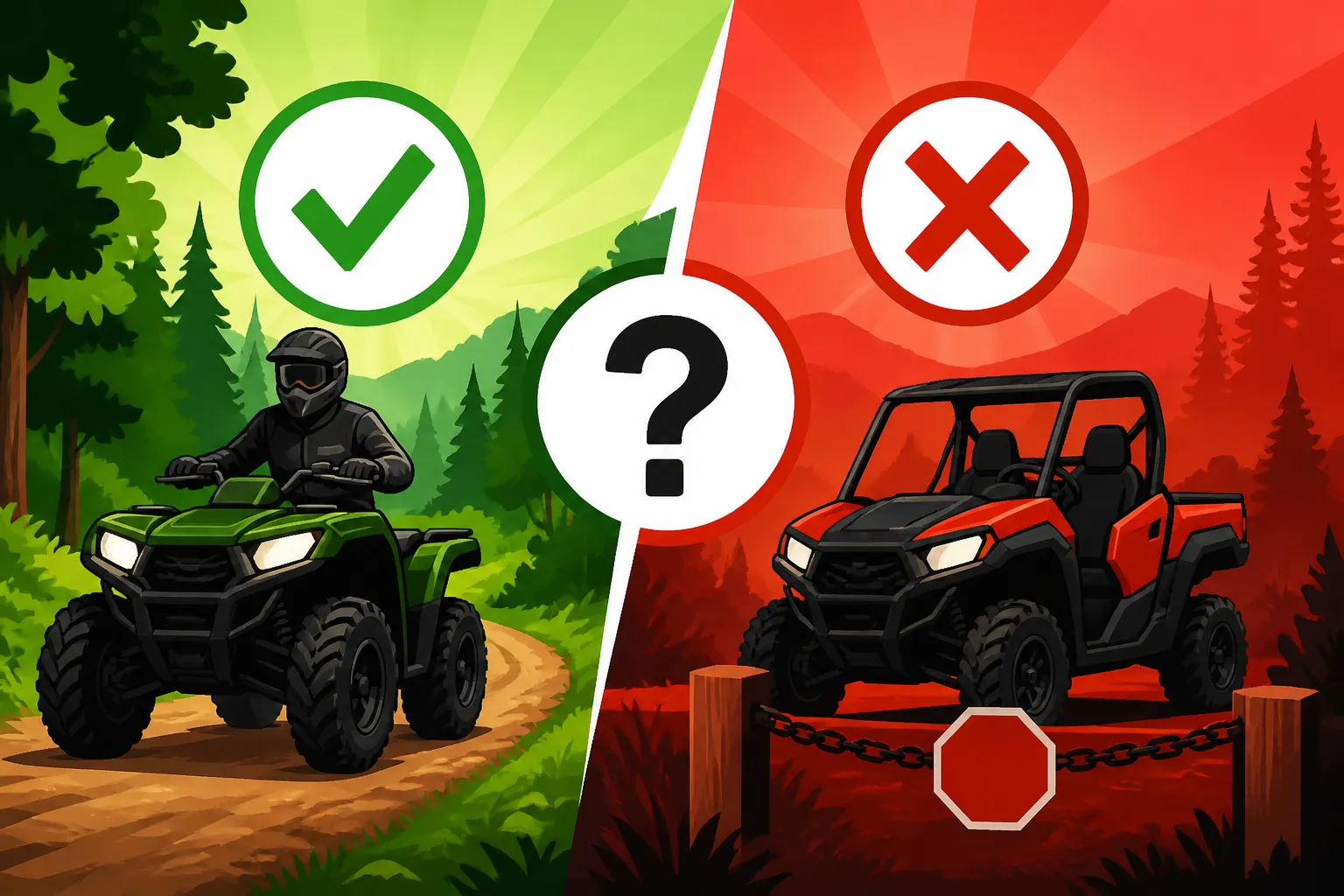
That is why the question is not simply “Is this Crown land?” It is also “Is motorized use allowed here, is this route open today, and can I reach it legally?”
Check the parcel and the route
Before setting out, identify the specific parcel and the route you intend to use. Use current mapping and local information to check whether the land is Crown land, privately owned or part of a protected area. Then look for applicable signs, trail closures and restrictions. If a route is unclear, ask the relevant land manager, local club or ministry office rather than assuming it is open.
A map can help you plan, but it may not show a new closure, seasonal restriction or local route condition. Confirm the status close to your ride, especially if the route crosses different land types or jurisdictions. Crown Land Ontario Riders May Use and Where Crown Land Riding Is Restricted address the difference between land that may be used and land where riding is limited.
Do not treat an unmarked track as an invitation. It may be a private driveway, a work road, a route that is closed to recreational vehicles or a connection across land where you do not have permission. Stay on established routes where riding is allowed, and turn back if a sign or barrier indicates a closure.
A club trail can cross Crown land
Club trail systems often connect roads, trails and other corridors to create a continuous riding route. The land underneath one section may be Crown land, but the trail still has a managing club and permit conditions. The permit supports access and trail operations; it is not a fee for owning or using every piece of Crown land.
Before riding, check the trail map and the club’s current permit information. Confirm that the pass you hold covers that trail system. A pass from one organization does not automatically cover every club trail in Ontario. Does Your Permit Cover the Next Club’s District? explains why checking the route’s coverage matters when a ride crosses between areas.
Some trail networks or sites have separate pass arrangements. Do not assume that a general trail permit covers a forest, park, club area or local route with its own access rules. If a pass is required, buy the one that applies to the place you intend to ride and follow the system’s conditions.
Other requirements still apply to your ATV or UTV
No trail-pass requirement does not mean no riding requirements. A trail permit is only one part of a legal and responsible ride. You may still need to meet registration, plate, insurance and equipment rules, and those rules can depend on where and how you operate the machine.
For example, riding a vehicle on a road is a separate question from riding it on Crown land. A Crown land route does not automatically authorize you to use a nearby municipal road, highway shoulder or road allowance. Check the local rules for any road connection, and do not assume a trail pass makes a closed road open.
Your registration and insurance responsibilities also remain in place. Review Ontario ATV Insurance Requirements and Insurance and Ontario ORV Registration if you are unsure what applies to your vehicle and riding plans. Carry the required documents and make sure the plate is visible and properly attached.
Special rules, closures and permissions
Some situations call for additional checks or authorization. Organized events, commercial activity or use of land for a purpose beyond ordinary recreational riding may involve separate requirements. If your ride involves an event, a group using a specific Crown parcel, or an activity that could affect land management, contact the responsible authority beforehand. When MNRF Approval Is Needed in Ontario covers circumstances where ministry approval may be relevant.
Also check for closures and temporary restrictions. A route can be closed to protect sensitive ground, manage a land-use conflict or address work and safety concerns. A past ride, an old map or a friend’s recollection is not a reliable substitute for checking current information.
Respect signs and barriers even when a trail appears passable. Do not ride around a gate or use a side track to bypass a closure. Avoid wetlands, soft ground and areas where your machine could damage the land or create ruts. If you cannot confirm that riding is permitted, choose a route with clear access rules instead.
Separate Crown land access from road access
A public-land free-use policy does not give you a right to ride on every road leading to that land. The approach route may be a municipal road with its own ATV bylaw, a private road or a route that does not allow motorized vehicles. Check the local rules for each road segment, including any restrictions on time, direction or vehicle class.
Likewise, a route may look like a road on a map but not be a public road open to your vehicle. Confirm its status before using it. If your ride requires a road connection, review Ontario ATV Rules on a Municipal Road and the local municipality’s current rules rather than relying on a trail map alone.
A practical checklist before riding
A few minutes of checking can prevent a long detour, an access dispute or a ticket. Use this process whenever you are planning a Crown land ride, especially in an unfamiliar area.
- Pin down the route. Mark your intended trail, access points and any road crossings. Avoid relying on a broad area name such as “the bush” or “Crown land nearby.”
- Confirm the land status. Check whether the route crosses Crown land, private property, a protected area or a combination of them.
- Look for riding restrictions. Check current closures, posted signs, barriers and land-use conditions. If the status is uncertain, contact the relevant authority or land manager.
- Identify who manages the trail. If it is a club trail or part of a managed network, check the club’s permit rules. Do not assume a pass is unnecessary just because the trail crosses public land.
- Check any separate pass. Some areas have their own access arrangements. Confirm whether the permit you have is accepted for the route, or whether another pass is required.
- Verify access to the trailhead. Make sure the roads and connecting routes you will use are open to your vehicle. Land access and road access are separate issues.
- Check your vehicle requirements. Confirm that registration, plate, insurance and any applicable equipment requirements are in order.
- Recheck shortly before the ride. Conditions and closures can change. A route that was open on a previous trip may not be open now.
If a club permit is not required for your route, that does not mean buying one is pointless. A permit may be useful when you want access to maintained club trails, marked routes or connected riding areas. The right choice depends on the ride you are planning, not on a general assumption that every Crown land trip either requires a pass or is entirely free of conditions.
When in doubt, choose a clearly permitted route. Respect local signs and land managers, stay on routes open to motorized use, and do not cross private land without permission. That approach is more reliable than treating “Crown land” as a universal pass.
Disclaimer
This article is for general informational purposes only and does not constitute professional advice. Laws, prices and regulations vary by location and change over time. Consult a qualified professional for guidance on your specific situation.