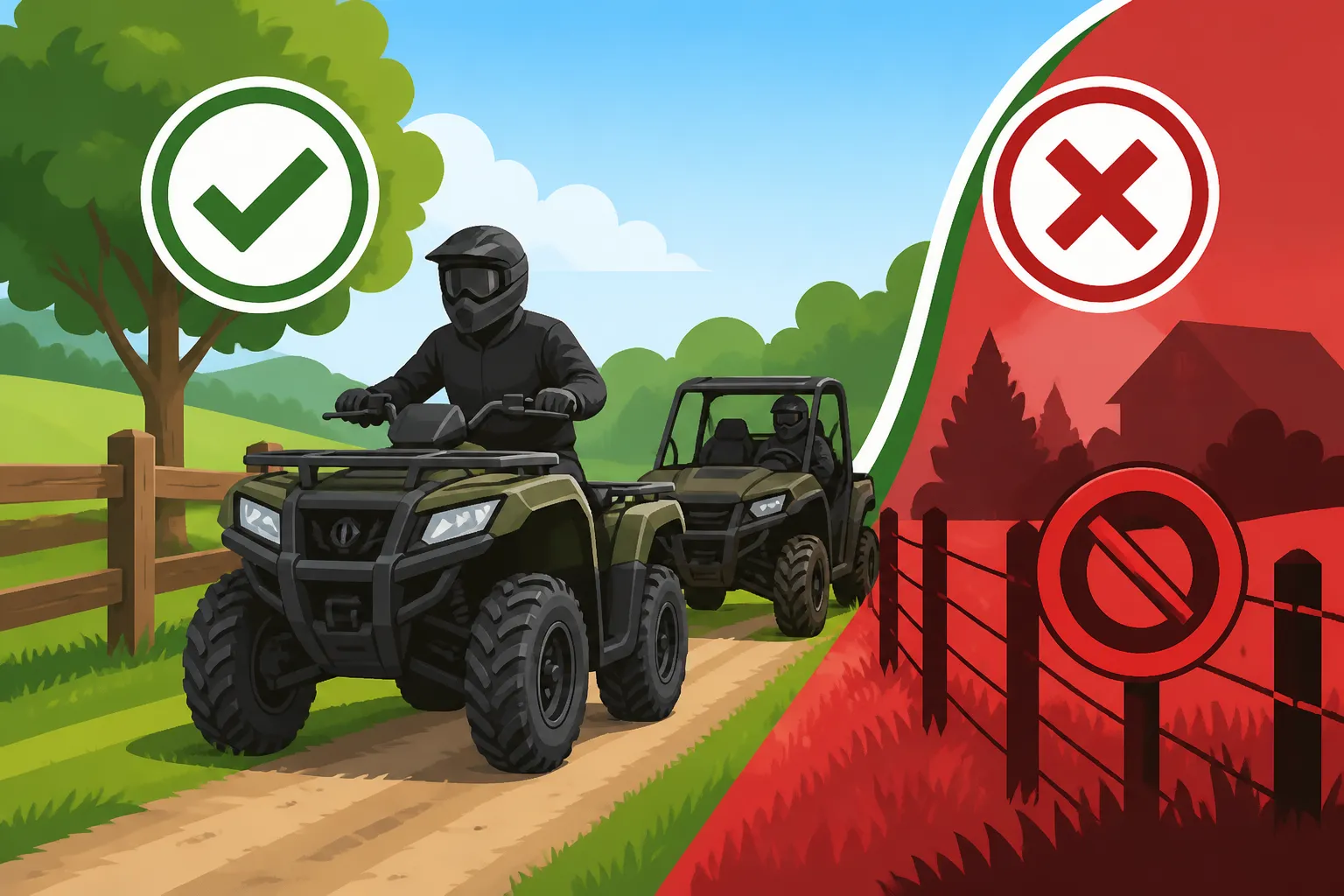
Ontario Rules for Crossing Private Land
Crossing private land can look like the quickest way to reach a trail, connect two routes or get around a closure. For Ontario ATV and UTV riders, the key point is simple: a trail permit or map does not automatically give you permission to cross someone else’s property. Here’s how to tell what access you have, ask for permission and avoid an expensive or unsafe mistake.
The basic rule: get permission before crossing
There is no general right to ride an ATV or UTV across private land in Ontario just because it would be convenient or because the route looks established. A property might be unfenced, unsigned and easy to reach, but that does not make it public riding space. If you do not know that you have permission to use it, do not ride across it.
Ontario’s trespass rules can apply when a rider enters land without permission in circumstances covered by the law, including where notice against entry has been given. Notice may take different forms. A sign, fence, gate or a direct instruction from an owner can make the boundary clear. The practical approach is not to test the limits of what a particular sign means: treat a clear notice as a reason to stay out and find an authorized route instead. For more on the general rules, see Ontario Trespass Rules for Riders.
Permission matters whether you intend to ride across a narrow strip, follow an existing track, use a field as a shortcut or pass through a gate to reach a trail. A route that appears to be a trail may be a private driveway, farm lane, logging road or track used by the owner. Its appearance is not proof that the public can use it.
This applies even when your intended crossing is brief. “I’m only passing through” is not permission. Nor does a trail permit, a club membership, a GPS track or another rider’s route give you a right to cross a parcel that is not included in the authorized route.
It helps to separate two questions:
- Can you ride the machine there? That depends on the applicable riding and vehicle rules.
- Can you enter that property? That depends on whether you have a lawful right or the owner’s permission to be there.
Meeting one condition does not satisfy the other. A registered, insured machine still needs authorized access to private property. For other land-access situations, see Ontario Landowner Permission Rules.
What counts as crossing
A crossing may be a single, direct passage between two authorized areas. But if you turn aside, follow a different track, stop to explore or continue riding on the property, you may be going beyond what the owner agreed to.
If an owner permits a specific crossing, stick to the route and conditions discussed. Do not assume that permission to pass through one corner of a property includes permission to ride elsewhere on it. Permission can also be limited to particular people, machines, dates or circumstances.
A route can change over time, too. A gate may be closed, a sign may have appeared, or a landowner may have withdrawn access. An old map, a previous season’s experience or a track saved on your phone cannot confirm that access is still allowed. Before riding, check current information about your route and its closures, such as Ontario Trail Conditions Before You Ride.
A trail permit is not permission to cross private land
A trail permit can authorize use of a participating trail network under that network’s rules. It does not give riders a general right to cross private property, leave an authorized trail or use any connecting route they find on a map.
Organized trail systems may cross private parcels through arrangements with landowners. Those arrangements can apply to a particular marked trail, not to the entire property. Riders need to stay on the authorized route and follow any conditions posted by the club or landowner. A permit for one club area also does not necessarily authorize travel onto a different network or across an unapproved connection. Check the route and network coverage rather than assuming that a connected-looking line is open; Does Your Permit Cover the Next Club’s District? explains why that distinction matters.
Use these questions to assess a route before you ride:
| What you see or have | What it means | What to do |
|---|---|---|
| A valid trail permit | You may have access to designated trails covered by that permit | Confirm that the exact trail and connection are authorized |
| A line on a phone map | It shows a route, not necessarily a public right of access | Check current club or landowner information |
| An established track across a field | It may be private or used only by the owner or authorized riders | Do not enter without permission |
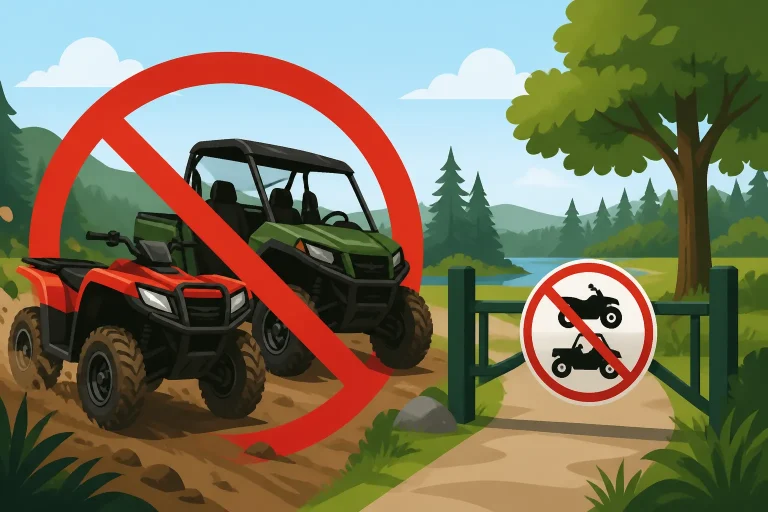
| A gate or a no-entry sign | There is a clear reason to stop and stay out | Do not go around, over or through it unless specifically authorized |
| A direct invitation from the owner | Permission may be limited to the stated route and conditions | Confirm the details and follow them |
| Another rider says the route is open | That rider may have different permission or outdated information | Verify access yourself |
When a trail is marked on a club map, follow the markings and any local instructions. Do not treat nearby private land as an acceptable detour around a muddy section, blocked gate or temporary closure. Riding off the marked route can damage property, disturb the land and put future trail access at risk. See Ontario Rules for Riding Off the Trail for the importance of staying on an authorized route.
A road, lane or logging road can create similar uncertainty. A visible road is not automatically open to ATV or UTV traffic, and permission to use a particular trail does not necessarily extend to an adjoining road. Check who controls the route and whether motorized access is allowed before continuing; Ontario Rules for Riding a Logging Road covers that separate issue.
How to ask for permission and keep it clear
If a private crossing would make a ride possible, ask the owner or the person authorized to manage the land before you go. Do not treat a lack of response as approval. If you cannot identify or reach the right person, choose another route rather than entering and hoping the owner will not mind.
A clear request should explain what you are asking to do, not just ask whether “the trail” is okay. For example, say where the proposed crossing starts and ends, how many machines would be involved, when you plan to ride and whether you want to cross once or use the route repeatedly. If the route is for a group ride, say so. Permission given to one rider may not cover a group.
Before setting out, confirm:
- The exact route. Use a map or agree on clear landmarks so there is no confusion about where you may ride.
- The permitted time. Ask whether access is for one crossing, a particular date or an ongoing arrangement.
- Who may ride. Confirm whether the permission covers just you, your passengers or the other riders in your group.
- Which machines are included. Do not assume that authorization for one type of vehicle covers every ATV or UTV.
- Any conditions. The owner may require riders to close a gate, avoid a field, stay off a wet section, travel at certain times or use another route.
- How access can change. Ask how the owner will communicate a closure or withdrawal of permission.
- Who can authorize access. A person using the property may not have authority to grant permission on behalf of its owner.
Keep a written record of the agreement if the route will be used more than once. A message or email can help both sides remember the route and conditions, but it is not a substitute for actually getting permission. If the owner sets a condition, follow it. If the route is no longer passable without leaving the agreed corridor, stop and find another way.
Permission does not turn the entire property into a public trail. Do not invite other riders to use the crossing unless the owner agreed to that, and do not publish or share the route as an open passage if it is private access. If a local club manages the connection, check with the club about what its permission covers and whether access is currently open.
Some riders confuse private land with Crown land, where different access rules may apply. Even Crown land is not automatically open to every route or activity: restrictions, closures and other rules can apply. A private parcel does not become Crown land because it is undeveloped or surrounded by public land. For that distinction, see Ontario’s Public Lands Act Free Use Policy.
If the route is blocked or you cross by mistake
If you reach a gate, barrier, sign or other indication that access is closed, stop before entering. Do not ride around the obstacle, move it, cut a fence or take a side route through a field. Turn back if you can do so safely, then check for an authorized alternative. If a marked trail appears blocked or the route has changed, contact the relevant club or property manager for current directions rather than improvising.
If you realize that you have entered private land without permission, do not continue riding to see where the trail goes. Slow down, avoid damaging the property, and leave by the safest reasonable route. If the owner is present, stay calm, be respectful and explain that you are leaving. Do not argue about whether a map, another rider or a missing sign made the route seem open. A confrontation can make a simple navigation error worse.
If the property owner asks you to leave, do so promptly and safely. Do not return later on the assumption that the request applied only to that ride. If you need to use a crossing regularly, seek explicit permission before trying again.
A wrong turn can also expose you to other hazards: crops, livestock, equipment, soft ground, ditches, water crossings or active work areas. A track that is easy to ride in dry conditions may become unsafe or damaging after rain. That is another reason to stay on the agreed route and avoid treating private land as an informal bypass.
When planning a ride, check the route before departure rather than relying on a single map or an old GPS track. Confirm that any trail segment and connection are open, that your permit covers the relevant network and that any private crossing is authorized. If access is uncertain, the safest decision is to turn around and choose a route you know you are allowed to use.
Disclaimer
This article is for general informational purposes only and does not constitute professional advice. Laws, prices and regulations vary by location and change over time. Consult a qualified professional for guidance on your specific situation.