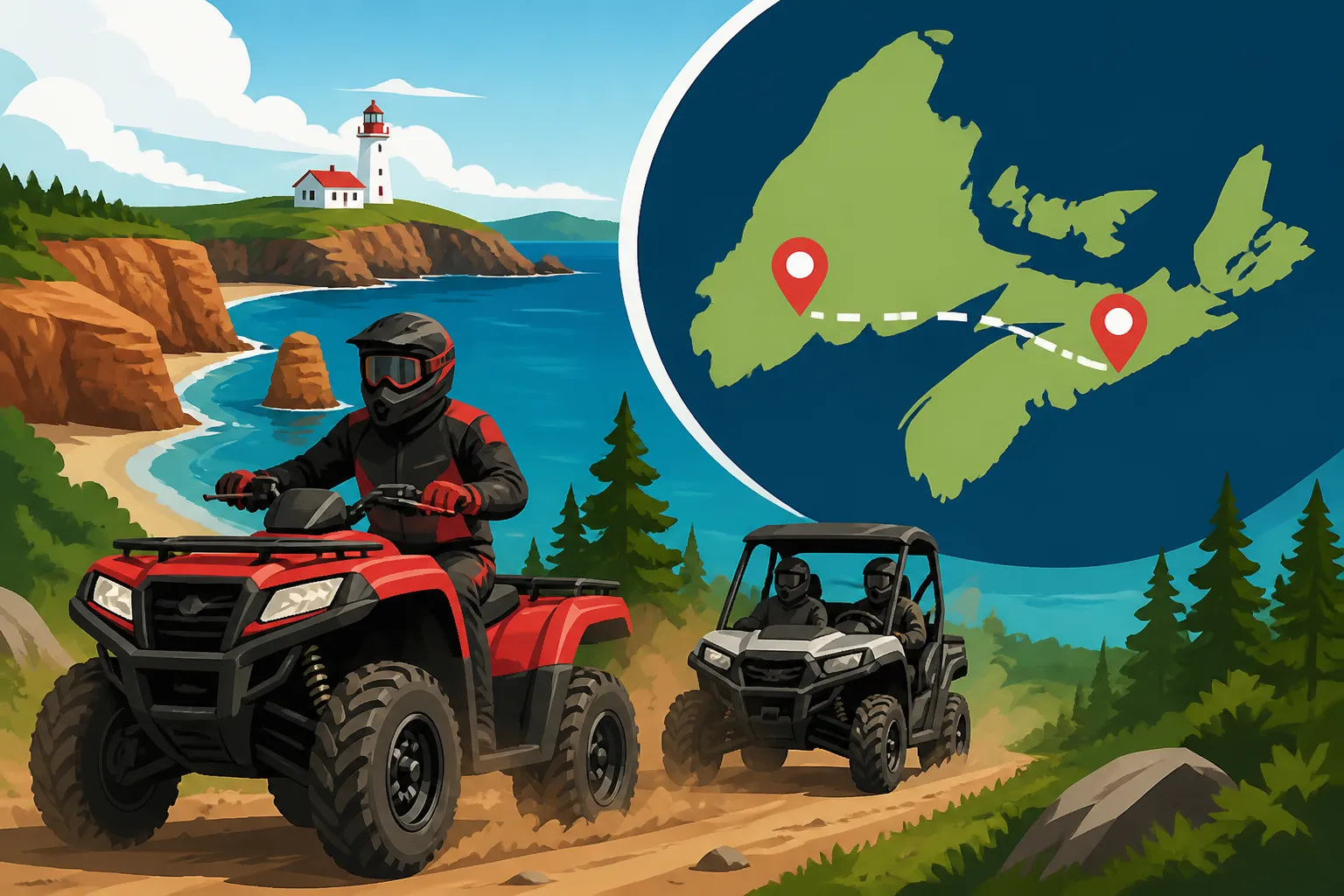
Riding the Maritimes on Your Annual
An Ontario annual ATV trail permit may be accepted on trails in New Brunswick, Prince Edward Island and Nova Scotia, making a Maritime trip simpler. But reciprocity does not mean every trail is open or that your Ontario registration replaces local requirements. The key is knowing which permit you hold, where it is recognized and what to check before unloading your machine.
What an Ontario annual permit covers in the Maritimes
The first distinction to make is between an Ontario vehicle registration and an Ontario trail permit. Registration is the provincial permit and plate for the machine. A trail permit is permission to use participating trail systems under the rules of the organization that issues or recognizes it. One does not automatically substitute for the other.
When riders talk about taking an “Ontario annual” to the Maritimes, they generally mean an eligible annual trail permit from Ontario’s organized trail network. Reciprocal arrangements allow qualifying Ontario permits to be recognized in New Brunswick, Prince Edward Island and Nova Scotia. Recognition can save you from having to buy a separate local trail pass for the riding covered by the arrangement.
That does not make the permit a universal pass. Reciprocity is between trail organizations and applies according to their current terms. It may not cover every privately managed route, club trail, riding area or special-use destination in a province. Some areas may have separate access rules or charges, while others may be closed to motorized vehicles. A trail shown on a map is not necessarily open to your machine.
If you are unsure which Ontario permit you have, start with Ontario ATV Trail Permits Explained. The name “annual” alone is not enough to establish that a permit qualifies for reciprocal access. Check the issuing organization, the permit’s validity dates and any machine or rider conditions attached to it. Confirm the latest recognition terms with the relevant trail organization before travelling.
| What you have or want to do | What it means for your trip |
|---|---|
| Ontario vehicle registration and plate | Identifies the machine for provincial registration purposes; it is not a trail pass. |
| Eligible Ontario annual trail permit | May be recognized on participating trails in New Brunswick, Prince Edward Island and Nova Scotia under reciprocal arrangements. |
| A trail in a local map or app | A useful planning lead, not proof that the trail is open or covered by your permit. |
| Riding outside participating trails | May require another permission, pass or local authorization. Check before entering. |
| Riding on a public road | Governed by road-use rules and local requirements, not trail-permit reciprocity. |
A practical way to think about reciprocity is: it may remove one permit purchase, but it does not remove the need to check access. Each province has its own network, operators and local conditions. Even within a participating network, a club or land manager may set rules that matter to your route.
For province-specific details, see Does New Brunswick Honour an Ontario Permit?, Ontario Permits Honoured in Prince Edward Island and Ontario Permits Honoured in Nova Scotia. Those distinctions matter when planning a route that crosses between provinces or includes trails managed by different organizations.
What reciprocity does not replace
A trail permit does not replace the machine’s registration, insurance or any other requirement that applies where you ride. Nor does it give you permission to ride anywhere simply because the annual permit is accepted in the province. Keep the trail-access question separate from the machine-and-rider requirements.
Before departure, make sure you understand:
- Registration and plate requirements. Carry the documents associated with your machine and make sure the plate is attached and readable. Ontario registration does not mean you can ignore the rules of the province you are visiting.
- Insurance. Confirm with your insurer that your coverage applies to the planned trip and type of riding. Do not assume that a trail permit includes the coverage your machine needs.
- Operator requirements. Check local rules for age, licensing, helmets and other safety equipment. Requirements may differ by province and by whether you are on a trail or a road.
- Trail access. Verify that the trail is open to your class of machine and that your permit is accepted there. Routes can cross public, private or managed land, each with its own restrictions.
- Road connections. A trail permit is not permission to ride on a public road. Any road section or crossing must be lawful under local rules, and the road may be closed to off-road vehicles.
For background on the Ontario side of the paperwork, Ontario’s One-Time ORV Permit explains the vehicle registration permit, while Ontario ATV Insurance Requirements covers insurance as a separate issue. If your trip involves any road riding, review the local road rules rather than treating trail reciprocity as road authorization.
Reciprocity can also be confused with a permit-sharing agreement between neighbouring provinces. Ontario’s arrangements with the Maritimes do not imply that an Ontario permit is recognized everywhere in Canada. Quebec, in particular, has a different situation; see Why Ontario and Quebec No Longer Share Permits. Check each province you plan to enter, even if you have ridden under reciprocal arrangements elsewhere.
How to check whether your route is covered
Do the checks in this order: first confirm the permit qualifies, then identify the participating trail network, and finally check whether the specific route is open and suitable for your machine. This avoids relying on an old forum post, a general map or a broad claim that a province “accepts” Ontario permits.
- Identify the exact Ontario permit. Check the issuing organization, the type of permit and its validity dates. If you bought it for a particular machine, confirm whether it is tied to that machine or otherwise subject to conditions.
- Confirm recognition in each province. Check the current terms with the relevant provincial or trail organization. If you are crossing into more than one Maritime province, verify each one separately.
- Find the trail operator for your planned route. A province-wide statement about reciprocity may not answer whether a particular club trail, private property route or destination is included.
- Check current trail status. Look for closures, seasonal restrictions, construction, weather-related damage and local notices. A trail can be covered by a permit but temporarily unavailable.
- Confirm the machine is allowed. Compare your ATV or UTV with the trail’s restrictions. Width, vehicle type, passenger arrangements and other limits may affect where you can ride.
- Save proof and contact details. Keep the permit confirmation and any relevant trail information available during the trip. If terms are unclear, get an answer from the organization responsible for the trail before you arrive.
The most common planning mistake is stopping after step two. Knowing that a permit is recognized in a province is helpful, but it does not confirm that your chosen route is part of the participating network. A multi-day ride may pass through several trail systems, and the boundaries between them are easy to overlook when planning from a single map.
Also check whether your permit remains valid for the full travel period. Annual permits do not necessarily follow the calendar year; the expiry or end date shown by the issuer is what matters. If your trip spans the permit’s end date, ask the trail organization whether you will need another permit for the remaining days.
Planning a smooth Maritime ride
Build the trip around confirmed trail access, not around a province name or a route drawn as one continuous line. If a route crosses between clubs or trail systems, record where the transition happens and who manages each section. Contact the relevant organization when the map, permit terms and online trail status do not agree.
A simple trip checklist helps:
- Confirm that the Ontario annual trail permit is the type recognized by the Maritime arrangement.
- Check its validity dates and any conditions attached to the permit.
- Verify recognition separately for New Brunswick, Prince Edward Island and Nova Scotia if you will ride in each.
- Confirm the specific trails are open and permit-covered on your planned dates.
- Check machine restrictions and local safety requirements.
- Make sure registration and insurance documents are current and accessible.
- Identify legal access points, staging areas and any road crossings.
- Save current trail maps and contact information before entering areas with limited cell coverage.
If a local organization requires a separate pass for a trail or facility, follow that requirement even if your Ontario permit is accepted on other nearby trails. Paying for a local pass may be necessary for that particular area; the existence of reciprocity does not make local access rules optional.
Keep your trail documents distinct from your vehicle documents. The Ontario vehicle permit and plate relate to registration, while your annual trail permit relates to access on participating trails. Carry the proof requested by the trail organization and keep your registration and insurance information available as well. For more on the difference between permit types, see The Permit Versus a Title in Ontario.
Finally, treat reciprocity as a useful travel benefit, not as a guarantee of access. It can simplify a Maritime trip by allowing a qualifying Ontario annual trail permit to be recognized on participating trails in New Brunswick, Prince Edward Island and Nova Scotia. The ride still depends on the specific route being open, the permit applying there, and your machine and riding plans meeting local requirements. A few checks before loading the ATV or UTV can prevent a wasted drive or an unexpected need to change plans.
Disclaimer
This article is for general informational purposes only and does not constitute professional advice. Laws, prices and regulations vary by location and change over time. Consult a qualified professional for guidance on your specific situation.