Ontario Landowner Permission Rules
You have an ATV or UTV ready to ride, but the route crosses a farm lane, cottage lot, woodlot or private trail. A trail permit or registration does not automatically give you access. Here’s how to tell when you need permission, what to clarify with the owner or occupier, and how to avoid mistaking a convenient route for an authorized one.
When You Need Permission to Ride Private Land
If land is privately owned or occupied, get permission before riding on it. That includes land that looks open, has no gate, or seems to connect naturally to a public road or trail. A lack of signs is not the same as an invitation.
Ontario’s trespass rules apply to entry onto premises, including land. The circumstances matter: signs, fences and other notices can clearly prohibit entry, but riders should not treat the absence of a warning as consent. If you do not know whether a route is private or whether riding is allowed, stop and check rather than assuming you can proceed.
Permission may need to come from the person who controls the land, not necessarily the person whose name appears on a property document. An owner, tenant, farm operator, property manager or other occupier may have authority over access, depending on the arrangement. If you are unsure who can authorize riding, ask before entering.
Permission is also separate from other requirements. You may need consent to cross private land even if:
- Your ATV is registered and has a plate.
- You have insurance.
- You hold an off-road trail permit.
- The route appears on a map or tracking app.
- Other riders have used the route.
- A nearby road or trail is open to ATVs.
A permit covers the use of the trails or properties included in its terms; it does not grant access to every private parcel along the way. Read Ontario ATV Trail Permits Explained and check which club or property is involved before you set out. If you are relying on a club-marked route, stay on the authorized trail and follow its signs and conditions.
| Situation | Is permission needed? | What to check |
|---|---|---|
| Riding across a farm field or lane | Yes, get the operator’s or occupier’s consent | Route, dates, hours, speed, livestock and gates |
| Crossing a private driveway or cottage lot | Yes, unless access is clearly authorized | Whether the owner allows ATV passage and where to ride |
| Riding in a privately owned woodlot | Yes | Boundaries, permitted trails, seasonal restrictions and logging activity |
| Using a club trail on private land | Follow the club’s access authorization and permit terms | Current trail status, route markings and whether your permit is valid there |
| Riding on Crown land | Private landowner permission is not the issue, but public-land restrictions still apply | Land status, closures, permitted use and any required approvals |
| Riding on a municipal road | Landowner consent does not make road use legal | The municipality’s by-law and provincial road-use rules |
A private property boundary can be hard to see on the ground. A track that looks like an old trail may cross several parcels, and a route that was open last year may no longer be authorized. Use maps as a planning aid, not as proof of permission. When in doubt, contact the owner or the organization responsible for the trail.
For more on the broader rules, see Ontario ATV Rules for Riding Private Property and Ontario Trespass Rules for Riders.
What to Ask Before You Ride
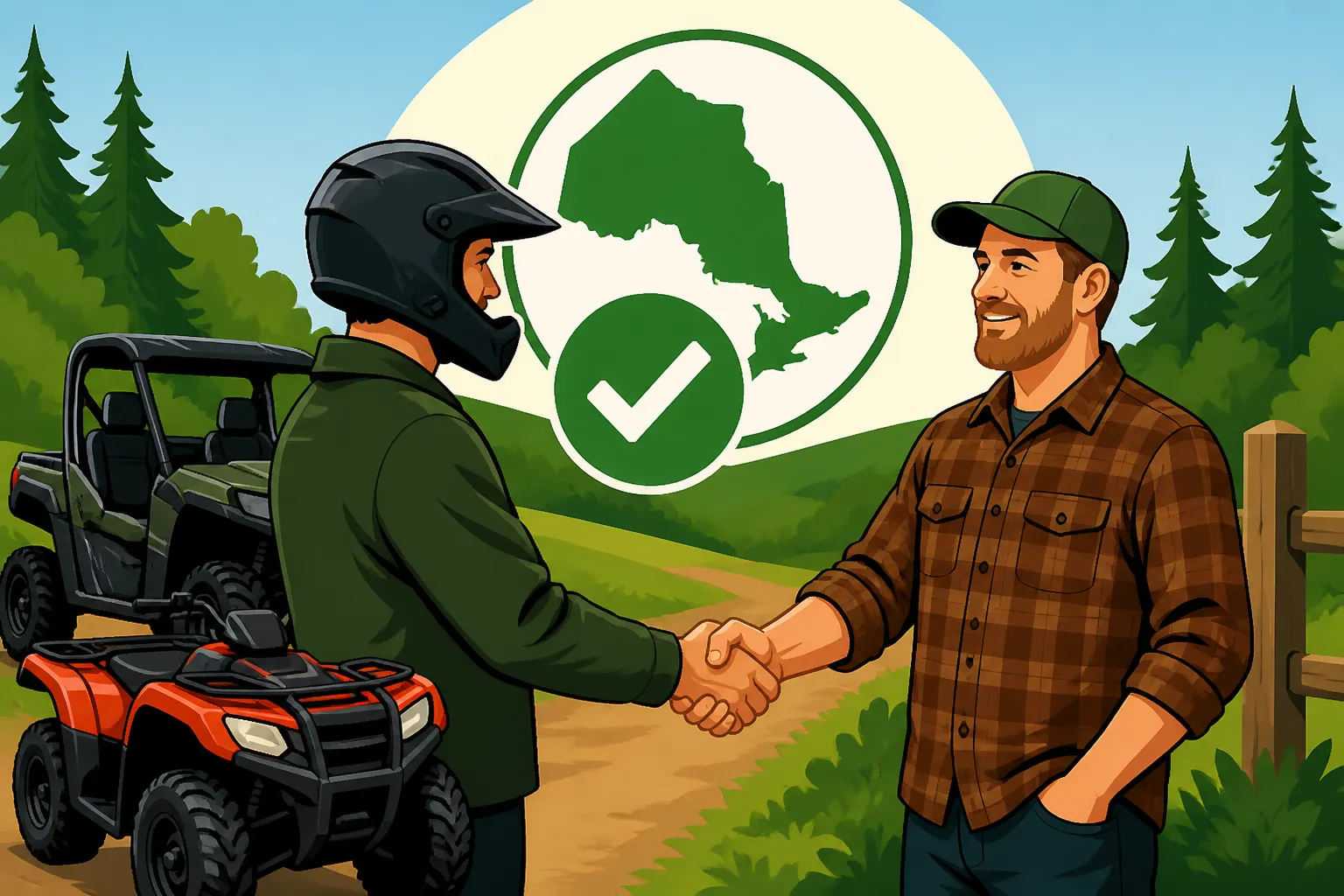
A quick conversation can prevent confusion, but a vague “sure, go ahead” may leave important questions unanswered. Agree on the route and conditions before the ride. For a group, a seasonal arrangement, or regular access, get the terms in writing. A text or email can help record what was agreed, though it does not replace any formal agreement the owner requires.
Ask the owner or occupier:
- Which route is allowed? Confirm the actual trail, lane or crossing. Ask where the private property begins and ends, and whether you may enter from a specific point.
- When may you ride? Permission for one afternoon does not necessarily cover a return trip, another season, nighttime use or every day of the week.
- Who may ride? Confirm whether permission applies only to you, named guests, a club group or other riders travelling with you.
- What machines are allowed? An owner may agree to a quad but not a wide side-by-side, or may set limits on the number of vehicles in a group.
- Are there speed or noise limits? Follow any conditions on speed, engine noise, stopping or idling, even if the trail seems empty.
- Are there areas to avoid? Fields, crops, gardens, livestock areas, wetlands, planted areas and equipment yards may be off limits.
- How should gates be handled? Ask whether a gate should be left as found, kept closed or not used at all. Never assume a gate is an invitation to enter.
- Are there seasonal restrictions? The owner may close the route during planting, harvest, wet conditions, hunting activity, logging or other work.
- Can you bring guests or invite others later? Permission for one rider does not automatically extend to a whole group.
- How can permission be withdrawn or changed? Make sure you know how the owner will notify you if access must stop.
Respect the conditions even if they are more restrictive than you expected. If the owner allows passage along one lane, that does not authorize exploring side trails or stopping elsewhere on the property. If permission is limited to crossing from one road to another, ride directly across using the agreed route.
A practical written note can include the property or route, who is allowed to ride, the permitted dates or season, any machine or group limits, and the owner’s contact details. It can also spell out conditions such as keeping gates closed, yielding to farm equipment, avoiding wet ground and staying off crops. Keep the note accessible during the ride, but do not treat it as a substitute for following posted signs or instructions.
Permission is not a guarantee that the route will remain open. Conditions can change because of weather, maintenance, property use or a landowner’s decision. Check again before a ride if time has passed since permission was given, and stop if you reach a new closure or instruction.
Farms, Woodlots, Trails and Road Allowances
Different kinds of land create different access questions. The basic rule remains the same: identify who controls the route, confirm that riding is allowed, and stay within the permission given.
Farms and working land
Farm property may include fields, lanes, barns, livestock areas, drainage features and equipment routes. A lane that appears unused may still be needed for machinery or access. Ask the farm operator where to ride and when. Avoid crops, livestock, stored materials and working areas, and do not block farm traffic.
Do not assume a friend’s permission covers the whole farm or neighbouring parcels. The person you know may not control every part of the route. If the route crosses a field owned or occupied by someone else, get that person’s authorization too. See [Ontario Rules for Riding Farm Land] for more about farm access and riding considerations.
Woodlots and logging areas
A woodlot can be privately owned, managed for forestry or subject to changing work conditions. Trails may be used by logging trucks or other equipment, and a route can become unsafe or off-limits without much notice. Confirm the permitted route and check for current signs or closures before entering. Do not ride around a barrier to continue on a familiar track.
For woodlot-specific questions, [Ontario Rules for Riding a Woodlot] is a useful companion. If the route is a rail-trail conversion or another managed corridor, verify which organization controls access. A visible trail or old rail bed does not, by itself, establish that ATV riding is permitted.
Club trails on private property
Many organized trail systems rely on permission from landowners. A trail club or federation may arrange access for a marked trail, but that access is limited to the authorized corridor and the conditions set by the property owner. Your permit does not let you leave the marked route to explore nearby land, take a shortcut or reach a viewpoint.
Check the trail organization’s current map and closure notices. A trail can cross a property where access is authorized but still be closed temporarily. If a sign tells riders to stay out, turn around or use a different route, follow it. For background on route authorization, see Ontario ATV Trail Permits Explained and Ontario Trail Closures to Check First.
Road allowances and municipal roads
An unopened road allowance is not automatically a public ATV trail. Its legal status, practical access and rules can be complicated, and nearby property use may affect whether you can reach or ride it. Likewise, permission from a landowner to cross a driveway or yard does not authorize riding on a public road.
For a municipal road, check the municipality’s current by-law and provincial requirements. Municipalities may allow off-road vehicles on some roads, restrict them to particular sections, set operating conditions or prohibit them altogether. A route shown on a rider’s map may cross a road that is closed to ATVs. See Checking a Township’s ORV By-law before using roads as part of a route.
Crown land is different from private land, but it is not automatically open for every kind of riding. Restrictions, closures and local rules may apply, and public access does not override posted notices or other controls. Check the land status and applicable conditions rather than treating a gap between private properties as unrestricted land.
If Permission Is Unclear or Access Is Disputed
If you cannot confirm that a route is authorized, do not ride it. Turn around or choose a route you know is open. Continuing because a track is already visible, because another vehicle went through, or because a map shows a line can put you in conflict with the person who controls the property.
If someone asks you to leave, stop safely, follow the instruction and leave by the route they identify if it is safe to do so. Do not argue on the trail or ride farther into the property to find another exit. If you have a written agreement and believe there is a misunderstanding, resolve it later with the owner or the organization that arranged access.
Be especially cautious when:
- A trail marker is missing, damaged or pointing in an unclear direction.
- A gate, chain, fence or sign indicates the route is closed.
- The trail crosses a work site, active farm area or logging operation.
- A property boundary appears to have changed.
- Someone says access has been withdrawn, even if you previously received permission.
- The route shown in an app differs from signs on the ground.
Do not remove, move or ignore barriers and signs. Avoid riding around a closure on adjacent land: the detour may be private too, and leaving a permitted trail can cause damage or create a safety risk. If a club trail is involved, contact the club for current information instead of making your own bypass.
Permission also does not replace registration, insurance or road-use requirements. Confirm that the machine and rider meet the rules that apply to the type of riding planned. For example, a private-land agreement does not make an ATV road-legal, and it does not ensure your insurance covers every activity or location. Review Insurance Required Even Off-Road in Ontario and check your policy with your insurer.
Before the next ride, use this simple process:
- Identify the land and the person or organization that controls access.
- Ask for clear permission for the specific route, dates and riders.
- Confirm any limits on vehicles, speed, hours, gates or areas to avoid.
- Check current trail notices, signs, closures and municipal road rules.
- Stay on the authorized route and stop if permission or access is challenged.
The safest approach is straightforward: treat private land as closed unless you have permission, make the boundaries and conditions clear, and do not assume that access granted for one route or occasion applies elsewhere.
Disclaimer
This article is for general informational purposes only and does not constitute professional advice. Laws, prices and regulations vary by location and change over time. Consult a qualified professional for guidance on your specific situation.