Equipment Ontario Requires on a Road-Legal ORV
It's incredibly frustrating when you want to take your ATV or side-by-side out for a spin on an open municipal road in Ontario, only to be met with a bewildering array of rules about what equipment you need. You're trying to do the right thing, but the specifics can feel like a moving target. This guide is here to cut through that confusion, outlining precisely the mandatory equipment your off-road vehicle must have to be considered road-legal in Ontario, so you can ride with confidence and peace of mind.
General Overview of Road Legalization in Ontario
Navigating the rules for riding your ORV on Ontario roads can feel like a maze, and honestly, many riders find themselves scratching their heads. The truth is, while certain roads are opening up to off-road vehicles, it’s not a free-for-all. There are specific classifications for different types of ORVs, and each comes with its own set of rules, including what equipment you need to have bolted on before you ever consider hitting the pavement. This isn't just about safety, although that's a huge part of it; it's also about ensuring that your machine can coexist with other road users and that you're prepared for the varying conditions you'll encounter.
The provincial government sets the baseline rules, primarily through the Off-Road Vehicles Act and its associated regulations. However, the decision to open specific roads, and sometimes even additional local requirements, often falls to individual municipalities. This is where a lot of the confusion comes in for riders, as what's legal in one township might not be in the next. It’s a dynamic landscape, and staying informed is key to avoiding fines and ensuring an enjoyable, legal ride. You can learn more about the foundational legislation in [The Off-Road Vehicles Act and Ontario Riders].
Understanding Ontario's ORV Classes
Ontario categorizes off-road vehicles into a few distinct classes, and these classifications significantly impact the equipment requirements for road use. It's not a "one size fits all" situation. For instance, a traditional single-rider ATV, which is generally designed for one person, falls under one set of rules, while a larger, multi-passenger side-by-side (often called an ROV or Recreational Off-Highway Vehicle) will have additional stipulations, particularly concerning occupant protection. This distinction is crucial because the design and intended use of these machines differ, and so do the safety considerations when they share the road with cars and trucks.
The main classes you'll typically encounter are ATVs (All-Terrain Vehicles), MPVs (Multi-purpose Off-Highway Utility Vehicles), and ROVs (Recreational Off-Highway Vehicles), with off-road motorcycles having their own set of specific rules too. An ATV is what most people picture: a straddle-style machine with handlebars. An MPV is often work-oriented, heavier, and might have a cargo bed. ROVs are side-by-sides, designed with a steering wheel, foot pedals, and bucket seats, much like a small car. Understanding which class your machine falls into is the first step in knowing exactly what equipment you'll need. Specifically, [Ontario's MPV Class and Its Weight Limit] and [Ontario's ROV Class and Its Engine Cap] delve deeper into these definitions.
When you're looking at your specific machine, grab your ownership papers or manual. It's not uncommon for a side-by-side that seems like an ATV to actually be classified as an ROV, which brings different rules into play, particularly for things like seat belts and rollover protection. This initial step of identification is paramount. Without knowing your vehicle's exact classification, you risk either over-equipping your machine unnecessarily or, more seriously, being under-equipped and facing potential fines or safety hazards on public roads.
The Role of Municipal By-laws
While the province lays down the groundwork, it's often your local municipality that has the final say on which roads are open to ORVs within its boundaries. This means that even if your ORV is perfectly equipped according to provincial standards, you still need to check the specific by-laws of the municipality you plan to ride in. Many riders have been caught off guard, assuming that because one township opened its roads, all neighbouring areas followed suit. Unfortunately, that's rarely the case, leading to confusion and, sometimes, tickets. You can read more about this local decision-making in [Why One Township Road Is Open and the Next Closed].
These municipal by-laws can dictate more than just which roads are open; they can sometimes impose additional requirements or restrictions, such as specific hours of operation, speed limits that are lower than the provincial maximums, or even rules about where you can park your truck and trailer when staging a ride. It's critical to remember that these local rules supplement, rather than replace, the provincial regulations. So, while you're ensuring your machine has all the right lights and mirrors, don't forget to do your homework on the local by-law. A quick call to the municipal office or a check of their website can save you a lot of grief.
For example, a municipality might have opened some of its lower-speed, less-travelled roads to ORVs, allowing riders to connect to trail systems or access local businesses. However, they might specifically prohibit ORVs on higher-traffic main arteries or through residential areas after certain hours. These by-laws are designed to balance the needs of ORV enthusiasts with the concerns of other residents and road users. Understanding and respecting these local nuances is part of being a responsible rider.
Why Specific Equipment Matters
Every piece of mandatory equipment for road-legal ORVs in Ontario serves a vital purpose, primarily centered around safety and visibility. These aren't just arbitrary rules dreamed up by bureaucrats; they are in place to minimize the risk of accidents and ensure that your ORV is as conspicuous and predictable as any other vehicle on the road. When you're sharing the pavement with cars, trucks, and even cyclists, being seen and being able to communicate your intentions is paramount.
Consider the basic act of driving on a paved road. You need to signal turns, stop safely, and be seen from a distance, especially at dusk or in adverse weather. Without proper lighting, mirrors, and braking capabilities, an ORV can quickly become a hazard. The requirements ensure that your machine meets a minimum standard for operating in traffic, protecting both you and others. It's about blending into the existing road-use environment in a way that doesn't compromise anyone's safety.
Beyond direct safety, having the correct equipment also demonstrates that you are a responsible operator. Law enforcement officers are keen to see that riders are taking the rules seriously. A properly equipped ORV is less likely to be pulled over, and if it is, you'll be able to quickly demonstrate compliance. It’s about building trust and showing that ORVs can be a legitimate and safe part of the road-using community, rather than a rogue element.
Mandatory Lighting and Reflectors
When you're out on the road, visibility is non-negotiable. Whether it's the bright midday sun or the gloom of a cloudy evening, your ORV needs to be seen by other drivers. Ontario's regulations are very clear about the lighting and reflective devices required, ensuring that your machine stands out and communicates your presence and intentions effectively. This goes far beyond just having a single headlight; it's about a complete system designed for all-around visibility and signaling, much like any car or motorcycle would have. Without these, you're not only risking a fine but, more importantly, your own safety and the safety of others on the road.
Headlights, Taillights, and Brake Lights
Every road-legal ORV in Ontario must be equipped with at least one headlight (white or amber) that is capable of illuminating the road ahead, as well as at least one red taillight that is visible from a specified distance to the rear. This dual system ensures that you can see where you're going and that others can see you approaching or receding. These lights must be operational whenever you're riding on an open road, not just when it's dark outside. Many experienced riders make it a habit to always ride with their lights on, regardless of the time of day, simply because it enhances visibility.
Beyond basic illumination, working brake lights are absolutely critical. When you apply your brakes, a red light (or lights) at the rear of your ORV must automatically illuminate, signalling to following traffic that you are slowing down or stopping. This seems like a no-brainer, but faulty wiring or burnt-out bulbs are common issues that can put you at serious risk. Before every road ride, give your brake lights a quick check. If you're riding alone, try backing up to a wall or window and looking for the reflection as you press the brake pedal. This simple check can prevent rear-end collisions and keep you compliant with [Ontario ATV Lighting Requirements].
It’s worth noting that simply having the lights isn't enough; they must be in good working order and clean. A mud-caked taillight, while technically present, won't provide the necessary visibility. Many aftermarket lighting options are available, and if you're upgrading, make sure they meet or exceed provincial standards for brightness and colour. Companies like SuperATV offer a range of robust lighting solutions designed to withstand off-road conditions while still being road-legal.
Turn Signals and Hazard Lights
For any ORV to be considered road-legal in Ontario, it must have functional turn signals that clearly indicate your intention to change lanes or make a turn. These signals, typically amber in colour, must be visible from both the front and rear of the vehicle. This is a fundamental aspect of road safety, allowing you to communicate your movements to other drivers well in advance, reducing the risk of collisions. Without proper turn signals, you're left guessing how to communicate your intentions, often resorting to hand signals which can be difficult to see or understand, especially at higher speeds or in busy traffic.
Many factory-equipped ATVs and older side-by-sides might not come with turn signals as standard. If yours doesn't, you'll need to install an aftermarket kit to meet this requirement. When installing, ensure the signals are properly wired, securely mounted, and bright enough to be seen in various conditions. Integrating a four-way hazard light function is also a smart move, allowing you to quickly alert other drivers to a stopped vehicle or a potential hazard on the road, providing an extra layer of safety, particularly if you have to pull over unexpectedly.
It’s not just about having the lights; it's about using them correctly. Always signal well in advance of your turn or lane change, giving other drivers ample time to react. This becomes even more critical on roads where vehicle speeds are higher. Practicing good signaling habits will not only keep you compliant but will also foster a safer and more harmonious road environment for everyone.
Reflective Taping and Side Markers
Beyond active lighting, passive reflective materials also play a crucial role in making your ORV visible, especially from the sides and in low-light conditions when your active lights might not catch every angle. Ontario regulations typically require certain reflective elements, such as red reflectors on the rear and amber reflectors on the front and sides of the vehicle. These simple additions dramatically increase your visibility to other drivers, particularly when their headlights sweep across your machine.
While your machine might come with some integrated reflectors, it's always a good idea to ensure they are clean, unobstructed, and meet the minimum size requirements. Some riders even go a step further, applying additional reflective tape to key areas of their ORV, such as the fenders or body panels, to maximize their presence on the road. This can be especially helpful for larger side-by-sides that might present a bigger profile but still need to be clearly outlined.
Think of reflective taping and side markers as your backup visibility system. They don't require power, so even if your electrical system fails, you'll still have a degree of passive visibility. When you're riding at dusk or dawn, or even just crossing a dark intersection, these reflectors can be the difference between being seen and being overlooked. Always ensure they are free from mud and debris before heading out.
Braking Systems and Performance
When you're riding on public roads, the ability to stop safely and effectively is paramount. Unlike off-road conditions where you might slide or use engine braking more aggressively, on pavement, you need precise and reliable stopping power. Ontario’s regulations for road-legal ORVs demand braking systems that are not only present but also perform adequately, ensuring you can bring your machine to a controlled halt under various circumstances. Skimping on brake maintenance or ignoring warning signs is a recipe for disaster on any road, let alone one shared with other vehicles.
Adequate Stopping Power
Your ORV must be equipped with a braking system that is capable of bringing the vehicle to a smooth, safe, and controlled stop. This usually means independently controlled braking systems for both the front and rear wheels, although the specific configuration can vary by machine type. For ATVs, this often involves a hand lever for the front brakes and a foot pedal for the rear, or sometimes a combined system. For side-by-sides, it will typically be a foot pedal controlling all four wheels, similar to a car. The key is that they must function reliably and provide sufficient stopping force.
Testing your brakes regularly is not just a suggestion; it's a critical safety habit. Before each road ride, ensure your brake levers or pedals offer firm resistance and that the machine responds predictably when you apply them. Listen for any grinding, squealing, or unusual noises that might indicate worn pads or other issues. If your brakes feel spongy or you have to apply excessive force, it's a clear sign that they need immediate attention. Remember, stopping distances can vary greatly between different surfaces, and your ORV will behave differently on pavement than it does on dirt or gravel.
It's also essential to consider the condition of your brake lines and fluid (for hydraulic systems). Any leaks or damage can severely compromise braking performance. If you've been riding through mud or water, it's a good practice to inspect your brake components for debris that could interfere with their function or accelerate wear. Investing in high-quality brake pads and performing routine maintenance will ensure you have the stopping power you need when it matters most.
Parking Brake Requirements
In addition to your primary braking system, road-legal ORVs in Ontario must also be equipped with a functional parking brake. This isn't just a convenience feature; it's a safety device designed to hold your machine stationary when parked, preventing it from rolling away, especially on an incline. Imagine parking on a slight hill to quickly check a map, only for your ORV to slowly begin creeping backwards into traffic – that's the scenario a parking brake is designed to prevent.
For many ATVs, the parking brake is integrated into the hand lever for the front brakes or sometimes a separate lever that engages the rear brakes. For side-by-sides, it's typically a separate lever or pedal, much like in a car. Whatever its design, it must be robust enough to securely hold your ORV in place. Test its effectiveness regularly; if you engage it and the machine still creeps, it likely needs adjustment or repair.
A working parking brake is particularly important when you're staging at a trailhead, stopping for a roadside break, or making quick stops in uneven terrain off the side of the road. It adds a crucial layer of safety, ensuring your machine stays put exactly where you leave it, protecting both your ORV and anyone around it. Always make it a habit to engage your parking brake whenever you dismount your machine on the road or in a public area.
Regular Maintenance Checks
Maintaining your ORV's braking system isn't a "set it and forget it" task; it requires ongoing attention, especially when you plan to use the machine on public roads. Regular maintenance checks are essential to ensure optimal performance and compliance with safety regulations. Neglecting your brakes is not only dangerous but can also lead to costly repairs down the line or, worse, a preventable accident.
Beyond the daily pre-ride checks, your braking system should be part of your routine service schedule. This includes checking brake pad wear, inspecting rotors or drums for damage, ensuring brake fluid levels are adequate and clean, and checking all lines and hoses for leaks or damage. If you're not comfortable performing these checks yourself, take your ORV to a qualified mechanic who specializes in off-road vehicles. They can identify potential issues before they become serious problems.
Remember that riding conditions, especially off-road, can be very demanding on braking components. Mud, water, and debris can accelerate wear on pads and rotors, and severe riding can even bend or damage components. Therefore, if you're frequently transitioning between trail riding and road use, your brake inspection schedule should be more frequent. A well-maintained braking system is a cornerstone of safe road operation.
Steering, Suspension, and Tires
The way your ORV handles, absorbs bumps, and maintains traction is crucial for safe operation on paved roads. Unlike the forgiving nature of dirt trails, road surfaces demand precision from your steering, stability from your suspension, and reliable grip from your tires. Ontario's regulations ensure that these fundamental components are up to snuff, preventing unpredictable handling and ensuring you can maintain control, especially when navigating traffic or encountering unexpected road conditions.
Functional Steering and Suspension
For your ORV to be considered road-legal, its steering system must be in good working order, allowing for precise control and predictable handling. This means no excessive play in the handlebars or steering wheel, and the machine should track straight without constantly needing correction. A loose or sloppy steering system can be incredibly dangerous on the road, where split-second decisions and accurate maneuvering are often required to avoid hazards. Regularly check all steering components, including tie rods, ball joints, and steering linkages, for wear or damage.
Similarly, your suspension system needs to be fully functional. While an ORV's suspension is designed to absorb big hits off-road, on pavement it contributes to stability, comfort, and tire contact with the road. Worn-out shocks or damaged springs can lead to a bouncy, unstable ride, making it difficult to maintain control, especially when cornering or braking. The machine should sit level, and the suspension should compress and rebound smoothly. A well-maintained suspension not only enhances safety but also makes the road ride much more enjoyable.
Before hitting the pavement, give your steering a quick check by rocking the handlebars or steering wheel side-to-side while the machine is stationary. Any excessive movement before the wheels respond could indicate a problem. For suspension, push down on each corner of the machine; it should rebound once or twice and then settle. If it continues to bounce or feels "dead," it's time for an inspection.
DOT-Approved Tires for Road Use
Perhaps one of the most overlooked, yet absolutely critical, components for road legality is your tires. While many off-road tires excel at digging through mud or gripping rocks, they might not be suitable or legal for paved road use. Ontario regulations generally require that any tire used on a road-legal ORV must be approved for highway use, often indicated by a "DOT" (Department of Transportation) stamp on the sidewall. These tires are designed with different tread patterns and rubber compounds that provide better grip, wear longer, and handle the heat generated by road friction more effectively than aggressive off-road-only tires.
Using non-DOT approved tires on public roads can result in fines and, more importantly, poses a significant safety risk. Off-road tires can have very poor traction on wet pavement, wear out extremely quickly, and even deform at road speeds, leading to unpredictable handling and potential blowouts. It’s a common misconception that if a tire fits, it’s fine for the road. Always check for that DOT stamp before venturing onto asphalt.
When choosing DOT-approved tires, consider the type of road riding you'll be doing. Some tires offer a good balance for both road and light trail use, while others are more street-oriented. Brands like SuperATV offer a variety of tire options, including those with DOT ratings that are suitable for mixed-use riding. Investing in the right tires is not just about compliance; it's about ensuring optimal performance, longevity, and above all, safety when you're riding on the pavement.
Tire Pressure and Load Ratings
Even with DOT-approved tires, proper tire pressure and understanding load ratings are essential for safe road operation. Off-road vehicle tires are often run at very low pressures for maximum traction on trails. However, these pressures are dangerously low for road use, leading to excessive heat buildup, poor handling, rapid wear, and a high risk of blowouts. Always consult your ORV's owner's manual or the tire manufacturer's recommendations for the correct road-specific tire pressure, which will invariably be higher than your trail pressure.
The load rating of your tires is also crucial, especially if you plan on carrying passengers or cargo. The load rating indicates the maximum weight a tire can safely support at its recommended inflation pressure. Exceeding this limit can lead to tire failure, poor handling, and increased stopping distances. While ORVs are generally lighter than cars, adding a passenger, a full cooler, and tools can quickly add significant weight.
Before every road ride, check your tire pressures with a reliable gauge and adjust them as needed. This simple step can dramatically improve handling, fuel efficiency, and tire longevity, all while enhancing safety. It’s a good practice to carry a small tire pressure gauge and a portable air pump with you, especially if you frequently air down for off-road sections and then air back up for road connections.
Safety Equipment: Horn, Mirror, and Seat Belts
Beyond the basics of seeing and being seen, Ontario's regulations for road-legal ORVs also mandate specific safety equipment designed to help you interact with other road users and protect occupants. These items are about communication and containment, ensuring that you can alert others to your presence and that you and your passengers are securely positioned within the vehicle, especially in the event of an unforeseen incident.
Audible Warning Device (Horn)
Just like any other motor vehicle on the road, your ORV must be equipped with a functional horn or an "audible warning device." This isn't just for letting your buddies know you're coming down the trail; on public roads, a horn is a vital safety tool. It allows you to alert pedestrians, cyclists, or other drivers to your presence, warn of potential hazards, or signal your approach when necessary. Imagine turning a blind corner on a quiet municipal road only to find a pedestrian in your path – a quick blast of the horn can prevent an accident.
Many ATVs come with a small, often weak, factory horn that might be barely adequate for trail use. For road legality, the horn must produce a clear, distinct sound that is audible from a reasonable distance. If your factory horn is weak or non-existent, you'll need to install an aftermarket horn that meets this standard. Ensure it's wired correctly and mounted securely so it doesn't rattle loose on bumpy sections of road.
A horn is a direct line of communication with other road users. It's not meant to be used in anger or frustration, but as a polite and effective warning system. Incorporating a check of your horn into your pre-ride routine is a quick and easy way to ensure this critical safety device is always ready when you need it.
Rearview Mirrors for Visibility
Maintaining situational awareness on the road means knowing what's happening around and behind you. That's why road-legal ORVs in Ontario must be equipped with at least one rearview mirror, and often two, depending on the machine type and its classification. For ATVs, a single rearview mirror providing a clear view to the rear is typically sufficient. However, for side-by-sides (ROVs) where a full field of vision is crucial, both a centre rearview mirror and at least one side-mounted mirror are usually required, mimicking the setup in a car. You can find specific requirements in [Ontario ATV Mirror Requirements].
A clear and unobstructed view to the rear is absolutely essential for safe lane changes, turning maneuvers, and simply being aware of approaching traffic. Many stock ORVs don't come with mirrors designed for road use, or they might be flimsy and prone to shaking. Investing in robust, properly sized mirrors that offer a stable, clear image is highly recommended. SuperATV, for example, offers a variety of durable mirrors, including break-away styles that can withstand trail riding while providing excellent visibility on the road.
Before each road ride, ensure your mirrors are clean, properly adjusted, and securely mounted. They should provide a clear view without excessive vibration. Remember, constantly turning your head to check behind you can be distracting and take your eyes off the road ahead, making properly adjusted mirrors a critical safety component.
Seat Belts and Occupant Protection
This requirement primarily applies to side-by-sides (ROVs) and Multi-purpose Off-Highway Utility Vehicles (MPVs) that are designed to carry passengers side-by-side, rather than traditional straddle-seat ATVs. If your ORV has bucket seats and is designed for multiple occupants, it must be equipped with functional seat belts for every seating position. These seat belts are not just for comfort; they are a vital safety feature, designed to keep occupants contained within the vehicle in the event of a rollover, sudden stop, or collision.
Ontario regulations are strict about occupant protection in ROVs. This also extends to rollover protective structures (ROPS) or occupant protective structures (OPS) that are integral to the design of side-by-sides. These structures are engineered to provide a zone of safety around occupants in a rollover scenario. If your ROV has these features from the factory, they must be intact and undamaged. Any modifications to these structures should only be done by qualified professionals, as compromising them could have severe safety consequences. You can read more about these requirements in [Ontario ATV Seat Belt Rules].
Before any ride on public roads, ensure that all occupants are properly buckled into their seat belts. It should be a non-negotiable part of your pre-ride checklist. Just as you wouldn't drive a car without everyone belted in, the same applies to your road-legal side-by-side. These safety features are there to protect lives, and their proper function is paramount.
Exhaust Systems and Noise Levels
Riding an ORV, whether on trail or road, often comes with a distinctive sound. However, when you bring that sound onto public roads, there are specific regulations in Ontario concerning your exhaust system and the amount of noise your machine can produce. These rules are in place to minimize noise pollution, maintain public peace, and ensure that your ORV isn't excessively loud, which can be a nuisance or even a hazard to other road users and residents.
Factory-Equipped Mufflers
For an ORV to be road-legal in Ontario, it must be equipped with a muffler that is in good working order and effectively reduces engine noise. The general expectation is that your machine should have the muffler it came with from the factory, or a legitimate aftermarket replacement that meets original equipment specifications for noise reduction. This means no "straight piping" or modifications that bypass or disable the muffler's function. The purpose of the muffler is to quiet the exhaust gases as they exit the engine, and any tampering that makes the vehicle significantly louder is usually illegal.
The reasoning behind this is two-fold: environmental and public relations. Excessive noise can disturb residents, frighten livestock, and generally create a negative impression of ORV riders. Keeping your muffler intact and functional demonstrates respect for the communities you're riding through and helps foster a more positive image for the entire ORV community. Always ensure your muffler is securely attached, free from leaks, and not modified in any way that would increase its sound output.
Regular inspection of your exhaust system for rust, holes, or loose connections is important. A small crack can turn into a significant noise issue quickly. If you notice your ORV getting progressively louder, it's time to investigate the exhaust system.
Legal Noise Limits
While the specific decibel limits for ORVs on public roads aren't always explicitly stated in every piece of legislation, the general principle in Ontario is that vehicles should not produce "unnecessary noise" or noise "greater than that permitted by law." This often defaults to the vehicle's factory specifications for noise output. An ORV that is significantly louder than its stock configuration, or one with a modified or absent muffler, is likely to be deemed non-compliant.
Law enforcement officers typically assess noise levels based on whether the sound is "excessive" or "unnecessary" under the circumstances, and they have the authority to issue tickets if they believe your ORV is creating undue noise. This means that even if you have an aftermarket exhaust, if it's too loud and draws negative attention, you could still be penalized. The goal is to keep your ORV's sound profile similar to how it was designed to be, avoiding modifications that make it exceptionally noisy.
When riding through residential areas or near populated zones, being mindful of your throttle input can also help reduce perceived noise. Even with a legal exhaust, revving your engine unnecessarily can create a disturbance. Being a courteous rider means being aware of the impact your machine's sound has on others. [Ontario ATV Muffler Rules] provides more insight into this area.
The Impact of Aftermarket Exhausts
Many ORV enthusiasts enjoy customizing their machines, and aftermarket exhaust systems are a popular modification. However, if you plan to use your ORV on public roads, you need to be extremely careful when selecting and installing an aftermarket exhaust. While some aftermarket systems are designed to enhance performance and still meet noise regulations, many are built solely for off-road use and will make your machine significantly louder than factory specifications, rendering it non-compliant for road use.
Before purchasing an aftermarket exhaust, always check if it is explicitly designated as "street legal" or "emissions compliant" for your jurisdiction. Reputable manufacturers will often state this clearly. If a system is designed for "closed course competition only," it is almost certainly not legal for use on Ontario roads. Installing such an exhaust will not only risk fines but can also contribute to the negative perception of ORV riders.
It's tempting to want a louder, more aggressive sound from your machine, but the trade-off for road legality and community acceptance is usually not worth it. If you're unsure whether an aftermarket exhaust meets the legal requirements, it's always best to err on the side of caution and either stick with the factory muffler or consult with a knowledgeable dealer or mechanic who understands Ontario's specific regulations.
Machine Dimensions and Weight Limits
The physical size and weight of your ORV are critical factors in determining its road legality in Ontario. Unlike a trail where width and weight might primarily affect maneuverability, on a public road, these dimensions dictate how your machine interacts with traffic lanes, bridges, and other infrastructure. Ontario has specific caps on width and categorizations based on weight, ensuring that ORVs sharing the road do not pose undue risks due to their sheer physical presence.
Width Restrictions (2.03 meters)
One of the most important dimension-based restrictions for ORVs on Ontario roads is the maximum width. Generally, an ORV cannot exceed 2.03 meters (80 inches, or just under 6 feet 8 inches) in width to be considered road-legal. This limit is in place to ensure that ORVs can safely share traffic lanes and fit within standard road infrastructure without impeding other vehicles or overhanging shoulders. Many modern side-by-sides, especially "sport" models, can come very close to or even exceed this limit, making it a crucial measurement to check.
If your side-by-side, such as a wider SuperATV custom build, exceeds this width, it will not be permitted on Ontario roads, even if it meets all other equipment requirements. This means taking an accurate measurement of your machine, from the widest points, usually the outside of the tires or fenders. Don't just rely on advertised specifications, as aftermarket accessories like wider wheels, tire spacers, or fender flares can easily push your machine over the limit.
Before you consider any modifications that might increase your ORV's width, always measure your current setup. If you're already close to the 2.03-meter mark, even slight changes could render your machine non-compliant. This restriction is very strictly enforced because an overly wide vehicle can become a serious hazard on narrow roads or when passing oncoming traffic. [Ontario ATV Width Limit for Road Use] details these rules further.
Weight Classifications (MPV, ROV)
Beyond width, Ontario's regulations also categorize ORVs based on weight, which can influence where and how they are permitted to operate on roads. As discussed earlier, the MPV (Multi-purpose Off-Highway Utility Vehicle) and ROV (Recreational Off-Highway Vehicle) classes have specific weight limits that help define them. For instance, an MPV is typically a heavier, utility-focused machine, while an ROV might be lighter but still subject to specific safety standards due to its passenger-carrying capabilities.
The weight classification is important because it dictates the engineering and safety standards applied to the vehicle, especially concerning braking, stability, and occupant protection structures. A heavier vehicle will naturally require more robust braking and potentially different handling characteristics than a lighter one. These classifications help ensure that the vehicle's design is appropriate for its intended use, including road operation.
When considering an ORV for mixed road and trail use, understanding its weight class is important. It ties into broader regulations concerning maximum gross vehicle weight, which includes the weight of the machine itself, plus all fluids, riders, passengers, and cargo. Overloading your vehicle, regardless of its class, is dangerous and can lead to poor handling, brake failure, and tire blowouts.
How these Limits Affect Your Ride
The width and weight limits are not just arbitrary numbers; they directly impact the safety and practicality of riding your ORV on Ontario roads. A machine that is too wide struggles to stay within its lane, particularly on older, narrower rural roads, increasing the risk of head-on collisions or forcing other vehicles off the road. An excessively heavy machine can put undue strain on its components, affecting braking performance and overall structural integrity, especially if it's not designed for that kind of load.
These limits are designed to integrate ORVs into the existing road infrastructure without requiring extensive modifications to roads or creating new hazards for other road users. It’s about ensuring compatibility and safety for everyone. As a rider, understanding and respecting these limits is paramount for a safe and legal journey.
Furthermore, these dimensions can influence which trails you can access or which municipalities might have more permissive by-laws. A narrower, lighter ATV might have more freedom than a very wide, heavy side-by-side when it comes to specific road sections or older trail bridges with weight restrictions. Always check the specific requirements for your machine against the local by-laws and provincial regulations before planning your route.
Additional Considerations for Road Use
Beyond the specific equipment requirements, operating an ORV on Ontario roads involves a broader set of responsibilities and legal obligations. These encompass everything from ensuring your vehicle is properly registered and insured, to having the correct license to operate it, and conducting thorough pre-ride inspections. Overlooking any of these additional considerations can lead to significant fines, legal issues, or serious safety implications, even if your machine is fully equipped.
Insurance and Registration Requirements
Before your road-legal ORV ever touches public pavement in Ontario, it must be properly registered with ServiceOntario and carry valid insurance. This isn't optional; it's a legal mandate. The registration process provides your ORV with a unique license plate and a permit, identifying it as a legitimate vehicle. The permit should always be carried with you or a true copy. For details on how to register, refer to [Registering an ATV in Ontario].
Insurance is equally critical. You need to have a motor vehicle liability insurance policy that covers your ORV, just like you would for a car or truck. This policy protects you from financial responsibility in the event of an accident where you are at fault, covering damages and injuries to others. Riding without insurance is one of the most severe infractions you can commit on an ORV in Ontario, carrying hefty fines and potential vehicle impoundment. Always carry proof of insurance with you while riding. [Ontario ATV Insurance Requirements] explains this in detail.
It's common for riders to assume their home insurance or auto insurance policy might cover their ORV, but this is rarely the case for road use. You almost always need a dedicated ORV policy or an explicit endorsement on an existing policy. Shop around, speak with an insurance broker who understands ORV coverage, and make sure your policy specifically covers road use if that's your intention.
Licensing and Rider Age
Just because your ORV is road-legal doesn't mean anyone can drive it on the road. Ontario has specific licensing requirements for operating ORVs on public roads, and these vary depending on the type of ORV and the age of the operator. For most ORVs on public roads, the operator needs at least a G2 or M2 level driver's license. A G1 or M1 license (learner's permits) are generally not sufficient for road use, as they come with supervision requirements that are often impractical or illegal for ORV operation.
Minimum age requirements also come into play. While you can operate some ORVs off-road at a younger age (e.g., 12 years old under supervision), the rules for public roads are stricter. Generally, operators need to be 16 years of age or older and hold the appropriate license. These regulations are in place to ensure that anyone operating an ORV on public roads has sufficient experience and understanding of traffic laws and safe driving practices. [Ontario ATV Licence Requirements] is a great resource for understanding these rules.
Always ensure that you, and any passengers who might be taking a turn at the controls, meet the licensing and age requirements. Ignorance of the law is no excuse, and fines for unlicensed operation can be substantial, putting a serious damper on your riding adventure.
Pre-Ride Checks and Road Readiness
Even with all the right equipment and paperwork, being truly road-ready means performing a thorough pre-ride inspection every time you plan to hit the pavement. This isn't just a casual glance; it's a systematic check of your ORV's critical components to ensure everything is in proper working order. Road riding places different stresses on your machine than trail riding, and a small issue that might go unnoticed off-road could become a major hazard on asphalt.
Your pre-ride checklist should cover all the mandatory equipment:
- Lights: Headlights, taillights, brake lights, turn signals, and hazard lights are all functional and clean.
- Brakes: Levers/pedals feel firm, no grinding, and parking brake holds securely.
- Tires: DOT-approved, correct pressure for road use, and no visible damage or excessive wear.
- Steering & Suspension: No excessive play, smooth operation, and no visible damage.
- Mirrors: Clean, adjusted for optimal view, and securely mounted.
- Horn: Works and is clearly audible.
- Exhaust: Secure, no leaks, and not excessively loud.
- Fluid Levels: Engine oil, coolant, brake fluid checked and topped up as needed.
- Belts & Hoses: For UTVs, check drive belts and all hoses for cracks or leaks.
- Loose Fasteners: Give your machine a once-over for any loose bolts or nuts that might have vibrated free on a trail ride.
This comprehensive check ensures that your ORV is not only compliant with Ontario's road-legal requirements but also safe and reliable for the journey ahead. Taking the time for these checks is an investment in your safety and enjoyment.
Equipment Checklist for Road-Legal ORVs in Ontario
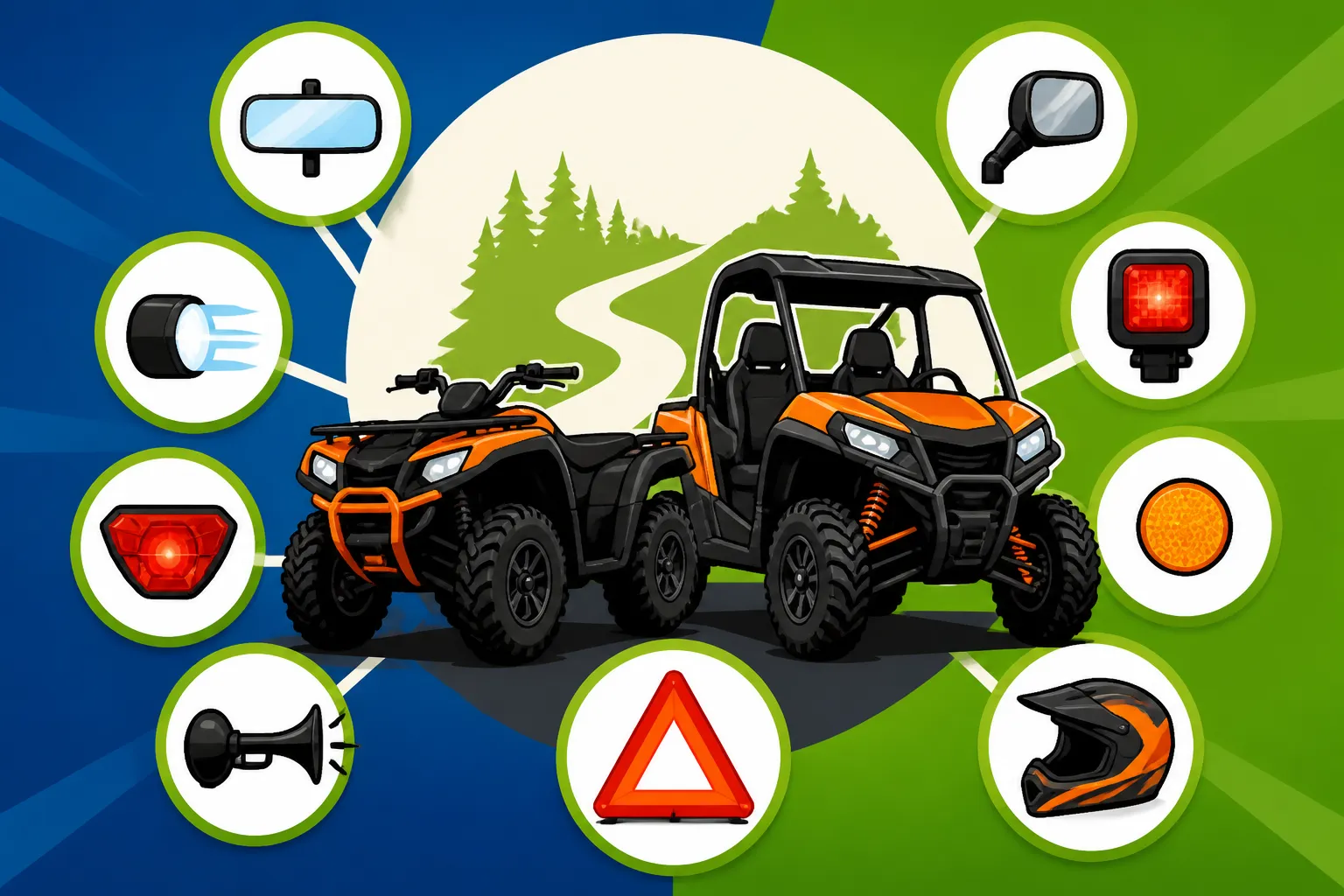
To help you keep track of all the requirements, here's a handy table summarizing the essential equipment for road-legal ATVs and Side-by-Sides (ROVs/MPVs) in Ontario. While many items are common to both, pay close attention to the specifics for occupant protection and visibility.
| Equipment Item | Requirement for ATV (Single Rider) | Requirement for Side-by-Side (ROV/MPV) | Notes |
|---|---|---|---|
| Headlights | At least one, white or amber, functional. | At least one, white or amber, functional. | Must be operational whenever riding on a road. |
| Taillights | At least one, red, functional. | At least one, red, functional. | Must be visible from a specified distance to the rear. |
| Brake Lights | At least one, red, functional, activates with brake application. | At least one, red, functional, activates with brake application. | Critical for signaling deceleration to following traffic. |
| Turn Signals | Functional, amber, front and rear visible. | Functional, amber, front and rear visible. | May require aftermarket installation for many models. |
| Hazard Lights | Recommended (often integrated with turn signals). | Recommended (often integrated with turn signals). | Useful for roadside stops or hazards. |
| Reflectors | Red to rear, amber to front/sides. | Red to rear, amber to front/sides. | Must be clean and unobstructed for passive visibility. |
| Braking System | Independent front/rear or combined, adequate stopping power. | Adequate stopping power for all wheels. | Must be in good working order, regularly inspected. |
| Parking Brake | Functional, capable of holding machine stationary. | Functional, capable of holding machine stationary. | Essential for safety when parked, especially on inclines. |
| Steering | Responsive, no excessive play. | Responsive, no excessive play. | Must allow for precise and predictable control. |
| Suspension | Functional, provides stability and control. | Functional, provides stability and control. | Ensures smooth ride and tire contact with road. |
| Tires | DOT-approved for highway use, correct pressure & load rating. | DOT-approved for highway use, correct pressure & load rating. | Check for DOT stamp on sidewall; off-road tires usually not suitable. |
| Horn | Functional, clearly audible warning device. | Functional, clearly audible warning device. | Must be loud enough to alert other road users. |
| Rearview Mirrors | At least one, providing clear view to rear. | At least one center and one side, providing clear view to rear/sides. | Essential for situational awareness in traffic. |
| Seat Belts | Not applicable (single-rider straddle machines). | Required for all seating positions. | Must be functional and used by all occupants. |
| Rollover Protection | Not applicable (ROPS/OPS not standard). | Integral ROPS/OPS must be intact and undamaged. | Provides occupant protection in event of rollover. |
| Muffler | Factory-equipped or equivalent, quiet operation. | Factory-equipped or equivalent, quiet operation. | No excessive noise; aftermarket exhausts must be street-legal. |
| Max. Width | N/A (generally narrower than 2.03m). | Not to exceed 2.03 meters (80 inches). | Measure from widest point (tires/fenders); wider machines are not road-legal. |
| Insurance & Registration | Mandatory, carry proof of both. | Mandatory, carry proof of both. | Non-negotiable legal requirements. |
| Driver's License | G2 or M2 minimum (typically). | G2 or M2 minimum (typically). | Operator must be 16+ years old with appropriate license; G1/M1 usually not sufficient. |
Disclaimer
This article is for general informational purposes only and does not constitute professional advice. Laws, prices and regulations vary by location and change over time. Consult a qualified professional for guidance on your specific situation.