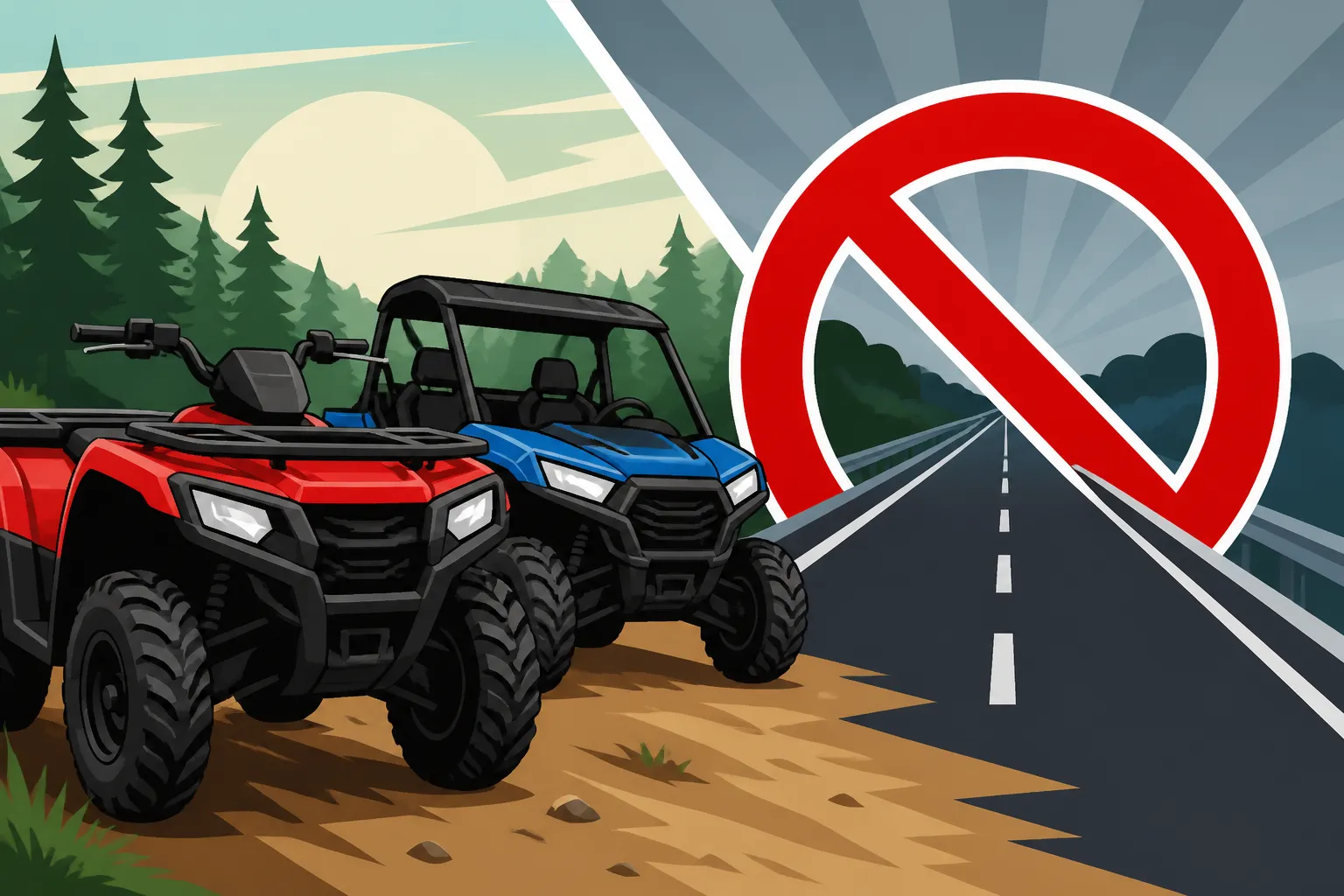
Ontario Highways Closed to ORVs
It’s a common scenario for many Ontario ATV and UTV enthusiasts: you’re out on a fantastic trail ride, the sun is shining, and you’re navigating some incredible terrain. Then, suddenly, your route hits a major provincial highway, forcing a detour or, worse, leaving you wondering if you can just quickly cross or even ride a short shoulder section. The frustration is real when you’re unsure where you can legally operate your off-road vehicle (ORV) versus where you absolutely cannot, especially when it comes to connecting trails or reaching a staging area. This guide is here to untangle the complexities of Ontario's rules regarding ORV access on our provincial highway network, helping you understand which highways are definitively off-limits and why.
The Core Restriction: What Makes a Highway Off-Limits?
Navigating Ontario's vast network of roads and trails with an off-road vehicle can sometimes feel like trying to solve a puzzle with missing pieces. Many riders, especially newcomers, often wonder why they can use some roads but are strictly prohibited from others, particularly major highways. It's not just about speed; it's deeply rooted in the province's legislative framework and the fundamental design and purpose of these different road classifications.
Understanding Ontario's Off-Road Vehicles Act ORVA
At the heart of the matter lies Ontario's Off-Road Vehicles Act (ORVA). This legislation is specifically designed to govern the operation of ATVs, UTVs, and other ORVs within the province. While it does allow for the use of ORVs on certain public roads, these allowances are very specific and come with strict conditions. The ORVA primarily defines where an ORV can be operated and under what conditions, always with an emphasis on safety for both the ORV operator and other road users.
Crucially, the ORVA does not grant blanket access to all roads. Instead, it creates a framework where municipalities can, through their own by-laws, open up certain sections of roads within their jurisdiction. However, this municipal authority generally stops at the boundaries of major provincial highways. These major arteries fall under a different legal umbrella, primarily regulated by the Highway Traffic Act (HTA), which has different provisions for the types of vehicles allowed and their operating conditions. The clash of these two acts, along with the physical design of the roads, is a major reason for the restrictions.
The Distinction Between Highways and Municipal Roads
For an ORV rider in Ontario, understanding the difference between a "highway" (in the provincial sense) and a "municipal road" is paramount. A municipal road is typically maintained by a city, town, township, or county. These are the roads where, provided a municipal by-law is in place, you might find specific sections open for ORV use, often connecting communities or linking to a trail network. Think of the smaller, often gravel or two-lane paved roads that wind through rural areas or the outskirts of towns. These roads are typically designed for lower speeds and less traffic volume.
Provincial highways, on the other hand, are part of a larger, interconnected network maintained by the Ministry of Transportation (MTO). These include everything from the major multi-lane 400-series highways to many King's Highways (like parts of Highway 7, 11, 17, etc.) that crisscross the province. These roads are engineered for high-speed, high-volume traffic, and often have limited access points. The fundamental difference in design, speed limits, and traffic flow makes them unsuitable for ORV operation, which is typically slower-moving and less robust in crash protection compared to conventional automobiles.
The Rationale Behind Highway Closures
The reasons for keeping ORVs off major provincial highways are multifaceted, focusing primarily on safety and traffic management. First and foremost is the significant speed differential. ORVs, even the most powerful UTVs, generally operate at much lower top speeds than the flow of traffic on a 400-series highway, where speeds can easily exceed 100 km/h. This speed disparity creates an extreme hazard, increasing the risk of rear-end collisions and making it incredibly difficult for other drivers to react in time. Imagine trying to merge or even just drive on a highway shoulder next to cars and trucks moving at such speeds; it’s a recipe for disaster.
Secondly, ORVs lack many of the safety features inherent in road-legal cars and trucks. They don't have the same crashworthiness, crumple zones, or advanced occupant protection systems designed for high-speed impacts. While [Ontario ATV Helmet Law] is mandatory, and side-by-sides often have seatbelts, these measures are primarily designed for off-road conditions, not for collisions with large vehicles at highway speeds.
Furthermore, these highways are designed for efficient, unimpeded movement of commercial and passenger traffic. Introducing slower-moving ORVs would disrupt this flow, creating bottlenecks and increasing the potential for accidents. The shoulders of these highways are also not intended for continuous travel; they are emergency lanes, and using them for routine ORV travel would compromise their effectiveness. It’s about maintaining the integrity and safety of a critical transportation network.
Specific Highway Designations That Exclude ORVs
When planning your off-road adventures in Ontario, it’s absolutely crucial to know which specific highway designations are outright forbidden for ORV use. This isn't a vague guideline; it's a hard and fast rule enforced by the province. Ignoring these prohibitions can lead to serious fines, impoundment of your machine, and putting yourself and others in grave danger.
The Infamous 400-Series Highways
Let's be unequivocally clear: all 400-series highways in Ontario are strictly off-limits to off-road vehicles. This includes the busy 401, the scenic QEW, the 400 up north, the 403, 404, 407, 409, 410, 416, 417, and every other highway in this series. These are multi-lane, controlled-access freeways designed for high-speed vehicular traffic. They are the backbone of Ontario's transportation network, connecting major cities and facilitating rapid movement of goods and people.
The design of these highways—their speed limits, the volume of traffic, and the sheer momentum of commercial trucks and passenger vehicles—makes them incredibly dangerous environments for an ORV. There are no safe shoulders for ORV travel, and merging or exiting would be an act of extreme recklessness. Even attempting to ride the shoulder for a short distance to connect a trail is a serious offence. Think about the speed differential: a transport truck travelling at 105 km/h encountering an ATV moving at 20 km/h (if it were even allowed to be there). The closing speed is immense, leaving virtually no time for evasive action. It's a risk no rider should ever contemplate taking.
Why Major Provincial Arteries Like the QEW Are Out
The Queen Elizabeth Way (QEW) is a prime example of a major provincial artery that falls squarely into the "forbidden" category. As a crucial link between Toronto, Hamilton, and the Niagara region, it's one of the busiest highways in North America. While it might not always carry the "400-series" numerical designation, its characteristics are identical: high-speed, high-volume, controlled-access, and utterly unsuitable for ORVs.
The same principles that apply to the 401 apply to the QEW: a critical lack of safety features for ORVs at these speeds, the profound speed differential with other traffic, and the potential for severe disruption to commercial and passenger flow. There's simply no provision in the Highway Traffic Act, nor in the design of the QEW, for off-road vehicles to operate safely or legally. Even if you needed to connect from one side of the QEW to the other for a trail, the only legal and safe way is to trailer your machine or find an alternative municipal road network that allows [Crossing a Provincial Highway Legally] at designated points.
Other Key Provincial Highways Where ORVs Are Banned
Beyond the 400-series and the QEW, many other King's Highways maintained by the MTO are also generally closed to ORVs. These include significant stretches of highways like:
- Highway 11: While some municipal by-laws might open very specific, short segments of older Highway 11 alignments or service roads, the main, high-speed thoroughfare is typically closed. [Parts of Highway 11 Open to Quads] refers to specific, designated, and usually very short sections, often older alignments, not the main highway.
- Highway 17: Similar to Highway 11, the main sections of Highway 17, especially those with high speed limits and heavy traffic, are off-limits. You might find a municipal by-law that allows you to cross it at an intersection or ride a very specific frontage road, but riding the main travel lanes or shoulder is prohibited. [Parts of Highway 17 Open to Quads] would similarly only apply to very limited, specific exceptions.
- Highway 60, Highway 28, etc.: Many other numbered provincial highways fall into this category. The general rule of thumb is: if it's a high-speed, busy provincial highway, assume it's closed unless you have explicit, verified information from a municipal by-law or the MTO stating otherwise for a very specific and limited section.
It’s never safe to assume. Always check with the local municipality or the OFATV (Ontario Federation of ATV Clubs) for detailed maps and legal access points. Attempting to ride on these prohibited provincial highways isn't just a matter of getting a ticket; it's a matter of life and death.
| Highway Type | ORV Access Status | Typical Speed Limits | Traffic Volume | Safety Risk for ORVs |
|---|---|---|---|---|
| 400-Series | CLOSED | 100-110 km/h | Very High | Extremely High |
| QEW | CLOSED | 100 km/h | Very High | Extremely High |
| Major King's Hwys | Generally CLOSED | 80-90 km/h | High | High |
| Municipal Roads | By-law Permitted | 50-80 km/h | Low to Moderate | Moderate |
| OFATV Trails | Permitted (Pass) | Varies, often <50 km/h | Low | Low |
Crossing Versus Riding: Navigating Major Roads
Understanding that major provincial highways are off-limits for riding is one thing, but what about those frustrating moments when a trail or municipal road crosses one? It's a common dilemma for riders in Ontario: you need to get from point A to point B, and a provincial highway sits squarely in your path. The key here is the distinction between riding along a highway and crossing it, and even then, there are very specific rules to follow.
Legal Requirements for Crossing a Provincial Highway
While you generally cannot ride on a provincial highway, the Off-Road Vehicles Act (ORVA) does make provisions for crossing them under strict conditions. This isn't a free-for-all, though. When [Crossing a Provincial Highway Legally], you must adhere to several crucial requirements:
- At a 90-Degree Angle: You must cross the highway at as close to a 90-degree angle as possible. This minimizes the amount of time you spend in the travel lanes and makes your intention clearer to oncoming traffic.
- Come to a Complete Stop: Before entering the roadway, you must come to a complete stop, just as you would at a stop sign or yield sign.
- Yield to All Traffic: You must yield the right-of-way to all traffic on the highway, both approaching and exiting. Only proceed when it is safe to do so and when you have a clear, unobstructed path across.
- Signal Your Intentions: Use appropriate hand signals (if your machine doesn't have turn signals or if they aren't clearly visible) to indicate your intention to cross.
- Use Available Shoulders/Medians: If the highway has wide, paved shoulders or a median, you may use these as a temporary staging point before crossing, but never for continuous travel.
- Direct Crossing: The crossing must be direct and expedient. You cannot travel down the highway shoulder or median for any distance before or after crossing.
- Equipment: Your ORV must be equipped with the necessary safety features for road use, even for a crossing. This includes proper lighting, brakes, and potentially mirrors, depending on the machine and local by-laws. For a UTV, ensuring your roll-over protection system is in good shape is critical.
It’s also important to remember that these crossing rules primarily apply to intersections where municipal roads or designated trails legitimately meet the provincial highway. You can't just pick a random spot to cross.
Designated Crossing Points and Safety Protocols
Ideally, ORV crossings of provincial highways should happen at designated points. These are often at controlled intersections with traffic lights, stop signs, or clear sightlines that allow for safer entry and exit. Many organized trail networks, like those maintained by the OFATV, will route their trails to cross provincial highways at the safest, legally permissible intersections. This often involves working with municipalities to ensure these points are recognized and, where possible, improved for ORV safety.
For instance, the OFATV (Ontario Federation of ATV Clubs) provides maps that often indicate these official crossing points. Utilizing these resources is key to safe and legal riding. If you’re unsure, it’s always better to find an alternate route, even if it means trailering your machine a short distance, than to risk an illegal or unsafe crossing. Remember, a quick glance might not give you the full picture of oncoming highway traffic, especially with faster vehicles. Visibility is paramount, and at night or in adverse weather, it becomes even more challenging. Accessories like high-quality LED light bars or auxiliary lights, perhaps from a brand like SuperATV, can drastically improve your visibility to other motorists, though they don't negate the need for caution and adherence to all rules.
Penalties for Illegal Highway Riding or Crossing
The consequences of illegally riding or crossing a provincial highway on your ORV in Ontario are severe and should not be underestimated. Enforcement officers, whether Ontario Provincial Police (OPP) or municipal police, are well aware of the rules and the dangers involved.
Penalties can include:
- Significant Fines: You could face substantial fines under both the Off-Road Vehicles Act and the Highway Traffic Act. These aren't minor parking tickets; they can run into hundreds or even thousands of dollars.
- Vehicle Impoundment: Your ORV could be impounded, leading to towing fees, storage fees, and the hassle of retrieving it, all at your expense.
- Licence Suspension: Depending on the severity of the offence and any prior history, you could face demerit points or even a suspension of your driver's licence.
- Insurance Implications: Operating your ORV illegally can void your insurance coverage, leaving you personally liable for any damages or injuries in the event of an accident. [Ontario Fines for No ATV Insurance] are already steep, but operating illegally amplifies the risk.
- Criminal Charges: In very serious cases, especially if reckless endangerment is involved or if an accident occurs, criminal charges could be laid.
It’s clear that the risks far outweigh any perceived convenience of illegally riding or crossing a provincial highway. Knowing the rules and adhering to them is not just about avoiding penalties; it’s about ensuring your safety and the safety of everyone else on the road.
The Limited Exceptions: Where Provincial Roads Might Be Open (and Why)
While the general rule is "no ORVs on provincial highways," Ontario's landscape of regulations is rarely black and white. There are indeed very specific, geographically limited exceptions where certain provincial roads, or parts thereof, might be open to ORVs. However, these are precisely that: exceptions, and they come with a raft of conditions and require a deep understanding of local bylaws and provincial regulations. It’s absolutely critical not to confuse these rare instances with a general green light.
Schedule B and the Ministry of Transportation
The primary mechanism for opening any part of a provincial highway to ORVs in Ontario is through Schedule B of Ontario Regulation 316/03, which falls under the Off-Road Vehicles Act. Schedule B is a list of specific sections of provincial highways where the Ministry of Transportation (MTO) has granted permission for ORVs to operate. This is not a blanket permission for an entire highway; it's painstakingly detailed, often listing specific kilometre markers or intersections.
The inclusion of a road segment on Schedule B is a careful and deliberate process. It usually involves a request from a municipality or a regional ORV club, followed by a thorough safety assessment by the MTO. They consider factors like traffic volume, speed limits, sightlines, the availability of safe shoulders, and the necessity of connecting a critical trail gap. It’s not something that happens lightly.
For example, you might find a very short section of an older King's Highway, which now acts more like a municipal road or a connecting piece between two trail systems, listed in Schedule B. However, these are typically lower-speed environments, often in northern or rural parts of the province where traffic is significantly less dense. The expectation is still that ORVs will operate safely, adhere to all rules, and likely connect to a legal trail or municipal road network almost immediately.
How Small Sections of Provincial Roads Get Opened
The process for getting a small section of a provincial road opened is intricate and locally driven. It usually begins with a local municipality identifying a critical gap in their ORV network that necessitates crossing or briefly using a provincial road. They then consult with local ORV clubs, like those under the OFATV umbrella, to understand the needs and potential safety concerns.
Once a need is established, the municipality or local ORV organization will submit a formal request to the MTO. This request typically includes detailed maps, traffic studies, and a justification for why the segment is necessary and how safety can be maintained. The MTO will then conduct its own engineering and safety assessments. If approved, the section is formally added to Schedule B.
It's vital for riders to understand that these opened sections are almost always:
- Short in Length: We're talking about a few hundred metres, or perhaps a kilometre or two, not vast stretches of highway.
- Low Speed: The speed limit on these specific sections might be reduced, or the road itself might be an older, lower-speed alignment.
- Clearly Marked: Legally opened sections are usually accompanied by specific signage indicating ORV access, often similar to [Ontario ATV Rules on a Municipal Road].
- Contextual: They serve a specific purpose, such as connecting two otherwise isolated trail segments or allowing access to a fuel station in a remote area.
These opened segments are not an invitation to ride indiscriminately on other parts of the provincial highway system. They are carefully managed exceptions to a broader prohibition.
Checking Local By-laws for Permitted Sections
Even if a section of a provincial road could theoretically be on Schedule B, its actual use by ORVs is often further refined and restricted by local municipal by-laws. This means that while the MTO might permit ORVs on a specific segment, the local municipality still needs to pass its own by-law to allow ORVs on the municipal roads leading up to and away from that provincial section.
Therefore, as a rider, your due diligence is twofold:
- Check Schedule B: You need to confirm that the specific provincial road segment is indeed listed in Schedule B of O. Reg. 316/03. The MTO website or relevant government publications are the authoritative source for this.
- Check Local Municipal By-laws: Just as importantly, you must confirm that the local municipality (the city, town, or township) has passed a by-law allowing ORVs on the connecting municipal roads. Many municipalities have specific rules about [Checking a Township's ORV By-law], including operating hours, speed limits, and which roads are open.
Without both these pieces of the puzzle in place, you cannot legally ride your ORV on that section of provincial road or the connecting municipal roads. The absence of one negates the other. It can be confusing, which is why organizations like the OFATV are invaluable resources for up-to-date trail maps and information on legal road access. They often compile and interpret these complex rules for riders, making it easier to plan a legal and enjoyable ride.
Planning Your Route: Avoiding Closed Highways
One of the biggest challenges for ORV riders in Ontario is navigating the patchwork of open and closed roads and trails. The constant need to avoid major provincial highways means that careful route planning isn't just a suggestion—it's an absolute necessity. Luckily, there are excellent resources and strategies available to help you enjoy Ontario's vast wilderness without running afoul of the law or putting yourself in harm's way.
Utilizing OFATV Trails and Municipal Road Networks
The backbone of legal ORV riding in much of Ontario is the extensive trail network maintained by the Ontario Federation of ATV Clubs (OFATV). With over [OFATV's 10,000 Ontario Kilometres] of trails, these networks are specifically designed for ORV use and often incorporate legally opened municipal roads. Buying an [Ontario ATV Trail Permit Cost] from the OFATV is your golden ticket to these trails.
When planning a ride, always prioritize OFATV-approved trails. These trails are maintained, signed, and, crucially, designed to navigate around or legally cross provincial highways. The OFATV also works closely with municipalities to get local road sections opened for ORV use, ensuring connectivity between trail segments.
Beyond the dedicated OFATV trails, many municipalities have their own bylaws that open specific municipal roads to ORVs. These are typically lower-speed roads, often gravel, that serve to connect communities or provide access to rural areas. When combined with OFATV trails, these municipal road networks can create extensive riding opportunities. Before you ride on any municipal road, always verify its status with the local municipality or check current OFATV maps, which often indicate these permitted road sections. Never assume a road is open just because it looks quiet or suitable for your machine. [Ontario ATV Rules on a Municipal Road] can vary significantly from one township to the next.
Trailering Your ORV to Designated Staging Areas
Given the widespread closure of provincial highways, trailering your ORV is often the most practical and safest way to access riding areas. Instead of trying to connect every single trail segment on your machine, plan to trailer your ATV or UTV to designated staging areas.
Many ORV clubs and trail systems have clearly marked staging areas with ample parking for trucks and trailers. These areas are specifically designed as starting points for rides, allowing you to unload your machine and hit the trails directly, bypassing any forbidden provincial highways. This approach offers several advantages:
- Safety: You avoid the inherent dangers of trying to ride on or near high-speed provincial highways.
- Legality: You ensure you're starting your ride from a legally permissible location, minimizing the risk of fines or impoundment.
- Convenience: Staging areas often have amenities like washrooms, picnic tables, and sometimes even fuel or food services nearby, making for a more comfortable start and end to your ride.
- Access: Trailering opens up access to remote or disconnected trail systems that would otherwise be impossible to reach legally on your machine.
Investing in a good trailer and ensuring your tow vehicle is up to the task is part and parcel of responsible ORV ownership in Ontario. For a UTV, especially one fitted with aftermarket accessories like heavy-duty bumpers or extra protection from a brand like SuperATV, finding a good trailer that can handle the weight and dimensions is key.
Tools and Resources for Route Planning
In this digital age, there's no excuse for getting lost or riding where you shouldn't. A variety of tools and resources are available to help you meticulously plan your ORV routes:
- QuadON App: The OFATV's official "QuadON" app is an invaluable resource. It provides up-to-date maps of all OFATV trails, including legally opened municipal road sections, and often highlights prohibited areas. You can download trails for offline use, which is essential given that cell service can be spotty in many remote riding areas.
- Club Websites and Maps: Each individual OFATV club maintains its own website, often with detailed maps of their specific trail systems. These maps are frequently more granular and can provide local insights into trail conditions, closures, and specific road access points.
- GPS Devices: A dedicated GPS unit preloaded with ORV trail maps is an excellent investment, especially for exploring new areas. Many units are rugged, waterproof, and designed for off-road use.
- Government Websites: The Ministry of Transportation (MTO) and municipal government websites are the official sources for regulatory information, including Schedule B listings and local by-laws. While less user-friendly for route planning, they are the definitive source for legal confirmation.
- Local Knowledge: Don't underestimate the value of local riders and clubs. Joining an OFATV club or participating in online forums can provide you with invaluable real-time information about trail conditions, recent by-law changes, and local nuances that might not be on a map yet.
By combining these resources, you can create a comprehensive riding plan that avoids all closed provincial highways, maximizes your legal trail time, and ensures a safe and enjoyable adventure.
Understanding the Safety and Environmental Concerns
The restrictions on ORV use on provincial highways aren't arbitrary; they are deeply rooted in legitimate safety concerns for all road users and a commitment to environmental protection. As responsible riders, understanding these underlying reasons helps us appreciate the rules and contributes to the long-term sustainability of ORV access in Ontario.
High-Speed Traffic and ORV Safety
The most immediate and obvious concern is the immense safety risk posed by mixing slow-moving ORVs with high-speed highway traffic. As we've discussed, provincial highways are engineered for vehicles traveling at 80 km/h and above. An ATV or UTV, even one capable of decent speeds, is not designed to operate safely in such an environment.
Consider the physics:
- Braking Distance: At highway speeds, the braking distance for a car or truck is substantial. An ORV, often lighter and with less robust braking systems compared to a car, would be a sudden, unexpected obstacle, significantly increasing the risk of a high-speed rear-end collision.
- Visibility: ORVs are smaller and sit lower than most highway vehicles, making them harder to see, especially in heavy traffic, at dusk, or in adverse weather conditions. Even with bright aftermarket lighting, like some robust options from SuperATV, it doesn't eliminate the inherent disadvantage.
- Crash Protection: While UTVs offer some rollover protection and seatbelts, and ATV riders wear helmets, these safety features are designed for off-road impacts, not collisions with vehicles weighing thousands of kilograms more at highway speeds. The outcome for an ORV operator in such a collision is almost invariably catastrophic.
- Operator Fatigue and Distraction: Highway driving demands constant vigilance. Drivers on highways are often conditioned to expect uniform speeds and vehicle types. An ORV suddenly appearing could cause momentary confusion, leading to dangerous swerving or braking.
These factors combine to create an unacceptable level of risk. The rules against ORVs on highways are, quite simply, life-saving measures.
Environmental Impact and Wildlife Protection
Beyond immediate safety, there are significant environmental considerations that contribute to the restrictions on ORV use, particularly on undeveloped land adjacent to highways or in environmentally sensitive areas. While highways themselves are paved and developed, they often traverse through or border natural habitats.
- Habitat Fragmentation: Highways already contribute to habitat fragmentation, making it difficult for wildlife to move safely. Allowing ORVs to further penetrate areas adjacent to highways could exacerbate this issue, increasing stress on wildlife populations.
- Erosion and Water Quality: Unauthorized ORV use, particularly in ditches, on embankments, or in natural areas near highways, can lead to soil erosion. This erosion can carry sediment and pollutants into nearby waterways, impacting aquatic ecosystems and water quality.
- Noise Pollution: While ORVs are generally louder than passenger cars, the focus here is on where that noise is produced. Unrestricted ORV use could disturb wildlife, especially during breeding or nesting seasons, in areas that might otherwise offer some refuge from highway noise.
- Vegetation Damage: Driving off designated trails can damage sensitive vegetation, including rare plants or young trees, disrupting ecosystems and potentially introducing invasive species.
- Waste Management: Unfortunately, some irresponsible individuals leave litter or dispose of waste improperly. Concentrated ORV use, if not managed, could lead to increased waste accumulation in roadside natural areas.
Responsible ORV operators are stewards of the land, and these rules help to ensure that riding occurs in designated areas where environmental impacts can be managed and mitigated. The objective is to balance recreational opportunities with the imperative to protect Ontario's natural heritage.
The Importance of Responsible Riding
Ultimately, understanding these safety and environmental concerns reinforces the importance of responsible riding. It's not just about following the letter of the law; it's about contributing to a positive image for the ORV community and ensuring that we can continue to enjoy our sport for years to come.
Responsible riding means:
- Adhering to all laws: This includes provincial acts, municipal by-laws, and specific trail rules.
- Staying on marked trails: Never deviate from designated paths, especially near highways or sensitive areas.
- Respecting private property: Always obtain permission before riding on private land. [Ontario ATV Trespass Rules] are serious.
- Minimizing impact: Ride cautiously, avoid excessive noise, and practice "tread lightly" principles.
- Proper equipment: Ensure your ORV is properly maintained and equipped with all necessary safety gear, from a well-fitting helmet to appropriate lighting.
- Being a good ambassador: Your actions reflect on the entire ORV community.
By embracing these principles, we can all play a part in promoting safe, legal, and environmentally conscious ORV recreation in Ontario, ensuring that the privilege of riding is sustained for future generations.
What if You Encounter a Closed Highway Accidentally?
Despite the best intentions and meticulous planning, sometimes things go awry. You might make a wrong turn, a trail might unexpectedly lead to a highway, or you might simply misread a map. Discovering you've accidentally ridden onto a prohibited provincial highway can be a moment of panic. Knowing exactly what to do in such a situation is crucial for your safety and to minimize potential legal repercussions.
Immediate Steps to Take
If you find yourself on a provincial highway where ORVs are prohibited, your immediate priority is safety, followed by getting off the highway as quickly and safely as possible.
- Stay Calm and Assess Your Surroundings: Panicking can lead to rash decisions. Take a deep breath and quickly evaluate the traffic situation around you.
- Move to the Shoulder (If Safe and Available): If there's a paved shoulder, carefully and slowly move your ORV onto it, as far to the right as possible, away from the active travel lanes. Use your signals to indicate your movement.
- Do NOT Attempt High Speeds: Your ORV is not designed for highway speeds, and attempting to keep up with traffic is incredibly dangerous. Maintain a slow, controlled speed on the shoulder, ideally walking speed, as you look for an exit.
- Look for the Nearest Safe Exit: Your goal is to get off the highway at the very first safe and legal opportunity. This could be an exit ramp, a cross-road, or a service road. Do not try to travel a long distance on the shoulder.
- Signal Clearly: When you see a safe exit, signal your intention well in advance and exit the highway as you would in a regular vehicle.
- Avoid Re-entry and Seek Alternative Routes: Once off the highway, re-evaluate your route. Use your maps or GPS to find a legal municipal road or trail that will take you where you need to go, even if it means a significant detour or trailering your machine.
Under no circumstances should you try to turn around in traffic, drive against the flow, or attempt to cross multiple lanes to get to an exit far away. The goal is to minimize your time on the dangerous highway environment.
Potential Fines and Enforcement
Even an accidental entry onto a prohibited provincial highway can lead to serious consequences if you are observed by law enforcement. Ignorance of the law is generally not considered a valid defense. [What an Ontario Officer Checks Roadside] includes validating your permit, insurance, and the legality of where you are riding.
Potential fines and penalties for riding on a prohibited provincial highway include:
- Offences Under the Off-Road Vehicles Act: You can be charged with operating an ORV on a prohibited highway, which carries significant fines.
- Offences Under the Highway Traffic Act: Depending on your actions, you could also face charges under the HTA, such as operating a vehicle not designed for the highway, improper use of the shoulder, or other traffic infractions.
- Vehicle Impoundment: It is highly likely your ORV will be impounded, resulting in towing and storage fees that you will be responsible for. This can be a costly and time-consuming ordeal.
- Licence and Insurance Impact: Repeated offences or particularly egregious actions could impact your driver's licence and your insurance rates. [The Motor Vehicle Liability Policy Ontario Wants] requires you to operate legally.
Enforcement officers prioritize public safety. When they see an ORV on a provincial highway, they recognize the extreme danger it poses and will act swiftly to remove the hazard and apply appropriate penalties.
The Importance of Knowing the Rules Before You Go
This scenario underscores the critical importance of diligent route planning and having a thorough understanding of Ontario's ORV regulations before you even start your ride. Relying solely on memory or assuming a route is legal can lead to these dangerous and costly encounters.
- Pre-Trip Planning: Always take the time to study your maps, whether paper or digital, and cross-reference them with official OFATV or municipal sources. Identify all known provincial highway crossings and ensure they are legal.
- Download Offline Maps: Cell service can be non-existent in many of Ontario's beautiful riding areas. Download digital maps to your phone or GPS device so you always have access to your route and current regulations, even without a signal.
- Stay Updated: Regulations can change. Periodically check OFATV news, municipal websites, or government resources for updates to by-laws or Schedule B listings.
- If in Doubt, Don't Go: If you are unsure about the legality of a particular road or crossing, err on the side of caution. It's always better to find an alternative route or trailer your machine than to risk breaking the law or, more importantly, your safety.
A proactive approach to understanding and adhering to the rules will not only prevent accidental highway encounters but also contribute to a safer and more enjoyable riding experience for everyone in Ontario.
The Future of ORV Access on Ontario Roads
The landscape of ORV access in Ontario is not static; it's a dynamic environment shaped by ongoing discussions, advocacy, and evolving policy. While major provincial highways remain largely off-limits, the conversation around ORV integration on other types of roads, and even limited provincial corridors, continues. Understanding these discussions gives us insight into the potential future of riding opportunities in the province.
Ongoing Advocacy and Policy Changes
The Ontario Federation of ATV Clubs (OFATV) and other rider organizations play a crucial role in advocating for ORV riders. They continuously engage with the provincial government, the Ministry of Transportation (MTO), and individual municipalities to expand legal riding opportunities. Their advocacy efforts are often focused on:
- Connecting Trail Networks: A primary goal is to close gaps in existing trail systems, which sometimes means seeking permission to use short, low-traffic sections of provincial roads or to establish new, safe crossing points.
- Clarifying Regulations: Advocacy also involves working to simplify and clarify the complex web of provincial acts and municipal by-laws, making it easier for riders to understand where they can legally ride.
- Promoting Economic Development: ORV tourism is a significant economic driver for many rural communities. Advocacy groups highlight this benefit to encourage greater ORV access, arguing that well-regulated ORV use brings dollars to local businesses.
- Enhancing Safety: While advocating for more access, these groups also emphasize safety, promoting rider training (like the voluntary [Ontario Rider Training and Why It Is Voluntary] programs) and responsible riding practices.
Policy changes, while often slow, do occur. For instance, the general framework for [Riding an ATV on Ontario Roads] has evolved over the years, with more municipalities opting in. This demonstrates a willingness to adapt, albeit cautiously, to the growing popularity of ORV recreation.
Pilot Projects and Municipal Engagement
One way new access is explored is through pilot projects. These are temporary, experimental programs designed to test the feasibility and safety of ORV access on specific road types or in certain areas. For example, a municipality might propose a pilot project to allow ORVs on a specific section of a regional road that connects two significant trail systems. If the pilot project proves successful, demonstrating minimal safety incidents and positive community impact, it can pave the way for permanent regulatory changes.
Municipal engagement is absolutely critical in this process. While the province sets the overarching framework, it's the local municipalities that have the power to open their own roads to ORVs. [Asking a Council to Open a Road] is a common strategy for local clubs and riders. This involves:
- Presenting a Case: Riders and clubs present data on economic benefits, safety plans, and how ORV access aligns with community goals.
- Addressing Concerns: They work to address concerns from residents, environmental groups, and other road users.
- Drafting By-laws: If approved, the municipality drafts and implements a new by-law, specifying which roads are open, what hours, and under what conditions (e.g., [Ontario's 20 and 50 km/h Speed Limits]).
This localized approach means that ORV access will continue to vary significantly across Ontario. What's permissible in one township, such as [Greater Napanee By-law 2022-0062], might be prohibited just across the border in another.
The Role of Rider Education
As ORV access potentially expands, the role of rider education becomes even more paramount. Increased access comes with increased responsibility. Well-informed and safety-conscious riders are essential for demonstrating that ORVs can be integrated safely and respectfully into public spaces.
Rider education covers a wide range of topics:
- Rules and Regulations: A deep understanding of provincial acts, municipal by-laws, and trail rules is foundational.
- Safe Operating Practices: This includes proper machine control, hazard avoidance, and group riding etiquette.
- Environmental Stewardship: Educating riders on how to minimize their environmental footprint is crucial for maintaining access to natural areas.
- Mechanical Knowledge: Understanding your machine and performing pre-ride checks, especially for road-legal equipment (like proper mirrors from SuperATV or compliant lighting), is part of being responsible.
By actively participating in rider education, supporting advocacy efforts, and engaging positively with local communities and governments, the ORV community can collectively work towards a future where responsible riding opportunities continue to grow in Ontario, always within a framework of safety and environmental respect. The key is continuous dialogue, adaptation, and a shared commitment to safe and sustainable recreation.
Disclaimer
This article is for general informational purposes only and does not constitute professional advice. Laws, prices and regulations vary by location and change over time. Consult a qualified professional for guidance on your specific situation.