Ontario ATV Width Limit for Road Use
Riders in Ontario often find themselves scratching their heads, wondering if their beloved ATV or UTV is actually legal to take on the roads. It's not just about having a plate and insurance; there are specific dimensional requirements that can trip up even experienced enthusiasts. One of the biggest head-scratchers is the width limit, especially with so many fantastic side-by-sides on the market that push the boundaries. This guide is here to clear up all that confusion, walking you through Ontario's specific width rules for road-legal off-road vehicles (ORVs) and what you need to know to stay on the right side of the law.
Understanding Ontario's Width Limit for Road-Legal ORVs
Navigating the rules for riding your off-road vehicle on Ontario roads can feel like traversing a particularly tricky trail – confusing and full of unexpected turns. One of the most common questions, especially for those with larger side-by-sides, revolves around the width of their machine. You might be perfectly set up for the trails, but what about the pavement?
The Specific Measurement: What 2.03 Metres Really Means
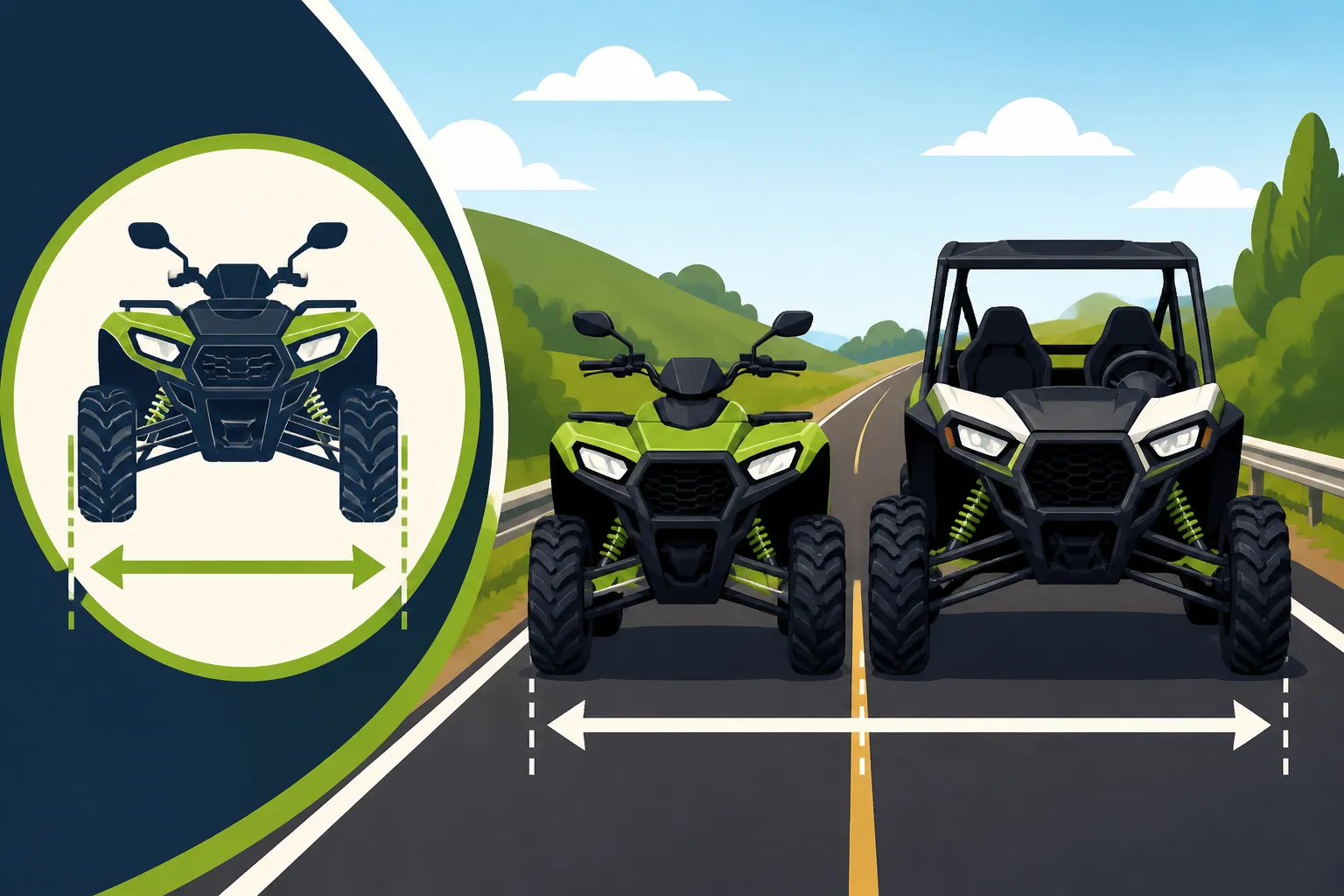
Let's get straight to the point: for many off-road vehicles (specifically Recreational Off-Highway Vehicles, or ROVs, which often include side-by-sides), Ontario legislation sets a maximum width of 2.03 metres (or approximately 80 inches). This isn't just a suggestion; it's a hard limit that can dictate whether your machine is allowed on municipal roads where ORVs are permitted. It's a critical measurement that often catches people off guard, especially if they've added wider tires, aftermarket wheels with different offsets, or even certain fender flares.
Why this specific number? Well, it boils down to road safety and the practicalities of sharing public roadways. Ontario's road infrastructure, from lane widths to shoulder clearances, is designed with conventional vehicles in mind. An ORV exceeding this width could pose a risk, making it harder for other vehicles to pass safely, potentially encroaching on oncoming traffic lanes, or simply not fitting comfortably within designated road shoulders. The goal is to integrate ORVs into the road system without creating undue hazards for other road users. It's all part of the larger framework governed by [The Off-Road Vehicles Act and Ontario Riders].
Which Machines Are Affected by the Width Cap?
While many traditional ATVs (quads) naturally fall within this 2.03-metre limit, it's typically the UTVs, or side-by-sides, that face the most scrutiny regarding width. Modern side-by-sides are often designed for aggressive off-road performance, which can mean wider stances, longer suspension travel, and substantial tire packages. Many factory models, especially sport-oriented UTVs, can push right up against or even exceed that 80-inch mark from the dealership floor.
For single-rider ATVs, it's less common to run into this issue unless significant modifications have been made to widen the track. However, if you've put on a lift kit, offset wheels, or extra-wide tires, you'll still need to measure. If your machine is classified as an ROV, this width restriction absolutely applies. Understanding the difference between these classes is crucial, as outlined in articles like [Ontario UTV Road Rules] and [Ontario Side-by-Side Road Rules]. It’s easy to assume "it's an ORV, so it's street legal," but the devil is truly in these dimensional details.
Why This Limit Matters: Safety, Legality, and Your Ride
It's natural to feel a bit frustrated by what might seem like arbitrary rules, especially when you just want to enjoy your machine. But the 2.03-metre width limit isn't there to make your life harder; it's a fundamental part of ensuring safety for everyone on the road and maintaining the legality of ORV use on public thoroughfares in Ontario.
The Rationale Behind the Width Restriction
Think about driving down a typical two-lane rural road. There isn't always a wide, paved shoulder, and sometimes there's no shoulder at all, just a ditch. If your ORV is too wide, it becomes incredibly difficult to pull over safely to allow faster traffic to pass. It also means you're taking up more of the lane, which can lead to uncomfortable and potentially dangerous situations when encountering oncoming vehicles, especially large trucks or buses.
This width restriction directly addresses these concerns, promoting safer interactions between ORVs and other vehicles. It helps ensure that ORVs can operate without unduly encroaching on the space needed by other road users, reducing the risk of collisions and near misses. The rules are designed to facilitate ORV access to roads in a controlled manner, supporting the idea of shared use rather than creating conflicts. This is also why we have specific rules around [Ontario's 20 and 50 km/h Speed Limits] for ORVs on roads – it's all about responsible integration.
Consequences of Exceeding the Width Limit
Ignoring the width limit isn't just a minor infraction; it can lead to serious consequences that could quickly put an end to your ride, and potentially lighten your wallet considerably. If a law enforcement officer determines your ORV exceeds the prescribed width while you're operating it on a public road, you could face significant fines. These aren't slap-on-the-wrist tickets; they can be substantial, reflecting the safety concerns associated with an oversized vehicle on public roads. It's similar to the penalties for other serious issues, like riding without proper coverage, as discussed in [Ontario Fines for No ATV Insurance].
Beyond the immediate financial penalty, there's the critical issue of insurance. Many insurance policies have clauses that require you to operate your vehicle in accordance with all provincial and municipal laws. If your machine is found to be non-compliant due to its width, your insurance company could potentially deny a claim in the event of an accident. Imagine getting into a fender-bender or worse, and then finding out your insurance is void because your machine was too wide to be legally on the road in the first place. That’s a nightmare scenario no rider wants to face. It underscores the importance of having proper [Ontario ATV Insurance Requirement] and ensuring your machine meets all legal criteria.
Furthermore, an ORV that doesn't meet the dimensional requirements might not even be considered an "ORV" for the purposes of road-use regulations. This could lead to further complications, as it wouldn't fit the legal definition under which permits and road access are granted. It's a risk simply not worth taking.
Measuring Your Machine and Ensuring Compliance
So, you're clued in on the importance of the 2.03-metre width limit. Now, how do you make sure your particular machine is compliant? It's not always as simple as a quick glance, especially with modifications or different tire setups.
How to Accurately Measure Your ATV or UTV
To accurately measure your ATV or UTV, you need to find the absolute widest point of the machine. This almost always means measuring from the outermost edge of one tire to the outermost edge of the corresponding tire on the opposite side. However, don't forget to account for any other protruding elements that might be wider, such as:
- Fender flares: Some aftermarket or factory flares extend beyond the tires.
- Wheel spacers: If you've added these for a wider stance, they directly impact your overall width.
- Aggressive tire treads: The sidewall bulge or knobby tread design can add fractions of an inch that accumulate.
- Mirrors or other mounted accessories: While typically not the widest point, double-check if they protrude significantly.
Here’s a simple process for measuring:
- Park on a level surface: This ensures an accurate measurement without any tilt affecting the perceived width.
- Use a long, rigid measuring tape or a straight edge: A fabric tape measure can sag and give an inaccurate reading. A long metal tape measure or even a straight piece of lumber held horizontally, with a ruler to measure the gap, works well.
- Measure from the widest point: This is typically the outside edge of the tire, or the outermost part of the fender flare, whichever extends further. Do this for both sides of the vehicle.
- Take multiple measurements: Measure at the front and the rear of the machine, as some vehicles might be wider at one end than the other. Use the largest measurement you get.
For example, if you've added a lift kit and a wider stance for better stability on the trails, or perhaps specific wheels from a company like SuperATV that offer different offsets, you absolutely must re-measure. Those small changes can easily push a UTV from compliant to non-compliant. Always measure before you attempt to ride on any public road. This step is just as crucial as ensuring you have the right [Measuring Your Machine Before a Road Ride].
What to Do if Your Machine Exceeds the Limit
Finding out your machine is too wide for road use in Ontario can be disheartening, but you have a few options, though some are more practical than others:
- Keep it off-road: The simplest solution is to accept that your particular ORV is strictly a trail machine. This might mean trailering it to and from your favourite riding spots instead of riding it down the concession road.
- Modify (if feasible and safe): In some very specific cases, you might be able to reduce the width of your machine. This could involve changing to narrower tires, removing wheel spacers, or even replacing wheels with a different offset. However, be extremely cautious with this approach. Modifying your machine's stance can impact its stability and handling, potentially making it less safe, especially at higher speeds or on uneven terrain. Always prioritize safety and consult with experts if you're considering such changes. Remember, many wider UTVs are designed that way for specific performance characteristics, and trying to "shrink" them for road legality might compromise their intended function.
- Check local municipal bylaws (but don't rely on it for width): While some municipalities have opened their roads to ORVs, and may have specific seasonal or time-of-day restrictions, it is highly unlikely they would override a provincial dimensional limit like the 2.03-metre width. [Ontario Municipalities That Opened Their Roads] typically do so under the provincial framework, which includes these width restrictions. Always check the specific by-law for the area you plan to ride, but assume the provincial width limit is non-negotiable.
Ultimately, if your recreational UTV exceeds the 2.03-metre width, your safest and most legally sound option is often to limit its use to private property and designated off-road trails.
Different ORV Classes and Their Width Considerations
Ontario's Off-Road Vehicles Act doesn't treat all off-road machines the same. Understanding the different classifications is key, as the width limit primarily impacts certain types more than others. This is particularly relevant when discussing the difference between a traditional ATV and a larger side-by-side.
ATVs, ROVs, and MPVs: Decoding the Definitions
When we talk about ORVs in Ontario, we're generally referring to a few distinct categories, and the width limit often pertains most critically to the "ROV" class:
- ATV (All-Terrain Vehicle): This typically refers to a four-wheeled (sometimes three-wheeled) motorized vehicle designed for off-road use, where the operator straddles the machine like a motorcycle. Most ATVs, even those with powerful engines, fall comfortably within the 2.03-metre width limit. So, for many traditional quad riders, width isn't usually their primary concern for road legality.
- ROV (Recreational Off-Highway Vehicle): This is where side-by-sides, also known as UTVs, typically fit. These are multi-wheeled vehicles with side-by-side seating, a steering wheel, and often a roll-over protection structure. Many modern ROVs, especially sport or utility models, are designed with a wider stance for stability and performance. This is the category where the 2.03-metre (80-inch) width limit is most frequently encountered and exceeded. If you're wondering [Why a Side-by-Side Is an ROV, Not an ATV], it often comes down to seating, controls, and yes, width.
- MPV (Multi-Purpose Off-Highway Vehicle): These machines are generally heavier, wider, and designed for utility purposes, often used in agriculture or construction. They have different weight and width limits, generally being allowed to be much wider than an ROV. However, these are not typically what recreational riders are using for trail riding or casual road excursions. They fall under a separate regulatory framework, and their road use is usually restricted to specific scenarios. For recreational riders, focusing on the ATV and ROV categories is most pertinent, but it's worth knowing that the MPV class exists with its own rules, including those for [Ontario's MPV Class and Its Weight Limit].
To clarify, here's a quick overview of how these classes generally relate to width for road use in Ontario:
| ORV Class | Description | Typical Width Concern for Road Use | Road Use Width Limit (ROV) |
|---|---|---|---|
| ATV | Straddle-style, typically 3 or 4 wheels, handlebars. | Generally not an issue. | N/A (usually much narrower) |
| ROV | Side-by-side seating, steering wheel, roll-over protection (e.g., UTVs). | High concern. | 2.03 metres (80 inches) |
| MPV | Utility-focused, heavier, wider, often for agriculture/industrial use. | Varies, but has different rules. | Specific to MPV class |
This table simplifies things, but always refer to the specific provincial regulations to understand the full scope of each class.
When a Wider Machine Can Still Be Road-Legal (and When it Can't)
For recreational riders primarily using ATVs and ROVs, the rule of thumb is quite clear: if your side-by-side (ROV) is over 2.03 metres wide, it's not considered road-legal under the standard provincial regulations that permit ORVs on certain municipal roads. There are no special "waivers" or exceptions for recreational ROVs simply because they are built wider from the factory or modified with common aftermarket parts.
It's important to differentiate this from MPVs, which, as mentioned, are designed for different purposes and have a separate set of rules that allow for greater dimensions. A very large, industrial UTV or purpose-built work vehicle might exceed 2.03 metres and still be legally operated on roads, but it would be classified as an MPV and meet those specific criteria, which are much stricter about speed, equipment, and areas of operation. This distinction is crucial, because a recreational side-by-side cannot simply "identify" as an MPV to bypass the width restriction. The specific criteria for [What Ontario Counts as an ATV on a Road] versus an ROV or MPV are very clearly defined in the Off-Road Vehicles Act and its associated regulations.
When considering aftermarket accessories, always keep width in mind. Even something as seemingly innocuous as an aggressive mud tire or a SuperATV bolt-on fender flare can add precious inches. While these additions might be fantastic for off-road performance, they need to be factored into your total width if you plan to hit the pavement. It's often the small, cumulative changes that push a machine past the legal limit without the owner even realizing it until a tape measure comes out.
So, while it might feel restrictive, this width limit is a key component of Ontario's approach to integrating ORVs onto its roads safely and responsibly. Knowing your machine's dimensions is just as important as knowing your route.
Understanding Ontario's ORV width limit is truly essential for any rider who dreams of connecting trails via municipal roads. While it might seem like a small detail, that 2.03-metre mark (80 inches) holds immense power over your machine's road legality. Taking the time to accurately measure your ATV or UTV, especially if it's a side-by-side or has aftermarket modifications, can save you from hefty fines, insurance headaches, and the disappointment of being pulled over. Ride smart, ride safe, and always be informed!
Disclaimer
This article is for general informational purposes only and does not constitute professional advice. Laws, prices and regulations vary by location and change over time. Consult a qualified professional for guidance on your specific situation.