Carrying a Passenger on a Two-Up Quad in Ontario
There’s nothing quite like sharing the thrill of an Ontario ATV ride with a friend or loved one, but for many riders, the question of whether it's actually legal to carry a passenger on their quad creates a real headache. You’ve got a "two-up" machine, it clearly has a passenger seat, but navigating Ontario's rules can feel like trying to cross a beaver pond without getting wet. This guide will clarify everything you need to know about legally and safely carrying a passenger on your two-up ATV or UTV in Ontario, making sure your shared adventures are always above board.
Understanding Ontario's "Two-Up" ATV Definition
The world of off-road vehicles (ORVs) can be a bit of a maze, especially when it comes to official classifications. What you call a "quad" or a "side-by-side" might fall under different legal definitions in Ontario, and these distinctions are absolutely crucial when you want to bring a passenger along for the ride. It's not just about whether your machine has a second seat; it's about whether it was designed to accommodate one safely and legally in the eyes of the law.
The Dedicated Passenger Seat: More Than Just a Padded Rack
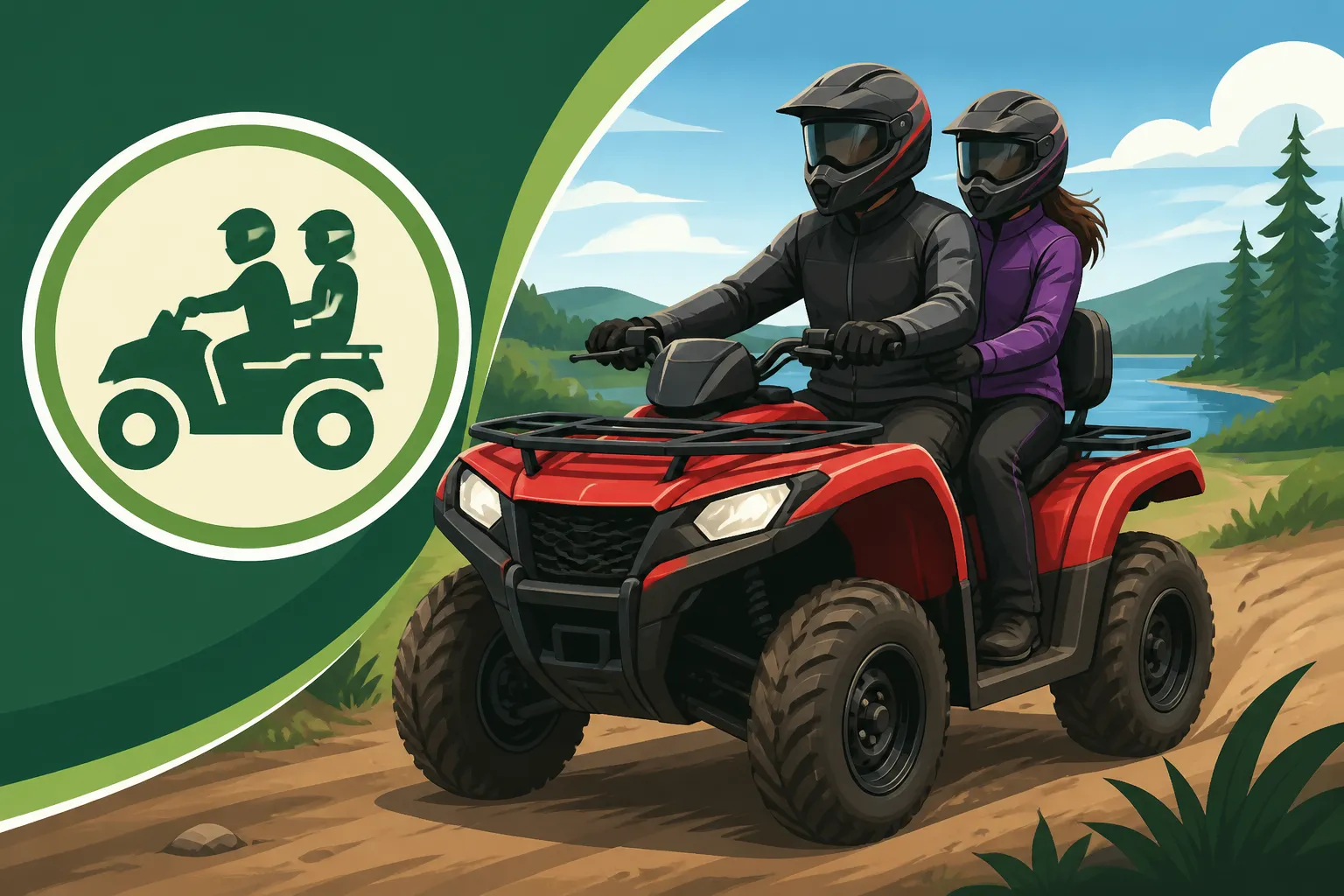
When we talk about a "two-up" or "tandem" ATV, we're specifically referring to an all-terrain vehicle that has been manufactured with a designated seat for a second person behind the driver. This isn't just a bungee-corded cushion on your rear rack, nor is it a make-shift setup. These machines are engineered from the ground up to safely support the weight of two individuals, often featuring a longer wheelbase, heavier-duty suspension, and specific footrests and handholds for the passenger. Think of popular models like the Can-Am Outlander MAX or Polaris Sportsman Touring — they are explicitly designed for two riders.
The critical difference here lies in the manufacturer's intent and design. A standard, single-rider ATV, even if it has a large rear rack, is not legally permitted to carry a passenger in Ontario. The frame, suspension, and balance points are all calibrated for one person. Adding a passenger to a single-rider machine dramatically alters its handling characteristics, making it significantly more unstable and dangerous, especially on uneven terrain or during quick manoeuvres. This distinction is paramount for both your safety and avoiding hefty fines.
If you're unsure if your machine qualifies, look for clear indicators from the manufacturer: a separate, elevated passenger seat, dedicated passenger footrests that are not part of the driver's floorboards, and solid handholds for the passenger to grip. Without these, even if you’ve somehow managed to create a second seating area, your machine will likely be deemed a single-rider ATV by an enforcement officer, and carrying a passenger would be considered illegal.
What Ontario Considers an ATV vs. an ROV (Side-by-Side)
Ontario's Off-Road Vehicles Act uses specific terminology that influences passenger rules. ATVs generally refer to all-terrain vehicles where the rider straddles the seat, like a motorcycle. Within the ATV category, you have single-rider quads and the purpose-built "two-up" tandem ATVs we've just discussed.
Then there are Recreational Off-Highway Vehicles (ROVs), which most of us call side-by-sides or UTVs. These are distinct from ATVs because the occupants sit side-by-side, often in bucket seats, and are typically enclosed within a roll-over protective structure (ROPS) with seatbelts. The rules for carrying passengers in an ROV are different because the design inherently offers different safety features. For an ROV, carrying the number of passengers for which the machine was designed and equipped (i.e., with factory-installed seats and seatbelts) is generally permitted, provided everyone follows the safety regulations like wearing helmets and using seatbelts. This means a three-seater side-by-side can carry three people if it has three seats and three seatbelts.
The key takeaway is to know what type of ORV you actually own according to Ontario’s definitions. If you have a true two-up ATV, you're looking at specific rules for that machine. If you have an ROV (side-by-side), its passenger capacity is determined by its design and safety features. Trying to fit more people than the machine was designed for, regardless of whether it's an ATV or ROV, is a recipe for trouble, both legal and safety-wise. [The ATV Class Under Ontario Regulation 316/03] provides more details on these classifications.
The Rules of the Road: Passenger Permitted Riding in Ontario
So, you’ve got a legitimate two-up ATV or a multi-passenger UTV. That's a great start! But simply owning the right machine doesn't automatically mean you can take a passenger anywhere you please. Ontario has specific regulations governing where and how you can ride with a passenger, particularly when you venture onto public roads or designated trail systems. It's about respecting the law and ensuring everyone's safety, not just your own.
Road Riding with a Passenger: Municipal By-laws and Provincial Highways
Riding an ATV on Ontario roads is a privilege, not a right, and it comes with strict conditions, especially for passengers. First and foremost, the road must be open to ORVs by a municipal by-law or be one of the few designated provincial highways. [Ontario ATV Rules on a Municipal Road] delves into this in detail. If the road isn't open, you can't ride on it, with or without a passenger.
For two-up ATVs specifically designed to carry a passenger, you are permitted to have a passenger on these open roads, provided all other conditions are met. This includes the driver holding the appropriate license (at least a G2 or M2), both riders wearing approved helmets with the chin strap fastened, and the machine being properly registered, plated, and insured. The passenger must also be able to reach the designated footrests and handholds designed for them. You can't just have a small child dangling their legs because they can't reach the pegs. When riding on these municipal roads, you are generally subject to speed limits of 20 km/h where the posted limit is 50 km/h or less, and 50 km/h where the posted limit is over 50 km/h.
Side-by-sides (ROVs) also have rules for road use. They must meet specific width and weight limits, and passengers must be properly restrained with seatbelts in addition to wearing helmets. While it might seem convenient to pop down a municipal road with a friend, always double-check the local by-laws. Some municipalities, even if they open roads to ORVs, might have specific restrictions on passenger age or type of machine. Ignoring these rules can lead to significant fines. [Are ATVs Street Legal in Ontario?] outlines many of these complexities.
Trail Systems and Crown Land: Sharing the Ride
When it comes to Ontario's vast trail systems, the rules for carrying a passenger on a two-up ATV are generally more straightforward, but still require adherence to safety and permit regulations. Most organized trail systems, particularly those managed by clubs under the Ontario Federation of ATV Clubs (OFATV), welcome properly equipped two-up ATVs with passengers. Your OFATV trail permit covers both the driver and the passenger on a designated two-up machine.
However, the safety considerations remain paramount. The passenger must still wear an approved helmet, be able to reach the footrests, and use the handholds. The driver must also adjust their riding style to account for the extra weight and higher centre of gravity. Technical trails that are challenging for a single rider can become significantly more difficult and dangerous with a passenger. It’s always best to start on easier trails and gradually work your way up. Organizations like SuperATV offer a range of accessories, from comfortable passenger grab handles to robust skid plates, which can enhance both safety and enjoyment for two-up riding, especially on challenging terrains.
On Crown Land, where "free use" policies often apply, the general rules regarding two-up machines still hold. If your ATV is designed for two, and you both meet the helmet and age requirements (more on age below), you can generally ride with a passenger. However, always be mindful of specific restrictions on Crown Land, such as those related to environmental protection areas, hunting zones during certain seasons, or areas closed for logging. Always ensure your machine is registered and insured, even if you’re riding exclusively on Crown Land. [Where to Ride an ATV in Ontario] offers insights into various riding locations.
Safety First: Essential Gear and Practices for Two Riders
Bringing a passenger along for an ATV ride exponentially increases the responsibility on the driver. It's not just about compliance with laws; it's about making sure both of you return home safely after an exhilarating day on the trails. Neglecting safety can turn a fun outing into a serious accident.
Helmets, Foot Rests, and Hand Holds: Non-Negotiables for Passengers
No matter where you're riding in Ontario – road, trail, or even private property – an approved helmet is non-negotiable for both the driver and the passenger. This isn't just a suggestion; it's the law. The helmet must be properly fitted, securely fastened with the chin strap, and meet safety standards such as DOT, Snell, or ECE. A poorly fitting helmet or one with an unbuckled strap is as good as no helmet at all in a crash. [Ontario ATV Helmet Law] reinforces this critical requirement.
Beyond helmets, a passenger on a two-up ATV must have access to dedicated footrests and handholds. These aren't just for comfort; they are essential for the passenger to maintain their balance and stability, especially over rough terrain or during sudden acceleration or braking. Imagine trying to stay seated on a bucking bronco without stirrups or a saddle horn – that's what a passenger without proper footrests and handholds experiences. The passenger needs to be able to brace themselves effectively. If your passenger cannot comfortably and securely reach these, they shouldn't be riding, regardless of their age. Aftermarket solutions from brands like SuperATV can sometimes provide ergonomic improvements if the factory setup isn't quite right for your passenger, but ensure any modifications are securely installed and do not compromise the machine's safety.
For UTVs (side-by-sides), the safety requirements extend to seatbelts and a roll-over protective structure (ROPS). Passengers must be securely buckled into the factory-installed seatbelts at all times. The ROPS provides a critical layer of protection in the event of a roll-over, making seatbelt use even more vital. Always inspect your machine's safety features before each ride, especially if you're carrying a passenger.
Rider Responsibilities: Communicating and Adapting Your Style
As the driver, you are ultimately responsible for the safety of your passenger. This means constantly assessing conditions, communicating with your passenger, and adapting your riding style. Before you even start the engine, have a conversation. Explain hand signals, what to do if you encounter an obstacle, and establish clear communication methods. A simple tap on the shoulder or a pre-arranged phrase can go a long way in preventing miscommunication on the trail.
With a passenger, your ATV will handle differently. It will feel heavier, take longer to brake, and be less nimble. The centre of gravity will be higher and further back, making it more prone to tipping if you take corners too fast or ride on steep side slopes. You must slow down, approach obstacles with more caution, and make smoother, more deliberate movements. Avoid aggressive riding, sudden acceleration, or sharp turns. Your priority is a safe and comfortable ride for your passenger, not setting a speed record.
Consider your passenger's experience level as well. A first-time rider will appreciate a much gentler pace and smoother trails than an experienced off-road enthusiast. Always check in with them throughout the ride: are they comfortable? Are they holding on securely? Are they getting tired? Being a responsible driver means being attuned to both your machine and your passenger's needs. Remember that a specific minimum age applies to supervised riding off-road: [Ontario's Off-Road Minimum Age of Twelve] provides more details.
Passenger Age Requirements and Licensing
While having a two-up machine equipped with all the right safety features is essential, Ontario also has rules about who can be a passenger, particularly regarding age and the driver's qualifications. These rules are in place to ensure that passengers are mature enough to follow instructions and contribute to their own safety, and that the driver is competent to operate a complex machine with added responsibility.
Ontario's Minimum Passenger Age and Maturity
Ontario's Off-Road Vehicles Act has specific minimum age requirements for operating an ORV, but for passengers on a designated two-up ATV or in a side-by-side, the rules are a bit more nuanced. Generally, a passenger on a designated two-up ATV on a prescribed road or trail must be able to reach and maintain secure contact with the footrests and handholds provided by the manufacturer. There isn't a hard-and-fast numerical age for road use, but rather a functional requirement for safety. If a child's feet are dangling or they can't firmly grip the handholds, they should not be on the machine.
For off-road riding, the minimum age for a passenger on a two-up ATV or ROV is eight years old, provided the machine is designed to carry a passenger. However, this rule typically applies to designated trails and public land. On private property, under direct adult supervision, exceptions might exist, but the safety principles of reaching footrests and handholds should still apply. It's crucial for the driver to gauge the passenger's maturity and ability to understand and follow safety instructions. A child who is easily distracted or doesn't follow directions could put both riders at risk.
For side-by-sides, as long as the child can properly use the seatbelt and wear an approved helmet, and the machine is designed for multiple occupants, they can typically be passengers. Always confirm the specific rules with the local trail authority or municipality if you're unsure, especially before a trip with younger family members. The rule of thumb: if they can't safely fit and utilize the safety equipment, they can't ride. [Ontario ATV Passenger Rules] covers this in greater detail.
Driver Licensing and Insurance Requirements for Passenger Rides
Carrying a passenger on an ORV in Ontario places additional emphasis on the driver's qualifications. If you are riding your two-up ATV or UTV on a public road where ORVs are permitted, the driver must hold a valid G2 or M2 driver’s license, at minimum. A G1 or M1 license is not sufficient for road operation, and definitely not when carrying a passenger. This ensures the driver has passed a certain level of competency testing. [Ontario's G2 and M2 Licence Requirement] clarifies these licensing specifics.
Beyond licensing, having proper insurance is absolutely critical, especially when carrying a passenger. In Ontario, all ORVs operated on public roads or trails must be insured under a motor vehicle liability policy. This policy should ideally cover third-party liability for injuries or damages that might occur. When you have a passenger, any injury they sustain, even if it's not "third-party" in the traditional sense, could become a significant issue without adequate coverage.
It's always a good idea to confirm with your insurance provider that your policy covers passenger liability when operating a two-up ATV or UTV, both on and off public roads. While the law mandates insurance for your liability to others, ensuring your policy extends to cover passengers is a prudent step for your peace of mind and their protection. Riding an uninsured ATV, especially with a passenger, can lead to substantial fines and personal financial risk in the event of an accident. [Ontario ATV Insurance Requirement] outlines the importance of proper coverage.
Consequences of Non-Compliance
Breaking the rules when it comes to carrying passengers on your ORV in Ontario isn't just a minor oversight; it can lead to serious legal and financial repercussions. Law enforcement takes ORV safety seriously, and fines for non-compliance can be substantial. Beyond that, the implications for your insurance coverage could be devastating if an accident occurs.
Fines and Penalties for Illegal Passenger Transport
If you are caught operating a single-rider ATV with a passenger, or a two-up ATV with a passenger who is not properly equipped (e.g., no helmet, unable to reach footrests), you could be facing significant fines under the Off-Road Vehicles Act or the Highway Traffic Act, depending on where the infraction occurs. These fines aren't just a slap on the wrist; they can easily run into the hundreds of dollars, and multiple infractions can quickly accumulate. For example, riding without a helmet carries its own specific penalty, and riding with a passenger on a machine not designed for it could be another.
Enforcement officers are well-versed in distinguishing between single-rider and two-up machines, and they know the safety requirements. They will check for dedicated passenger seats, footrests, and handholds, and assess whether the passenger is able to utilize them safely. Don't think you can simply add a makeshift seat and get away with it – the law is quite clear on factory design. Furthermore, if you are operating an ORV on a prohibited road, or if the driver does not possess the appropriate license, these are additional offenses that will stack up, making a fun ride quickly turn into a very expensive one. [Riding an Unregistered ATV in Ontario] talks about one such common offense that can add to your troubles.
Insurance Implications for Unapproved Passenger Rides
Perhaps even more concerning than the immediate fines are the potential insurance implications. Your motor vehicle liability policy, which is mandatory for ORV operation, is often conditional on you adhering to all applicable laws and regulations. If you're involved in an accident while carrying an unauthorized passenger (e.g., on a single-rider ATV, or a two-up ATV where the passenger isn't compliant with safety gear), your insurance company could deny coverage.
Imagine a scenario where your passenger is injured in a mishap. If your insurance company determines you were operating the ORV illegally by carrying that passenger, you could be personally liable for their medical expenses, lost wages, and any other damages they claim. This could amount to hundreds of thousands, or even millions, of dollars. The financial devastation of such a situation can be life-altering.
Always be transparent with your insurance provider about how and where you use your ORV, especially if you plan to carry passengers. Ensure your policy explicitly covers your two-up machine and any passengers you legally carry. It’s a small investment in time to confirm your coverage versus the enormous risk of an uninsured liability. Don't put yourself or your loved ones in such a vulnerable position by cutting corners on safety and compliance.
Disclaimer
This article is for general informational purposes only and does not constitute professional advice. Laws, prices and regulations vary by location and change over time. Consult a qualified professional for guidance on your specific situation.