Where the Helmet Rule Does Not Apply
Navigating the world of ATVs and UTVs in Ontario can feel like a minefield of regulations, and one of the most common questions riders have is about helmets. It's frustrating to hear conflicting information or worry about fines when all you want to do is enjoy your machine safely. This guide will cut through the confusion, clearly outlining exactly where and when helmets are legally required for off-road vehicles in Ontario, and just as importantly, where they might not be, so you can ride with confidence and peace of mind.
The General Rule: Helmets are Mandatory for Most Ontario ORV Riding
Let's start with the baseline, because for the vast majority of your riding adventures in Ontario, a helmet isn't just a good idea, it's the law. The province takes rider safety seriously, and that's reflected in the regulations surrounding off-road vehicles (ORVs), which include everything from your standard ATV to your off-road motorcycle and even many side-by-sides. If you're venturing out beyond your own backyard, expect to strap on that lid.
Public Roads, Highways, and Shoulders
This is probably the most straightforward area of the law. If you're operating an ORV on any public highway, road, or even the shoulders and ditches adjacent to them, the helmet rule applies. This isn't just about high-speed thoroughfares; it includes municipal roads, unassumed road allowances, and even the gravel roads in your local township that might be open to ORV traffic. The Off-Road Vehicles Act is pretty clear here: if you're on a "highway" (which is broadly defined to include roads, streets, lanes, and anything public), you and any passengers must be wearing an approved helmet. This is crucial for riders who use their quads to access trails or cross from one section of their property to another via a public road. [Ontario ATV Rules on a Municipal Road] You might think a quick hop across a quiet country road doesn't warrant a helmet, but legally, it does. This rule is in place because public roads, even those with lower speed limits, present inherent risks due to other traffic, pedestrians, and varying road conditions. The intent is to protect riders in an environment where unexpected interactions are always a possibility.
Designated Trails and Managed Lands
When you head out to enjoy Ontario's fantastic network of organized trails, such as those maintained by the Ontario Federation of ATV Clubs (OFATV) or other regional associations like HATVA or EOTA, you'll find that helmets are universally required. These trails are managed for safety, and helmet use is a condition of riding on them, often explicitly stated on your trail permit. [Ontario ATV Trails Explained] This also extends to other managed lands where ORV use is permitted, such as some Crown land areas that have specific regulations or even certain privately owned and operated recreational properties that allow public access. Even if you're exploring vast tracts of Crown land where the rules might feel a bit looser, it's generally understood that safe operating practices, including helmet use, are expected. While specific signage might not be on every single tree, the general safety guidelines for ORV operation apply. The organizations that maintain these trails invest heavily in safety, and mandatory helmet use is a core component of that commitment, helping to ensure everyone comes home safely after a day of riding. [Ontario Rules for Riding Crown Land]
Passengers and Age Considerations
The helmet rule isn't just for the driver; it extends to every person riding on an ORV. This means if you have a passenger on a two-up quad, or someone riding in the back of your side-by-side, they too must be wearing an approved helmet. There are no age-based exemptions for passengers when it comes to helmet use on public roads or designated trails. Even young children, if they are old enough to be passengers, must be properly fitted with an approved helmet. [Ontario ATV Helmet Law for Passengers] While there are minimum age requirements for operating an ORV in Ontario, especially on roads, the helmet rule for passengers is universal. For instance, while a 12-year-old might be permitted to ride unsupervised on private property under certain conditions, if they are a passenger on a public road, they still need that helmet. [Ontario ATV Minimum Age on a Road] This underscores the province's commitment to protecting all occupants of an ORV, recognizing that anyone on the machine is at risk in the event of an accident.
Key Exceptions: When You Might Not Legally Need a Helmet in Ontario
Now for the part you've been waiting for: the specific scenarios where you might be able to leave the helmet hanging on the hook, at least legally speaking. It's important to understand these distinctions clearly, as misinterpreting them could still lead to fines or, more importantly, put your safety at risk. These exceptions are specific and generally don't apply to the broad public use of ORVs.
Riding Exclusively on Your Own Private Property
This is the most common and widely understood exception. When you are operating your ORV exclusively on land that you own, and that land is not accessible to the public (i.e., not a designated trail or public access point), Ontario's helmet laws generally do not apply. This means if you're cruising around your own farm fields, navigating your woodlot, or just tooling around your large backyard, you are not legally required to wear a helmet. [Riding Unsupervised on Your Own Property] However, it's critical to emphasize "exclusively on your own private property." The moment you cross a property line onto public land, or even land you don't own where the public might have access, the helmet requirement kicks back in. This exception also doesn't negate the need for common sense and safety. While legal, riding without a helmet even on private land significantly increases the risk of serious injury in a fall or collision. Many experienced riders will still opt to wear a helmet on their own property, simply because accidents can happen anywhere, regardless of legal mandates.
Certain Recreational Off-Highway Vehicles (ROVs/UTVs) with Specific Safety Features
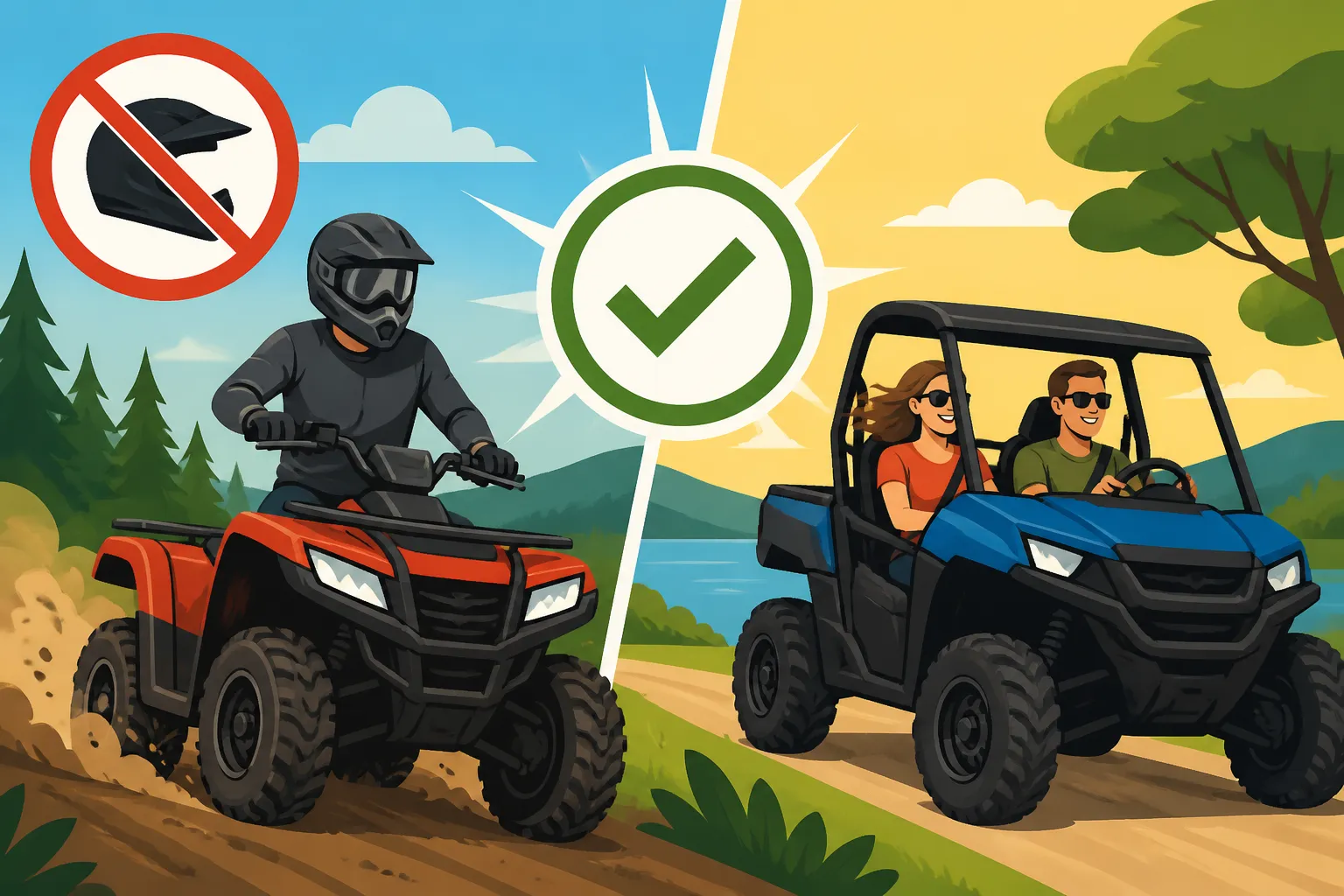
Here's a crucial and often overlooked exception, particularly relevant to UTV (Utility Terrain Vehicle) or side-by-side owners. Ontario Regulation 316/03, which governs ORV operation, states a specific exemption for certain recreational off-highway vehicles (ROVs). An approved helmet is not required if:
- The ROV is equipped with a rollover protective structure (ROPS).
- The ROV is equipped with a seat belt assembly.
- The seat belt is being worn by the operator and any passengers.
This means if your side-by-side has a factory-installed or aftermarket ROPS that meets safety standards, and you and your passengers are all securely buckled in, you are legally exempt from wearing a helmet. This is because the ROPS and seat belts are designed to offer a similar level of head protection to that which a helmet would provide in an accident, particularly a rollover. Many popular UTVs from manufacturers like Polaris, Can-Am, and Arctic Cat come standard with these features. Owners might also upgrade their machines with enhanced ROPS from companies like SuperATV, ensuring they meet the safety requirements to qualify for this exemption. [Roll-Over Protection on an Ontario ROV] It is absolutely vital that both the ROPS and the seat belts are in good working order, properly installed, and used at all times to qualify for this exception. Simply having them installed but not buckled up means the helmet rule still applies. [Seat Belts and Occupant Protection in Ontario] This exception is a game-changer for many UTV owners who prefer the open-air feel without a helmet, but it comes with stringent safety conditions that must be met.
Agricultural Operations (on private farm land)
While there isn't a blanket helmet exemption specifically for "farm use," the reality for many farmers aligns with the private property exception. If a farmer is operating an ORV exclusively on their own private farm land for agricultural purposes, the helmet law does not apply. This could include checking fences, herding livestock, or transporting tools across fields. [The Farm-Use Exemption in Ontario] However, the moment that ORV leaves the private farm fields and enters a public road, even if it's still being used for farm-related tasks (like driving between two fields separated by a public road), the helmet requirement typically kicks back in, unless the vehicle is an ROV that meets the ROPS and seat belt exemption detailed above. It's important for farmers to be aware of this distinction. While an ORV used solely for work on private property falls under the "private land" exception, its use on public roads, regardless of purpose, generally requires a helmet or the specific ROPS/seat belt exemption for UTVs.
Here's a quick overview of helmet requirements:
| Riding Location/Scenario | ATV Helmet Required? | ROV (UTV) Helmet Required? |
|---|---|---|
| Public Roads/Highways | Yes | Yes, UNLESS equipped with ROPS & seat belt (and worn) |
| Designated OFATV Trails | Yes | Yes, UNLESS equipped with ROPS & seat belt (and worn) |
| Crown Land (General Use) | Yes | Yes, UNLESS equipped with ROPS & seat belt (and worn) |
| Exclusively on Your Own Private Land | No (Legally) | No (Legally) |
| Agricultural Use (Private Farm Land) | No (Legally) | No (Legally), UNLESS on public road, then ROPS & seat belt applies |
Why Safety Still Matters: Beyond Legal Requirements
Even in situations where you are legally exempt from wearing a helmet, it's paramount to understand that safety remains your top priority. Laws represent minimum standards, but personal safety often requires exceeding those minimums. Thinking beyond the letter of the law can literally be a life-saving habit.
Mitigating Injury Risks
The primary reason helmets are mandated in most ORV riding scenarios is simple: head protection. Accidents can happen swiftly and unexpectedly, even at low speeds or on seemingly familiar terrain. A small bump, a hidden rut, or a momentary lapse in judgment can lead to a fall or collision. The human skull, while robust, is not impenetrable, and the brain inside is incredibly vulnerable to trauma. Head injuries can range from concussions, which can have long-lasting effects, to severe traumatic brain injuries (TBIs) that can result in permanent disability or even death. A properly fitted, approved helmet absorbs and disperses impact energy, dramatically reducing the risk of these severe outcomes. While you might feel invincible cruising across your private field, a simple tip-over could still lead to a serious head injury if you're not protected. Even if your UTV has a robust ROPS from a company like SuperATV, providing excellent rollover protection, a sharp turn or collision could still cause your head to strike an internal structure if you're not fully belted in and protected. It's always better to over-prepare for safety than to regret an avoidable injury.
Insurance Coverage and Liability
Beyond your physical well-being, there are significant practical implications to consider regarding insurance and liability, especially when not wearing a helmet. While Ontario's helmet laws for ORVs have specific exemptions, your insurance provider might view things differently. Most insurance policies are predicated on riders taking reasonable precautions to ensure their safety. If you are involved in an accident, even on private property where a helmet wasn't legally required, your insurance company could potentially argue that your injuries were exacerbated by not wearing one. This might impact the extent of your coverage for medical expenses or other claims. [Ontario ATV Insurance Requirements]
Furthermore, if you are riding on someone else's private property with their permission, and an accident occurs while you weren't wearing a helmet (even if not legally required), it could complicate liability discussions. While the landowner might have given permission to ride, they may also expect you to exercise reasonable care. The legal implications can be murky and complex, making the simple act of wearing a helmet a powerful layer of protection, not just for your head, but for your financial and legal standing too. It's always prudent to check with your insurance provider to understand how helmet use (or lack thereof) might affect your specific policy.
Choosing the Right Gear for Every Ride
Regardless of where you're riding or whether a helmet is legally mandated, making informed choices about your gear is a fundamental aspect of responsible ORV operation. Your helmet is just one piece of a larger protective ensemble designed to keep you safe and comfortable, allowing you to focus on the ride itself.
Understanding Approved Helmets in Ontario
When a helmet is required, it must be an "approved" helmet. In Ontario, this means it must meet specific safety standards. Look for helmets that are certified by organizations like:
- DOT (Department of Transportation): This is a US standard, but widely accepted.
- Snell Memorial Foundation: A rigorous, voluntary standard often exceeding DOT requirements.
- ECE (Economic Commission for Europe): A European standard also accepted in Canada.
- CSA (Canadian Standards Association): While less common for ORV helmets specifically, some multi-sport helmets might carry this.
The key is to ensure the helmet has the appropriate certification sticker, usually on the back. [Approved Motorcycle Helmets in Ontario] Beyond certification, proper fit is non-negotiable. A helmet that's too loose won't offer adequate protection and can even become a hazard. It should fit snugly all around your head, without painful pressure points, and should not move independently of your head when you try to rotate it. The chin strap is also crucial; it needs to be securely fastened at all times to keep the helmet in place during an impact. [Chin Straps and Ontario Enforcement] A certified helmet with a loose chin strap is as good as no helmet at all. Take the time to try on several helmets and get expert advice to ensure you find the perfect, protective fit.
Essential Protective Equipment Beyond the Helmet
While the helmet often takes centre stage, it's part of a broader system of protective gear that seasoned riders swear by. Investing in quality gear for every ride, regardless of its length or location, is a smart move.
- Eye Protection: Goggles or a helmet visor are critical for protecting your eyes from dust, debris, insects, branches, and harsh sun. Even on a clear day, a stray pebble kicked up by a tire can cause serious damage.
- Gloves: Protect your hands from blisters, abrasions, and impacts. They also improve your grip on the handlebars.
- Sturdy Footwear: Over-the-ankle boots are ideal, providing support and protection for your feet and ankles from impacts, hot engine parts, and rough terrain. Avoid open-toed shoes or sneakers.
- Long-Sleeved Shirt and Pants: Durable, long-sleeved clothing helps protect your skin from scrapes, cuts, sun exposure, and bug bites. Specialised riding gear is designed with impact zones and abrasion resistance in mind, offering superior protection compared to everyday clothing.
- Body Armour/Chest Protector: For more aggressive riding or higher speeds, a chest protector and other body armour can offer additional protection for your torso and joints.
Remember, every piece of gear plays a role in your overall safety envelope. Thinking comprehensively about your protection before every ride allows you to enjoy the thrill of the trail with greater confidence and peace of mind.
Disclaimer
This article is for general informational purposes only and does not constitute professional advice. Laws, prices and regulations vary by location and change over time. Consult a qualified professional for guidance on your specific situation.