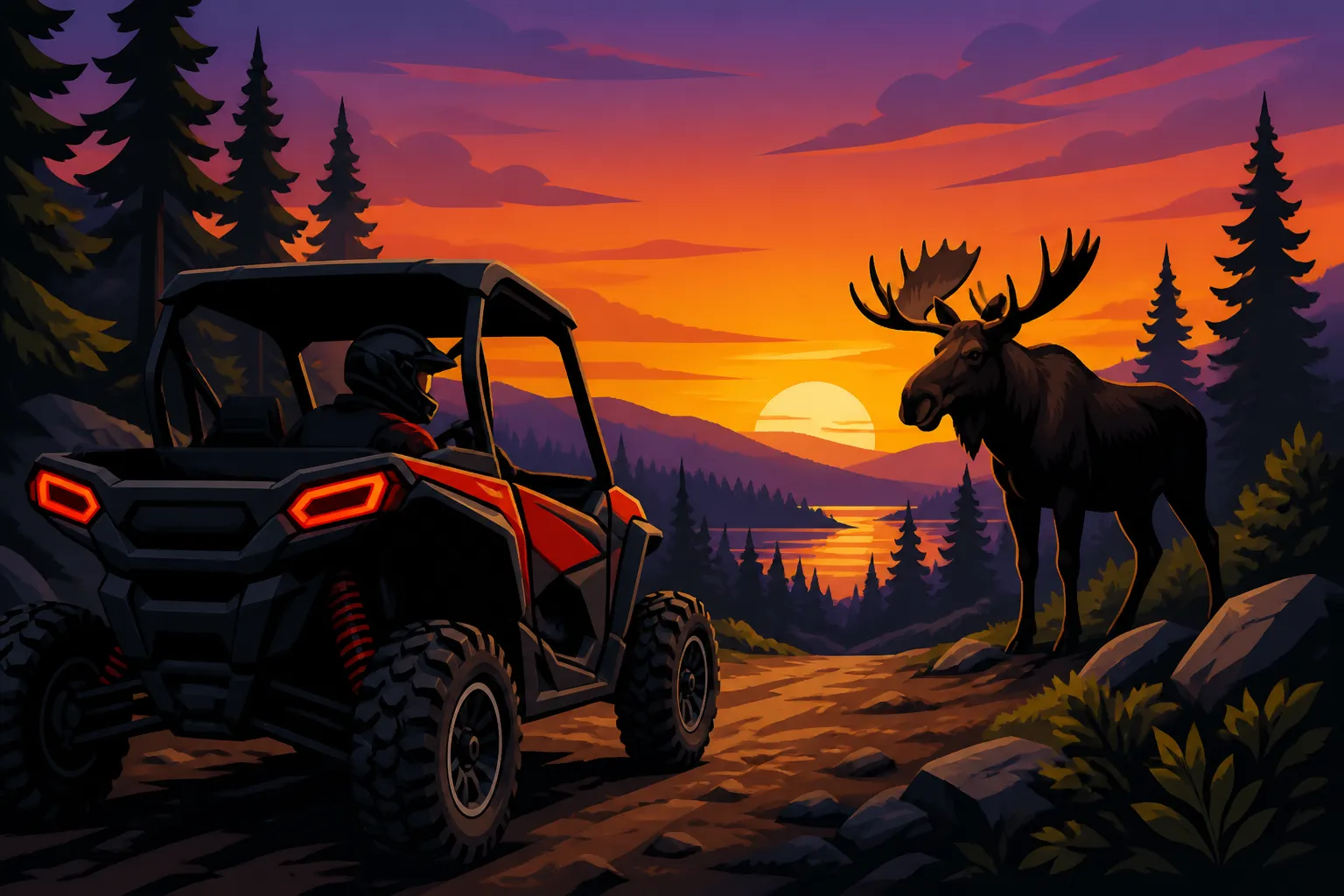
Moose on a Trail at Dusk
A moose can appear around a bend with very little warning, especially when an Ontario ATV ride runs into dusk. Their size, dark colouring and unpredictable movements make a close encounter stressful for even experienced riders. This guide explains how to reduce the chances of surprising a moose, what to do if one is on the trail, and how to plan a safer ride home.
Why dusk makes a moose encounter harder
Moose are difficult to spot in fading light
Moose are active at different times of day, and an animal may be feeding or crossing a trail when riders arrive. At dusk, the trouble is not just that it is getting dark. Forest shadows deepen, the trail surface loses contrast, and a moose’s dark coat can blend into trees or brush. A rider may notice movement before being able to tell what is moving—or how close it is.
This can happen on a familiar route, too. A trail that felt open in daylight may become hard to read once the sun drops behind a ridge or tree line. A bend, a small rise, or thick vegetation can hide an animal until a machine is close. On trails in northern Ontario, including routes around Algoma Country and north of Lake Superior, long distances between staging areas can also make a late finish harder to manage.
The practical response is to treat dusk as a change in riding conditions, not simply the last part of the day. Slow down before blind corners and narrow sections, leave more room between machines, and avoid riding faster than you can safely stop within the distance you can see. For seasonal planning, Ontario Riding in Autumn Colour also covers the way shorter daylight hours can affect a trail outing.
Moose may behave unpredictably when surprised
A moose is a large wild animal, not a trail obstacle that will reliably step aside when a vehicle approaches. It may move away, stand its ground, or react defensively. A cow with a calf can be especially concerning, and a bull may behave unpredictably during the rut. You may not see a calf or another moose immediately, particularly where brush or trees block the view.
The safest assumption is that a moose needs space and an escape route. Don’t ride toward it to get a better look, try to pass closely, or position machines so it is boxed in. A moose that seems calm can still move suddenly. Riders should resist the urge to treat an encounter as a photo opportunity; staying mounted and filming from close range is not a safe substitute for giving the animal room.
If you see a moose ahead, stop at a safe distance and keep the group together. Give the animal time to move away on its own. If it does not, or if it starts moving toward the riders, back away slowly when there is a clear route to do so. Do not attempt to herd it down the trail or squeeze past it along the shoulder.
How to ride more safely as daylight fades
Set a turnaround time before leaving
The simplest way to avoid a dusk encounter is to avoid being far from your staging area at dusk. Before setting out, estimate the ride time realistically, including stops, slow sections and the possibility of a detour. A loop that seems manageable on a map can take longer when the trail is wet, rutted, unfamiliar or busy.
Set a turnaround time that leaves a cushion for the return trip. Agree on it before anyone is tired or tempted to “just finish the loop.” If the group reaches the planned turnaround point later than expected, shorten the ride rather than pushing on. That can be frustrating when everyone has travelled a long way to ride, but it is usually a better trade than navigating an unfamiliar trail in failing light.
Check the daylight window and local trail conditions before departure, then choose a route that suits the group’s pace and experience. Ontario Trail Conditions Before You Ride is useful when you need to account for closures or conditions that could slow the trip. For route familiarity, Ontario Trail Maps and the Club That Made Them can help riders think through how they will navigate and return, rather than relying on memory alone.
| Before the ride | Why it matters at dusk | Practical choice |
|---|---|---|
| Route and turnaround point | A late detour can leave the group far from the staging area after dark | Choose a shorter loop with a clear return plan |
| Daylight and weather | Cloud, rain and tree cover can reduce visibility earlier than expected | Leave a generous buffer instead of planning to ride until sunset |
| Group spacing | Riders close together may have less time to react to an animal or obstacle | Keep enough space to stop without creating gaps that split the group |
| Navigation and communications | A wrong turn or dead zone can extend the ride | Carry a map and a backup way to communicate |
| Lights and machine condition | Poor lighting or a mechanical issue makes the return more difficult | Check lights and basic equipment before leaving |
Adjust speed, spacing and attention
As light fades, slow down before visibility becomes a problem. Keep your eyes moving between the trail ahead, the edges of the route and the areas where an animal could emerge. Avoid staring only at the patch illuminated by your headlights; peripheral movement may be the first sign of wildlife. On unfamiliar trails, take particular care at bends, crossings and narrow passages where an animal could be obscured.
Keep a sensible gap between machines. If everyone rides close together, the lead rider may have little room to stop and the following rider may be unable to react safely. If the group spreads too far apart, someone may not know that the lead rider has stopped. Agree on a simple way to communicate a stop, and make sure the last rider knows when the group is moving again.
Night riding also brings other risks, including reduced ability to spot trail damage and other users. Check the rules that apply to your route and machine before setting out; Ontario ATV Rules for Riding at Night is a relevant starting point. A navigation tool such as onX Offroad may help a group keep track of a planned route, but it cannot show whether a moose is just beyond the next bend. Use mapping as backup, not as a reason to ride faster or later.
What to do if a moose is on the trail
Stop and give it room
When a moose appears ahead, slow down smoothly and stop before reaching it. Avoid revving the engine, accelerating toward the animal, or making sudden movements that could startle it. Keep the group behind the lead rider and make sure no one tries to pass on the side. If there is a clear, safe way to retreat, back away slowly and leave the moose an open route away from the machines.
Do not assume that the trail itself is the only way the animal can go. It may move into nearby brush or cross the route. Give it time and space to choose. If it moves off, wait and watch from a safe distance before proceeding; don’t immediately follow it into the trees or try to ride after it. A second animal may be nearby, and the first may still be close.
If the moose appears agitated, approaches, or blocks the route without a safe way past, prioritize distance over completing the ride. Turn around if you can do so safely, or wait for the animal to move away while keeping the group calm and together. A detour or an early end to the ride is inconvenient. A close encounter can be much worse.
Keep the group from making the situation worse
A sudden wildlife sighting can make riders react in different ways: one person may stop, another may try to reverse, and someone behind may not understand what is happening. Before the ride, agree that the lead rider will signal a stop and that everyone will remain in position until the group knows what is ahead. Avoid having riders crowd forward to see.
If the group must turn around, do it deliberately and one machine at a time where space allows. Don’t create a noisy cluster or block the animal’s path. If a rider is separated, use your pre-agreed communication plan rather than sending someone back toward the moose to find them. In remote areas, a phone may not connect, so check reception assumptions and backup arrangements before departure; Cell Dead Zones in the North explains why communication planning matters on northern rides.
A mapping app can help the group understand where it is relative to a trail junction or staging area, but it does not replace good judgment around wildlife. Some riders use onX Offroad as one part of their route-planning setup, alongside a downloaded or paper map and a clear turnaround plan. If the route is unfamiliar, use the tool before the ride to understand your options—not while approaching an animal with your attention fixed on a screen.
Planning around wildlife and remote trails
Choose routes and timing with care
A ride that ends near dusk may be more demanding than the same route in full daylight. Consider the terrain, the amount of tree cover, how familiar the group is with the area and how far it is from the trailhead. In a place such as the Chapleau area, a remote route can make a delay more consequential than it would be on a short, well-known loop close to town.
Check for local restrictions and trail information before you ride. If travelling through a protected or managed area, make sure you understand the applicable rules rather than assuming that every road or trail is open to ORVs. For example, Riding Rules Inside the Chapleau Game Preserve is relevant to anyone planning a ride in that area. When a route crosses different land types or club areas, confirm the permitted route and access points in advance.
For longer trips, tell someone where you plan to ride and when you expect to return. Bring enough supplies to manage a delay, including warm layers when temperatures may fall after sunset, water and a way to navigate if a phone loses service. If a route takes you through the Lake Superior region, Riding North of Lake Superior can help with broader trip-planning considerations for that part of the province.
Treat wildlife sightings as a reason to reassess
Seeing a moose does not necessarily mean a trail is unsafe for the rest of the day, but it is a reason to pay closer attention to conditions. The animal may have crossed the trail and continued away, or there may be more wildlife nearby. If visibility is poor, the group is behind schedule, or riders are getting tired, turning back may be the most sensible decision.
The same caution applies to other wildlife. A rider concentrating on a moose should not overlook the possibility of another animal, a hidden rut or a sharp turn. Bears on a Northern Trail offers additional context for staying alert around wildlife in remote riding areas. The general habit is the same: observe from a distance, avoid approaching or feeding animals, and leave the area if you cannot pass safely.
After the ride, review what worked and what did not. Perhaps the group started too late, chose a loop that was too ambitious, or lacked a clear signal for stopping. Adjust the next outing accordingly. An app such as onX Offroad can be one navigation aid when planning an alternate route, but a realistic schedule, working lights, careful speed and a willingness to turn around remain the essentials.
Disclaimer
This article is for general informational purposes only and does not constitute professional advice. Laws, prices and regulations vary by location and change over time. Consult a qualified professional for guidance on your specific situation.