Ontario ATV Rules for Riding at Night
You've just finished a fantastic day of riding, the sun is beginning its slow descent, painting the Ontario sky with incredible colours, and that feeling of "just one more loop" starts to creep in. But as the light fades, a common question pops into many riders' minds: "Can I actually ride my ATV or UTV after dark in Ontario?" It's not always clear-cut, and the rules around night riding can feel like a tangled mess of regulations, local bylaws, and common sense. This guide is here to untangle all of that, covering the essential equipment, legal requirements, and crucial safety considerations for taking your machine out when the stars come out, whether you're on a trail, private land, or a municipality's open road.
The Legalities of Riding an ATV at Night in Ontario
It's tempting to think that if your ATV or UTV has lights, you're good to go once the sun dips below the horizon. However, the legal framework in Ontario for operating off-road vehicles (ORVs) at night is quite specific, especially depending on where you're riding. The primary piece of legislation governing ORVs is the Off-Road Vehicles Act, and it has a lot to say about visibility and equipment, particularly when it comes to operating in low-light conditions. Failing to comply isn't just a safety risk; it can also lead to fines and other legal consequences, ruining an otherwise perfect night out.
When Does "Night" Begin and End?
The official definition of "night" for vehicle operation purposes isn't just when it feels dark to you. In Ontario, the Highway Traffic Act (which influences ORV regulations on roads and sometimes trails) defines night as the period between one-half hour before sunset and one-half hour after sunrise. This half-hour buffer is crucial; it means you need to have your lights on, and your machine needs to be properly equipped for night operation, even during those twilight hours. It's not just about complete darkness; it's about diminishing visibility.
Imagine you're wrapping up a late afternoon ride near Bancroft, perhaps coming off some of the [Eastern Ontario Trails Alliance Pass] network. You check your watch, and sunset is at 7:30 PM. That means by 7:00 PM, your ATV or UTV should already be fully prepared for night riding, with all required lights functional and activated. This applies whether you're navigating a winding trail or making your way back to your staging area on a municipal road. Being proactive and anticipating the light change is key to staying safe and legal.
General Principles for Off-Road and On-Road Night Riding
The general principle across all riding environments when it comes to night operation is visibility. You must be able to see where you are going, and perhaps even more critically, other people (and vehicles) must be able to see you. On designated trails or Crown Land, while the rules might feel a little less rigid than on public roads, the expectation of being visible and having adequate lighting remains absolute. You're responsible for your own safety and the safety of others who might be sharing the space, even in the deep bush.
When you transition from a private trail system, like one of the numerous [Ontario's OFATV Trail Network] routes, onto a municipal road that permits ORVs, the rules instantly become much stricter. On roads, your ATV or UTV is treated more like any other motor vehicle when it comes to lighting requirements after dark. This means having properly functioning headlights, taillights, and brake lights, among other things. The Ministry of Transportation Ontario (MTO) regulations are in full effect, and local police or OPP officers will be enforcing them, especially if you're out and about when it's dark.
The Importance of Visibility for Safety and Compliance
Visibility isn't just a suggestion; it's a lifeline. The sad truth is that a significant number of ORV accidents happen due to inadequate visibility, both of the rider and of the obstacles or terrain ahead. At night, hazards that are easily spotted in daylight become invisible traps. A downed log, a sudden dip, or an unexpected turn in the trail can all lead to disaster if you can't see them coming. This is why investing in good quality lighting is not just about meeting legal requirements; it's about personal survival and preventing serious injury.
Consider a scenario where you’re navigating some familiar trails near Haliburton after dusk. Even if you know the area like the back of your hand, a slight misjudgment of depth or distance due to poor lighting can send you into a ditch. For road use, an oncoming car simply might not see a dimly lit or unlit ORV until it's too late. The law requires specific lighting standards precisely because these machines are smaller and can be harder to spot than a full-sized vehicle. Making sure your machine is a beacon in the dark is the first step in responsible night riding.
Essential Lighting and Equipment for Night Riding
When it comes to equipping your ATV or UTV for night riding, simply having "a light" isn't enough. Ontario regulations specify exactly what kind of lighting your machine needs to have, particularly if you plan on operating it on any public roads or road allowances. Even for purely off-road use, exceeding these minimums is a smart move for safety. Think of it as painting your machine with light, ensuring you can see everything ahead and that everyone around you can see you.
Headlights: More Than Just Seeing Where You're Going
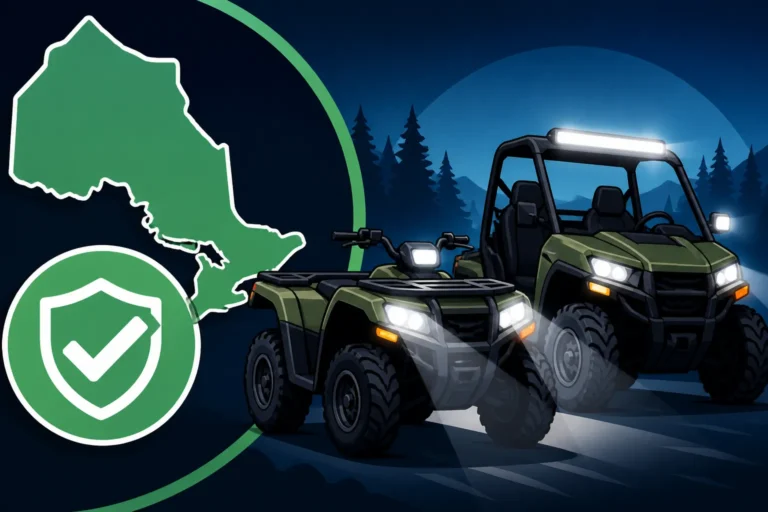
The Off-Road Vehicles Act, along with aspects of the Highway Traffic Act for road-legal ORVs, mandates that your ATV or UTV must be equipped with at least one headlight that emits a white or amber light. This headlight must be visible from a distance of at least 150 metres in normal atmospheric conditions. For any machine driven on a highway (where permitted), it actually requires two headlights, positioned symmetrically, with both high and low beam capabilities.
This isn't just about throwing a beam forward; it's about casting enough light to safely navigate diverse terrain at typical riding speeds. Many stock headlights on older machines, or even some entry-level models, might barely meet the minimum legal requirement but fall far short of what's truly needed for comfortable and safe night riding. Upgrading to brighter LED headlights or adding auxiliary light bars, such as those offered by brands like SuperATV, can dramatically improve your ability to see hidden obstacles and react in time. Imagine trying to spot a freshly fallen tree across the trail with weak, yellowish light versus a powerful, wide-angle LED beam cutting through the darkness. The difference is literally night and day.
Taillights and Brake Lights: Being Seen From Behind
Just as important as seeing where you're going is ensuring you're seen by anyone behind you. The law requires your ATV or UTV to have at least one red taillight visible from a distance of 150 metres to the rear. Additionally, if your ORV is capable of speeds greater than 20 km/h (which most are), it must also have a red brake light that illuminates when the brakes are applied. Again, on roads where [Riding an ATV on Ontario Roads] is permitted, these requirements are rigorously enforced.
Think about a group ride: if the rider behind you can't clearly see your taillight or, more critically, your brake light, they might not have enough time to react if you suddenly slow down or stop. This is a common cause of rear-end collisions on trails. A bright, well-maintained taillight and brake light system is non-negotiable for night riding safety. It communicates your intentions to others, whether they are fellow riders, drivers of other vehicles, or even pedestrians.
Reflectors and Auxiliary Lighting
Beyond the mandatory headlights and taillights, Ontario regulations also require ORVs to have a white reflector on the front and a red reflector on the rear if they are operated between one-half hour before sunset and one-half hour after sunrise. While these reflectors don't actively emit light, they greatly enhance your visibility by catching light from other sources, like an oncoming vehicle's headlights. They serve as a passive safety feature, a little extra peace of mind.
Many experienced night riders don't stop at the minimum requirements. This is where auxiliary lighting comes into play, transforming a basic setup into a true night-conquering machine. Light bars, often mounted on the front bumper, roof, or even a winch plate, can provide an incredible flood of light, illuminating the trail edges and even wider areas than your primary headlights. Rock lights, mounted underneath the vehicle, can help you see tricky terrain directly under your machine, which is invaluable for technical crawling. Side-mounted lights can improve peripheral vision, helping you spot wildlife or obstacles approaching from the sides. Companies like SuperATV specialize in these kinds of robust, weather-resistant auxiliary lighting solutions that can make a huge difference to your confidence and safety after dark. While these aren't always legally mandated for off-road use, they are definitely highly recommended for anyone serious about night riding.
| Lighting Feature | Required for Off-Road (Trails, Crown Land) | Required for On-Road (Municipal Roads) | Recommended for Enhanced Safety |
|---|---|---|---|
| Headlight(s) | At least one white/amber (150m visibility) | Two white (high/low beam, symmetrical) | LED upgrades, powerful light bars |
| Taillight(s) | At least one red (150m visibility) | At least one red (150m visibility) | Brighter LED taillights |
| Brake Light(s) | Red (if > 20 km/h) | Red (if > 20 km/h) | Brighter LED brake lights |
| Front Reflector | White (passive visibility) | White (passive visibility) | Reflective tape on gear/helmet |
| Rear Reflector | Red (passive visibility) | Red (passive visibility) | Reflective tape on machine/trailer |
| Auxiliary Lights | Not required, but strongly recommended | Not required (check local bylaws for use) | Light bars, rock lights, side lights |
Navigating Different Riding Environments After Dark
The Ontario ORV landscape is vast and varied, from expansive Crown Land to intricate club trail networks and even specific municipal roads that have been opened to ORV traffic. Understanding how night riding rules change across these environments is crucial for staying out of trouble and having a fun, safe experience. The common thread is always safety and visibility, but the specifics can vary wildly.
Night Riding on Public Roads and Road Allowances
This is where the rules are the most stringent, and for good reason. When an ATV or UTV is operated on a public road where it's legally permitted, it falls under many of the same regulations as other motor vehicles. This means not only must your headlights, taillights, and brake lights be fully functional and up to standard, but you also need to adhere to speed limits and other road-specific rules. The [Ontario ATV Lighting Requirements] are particularly detailed for road use. Beyond the lights, you need to ensure your machine meets other road-legal criteria, like mirrors and a properly mounted license plate. Remember, an officer checking your vehicle at night will be scrutinizing all these elements, not just your lights.
Many municipalities in Ontario have opened specific roads to ORVs, but these come with their own set of rules, often including designated riding hours. Some bylaws might even prohibit night riding on municipal roads entirely, or restrict it to specific routes and times. It's critical to know the local bylaws of any township or county you plan to ride in after dark. For example, a by-law that allows ORVs during the day might not extend those privileges into the night. What applies in [Greater Napanee By-law 2022-0062] might be different from the rules you encounter in [Bluewater's Off-Road Vehicle Rules]. Always check ahead, because ignorance of the bylaw is no excuse, especially if you're stopped by an officer.
Riding on OFATV Club Trails and Crown Land at Night
For the vast network of trails maintained by the Ontario Federation of ATV Clubs (OFATV), and on much of Ontario's Crown Land, night riding is generally permitted, assuming your machine is properly equipped with the necessary lighting. However, this doesn't mean it's a free-for-all. Many OFATV clubs, which administer trails like those found in [Haliburton's 1,000 Kilometres] or the [Voyageur Multi-Use Trail at Mattawa], might have their own specific rules or recommendations regarding night use for safety or to minimize disturbance to local residents. Always consult the specific club's website or signage for any unique regulations.
On Crown Land, the "free use" policy for ORVs often extends to night riding, but this assumes responsible operation. While there might not be specific 'night riding only' laws for Crown Land, the general requirements for lights and visibility still apply. Remember, even if you’re far from civilization, you could encounter campers, hunters, or other recreational users. Common courtesy and extreme caution are paramount. Navigating unfamiliar terrain in complete darkness, even with excellent lighting, requires a heightened sense of awareness and reduced speed. Always carry a reliable map or GPS, and ideally, ride with at least one other person in case of an emergency. Your [Ontario ATV Insurance Requirements] still apply, even in the deepest woods.
Private Property and Local Bylaws After Dark
Riding on private property, such as your own land or land you have permission to use, offers the most flexibility regarding night riding. The provincial Off-Road Vehicles Act primarily governs public lands and roads, so on private land, you're mostly bound by the landowner's rules and general safety precautions. If you own the land, you set the rules for your own operations. However, even on private property, your machine must still be equipped with working headlights and taillights for safe operation, especially if you're riding after dusk. It's just common sense.
Even on private property, there's a crucial caveat: local municipal bylaws. Many townships have noise bylaws that can restrict the operation of loud vehicles, including ATVs and UTVs, during specific nighttime hours. While these bylaws might not explicitly prohibit "riding," they can prohibit "excessive noise" during certain times, which an ORV certainly can produce. Imagine upsetting your neighbours by revving your engine late at night, even if it's on your own property. It’s always a good idea to be a considerate neighbour and check local bylaws to avoid complaints or potential fines related to noise pollution. What might be fine during the day could be a nuisance, and thus a bylaw infraction, after dark. This is another example of why [Why One Township Road Is Open and the Next Closed] often comes down to local community standards and political will, even impacting how private property use is regulated.
Disclaimer
This article is for general informational purposes only and does not constitute professional advice. Laws, prices and regulations vary by location and change over time. Consult a qualified professional for guidance on your specific situation.