What Ontario Charges Visitors to Ride
What Ontario Charges Visitors to Ride
Planning an ATV or UTV trip in Ontario can mean paying for more than one kind of access. A machine may need provincial registration and insurance, while a trail network, club or private property owner may require a separate permit. This guide explains what visitors may be charged for, when a pass is needed, and how to avoid paying for access you do not use.
The short answer: there is no single Ontario riding fee
Ontario does not have one province-wide charge that buys access to every trail, road and riding area. What you pay depends on where you plan to ride, who manages the land and whether your trip uses an organized trail network.
A visitor might pay for a trail permit, a club or land-access pass, parking, or a guided tour. On some public land, riding may be allowed without buying a trail permit, provided the route and activity comply with the applicable rules. On a private trail network, a permit may be required even if the machine is already registered and insured.
That is why a useful first question is not “What does an Ontario ATV permit cost?” It is “What access am I buying, and where will I ride?”
| Charge or requirement | What it generally covers | Is it the same everywhere? |
|---|---|---|
| Provincial vehicle registration | Identifies the machine for provincial registration purposes | No. Requirements depend on the machine and circumstances |
| Vehicle insurance | Liability coverage required for many riding situations, including off-road use | Policy details and proof requirements can vary |
| Trail permit | Access to a participating trail network for the permit’s stated period and conditions | No. The network and permit terms matter |
| Club or land-access pass | Access to a particular club area, forest, or privately managed trail system | No. Some organizations sell separate passes |
| Parking or staging fee | Use of a designated parking or staging area | No. It is set by the land manager |
| Guided-tour charge | A packaged experience that may include a machine, guide, safety gear or trail access | No. Inclusions vary by operator |
| Public-land access | May involve no trail-permit charge in some locations, but does not mean unrestricted riding | Restrictions still apply |
Treat these as separate items in your trip budget. Paying for registration does not automatically buy trail access. Buying a trail permit does not register the ATV or provide insurance. A parking pass may authorize use of a lot without authorizing a ride on every trail nearby.
If you are coming from outside Ontario, start with Ontario ATV Trail Permits Explained and Ontario ATV Registration for a Visiting Rider. The first helps you sort out trail access; the second addresses the separate provincial vehicle-registration question.
What a trail permit pays for
A trail permit is permission to use a defined trail system under the conditions set by the organization that manages it. Depending on the system, the permit may be issued through a trail association or federation, a club, a forest operator or another land manager.
An annual permit is often the practical choice for someone planning multiple rides over a longer period. Short-term passes can make more sense for a weekend, a single outing or a visitor who is trying a network before committing to a longer trip. The exact options and permitted dates differ by provider, so check the seller’s current terms before you buy.
A permit may be tied to a particular vehicle, rider, club area or network. Do not assume that a pass bought for one machine can be moved to another, that one pass covers a whole group, or that a permit sold by one organization automatically covers a nearby system. Those details are important when comparing costs.
Network access is not necessarily provincial access
Ontario’s trail systems are not all under one operator. Some areas participate in broader permit arrangements, while others sell their own passes or have distinct access rules. The differences can be easy to miss if you are planning by town name rather than by trail map: a ride that starts in one community may connect to more than one trail manager’s territory.
This is why a trail permit should be read as an access product, not as a province-wide riding licence. Check the network’s map and permit conditions, then confirm whether the route crosses into another system. A line on a map does not, by itself, prove that the same permit applies on both sides.
Some organizations may also distinguish between club membership and a permit. Membership may support a local club or provide additional benefits, while the permit is the item that authorizes trail use. In other cases, a pass may include a membership component. Ask what the purchase includes rather than assuming that “joining the club” and “getting a trail permit” mean the same thing.
For more detail on those differences, see Ontario’s Separate Club Passes and Ontario Club Membership Versus a Trail Permit.
Permits can fund trail maintenance and administration
A trail permit is not just a ticket for using a route. Depending on the organization, permit revenue can help pay for trail maintenance, signage, insurance, administration and other operating needs. Some systems distribute a portion of permit revenue to a selected club or area; others set their own approach.
Those differences help explain why two trail systems can charge differently or offer different pass types. One may maintain a large network across several communities; another may manage a compact area with separate land-access arrangements. A permit’s value depends not only on its duration but on the area it covers, the condition of the trails and whether it suits your plans.
Before buying, ask:
- Which trails and land areas does the permit cover?
- Does it cover every machine in the group, or only the machine shown on the permit?
- Is access limited by dates, operating hours or seasonal closures?
- Are there additional parking, forest-entry or club charges?
- Does the pass cover connections into neighbouring trail systems?
- What proof of purchase must you display or carry?
If those answers are unclear on the sales page, contact the permit seller or trail organization directly. A quick confirmation is usually easier than sorting out an access problem at a trailhead.
When a visitor may ride without buying a trail permit
A trail permit is not automatically required for every place where an ATV can physically travel. Ontario has public-land rules that may allow free use in some circumstances, but “free use” should not be read as permission to ride anywhere or by any route.
Public land can have limits on vehicle use, seasonal restrictions, closures, access conditions and local rules. A route may pass through land with a different manager, enter a protected area or cross private property. A road or trail visible on a map may not be open to motorized use. Conditions can change, too, so a route that was usable on a previous trip may not be open now.
The practical distinction is this:
- A trail permit is an access requirement set by a trail or land manager.
- Public-land rules determine whether and where riding is allowed on public land.
- Vehicle registration and insurance are separate requirements and do not disappear just because no trail pass is needed.
Learn what the public-land policy does and does not allow in Ontario’s Public Lands Act Free Use Policy and What Free Use Means on Crown Land. Then verify the specific route before riding. Check current land-management notices, posted signs, trail maps and local restrictions. If you are uncertain whether a route is open to an ATV, do not treat the lack of a gate or sign as confirmation that it is legal.
“No permit required” does not mean “no rules apply”
A visitor may still need to follow provincial requirements for the machine and rider. Depending on where and how the ATV is being used, that can include registration, liability insurance, carrying required documents, helmet rules, age restrictions and equipment requirements. If a route uses a road, road-use rules apply as well.
You also need permission to ride on private land. A trail pass for one system does not give permission to cross someone else’s property, even when doing so would make a convenient shortcut. Similarly, a public trail permit does not authorize riding in a provincial park, conservation area or other place where motorized riding is restricted.
For a fuller overview of coverage and documentation, read Ontario ATV Insurance Requirements. For the separate question of registration, a visitor should not assume that a plate from home settles every Ontario requirement; check Ontario Rules for an Out-of-Province Machine if your machine is registered elsewhere.
Public-land trips need route planning
A public-land trip can look inexpensive because there may be no trail pass to purchase, but it can require more research. You need to confirm that the land is open to the kind of riding you intend to do, that the route is legal from your starting point, and that you are not crossing into an area with different rules.
Make a route plan before unloading. Identify the land manager, check for closures and seasonal limitations, and note where the route crosses roads, private parcels or managed trail systems. Keep a backup plan in case a road or route is closed. If you are using an offline map, make sure it shows current access information rather than only the physical location of tracks.
The principle is simple: riding without a trail permit can be lawful in some places, but the rider remains responsible for confirming that the particular ride is allowed.
Reciprocity: what a visitor’s home permit may cover
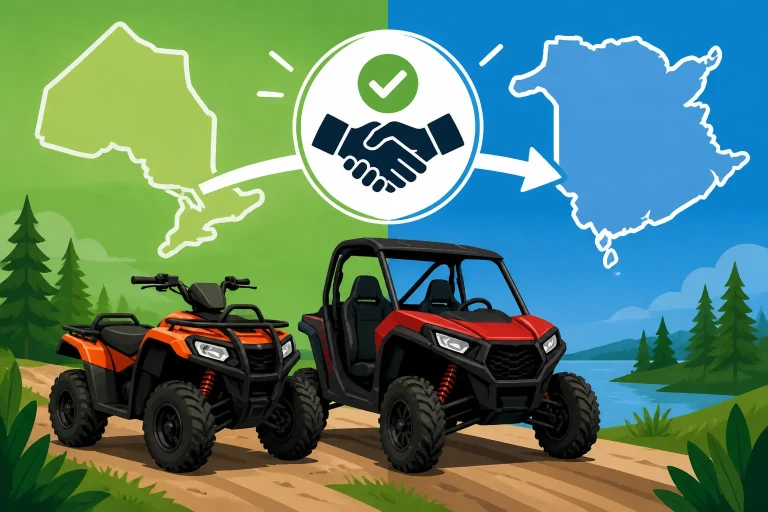
Reciprocity is an agreement under which one organization recognizes a permit from another area. It can be helpful when traveling between participating trail networks, but it is not a blanket rule that applies to all of Ontario.
The word “reciprocity” can create the impression that a permit bought at home will work everywhere. In practice, recognition depends on the organizations involved, the territory, permit type and current agreement. A pass may be accepted in one neighbouring province or trail system and not in another. A reciprocal arrangement may also come with conditions, such as carrying proof of the original permit or following the host network’s local rules.
Visitors should confirm reciprocity with both sides of the intended ride:
- Check with the organization that issued your existing permit.
- Check with the Ontario trail system or land manager where you plan to ride.
- Ask whether your specific permit type is accepted, not just whether permits are “reciprocal.”
- Confirm the dates, machines and trail areas covered.
- Keep proof of the permit and any confirmation with you.
Ontario permits may be recognized by certain participating trail organizations outside Ontario, but arrangements are not universal. If your trip includes riding in another province, check that province’s current policy before leaving. The same caution applies in the other direction: a visitor’s home permit may not be accepted on an Ontario network.
Do not assume that registration is reciprocal trail access
A provincial plate or registration document identifies the machine under a vehicle-registration system. It is not a trail pass. A visitor can have a machine properly registered at home and still need a separate permit to use an Ontario trail network.
Likewise, acceptance of an out-of-province permit does not necessarily settle vehicle registration, insurance or road-use questions. These are different systems administered for different purposes. Check them separately instead of relying on a single document to answer every question.
Quebec and the Maritimes are separate checks
If your route crosses between Ontario and Quebec, verify the current permit rules on both sides. Do not assume an old arrangement still applies or that a permit accepted in another province will work in Quebec. The relationship between Ontario and Quebec trail permits has changed, and riders should confirm the current requirements with the relevant organizations before making plans. See Does Quebec Honour an Ontario Permit? for the specific cross-border question.
The Maritimes require their own checks as well. Some participating organizations in New Brunswick, Prince Edward Island and Nova Scotia may recognize Ontario permits under their arrangements, but you should confirm the current conditions with the host trail network. A reciprocal permit does not automatically cover every trail, club or private land area in the province.
A practical rule: reciprocity is something you verify for a specific ride, not something you infer from the word “annual” or from the fact that a permit is valid for many months.
Other charges that can affect a visitor’s budget
The trail permit is only one possible line in the trip budget. Depending on where you ride, how you travel and whether you bring your own machine, you may encounter other charges.
Parking and staging
Some managed riding areas charge for parking, staging or vehicle entry. The fee may be separate from the trail permit, and the person paying for parking may not be the same organization that sells the trail pass. Read the parking terms carefully: a vehicle pass for a truck or trailer does not necessarily authorize an ATV to use nearby trails.
If your plan includes an unfamiliar staging lot, confirm the entrance location, hours, payment method and whether the pass needs to be displayed. A lot that appears close to a trail on a map may belong to a different operator or may not be a legal place to unload.
Private forest or managed-area access
Some forests and managed recreation areas set their own entry conditions and may sell day, seasonal or other passes. Their rules may cover more than motorized trail access, such as parking, visitor entry or use of specified routes. A broader trail permit may not replace those requirements.
This is one reason to check the land manager’s own information rather than relying solely on a general trail map. The map can show a route, while the land manager’s current terms tell you whether you may use it and what you need to pay.
Rentals and guided tours
If you rent an ATV or book a guided ride, access may be bundled into the rental or tour, but it is not safe to assume that it is. An operator may include a trail permit, provide a machine that is already registered and insured for the activity, or require the rider to purchase or arrange some items separately. A rental agreement may also set its own operating area and conditions.
Before booking, ask:
- Is trail access included, and which trail system does it cover?
- Is the machine permitted only on a guided route or also for independent riding?
- Are parking, fuel, safety gear and passenger charges included?
- What insurance is provided, and what remains the renter’s responsibility?
- Are there additional costs if the group uses a different trail area?
These questions are more useful than comparing only the advertised rental or tour price. For a broader overview, see Ontario Rentals Versus Buying a Machine and Ontario Tours That Include a Trail Permit.
Registration, insurance and travel costs
Visitors riding their own machine should budget for the costs associated with transporting and operating it, including any registration or insurance needs that apply. If you are crossing a provincial or international border, additional paperwork or vehicle requirements may apply. The details depend on the machine, where it is registered and how it is being used.
Fuel, lodging, meals and trailer parking can also exceed the cost of the permit on a multi-day trip. These costs are not Ontario trail fees, but they matter when deciding whether a short-term pass or a longer permit is a sensible choice.
For named companies or products, current prices and terms can change. Check the permit seller, land manager, rental operator or insurer directly rather than relying on an old quote or a price shown in an outdated trip report.
Choosing the right permit for your visit
The least expensive permit on a list is not necessarily the best fit. Compare the pass against your actual riding plan: the number of riding days, the systems you expect to use and whether you will return later.
Start with the route, not the pass
Write down the trail areas or land-management zones you plan to visit. If you have not chosen a route yet, pick the likely starting area and check which organization maintains or controls it. Then trace your intended ride across any network boundaries.
This approach avoids buying a permit because it looks comprehensive, only to find that your destination uses a different pass. It also helps you avoid paying for a longer period than you need. If you are making several trips in the season, compare the short-term options with the annual option using the provider’s current terms.
Count the machines and riders correctly
Permit rules may be based on the machine, the rider or another unit. A family or group should check whether each machine needs its own permit and whether a permit can be shared. Do not assume that one person’s pass covers every ATV in a convoy.
If you are traveling with a rented machine, ask who is responsible for the permit. The rental company may arrange it, but the answer should be explicit. If the operator says access is included, find out which network and whether the inclusion applies for the entire booking.
Check the dates and restrictions
A permit’s name does not tell you every condition. Look for the valid period, areas covered, vehicle limits, display instructions, permitted operating hours and seasonal restrictions. A pass that is valid on a calendar may not mean every trail is open for the full period.
Weather and trail conditions matter, too. Spring thaw, heavy rain, maintenance work or temporary closures can affect access. Check the trail organization’s current notices before you leave and again near the ride date. Ontario Trail Conditions Before You Ride and Ontario Trail Closures to Check First can help with that planning.
Keep proof accessible
If the permit is provided digitally, save it somewhere you can open without a reliable cell signal. If a sticker or display item is required, follow the issuer’s instructions for that specific permit. Keep any purchase confirmation and permit details with your trip documents.
A waterproof document pouch can help protect registration and insurance papers from mud and rain. If you are comparing pouch styles or a basic phone mount, Amazon is one place riders may look; choose gear that fits your machine and does not block controls or visibility. Whatever you buy, test it before the trip rather than discovering on the trail that it will not stay secure.
A practical checklist before crossing into Ontario
A few checks at home can prevent a wasted day or an avoidable fee at the trailhead.
- Choose your riding area. Identify the trail network, forest or public-land route rather than selecting only a nearby town.
- Find the land manager. Confirm who controls the route and whether a separate pass is required.
- Check permit coverage. Verify the permit type, valid dates, number of machines covered and any territory limits.
- Confirm reciprocity. Ask both the issuing organization and Ontario host network whether your existing permit is accepted.
- Separate access from vehicle requirements. Check registration and insurance independently of trail-permit rules.
- Review restrictions. Look for closures, seasonal conditions, local by-laws and private-property boundaries.
- Ask about extra charges. Confirm parking, staging, forest entry, rental or guided-tour inclusions.
- Save your documents. Keep proof of registration, insurance and permit accessible, including offline copies where appropriate.
- Recheck just before riding. Trail status and local access conditions can change after you make your plan.
For basic trip equipment, a secure phone mount or waterproof storage can make maps and paperwork easier to manage. Amazon may offer a broad selection, but check fit, mounting method and water resistance carefully; a low-cost accessory is not a bargain if it comes loose on rough ground. Carry a paper or offline backup for navigation, especially where coverage is uncertain.
How to think about the total cost
For a visitor, the total cost is the sum of the items required for the chosen ride—not a single Ontario-wide tariff. One trip may involve a trail permit and a parking fee. Another may use a public-land route where no trail permit is required, but still involve vehicle, insurance, fuel and travel costs. A guided tour may bundle some access costs while charging separately for others.
The best way to avoid overpaying is to match the purchase to the route:
- Do not buy a province-wide benefit that does not exist.
- Do not assume a trail permit covers every adjoining network.
- Do not pay for a trail permit if your planned route does not require one, but verify that the route is lawful and open.
- Do not mistake free public-land use for unrestricted access.
- Do not assume your home permit, registration or insurance answers the other questions.
- Confirm current fees and terms directly with the organization responsible for the ride.
If you are making a short visit, a day or multi-day pass may fit better than a longer permit, if the relevant network offers one. If you plan to return repeatedly, compare the full range of current permit options and coverage. If your ride crosses several systems, ask whether one pass covers the whole route or whether separate passes are required.
A little advance checking can save both money and frustration. The goal is not to buy the most permits possible; it is to know which ones apply to the places you will actually ride.
Disclaimer
This article is for general informational purposes only and does not constitute professional advice. Laws, prices and regulations vary by location and change over time. Consult a qualified professional for guidance on your specific situation.