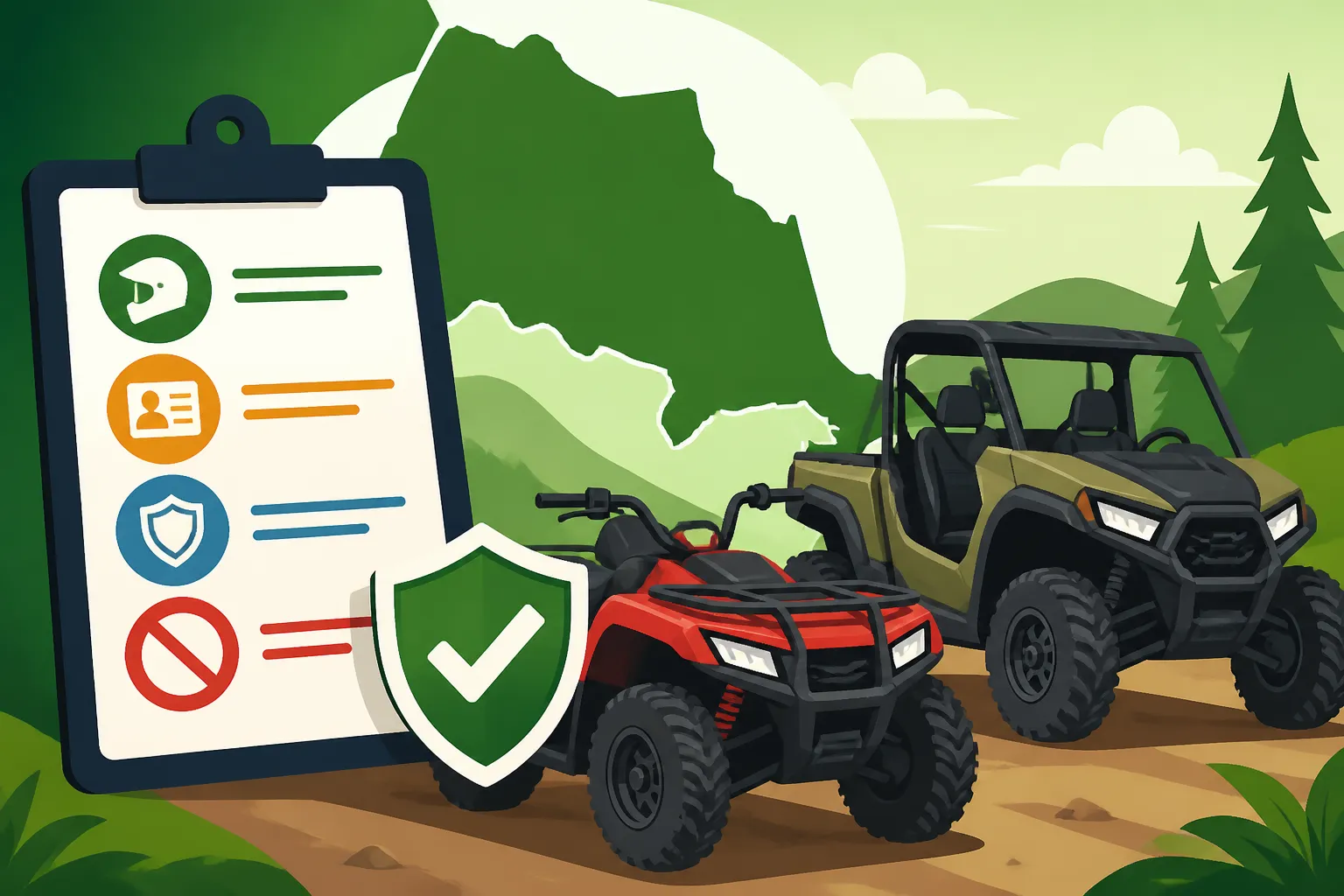
Ontario Rules for a Rented Machine
Renting an ATV or UTV in Ontario can make a trail day simple, but the machine’s paperwork, insurance, road access and trail permissions still matter. The rental company may handle some requirements and leave others to you. This guide explains what to confirm before booking, what to check at pickup, and how to avoid assuming that a rental, a trail pass and permission to ride are all the same thing.
Understand what the rental does and does not cover
A rental agreement gives you permission to use a particular machine under the operator’s conditions. It does not automatically give you permission to ride anywhere in Ontario, make every road legal to use, or extend a trail permit beyond the areas it covers.
Think of a rental ride as involving three separate sets of rules:
- The law: Ontario’s requirements for the vehicle, rider, insurance, helmets and any road use.
- The land or trail rules: Whether the route is open to ATVs or UTVs, and whether a trail permit or other permission is required.
- The operator’s contract: The rental company’s minimum age, licence, passenger, route, damage and return conditions.
You need to meet all three. If an operator lets you book, that does not necessarily mean you can legally ride every route you had in mind. And a machine that is road-equipped is not automatically allowed on a particular road.
Ask what “included” means
When a rental listing says that a trail pass, insurance, safety equipment or fuel is included, ask what the phrase covers in practice. For example:
- Does the trail permit cover the exact club or trail system you plan to ride?
- Is the permit valid for every rider, or only for the rented machine?
- Does the insurance apply to the route, type of machine and riders in your group?
- Are helmets supplied in suitable sizes?
- Is fuel included for the whole outing, or is the machine simply delivered with fuel?
- Does the rental include a guide, or are you expected to navigate independently?
Get answers in writing when possible, especially if the rental is part of a tour or a package with lodging. The exact terms can differ from one operator to another.
If the machine is being rented without a guide, clarify who is responsible for route planning and checking trail conditions. A guide may help with directions and local hazards, but you are still expected to follow the operator’s instructions and applicable rules.
Separate a guided tour from an independent rental
A guided tour and an independent rental can feel similar, but they do not necessarily work the same way. A guided tour usually keeps the group on a route chosen by the operator. A self-guided rental may leave you responsible for navigation, trail access and returning on time.
Before paying a deposit, read Ontario ATV Tour Prices if you are comparing guided options with a machine you operate yourself. For a tour, also confirm whether the fee covers the machine, guide, required equipment, permits and any passenger. For an independent rental, ask what route you may use and whether you receive a map or navigation device.
A rental company’s route instructions are not a substitute for checking closures. Trails can be closed temporarily for weather, maintenance, logging or other reasons. If the route has changed since your booking, ask the operator what alternatives are approved rather than taking a shortcut onto an unmarked road or trail.
Check age, licence and rider requirements before booking
Rental companies set their own eligibility conditions, which may be stricter than the minimum requirements that apply under provincial law. One operator might accept a rider who meets the legal baseline; another may require more experience, a particular driver’s licence or a higher minimum age.
Ask about each rider, not just the person making the reservation. That includes anyone who may drive for part of the trip, switch seats, ride as a passenger or join a guided group.
Confirm who is allowed to operate
If you will ride on a road, Ontario’s requirements are different from simply riding off-road. Road use can require a valid driver’s licence of an eligible class, along with a road-eligible vehicle and compliance with other conditions. A licence that allows you to drive a car does not by itself make a machine legal on every road.
Review Ontario ATV Licence Requirements and Ontario ATV Rules on a Municipal Road before planning a route that uses public roads. If you hold a learner’s licence or a licence from another jurisdiction, ask the rental operator and verify the current rules that apply to your situation. Do not assume a rental company’s brief booking form has checked every road-use detail for you.
For off-road operation, minimum-age rules and supervision requirements may apply. The rental company may impose a higher minimum age, require direct adult supervision, or decline to rent to younger riders entirely. Ask what counts as supervision under the operator’s policy; having an adult in the same group may not meet its requirements.
A driver’s licence and an ATV safety course are not interchangeable. A course can be useful preparation, particularly for a first-time rider, but it does not necessarily replace a licence required for road riding. Ontario’s training options and legal requirements are discussed in Is an ATV Safety Course Required in Ontario?.
Ask about passengers and seat capacity
Never assume that a passenger can ride simply because there is room on the seat or in the vehicle. Confirm that the machine is designed and equipped for the number of occupants, that the rental contract allows passengers, and that the passengers meet any age or size conditions.
For a UTV, check that every passenger has a designated seat and that the operator provides the required occupant-protection equipment. A child should not be placed in a cargo area or carried in a position not designed for a passenger. For a single-rider ATV, the fact that a second person can physically sit on it does not make it a two-person machine.
Ask the company:
- How many people may ride in the machine?
- Is a passenger allowed on the specific model you booked?
- Are children accepted as passengers, and what age or height limits apply?
- Must passengers wear a helmet or use a seat belt?
- Can the driver change during the rental?
- Does the passenger have to sign a waiver or provide identification?
Ontario’s passenger rules are not just a matter of comfort. The machine’s design, the route and applicable law all matter. See Ontario ATV Passenger Rules for a closer look at the legal side.
Check helmet and protective-equipment arrangements
Ask whether the operator supplies helmets and whether you may bring your own. A helmet must fit properly and be suitable for the activity. A loose or poorly secured helmet is not a good backup plan if the supplied size is wrong.
Ontario’s helmet requirements are covered in Ontario ATV Helmet Law. A rental company may require helmets even in circumstances where a particular legal rule might differ. Follow the stricter applicable requirement: the law, the rental agreement or the route operator’s safety policy.
Bring clothing appropriate to the terrain and weather: sturdy footwear, gloves, eye protection and layers that can handle dust, rain or mud. If buying personal gear, Amazon may be one place to compare items such as gloves or goggles, but check fit, protective ratings and return terms rather than choosing by appearance alone. Some rental operators supply part of the gear, so confirm what you need before packing or buying.
Confirm registration, insurance and road legality
The rental company normally remains responsible for providing a properly registered machine and arranging the insurance required for its intended use. That does not mean you should skip the checks. You are the person operating the machine, and the rental contract may make you responsible for following the restrictions and reporting a problem.
Before leaving the pickup area, ask how to access the vehicle permit and proof of insurance. Do not assume that paperwork is safely stored in a place you can reach, or that a phone photo is accepted as proof. Ask the operator what documents must be carried and how they should be protected from water and damage.
Ask what the insurance actually covers
“Insured” is not a complete description of your protection. There can be different terms for liability coverage, damage to the rental machine, theft, deductibles, exclusions and who is authorized to drive. The rental company’s insurance may satisfy a legal requirement while still leaving you financially responsible for damage to the machine under the contract.
Ask these questions before booking:
- Is liability insurance in place for the planned riding area?
- Are all named drivers covered, or only the person who signs the agreement?
- Does coverage apply to passengers?
- Are there restrictions on trails, roads, racing, water crossings or other activities?
- What happens if the machine is damaged, stolen or involved in a collision?
- Is there a deductible, damage waiver or other amount you could be responsible for?
- Do you have to report an incident immediately, and to whom?
Read the contract’s damage and insurance sections closely. A damage waiver may reduce certain risks but may not cover every situation. It may have exclusions, conditions or obligations, so ask the operator to explain any wording you do not understand. Ontario ATV Insurance Requirements provides more context on the insurance side.
Do not rely on your personal auto policy, credit card or home insurance to cover a rental ATV or UTV unless the insurer or provider confirms that in writing. Coverage for an automobile does not automatically extend to an off-road vehicle.
Make sure the machine is suitable for the intended road use
A machine rented for a trail excursion may not be suitable or permitted for road riding. Road use is controlled by more than the presence of a plate or working lights. The machine must meet the applicable requirements, and the road itself must be one where that type of vehicle is allowed.
Some roads may be opened to certain off-road vehicles by local rules, while others remain closed. A township boundary can change what is allowed, and a route that appears to connect two trails may include a road where riding is prohibited. The operator should be able to tell you whether the planned route uses public roads and what rules apply.
If you expect to cross or travel along a road, verify the details with the rental business before departure. Ask which roads are approved and whether your machine’s equipment and your licence meet the conditions. Do not follow another rider onto a road just because they appear to know the area.
For a rental ride that stays on private land or a managed trail system, road requirements may not apply in the same way, but other legal, land-access and operator rules still do. The safe approach is to ask the operator to identify the actual riding area, not to infer that all off-road use is interchangeable.
Do not ignore a paperwork problem
If the plate is missing, the permit details do not appear to match the machine, or you cannot locate the required insurance proof, stop and ask the operator to resolve it. Do not take the machine onto a public road or trail while assuming the paperwork is probably somewhere in the vehicle.
A rental company should be able to explain how its machines are registered and what you must carry. You are not expected to register the rental in your own name, but you should know how to show the documents the operator says are required. If anything seems inconsistent, get clarification before riding rather than trying to sort it out at a roadside stop.
Understand trail permits and reciprocity
A road permit and a trail permit serve different purposes. Registration identifies a vehicle for the applicable provincial system. A trail permit or pass is tied to access on a particular trail network or land system. Having one does not automatically provide the other.
This distinction is especially important when a rental starts near a trailhead, a lodge or a tourism area. The fact that a rental company is located beside a trail does not prove that the rental price includes access to that trail. Nor does a permit for one club or network necessarily cover another.
Ask exactly where the rental permit is valid
Before the ride, ask the rental company to identify the network or land area covered by any included pass. Request the name of the club or organization, the route boundaries and any restrictions on the pass. If the ride crosses into another club area, ask who confirms that the permit is accepted there.
Ontario ATV Trail Permits Explained is a useful starting point for understanding the difference between trail access and vehicle registration. The permit details and access rules are set by the relevant trail or land authority, so confirm current conditions with the operator or the organization managing the area.
A rental company may arrange a pass for the machine, the rider or the outing as a whole. Those are not necessarily equivalent. Ask whether every person in the group needs a separate permit, whether the permit must be displayed on the machine, and what proof you should carry. Some systems use a physical tag or sticker; others may have different ways to confirm access.
Do not borrow a friend’s permit or assume that a pass attached to one vehicle can be used on another. Follow the specific permit conditions. If a rental operator tells you a pass is included, ask how it is assigned and what to do if the tag or paperwork is missing.
Do not assume reciprocity
A trail pass may be accepted in some partner areas and not in others. Reciprocity can also depend on the organization, the route, the type of permit and current agreements. Do not rely on an old forum post, a map from a previous season or a general claim that “Ontario permits work everywhere.”
If the route crosses a club boundary, ask the rental operator to confirm that the pass covers the next area. The question Does Your Permit Cover the Next Club’s District? explains why checking boundaries matters even when a ride appears to follow one continuous trail.
Cross-border riding requires an additional check. An Ontario pass is not automatically valid in another province, and a trail agreement does not replace that province’s vehicle, insurance or riding rules. Reciprocity information can change, so confirm it with the organization responsible for the destination. For an overview, see Ontario Trail Permit Reciprocity With the Maritimes.
The rental company should be able to tell you whether the machine is intended for local trails only or whether it can be taken into another permit area. If the operator cannot confirm the pass is valid for a proposed route, do not assume access. Choose a route that the operator has verified or contact the trail organization directly.
Crown land and public access are not a blanket pass
Some riders hear that public land can be used without a trail pass and conclude that any route across Crown land is open. That is too broad. Access can be limited by land-use rules, closures, signs, road restrictions, environmental conditions, events and other permissions. A local bylaw or a land manager’s direction may also affect where a vehicle can travel.
A rental agreement does not authorize you to leave a marked trail, cross private property or ride through a closed area. If the operator gives you a map, ask how closures are shown and whether the route uses land that requires separate permission. When signs or conditions conflict with a suggested route, stop and confirm rather than pushing ahead.
A trail permit also does not guarantee that the trail is open on the day of your ride. Weather, maintenance, logging and seasonal restrictions can affect access. Check conditions shortly before departure, especially after heavy rain or during spring thaw.
Inspect the machine and agree on the rules at pickup
A few minutes spent at pickup can prevent a breakdown, a disagreement about damage or an unsafe start. The inspection does not need to be technical. Your goal is to notice visible problems, understand the controls and make sure the machine matches the booking.
Walk around before starting
Look over the machine with the rental employee. Check for visible damage to body panels, racks, mirrors, lights, tires, wheels, seat belts and protective equipment. Photograph existing scratches, cracks or other damage with the employee’s knowledge, and ask that it be noted on the rental record.
Check that the plate is present and readable if the machine is supposed to have one. Ask where the permit and insurance proof are kept and how to access them. If a helmet, goggles or other equipment is supplied, make sure each rider has a suitable fit.
Do not take a machine that appears unsafe or materially different from the one you reserved without first discussing it. A damaged tire, loose steering component, faulty belt or warning light is a reason to pause and ask for help. It is not your job to diagnose or repair the machine at the trailhead.
If the operator offers a quick demonstration, pay attention to starting, shifting, braking, parking, engaging four-wheel drive and using any safety features. The exact controls differ by model. If you are unsure, ask for another demonstration before heading out.
Get the route and emergency plan
For an independent ride, ask what route is approved, how long it should take, and where you are expected to stop or turn around. Ask whether there are fuel stops, limited-cell-coverage areas, trail closures or places where a machine cannot be retrieved easily.
Find out how to contact the rental business if you break down, get lost or have an accident. Get the number in a form you can access if your phone battery is low or you lose service. Confirm whether the operator provides a tow or recovery service, whether it is available throughout the route and whether a separate charge or contract condition applies.
If you are riding with a group, agree on a simple plan before setting off:
- Keep the group together and identify who rides at the front and back.
- Set a meeting point if riders become separated.
- Decide how the group will communicate where cell service is unreliable.
- Tell someone outside the group where you plan to ride and when you expect to return.
- Keep enough time and fuel to return before the rental deadline.
A phone map can help, but it should not be your only navigation plan in a remote area. If you use a phone for directions, bring a secure mount and a way to protect it from rain and dust. Amazon may offer mounts or dry pouches, but check that the mount fits your device and does not interfere with the controls or your view. A mount is an aid, not a substitute for the operator’s approved route information.
Follow the rental contract during the ride
The contract may restrict where you can ride, who can operate the machine, whether you may tow anything, or whether the vehicle can be taken onto roads. It may also prohibit racing, water crossings, riding under the influence or carrying unapproved passengers.
Treat these conditions as part of the ride plan. Going off route can put you at risk, affect insurance or violate the agreement even if you do not damage the machine. If a trail is blocked, do not create a new route across private land or a closed area. Contact the operator for an approved alternative.
Ride at a pace that gives you time to respond to terrain and other users. Reduce speed for poor visibility, loose surfaces, steep sections and wet conditions. Leave space between machines, particularly in dust or mud. In a UTV, use the seat belts and keep arms and legs inside the vehicle. In an ATV, use the machine as designed and do not carry more occupants than it is built to carry.
Avoid common rental problems
Many rental disputes start with a difference between what the customer thought was included and what the contract actually says. Others happen because riders rely on a permit or insurance statement without checking its limits. These issues are easier to prevent before the ride than to resolve at the return counter.
Ask about damage and deposits before you sign
A security hold, deposit or damage waiver may be part of the rental agreement. The amount and conditions vary, so confirm them directly with the operator. Ask how a hold is handled, when it is released and what types of damage or conduct could lead to a charge.
Find out what the contract treats as ordinary wear and what it treats as damage. Mud on a machine may be expected, while a broken panel or damaged tire may be handled differently. Ask whether you must clean the machine before return, whether there is a fee for excessive mud, and what happens if the machine is returned late.
Before departure, take clear photos of existing damage and note the fuel level or other return conditions that the operator records. At return, walk around the vehicle with staff if possible. Report damage promptly, even if you are unsure how it happened. Hiding a problem can make the situation worse and may conflict with the contract’s reporting requirements.
For more on what to ask, see Ontario Rental Deposits and Damage Waivers. A waiver is not automatically comprehensive insurance. Read its exclusions and obligations before treating it as full protection.
Do not assume a rental can be taken wherever you want
A rental may be limited to a designated trail system, township, property or guided route. Some contracts prohibit road use entirely. Others may allow limited road travel only on an approved route and with an eligible driver. Ask before booking if you plan to ride from a cottage, campground or lodging property to a trailhead.
Do not use a ditch, shoulder, sidewalk, bike path or unopened road allowance as an improvised connection. These areas have their own rules and may be private, restricted or unsafe. If your route requires a public-road segment, confirm that it is legal for the machine and allowed by the rental company.
Likewise, do not assume that a machine may be driven across a property just because it appears to connect two trails. Landowner permission and official access rules still apply. Stay on the route you were authorized to use.
Know what to do if the ride changes
Conditions can change after you leave. A storm may make a trail unsafe, a route may be closed, or the machine may develop a problem. If you need to alter the plan, contact the rental operator whenever possible and stay within the route and access rules they have confirmed.
If the machine is damaged or someone is injured, move to a safe place if you can, contact emergency services when needed and notify the operator as soon as practical. Follow any reporting steps in the agreement. Do not continue riding a machine that may be unsafe just to avoid a late return.
If a rider becomes separated, use the group’s agreed meeting plan and avoid sending inexperienced riders off alone to search. In remote areas, conserve phone battery and use the emergency contact method provided by the operator. Do not assume that another rider will know how to reach the rental business or identify your location.
Take extra care when renting outside your home area
Visitors may be unfamiliar with Ontario’s road rules, trail permits and terrain. A valid licence from home does not necessarily answer whether you meet the requirements for a particular Ontario road ride. Likewise, a machine rented in Ontario may not be allowed across a provincial or international border.
Ask the operator whether the rental is restricted to Ontario and whether its insurance remains valid outside the permitted area. Confirm vehicle import, registration, insurance and trail-access rules before attempting a cross-border ride. A trail pass’s reciprocity does not settle the vehicle or insurance questions.
If you are arriving from another province and bringing your own machine rather than renting, the rules are different. Ontario Rules for an Out-of-Province Machine covers that situation. For a rental, follow the rental company’s border and route restrictions even if you believe your own paperwork would otherwise allow the trip.
A practical checklist for a smooth rental
Use this checklist before you book, at pickup and before you ride. If the operator cannot answer a key question, pause and get an answer from the relevant trail organization, insurer or public authority before relying on an assumption.
Before booking
- Confirm the machine type, seating capacity and who may operate it.
- Ask the operator’s minimum age and licence requirements for every driver.
- Check whether passengers are permitted and whether children can ride.
- Confirm whether the rental is guided or independent.
- Ask which trails or roads the rental may use.
- Confirm whether a trail permit is included and exactly where it is valid.
- Ask what insurance is provided and what the contract makes you responsible for.
- Review the deposit, damage waiver, cancellation and late-return conditions.
- Confirm whether helmets, goggles, fuel and navigation support are included.
- Ask what happens if weather or a trail closure disrupts the planned route.
At pickup
- Match the machine to your reservation and check its seating arrangement.
- Walk around it with staff and record visible damage.
- Confirm the plate and required paperwork are present.
- Ask where the permit and insurance proof are kept.
- Check helmet and seat-belt fit for each rider.
- Learn the controls, safety features and emergency shutoff.
- Get the approved route, return time and breakdown contact information.
- Ask how to report a collision, injury or mechanical problem.
Before setting off
- Make sure every rider understands the route and group plan.
- Check trail conditions and closures.
- Verify that the route stays within the permitted area.
- Carry the required documents in the way the operator specifies.
- Bring suitable clothing, water and any personal safety items you need.
- Charge your phone and save the operator’s contact details.
- Do not ride if the machine appears unsafe or the paperwork is unresolved.
A rental should make access to an ATV or UTV easier, not leave you guessing about where you can ride or who is covered. Confirm the limits before you sign, inspect the machine with the operator and treat the trail permit, insurance and road-use rules as separate questions. When the route or coverage is unclear, get a direct answer before starting the engine.
Disclaimer
This article is for general informational purposes only and does not constitute professional advice. Laws, prices and regulations vary by location and change over time. Consult a qualified professional for guidance on your specific situation.