Ontario ATV Registration for a Visiting Rider
Heading out for an ATV or UTV adventure in Ontario is an exciting prospect, especially with our vast network of trails and scenic landscapes. But if you’re coming from another province or even another country, you might be scratching your head, wondering if your home registration and insurance will cut it. It's a common frustration, and many riders assume a quick trip across the border means everything transfers seamlessly. This guide is here to untangle the complexities of Ontario's off-road vehicle (ORV) regulations, ensuring you understand exactly what you need to have a legal and stress-free ride as a visiting rider.
Understanding Ontario's ATV/UTV Registration for Visitors
Ontario's approach to ATV and UTV registration can feel a little different if you're used to annual renewals or different ownership documentation. Many visitors arrive assuming that as long as their machine is registered in their home province or state, they're good to go. While that's largely true for registration itself, there are specific nuances and additional requirements that are uniquely Ontarian, especially regarding insurance and trail access. It's not just about having a plate; it's about having the right paperwork for our specific rules.
The "One-Time" Registration Model
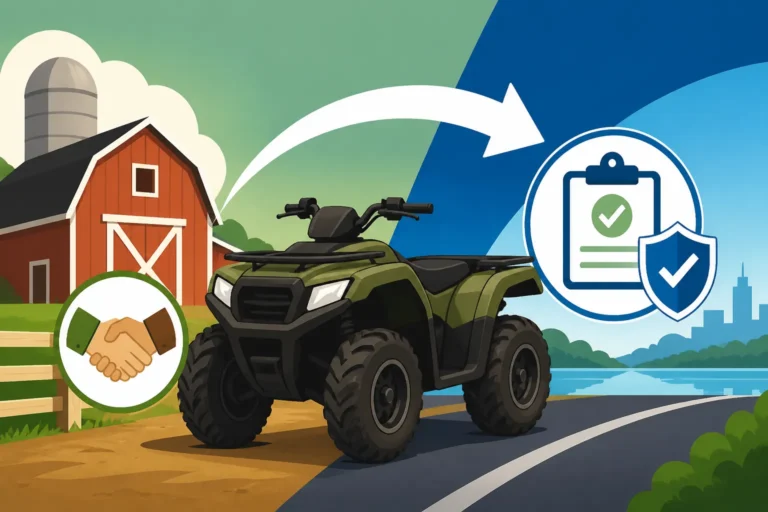
One of the biggest differences you'll encounter in Ontario is our "one-time" registration system for off-road vehicles. Unlike cars or even snowmobiles, ORVs in Ontario typically only need to be registered once when they're first brought into the province or purchased. Once you've got that shiny green Ontario Vehicle Permit in your name, you don't renew it annually, and you don't pay a yearly sticker fee. This can be a huge relief for Ontario residents, but it often confuses visiting riders who are accustomed to displaying a current validation sticker from their home jurisdiction.
For a visiting rider, this means you won't be expected to obtain an Ontario Vehicle Permit for your machine. Your valid registration from your home province or state is generally accepted as proof that your machine is legally owned and recognized. However, this doesn't mean you can just wave any old piece of paper around. You need to carry the official proof of registration or ownership issued by your home jurisdiction. Think of it as your machine's birth certificate and current address.
This unique system means there's no "Ontario visitor registration" to apply for in the traditional sense. You're simply operating under an agreement that recognizes your home province's or state's official documentation. It simplifies one aspect but then places greater emphasis on other critical requirements, like insurance, which we'll delve into shortly. Don't be fooled into thinking "one-time" means "no rules for visitors."
Permit Versus Plate for Visiting Riders
When you're visiting Ontario with your ATV or UTV, you might wonder if you need an Ontario license plate or if your existing plate will suffice. The good news is that if your machine is legally registered and plated in your home province, state, or country, you generally don't need to get an Ontario ORV plate. Your current plate, properly displayed, acts as your machine's identifier.
However, there's a crucial distinction. While you don't need an Ontario plate, your machine must still display a valid plate from its home jurisdiction. This plate needs to be securely mounted, visible, and legible, just as it would be back home. An Ontario Provincial Police (OPP) officer will be looking for this identifier, along with your proof of ownership, to confirm the machine's legitimacy. You'll want to ensure your home province's plate isn't obscured by mud, snow, or accessories, as that could still lead to questions or even a stop.
This also means that if your home jurisdiction doesn't issue plates for ATVs or UTVs, or if you're coming from a region where ORVs are entirely unregulated, you might face significant hurdles in Ontario. Our laws require a visible identification marker. Always carry the physical proof of registration, not just a photo on your phone. For more specific details, you can look into [Ontario Rules for an Out-of-Province Machine].
What You Absolutely Need to Ride in Ontario as a Visitor
Beyond simply understanding the registration model, there are concrete requirements every visiting ORV rider must meet to legally operate their machine in Ontario. Failing to meet these can lead to fines, your machine being impounded, or even more serious legal trouble. It's not just about compliance; it's about safety and liability, too. Think of these as the "big three" for any rider, visitor or resident, taking to Ontario's trails or approved roads.
Proof of Ownership/Registration from Home Jurisdiction
This is your machine's identity card. You must carry valid proof of ownership or registration from your home province, state, or country. This document serves as undeniable evidence that you are the legal owner or that you have permission to operate the machine. An Ontario officer needs to see this to confirm the machine isn't stolen and is legitimately part of a recognized registration system.
What kind of documents qualify? Typically, this would be your official vehicle registration card, a certificate of title, or a similar document issued by the government agency responsible for vehicle registration in your home jurisdiction. It needs to be the original document or a certified true copy – a blurry photo on your phone might not cut it, especially in a roadside stop situation. Imagine you're riding near Timmins and get stopped by an OPP officer. They ask for your papers. Handing over a clear, official document instantly builds credibility and speeds up the process. If you've just purchased a used machine in your home province and haven't fully registered it yet, make sure you have the bill of sale. If you're borrowing a machine from a friend or family member, consider having a written agreement, perhaps one quickly drafted through a service like LawDepot, giving you permission to use it and outlining the ownership details. This adds an extra layer of protection and clarity.
Without this proof, you're essentially riding an unidentifiable vehicle, which can lead to serious consequences under [The Off-Road Vehicles Act and Ontario Riders]. Always keep it in a waterproof bag or container, easily accessible but secure, perhaps in a glove box or a sealed pouch on your machine.
Mandatory Insurance Coverage
This is perhaps the most critical requirement, and one where many visitors inadvertently fall short. Ontario has mandatory insurance requirements for all off-road vehicles, whether they're being ridden on private land, designated trails, or approved roads. This isn't just a suggestion; it's the law. Your machine must be covered by a motor vehicle liability policy. This policy provides coverage for potential damages or injuries you might cause to others while operating your ORV.
The challenge for visitors is ensuring their existing insurance policy from their home jurisdiction provides adequate coverage while riding in Ontario. Some policies are perfectly fine and extend coverage across borders, but others might have territorial limits that exclude Ontario. Before you even cross the provincial or international border, contact your insurance provider. Ask them specifically if your ORV policy covers you for third-party liability and property damage while operating your ATV or UTV in Ontario. Confirm the coverage limits meet or exceed Ontario's minimum requirements. If you get stopped by an officer, they will ask for proof of insurance. Having an insurance card or policy document that clearly states coverage in Ontario is vital.
Riding without proper insurance in Ontario carries steep penalties, including substantial fines and potential impoundment of your machine. It's not worth the risk. Don't assume your auto policy covers your ORV, or that your ORV policy automatically covers you in another jurisdiction. For more information, take a look at [Insurance and Ontario ORV Registration] and [Ontario ATV Insurance Requirement]. Make sure you have physical proof of your insurance with you on every ride.
OFATV Trail Permit If Riding Designated Trails
If your plan involves riding on any of Ontario's extensive network of managed, signed, and maintained trails – such as those managed by the Ontario Federation of ATV Clubs (OFATV) or their member clubs (like HATVA in Haliburton or EOTA in Eastern Ontario) – you will need an OFATV trail permit. These permits are crucial for funding trail maintenance, insurance for the trails themselves, and ensuring a safe riding experience.
Even if your machine is perfectly registered and insured from out-of-province, if you're on a designated OFATV trail without the appropriate permit, you're riding illegally. The good news is that OFATV offers various permit options, including day passes, three-day passes, and annual passes, which are available for purchase online or at various local retailers. You can choose the option that best suits the length and frequency of your visit.
It's important to understand that riding on these club trails is a privilege, and the permit fees go directly back into maintaining the trails for everyone's enjoyment. This is where you'll find the best riding experiences, so consider it a necessary investment in your adventure. You'll receive a sticker to affix to your machine and usually a paper permit to carry with you. Make sure both are visible and readily available if you encounter a trail warden or law enforcement. Read more about [Ontario ATV Trail Permits Explained] and [What Ontario Charges Visitors to Ride] to plan your permit purchase.
Navigating Road Access and Other Key Regulations
Having your ORV registered and insured is a fantastic start, but it doesn't automatically mean you can ride anywhere. Ontario has specific rules about where ATVs and UTVs can operate, particularly concerning public roads and land. As a visitor, understanding this patchwork of regulations is crucial to avoid unintended fines or trespassing.
Understanding Ontario's Road Access Rules
This is where things can get a bit tricky, even for seasoned Ontario riders. Unlike some jurisdictions where ORVs have broad road access, Ontario has a more fragmented approach. While the province sets some overarching rules for ORV operation on roads, the decision to actually open municipal roads to ORVs rests largely with individual municipalities. This creates a "patchwork" system where one township's roads might be open, while the very next township's roads are completely closed.
Provincially, if a road is open, there are specific conditions:
- Speed Limits: Generally, ORVs are restricted to 20 km/h on roads with a posted limit of 50 km/h or less, and 50 km/h on roads with a posted limit greater than 50 km/h.
- Equipment: Your machine must meet certain equipment standards (e.g., proper lighting, mirrors, brakes, muffler).
- Helmet: A DOT-approved helmet with the chin strap fastened is mandatory for all riders and passengers.
- Licence: You need at least a G2 or M2 level licence (or an equivalent valid driver's licence from your home jurisdiction) to operate an ORV on a public road. A G1 or M1 learner's permit is not sufficient.
The most important takeaway for a visiting rider is this: never assume a road is open. You must verify the local municipal bylaws for the specific area you plan to ride. Information can usually be found on the municipality's website, or you can call their municipal office. For example, municipalities like [Greater Napanee By-law 2022-0062] or [Middlesex Centre By-law 2021-010] have specific bylaws. Always check [Checking a Township's ORV By-law] before you venture out. Riding an ORV on a prohibited road can lead to significant fines.
Operator Licence and Age Requirements
Just like with road-legal vehicles, operating an ATV or UTV in Ontario comes with specific licensing and age requirements, which vary depending on where you're riding and the age of the operator. These rules apply equally to visiting riders as they do to Ontario residents.
For road riding (on approved municipal roads):
- Licence: As mentioned, you need a valid G2 or M2 class driver's licence (or equivalent from your home jurisdiction). This means no G1 or M1 equivalent. Your foreign driver's license should be accepted as long as it's valid and covers the appropriate class of vehicle operation.
- Minimum Age: Operators must generally be 16 years of age or older.
- Passengers: If your ORV is designed for a passenger (tandem seat, footrests), they must also meet age and helmet requirements. Single-rider machines are strictly for one person.
For off-road riding (on trails, private property, Crown Land):
- Minimum Age: A person 12 years of age or older may operate an ORV off-road. However, if they are under 16, they must be supervised by someone 16 or older, or be riding on their own property. They should also complete an approved safety course.
- Children Under 12: Children under 12 may only ride on private property owned by their parents or guardian, or on private property with written permission from the landowner, and under direct supervision.
These age and licence rules are strictly enforced for safety reasons. For example, if you're visiting and want your 14-year-old to experience the trails, they can do so, but always under direct supervision. Be familiar with [Ontario ATV Helmet Law] and [Ontario ATV Minimum Age on a Road] to ensure everyone in your group is compliant.
Practical Tips for a Smooth Ontario ORV Trip
Preparing for an ORV trip to Ontario as a visitor can seem like a lot of hoops to jump through, but with a little foresight, you can ensure a seamless and enjoyable experience. The key is preparation and knowing exactly what documents to have on hand and how to get the most out of our amazing trail systems.
Document Checklist for Your Trip
To make sure you've got all your ducks in a row, here's a handy checklist of documents to gather before and during your ride. Always keep these in a waterproof, easily accessible pouch on your person or securely on your machine.
| Document Type | Description | Why It's Important |
|---|---|---|
| Proof of Ownership/Registration | Your official registration card, certificate of title, or equivalent document from your home jurisdiction. If you're borrowing the machine, have a written permission letter from the owner. | Proves legal ownership and right to operate. Essential for roadside checks and confirms your machine isn't stolen. |
| Proof of Insurance | Your physical insurance card or policy document, clearly stating coverage for ORV operation in Ontario. Confirm territorial limits with your insurer before you travel. | Mandatory in Ontario. Riding without it can lead to severe fines and vehicle impoundment. |
| Valid Driver's Licence | Your G2/M2 equivalent driver's licence from your home jurisdiction. If riding off-road with a minor, ensure you meet supervision requirements. | Required for any road access, and for all operators. Confirms you are legally permitted to operate a motorized vehicle. |
| OFATV Trail Permit | Your physical OFATV permit sticker (affixed to your machine) and the accompanying paper permit if you plan to ride designated club trails. | Grants legal access to OFATV's 10,000+ km of trails. Fees directly support trail maintenance and insurance. |
| Municipal Bylaw Printouts (Optional but recommended) | If you plan to use municipal roads for access, print out or save digital copies of the relevant ORV bylaws for those specific townships/towns. | Proves you've done your homework and clarifies specific speed limits, hours, and routes for local enforcement. |
| Emergency Contact Information | A laminated card with emergency contacts, medical information, and any known allergies. | In case of an accident or emergency, this provides vital information to first responders. |
If you find yourself in a situation where you're borrowing an ATV or UTV, or even if you just want to formalize permissions, a service like LawDepot can be a great resource for quickly generating a simple Bill of Sale or a Letter of Authorization to ensure you have all your bases covered regarding ownership or permission to use the machine. Having clear documentation, especially when crossing borders or operating a machine that isn't solely in your name, can prevent a lot of headaches.
Planning Your Route and Staying Informed
Once you've got your paperwork in order, it's time to focus on the fun part: riding! Ontario offers an incredible diversity of riding experiences, from rugged northern trails to scenic routes through eastern Ontario. Effective route planning and staying informed about local conditions will elevate your trip from good to unforgettable.
- Utilize the QuadON App: This is an essential tool for any ORV rider in Ontario. The QuadON app, available for smartphones, provides up-to-date trail maps, points of interest, fuel stops, and even real-time trail closure information from OFATV member clubs. Download it before you leave home and plan your routes in advance. It's like having a local guide in your pocket.
- Check Trail Conditions: Before heading out, especially in early spring or late fall, always check trail conditions. Many clubs close trails during spring thaw to prevent damage, or temporarily close sections for logging operations. The OFATV website and the QuadON app are your best sources for this information. Don't risk damaging trails or getting stuck.
- Crown Land vs. Private Land: While Ontario has extensive Crown Land open for recreational use, not all of it is accessible by ORV, and some areas have specific restrictions. Provincial Parks, for example, are generally closed to ORVs. Always be aware of whether you're on Crown Land, private property, or a designated trail. If you're crossing private land, even to get to a trail, you must have permission from the landowner. If you're dealing with a private landowner and need a quick, formal agreement for access, a template from LawDepot can come in handy to ensure clarity for both parties.
- Local Tourism Information: Don't underestimate the value of local tourism offices or visitor centres. They can provide invaluable insights into local trail networks, recommended routes, fuel availability, and places to eat or stay that are ORV-friendly. Many northern towns, in particular, are actively embracing ORV tourism and can offer great resources.
- Fuel and Supplies: Plan your fuel stops, especially on longer loops in remote areas. Cell service can be spotty in some parts of northern Ontario, so don't rely solely on your phone for navigation or emergencies. Carry a paper map, a satellite messenger if venturing far off the beaten path, and always pack essential supplies like water, snacks, a basic tool kit, and a first-aid kit. Consider [Where to Ride an ATV in Ontario] for inspiration.
By following these practical tips, you can focus less on administrative worries and more on experiencing the beauty and thrill of Ontario's vast ORV landscape. Enjoy your ride, and stay safe out there!
Disclaimer
This article is for general informational purposes only and does not constitute professional advice. Laws, prices and regulations vary by location and change over time. Consult a qualified professional for guidance on your specific situation.