Ontario Permits Honoured in Prince Edward Island
Ontario Permits Honoured in Prince Edward Island
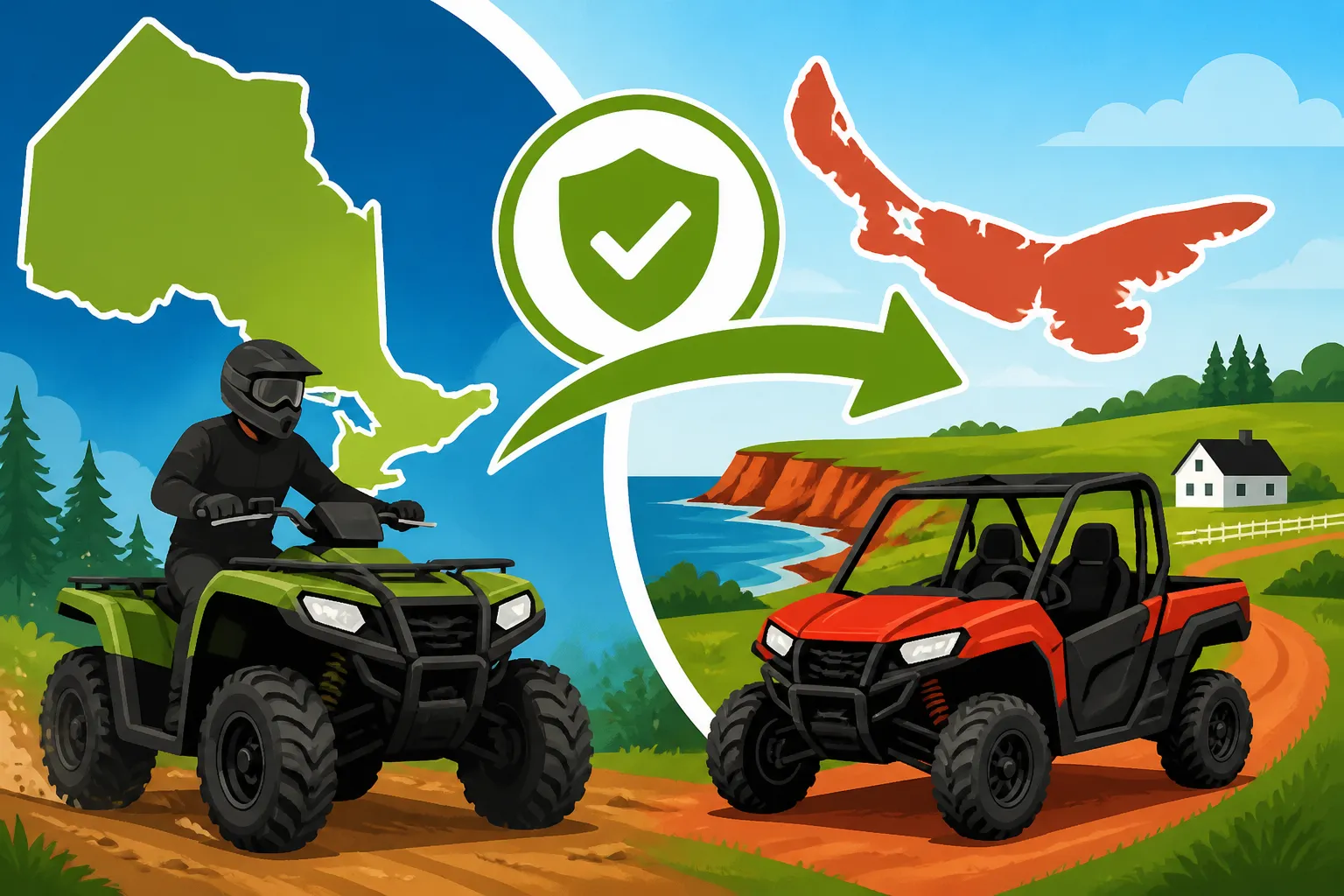
An Ontario ATV trail permit may let you ride participating trails in Prince Edward Island without buying a second trail permit—but reciprocity has limits. The key is confirming that your permit type and the trails you plan to use are covered. This article explains what to check before you travel and what your Ontario permit does not replace.
What an Ontario permit can cover in Prince Edward Island
Ontario and Prince Edward Island have a trail-permit reciprocity arrangement for eligible riders. In practical terms, a qualifying Ontario permit can be accepted for access to participating PEI ATV trails. That can simplify a trip: instead of arranging a separate trail permit for each province, you may be able to use your Ontario permit in both places.
The important word is eligible. Reciprocity is not the same as blanket permission to ride every trail, road or piece of land in PEI. The arrangement applies to participating trail systems and depends on the conditions set by the organizations responsible for those trails. It also does not override provincial laws, municipal bylaws, private-land permissions or trail closures.
For Ontario riders, the permit type matters. Reciprocity is generally associated with an eligible OFATV annual trail permit. Do not assume that a day permit, short-term permit, club-only membership or pass sold by a separate trail operator will work the same way. Confirm the exact permit and access conditions before setting out. Ontario Trail Permit Reciprocity With the Maritimes gives the broader picture of how cross-province recognition works.
A permit is also not the same thing as vehicle registration. Your Ontario ORV registration, plate and vehicle permit remain separate from your trail access permit. Likewise, a trail permit does not replace required insurance or any safety equipment required by law. Keep the differences clear:
- Trail permit: Provides access to trails covered by the permit arrangement, subject to local conditions.
- Vehicle registration: Identifies the machine under Ontario’s registration system.
- Insurance: Provides the required coverage for riding where insurance is legally required.
- Local permission: May still be needed for private land or access that is not part of a participating trail system.
If you are still sorting out which document does what, start with Ontario ATV Trail Permits Explained. For vehicle registration, Registering an ATV in Ontario covers the separate process.
Reciprocity is not a province-wide riding pass
A recognized permit can help you access participating trails, but it does not open every route in Prince Edward Island. Some trails may be closed, restricted to certain users, or subject to seasonal conditions. A route that appears on an old map may not be open when you arrive, and an open trail does not necessarily mean nearby roads are open to ATVs.
Before travelling, identify the trail system you intend to ride and check its current visitor information. Ask whether it accepts the Ontario permit you hold, whether any local registration or proof of insurance is required, and whether there are additional rules for visitors. If the answer is unclear, get confirmation from the organization responsible for the specific trail rather than relying on a general statement that “Ontario permits are accepted.”
Check that your permit qualifies before you travel
The safest assumption is that reciprocity applies only to the permit types specifically covered by the arrangement. A permit that gives access to some trails in Ontario may not automatically qualify simply because it is valid in Ontario.
This distinction matters because Ontario has multiple trail organizations and access arrangements. Some passes are issued through a federation, while other trail systems sell their own passes. There can also be a difference between buying a trail permit and joining a local club. Ontario’s Separate Club Passes explains why one Ontario pass may not cover every trail system at home, let alone a separate system in another province.
Use the following checks before you rely on reciprocity:
| What to check | Why it matters | What to confirm |
|---|---|---|
| Permit issuer | A separate pass may not be part of the reciprocal arrangement | Whether the named issuer is covered |
| Permit type | Annual and short-term permits may have different conditions | Whether your exact permit is accepted in PEI |
| Validity dates | A permit must be valid when you ride | The start and end dates shown on your permit |
| Trail operator | Recognition may apply to participating trails, not all trails | Whether your intended trail system participates |
| Machine covered | A permit may be associated with a particular machine or permit record | Whether the ATV or UTV you are bringing is covered |
| Visitor requirements | Trail access does not cancel local legal requirements | Registration, insurance, safety and display rules |
If you hold an annual permit, check that it will still be active during your trip. Do not assume a permit from a previous riding season remains valid just because you still have the sticker or a saved confirmation. How Long an Ontario Trail Permit Lasts explains why the validity period should be checked rather than guessed.
Also make sure you understand whether the permit is linked to one machine. If you are travelling with more than one ATV or UTV, do not assume one permit covers both. Confirm how the permit is issued and whether the machine details need to match the machine you take to PEI. Ontario Trail Permit for a Second Machine is useful if more than one vehicle is part of the trip.
What if you bought an Ontario pass outside the usual system?
A pass purchased for a particular Ontario forest, club, event or trail organization may provide access only to that organization’s trails. It might not be an eligible permit for reciprocity. The place where you bought the pass is not the only issue; the issuer, permit type and published conditions all matter.
Read the permit confirmation and any terms attached to it. If the documents do not clearly state whether it qualifies in PEI, contact the permit issuer and the PEI trail organization before travelling. A quick confirmation can prevent a wasted trip or an unexpected access problem at a trailhead.
Avoid treating online forum posts or another rider’s old trip report as definitive. They may describe a different permit, a previous agreement or a trail that is no longer open. Reciprocity rules and trail access can change, so confirm current details with the organizations involved.
What the Ontario permit does not replace
The permit’s purpose is trail access under the applicable arrangement. It is not a substitute for the legal documents and permissions that apply to riding an ATV or UTV in PEI.
Registration and vehicle documents
Carry the documents associated with your Ontario machine and verify that they meet the requirements for a visiting vehicle in PEI. The trail permit does not register the machine, prove ownership or authorize road use. If your machine is registered in Ontario, keep its registration documents with you and check the rules for out-of-province vehicles before travelling.
Do not confuse an Ontario plate with a trail-permit sticker. They serve different purposes and may be checked by different authorities. Ontario ATV Plate Placement Rules explains the Ontario plate requirement, while Reading an Ontario ORV Permit helps identify the information on the vehicle permit itself.
Insurance
A trail permit is not an insurance policy. Check that your existing policy covers the machine and the kind of riding you plan to do in PEI. Ask your insurer about out-of-province coverage, permitted trail use, passengers, towing and any exclusions that could apply. Carry proof of insurance in the form required for your trip.
Do not assume that coverage for riding in Ontario automatically answers every question about a PEI trip. Tell your insurer where you will ride and how the machine will be used. Ontario ATV Insurance Requirements explains the Ontario side of the issue, but your insurer is the right place to confirm the coverage in your specific policy.
Road use and local rules
Trail reciprocity does not grant permission to ride on public roads. Road access depends on the laws and local rules that apply in PEI, and permission can differ from one place to another. A connector route on a trail map is not necessarily a public road open to ATVs.
Before using any road, confirm that the route is permitted for your machine and that you meet the applicable requirements. Those may include rules for registration, insurance, licence, helmet, equipment and speed. If you are unsure, stay on trails that the responsible organization identifies as open to your vehicle.
The same caution applies to private property, beaches, parks and other public lands. A trail permit cannot give you a right to cross land that the permit does not cover. Follow signs and closures, and get permission where needed.
Plan the ride around the actual trails
A permit is useful only if the trails you want to ride are open and suitable for your machine. Before departure, check the specific trail network, not just a general map of Prince Edward Island.
Confirm the trail system and access point
Start with the trail organization responsible for the route. Check whether it accepts your Ontario permit and whether there are any visitor instructions. Confirm where the trail begins, where vehicles may be staged, and whether the intended route connects to other trails that have separate access conditions.
Do not assume that an access point shown in a navigation app is a legal staging area. Use the operator’s current directions and parking information. If you are arriving with a truck and trailer, check that there is room to park without blocking a road, driveway or trail entrance.
If your route crosses between trail systems, verify each segment. Recognition on one network does not necessarily mean access on a neighbouring network. A trip that looks like one continuous line on a map may cross land managed by different groups.
Check closures and seasonal conditions
Trail status can change because of weather, maintenance, landowner requests, construction or seasonal restrictions. Wet or soft ground can also make a route unsuitable even when it has not been formally closed. Riding around a closure or leaving the trail to avoid a muddy section can damage land and create access problems for everyone.
Check conditions close to your departure date and again on the day of the ride if the operator provides updates. Pay attention to signs at the trailhead and on the route. A previous trip report, printed map or saved route should not override a current closure notice.
Bring proof and keep it accessible
Carry the permit confirmation and any required permit display on the machine. If the permit is digital, save the relevant information so it is available when cell service is weak. A screenshot or downloaded copy may help you show what you purchased, but do not assume that a phone image replaces a required sticker or physical display.
Keep the following together, while protecting them from water and damage:
- Ontario vehicle registration documents
- Proof of insurance
- Trail-permit confirmation
- Identification and any licence required for the planned riding
- Emergency contact information and trail details
For a longer ride, tell someone where you plan to go and when you expect to return. Cell coverage can be limited in some riding areas, so do not make a phone signal your only safety plan. Carry basic repair supplies, water and clothing suitable for changing weather.
A practical checklist for an Ontario-to-PEI ride
Use this checklist before loading the machine. It helps separate permit questions from the other requirements that can affect a trip.
- Identify the permit issuer. Check the permit or purchase confirmation, not only the sticker colour or logo.
- Confirm the permit type. Ask whether your exact permit is covered by the PEI arrangement. Do not presume a short-term or standalone pass qualifies.
- Check the validity dates. Make sure the permit remains valid for every day you plan to ride.
- Name the trails you intend to use. Confirm acceptance with the organization responsible for those trails.
- Verify machine coverage. Make sure the ATV or UTV you are bringing is the machine covered by the permit, where applicable.
- Check legal requirements for visitors. Confirm vehicle documents, insurance, safety equipment and any operator requirements with the relevant PEI authority or trail organization.
- Review the route. Check closures, access points, staging and any road sections.
- Carry proof. Bring the permit confirmation, registration and insurance documents in an accessible form.
- Follow local signs and conditions. The permit does not override a closure, landowner restriction or local rule.
- Recheck before riding. Trail information can change between trip planning and arrival.
If your main reason for purchasing an Ontario permit is to ride several provinces, compare the arrangements before you buy. The QuadON Annual Permit in Ontario describes the annual permit option, while Ontario Permits Honoured in New Brunswick and [Ontario Permits Honoured in Nova Scotia] cover other parts of the regional arrangement. Each province can have its own conditions, so acceptance in one place should not be treated as proof of acceptance everywhere.
Common assumptions that cause trouble
“My Ontario permit is valid, so every PEI trail is open to me”
A valid permit does not make every trail available. The trail must be part of the covered network and open to your type of vehicle. Confirm the specific trail system and obey local closures.
“The sticker replaces my registration and insurance”
It does not. A trail permit is for trail access. Keep your vehicle registration and insurance documents separate and make sure they meet the requirements for riding in PEI.
“Any Ontario pass should be accepted”
Not necessarily. Ontario has different trail organizations and passes. Reciprocity may apply only to a named permit or category of permit. Ask about the actual issuer and permit type.
“If a route is on my map, I can ride it”
Maps can be incomplete or out of date, and a route may cross a closed trail, private property or a road where ATVs are not allowed. Check current information from the trail operator and follow signs.
“The same rules apply because my machine is registered in Ontario”
Your Ontario documents do not exempt you from the rules that apply where you ride. Confirm visitor requirements for PEI and follow the local rules for trails and roads.
Frequently Asked Questions
Can I use an Ontario ATV permit to ride in Prince Edward Island?
An eligible Ontario trail permit may be accepted on participating PEI ATV trails under the reciprocity arrangement. Confirm that your exact permit type and intended trail system are covered before travelling.
Does an Ontario permit let me ride every trail in PEI?
No. Reciprocity does not create province-wide access. Trail participation, closures, land access and local rules still apply.
Does my Ontario permit replace registration or insurance?
No. It is a trail-access permit, not vehicle registration or insurance. Carry the required documents and confirm that your insurance covers the trip.
Can I assume a day permit or separate club pass is accepted?
No. Do not assume a short-term permit or a pass from a separate Ontario organization qualifies. Check with the issuer and the PEI trail organization.
Disclaimer
This article is for general informational purposes only and does not constitute professional advice. Laws, prices and regulations vary by location and change over time. Consult a qualified professional for guidance on your specific situation.