Crossing a Provincial Highway Legally
It's a familiar scenario for many Ontario ATV and UTV riders: you're enjoying a fantastic day on the trails, maybe linking up with friends or exploring new territory, when suddenly, a major provincial highway stands between you and the next section of your adventure. It can be incredibly frustrating to hit this kind of roadblock, leaving you wondering if you're stuck, or worse, if you can just dash across quickly without consequence. This guide will walk you through the precise rules and best practices for legally and safely crossing a provincial highway in Ontario, helping you navigate these tricky intersections with confidence and avoid potential fines.
Understanding the Legal Landscape for ORV Highway Crossings
Navigating Ontario's roadways on an off-road vehicle (ORV) can feel like a minefield of rules, and for good reason—safety is paramount, both for you and for other motorists. When it comes to provincial highways, the rules are even more stringent than local municipal roads. It's not just about common sense; it's about specific legislation that dictates what you can and cannot do with your ATV or UTV. The key piece of legislation here is the Off-Road Vehicles Act, which outlines the basic framework, but often defers to the Highway Traffic Act when ORVs interact with public roads.
The "Highway Traffic Act" and Off-Road Vehicles
The Highway Traffic Act (HTA) governs pretty much everything that moves on Ontario's roads, from cars and trucks to motorcycles and, yes, even ORVs when they're not strictly off-road. For the most part, provincial highways, especially the high-speed, multi-lane arteries like the 400-series highways, are absolutely off-limits for ATVs and UTVs. You can't ride on them, you can't ride along them, and often, you can't even ride on their shoulders. This is a critical distinction to understand. The HTA prioritizes the safe flow of high-speed traffic, and an ORV, by its very nature, isn't designed for those environments. This is different from how some [Ontario ATV Rules on a Municipal Road] might apply.
The good news is that the HTA does make provisions for crossing certain highways, but these are very specific and come with a strict set of conditions. It's not a free-for-all, and any deviation can lead to serious legal trouble. You need to know these rules backwards and forwards before you even consider approaching a provincial highway.
What Constitutes a Provincial Highway in Ontario?
In Ontario, provincial highways are roads maintained by the Ministry of Transportation (MTO) and are typically identified by specific highway numbers (e.g., Highway 7, Highway 11, Highway 60). These are distinct from municipal roads, which are maintained by cities, towns, or townships. The crucial point is that just because a municipality has opened some of its roads to ORVs doesn't mean those ORVs can then hop onto an MTO-maintained highway.
Understanding this distinction is vital. A trail might lead right up to what looks like a quiet stretch of road, but if it's designated as a provincial highway, your permissions change immediately. There are often clear signs indicating the transition from a municipal road to a provincial highway. Ignoring these signs, or assuming all roads are treated equally, is a common mistake that can lead to fines for [Riding an Unregistered ATV in Ontario] if you're also not compliant with other regulations.
The Specifics of Legally Crossing a Provincial Highway
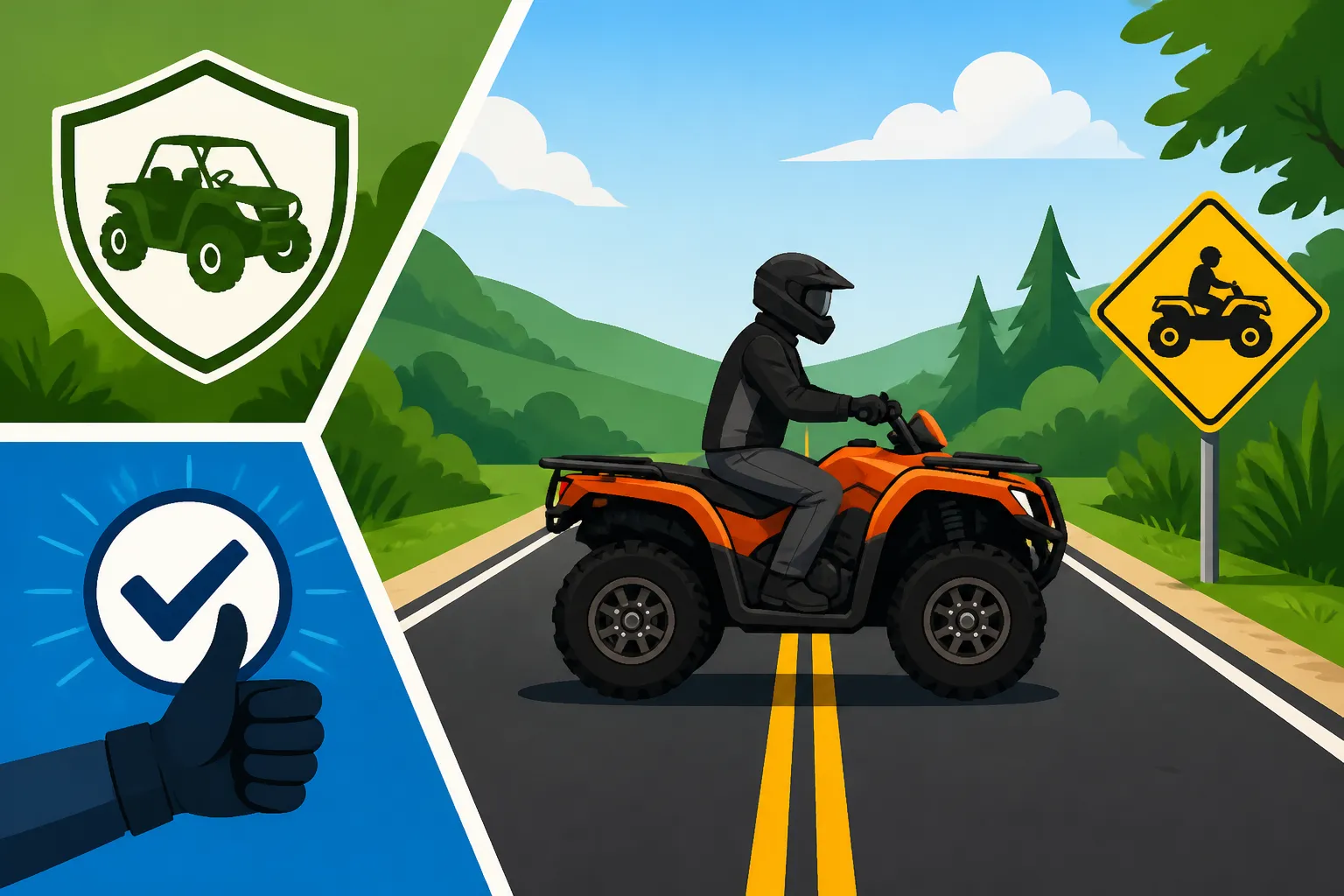
So, you're at a provincial highway and need to get to the other side to continue your ride. What are your options? For most provincial highways, particularly those with a speed limit over 50 km/h or multiple lanes, you are generally only permitted to cross at a 90-degree angle, from one side of the travelled portion to the other, at an intersection where public roads meet. This isn't about riding down the highway; it's about getting across it as quickly and directly as possible.
Crossing at Controlled Intersections Only
The most important rule is that you can only cross a provincial highway at an intersection where another public road (like a county road or a municipal street) meets it. You can't just cut across anywhere you see a gap in traffic or where two trails might appear to meet. These intersections are typically signalized, have stop signs, or are otherwise clearly marked as a junction point. This ensures that you're entering the flow of traffic at a predictable location, where other drivers expect to see vehicles.
You must come to a complete stop, check for traffic in both directions, and then proceed directly across. You're not permitted to turn onto the highway and ride a short distance, even if it feels like the safest way to navigate the turn. The moment you make that turn, you're illegally operating on the provincial highway, which carries significant penalties. This is where [Ontario's 20 and 50 km/h Speed Limits] for ORVs on roads become irrelevant, as you're not meant to be riding on the highway at all, only crossing it.
Exceptions for Specific Highways (Schedule B)
While most provincial highways are off-limits, there are some very specific, often more rural, provincial highways or sections of highways that have been opened up for ORV use by regulation. These are typically found in Schedule B of Ontario Regulation 316/03, under the Off-Road Vehicles Act. These sections are exceptions, not the rule, and often have specific conditions attached, such as speed limits or time of day restrictions.
It's absolutely crucial to check local municipal bylaws and the latest provincial regulations for any specific highway you intend to cross or ride near. Never assume a highway is open just because you see other ORVs on it or because a friend mentioned it. Conditions change, and local regulations can vary. For example, you might find a section of [Parts of Highway 11 Open to Quads] in one region, but the very next section is strictly prohibited. Ignorance of the law is not a defence, and the fines for operating on a closed highway can be substantial, including potential impoundment of your machine.
| Highway Type | Riding ON Highway | Riding ALONG Shoulder | Crossing (90-degree) |
|---|---|---|---|
| 400-Series | No | No | No |
| Major Provincial | No | No | Yes (at intersections) |
| Schedule B Listed | Yes (with conditions) | Yes (with conditions) | Yes (at intersections) |
| Municipal Roads | Yes (if opened by by-law) | Yes (if opened by by-law) | Always (if allowed on road) |
Essential Requirements for Highway Crossings
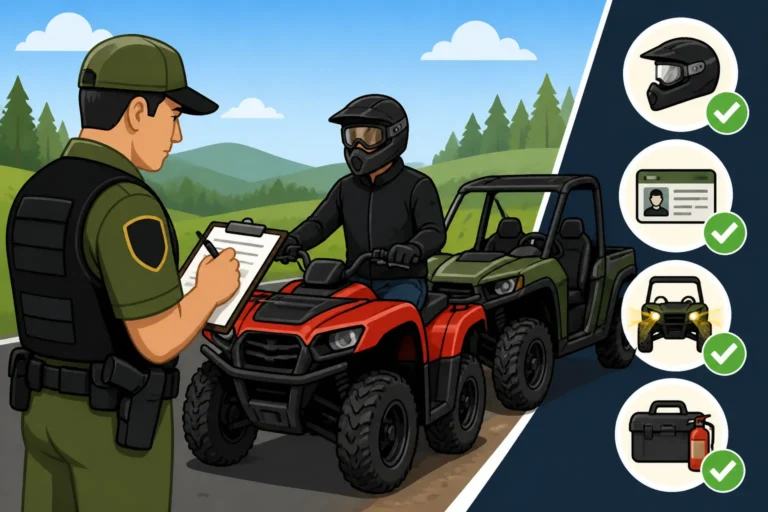
Even when legally crossing a provincial highway at an approved intersection, you're still operating a vehicle on a public roadway, and that means adhering to a suite of other requirements. These aren't suggestions; they are legal necessities to ensure your safety and the safety of others, and to avoid fines if you encounter law enforcement.
Proper Licensing and Insurance
Just like driving a car, operating an ORV on any public road, even for a brief crossing, requires you to be properly licensed. In Ontario, this means holding at least a G2 or M2 driver's licence. A G1 or M1 is not sufficient for independent operation on a public road, including crossings. [Can You Ride an ATV in Ontario With a G1]? The answer is generally no when it comes to public roads. Always carry your valid licence with you.
Beyond licensing, you absolutely must have valid insurance. [Ontario ATV Insurance Requirements] are mandatory for any ORV operating on a public road, and that includes highway crossings. Your policy must be a Motor Vehicle Liability Policy, providing at least $200,000 in third-party liability coverage. Always carry your proof of insurance, whether it's the physical card or a true digital copy on your phone. An officer checking roadside will ask for it, and the penalties for being uninsured are severe. This is not the time to be caught off guard.
Your Machine's Road-Ready Condition
For any road use, even just crossing, your ATV or UTV needs to meet certain equipment standards. This isn't just about what looks good; it's about visibility and safety. Your machine must have:
- Working Headlights and Taillights: Essential for visibility, especially in low light conditions or inclement weather.
- Brake Lights: Crucial for signaling your intentions to other drivers.
- A Horn: For signaling your presence.
- Mirrors: You need at least one mirror to see traffic behind you. Products like those from SuperATV offer robust mirror kits that can handle the rigours of off-road use while providing excellent visibility for road sections.
- Muffler: Must be in good working order and not exceed noise limits.
- Proper Tires: While not explicitly a "road tire" requirement, tires must be in good condition.
- A clearly visible [Ontario ORV Plates and Where They Mount]: Your licence plate needs to be securely attached and legible.
Before you even think about approaching a provincial highway, do a quick walk-around of your machine. Check that all your lights are working, your horn beeps, and your mirrors are adjusted. This quick check can save you a lot of grief.
Helmet Use and Occupant Protection
Ontario's helmet law is non-negotiable for ORV riders. Any time you are riding an ATV or off-road motorcycle on a public highway or a road, or even on private property without direct supervision, you must wear an approved motorcycle helmet. This applies equally to highway crossings. The helmet must be properly fastened with the chin strap. [Ontario ATV Helmet Law] extends to all operators and any passengers on a two-up machine.
For UTVs (classed as Recreational Off-Highway Vehicles or ROVs), seatbelts are mandatory for all occupants, and the ROV must be equipped with roll-over protective structures. Ensure everyone is buckled in before attempting a crossing. This isn't just about avoiding a ticket; it's about protecting yourself and your riding companions from the very real dangers of road traffic.
Executing the Crossing Safely and Legally
Once you've confirmed you're at a legal crossing point and your licence, insurance, and machine are all in order, it's time to actually make the crossing. This is where patience, observation, and decisive action come into play.
Approaching the Highway
As you approach the intersection, slow down and be acutely aware of your surroundings. Look for any signage indicating restrictions or specific rules for ORVs. If you're coming off a trail, you might be transitioning from a quiet, natural environment to a busy, high-speed roadway. This mental shift is crucial.
Stop completely at the edge of the paved road or at the stop line, if one is present. Signal your intent to cross if your machine has turn signals, or use clear hand signals if it doesn't. Remember, other drivers may not expect to see an ORV, so make your intentions as clear as possible.
The Crossing Procedure
- Stop and Observe: Come to a complete stop. Look left, then right, then left again. Check your mirrors if you're approaching from a side road. Be absolutely sure the way is clear. Assess the speed of approaching traffic. Don't rush this step.
- Wait for a Safe Gap: Do not attempt to cross if there's any doubt about having enough time or space. Provincial highways often have fast-moving traffic, and misjudging speed or distance can be catastrophic. Wait for a gap that allows you to cross safely without forcing other vehicles to brake or swerve.
- Cross Directly and Decisively: Once you're certain it's safe, proceed directly across the highway at a 90-degree angle. Accelerate smoothly and maintain a steady course. Do not weave or hesitate. Your goal is to get from one side to the other as efficiently as possible.
- No Riding on the Shoulder or Into the Ditch: As tempting as it might be to ride a short distance on the shoulder to line up a crossing, or to cut through the ditch, this is generally illegal. Stick to the 90-degree crossing at the designated intersection. The [Off-Road Vehicles Act and Ontario Riders] outlines these specific limitations.
Remember, the emphasis is on crossing, not traveling on the highway. Your interaction with the provincial highway should be as brief as humanly possible, minimizing your exposure to high-speed traffic.
Fines and Consequences for Non-Compliance
It's easy to think that a quick, illicit dash across a highway might go unnoticed, but the reality is that law enforcement takes ORV safety on roads very seriously. The consequences for not following the rules when crossing a provincial highway can range from significant fines to having your machine impounded, and even criminal charges in the event of an accident.
Penalties You Could Face
Operating an ORV on a prohibited section of highway, or failing to meet the equipment, licensing, or insurance requirements for road use, can lead to a variety of charges under both the Off-Road Vehicles Act and the Highway Traffic Act.
Common fines include:
- Operating an ORV on a prohibited highway: This is a direct violation of the HTA and can carry substantial fines.
- No valid driver's licence: Operating any motor vehicle without the proper licence is a serious offence.
- No insurance: This is one of the most heavily penalized offences in Ontario's traffic laws, with fines often in the thousands of dollars, and even vehicle impoundment.
- No approved helmet: Fines apply for both the operator and any passengers.
- Missing or improper equipment: Fines for non-functioning lights, no mirrors, or an illegal exhaust can add up quickly.
- Improper plate display: Your plate must be visible, clean, and properly mounted. [Can You Be Fined for a Mud-Covered ORV Plate]? Yes, you can.
Beyond the immediate fines, you could face demerit points on your driver's licence, increased insurance premiums, and if your machine is impounded, the costs of towing and storage can be hundreds, if not thousands, of dollars.
The Dangers of Illegitimate Crossings
Leaving aside the legal ramifications, the biggest consequence of an illegal or unsafe highway crossing is the risk of a serious accident. ORVs are not designed to interact with high-speed road traffic. Their visibility is lower, their stopping distances can be different, and their handling characteristics are geared towards off-road terrain, not smooth, fast pavement.
A collision with a car or truck on a provincial highway can be fatal for an ORV rider. It's simply not worth the risk. Always prioritize safety over convenience. If you are unsure whether a crossing is legal or safe, the best course of action is to find an alternative route, even if it means trailering your machine a short distance or consulting local maps and bylaws. Your life, and the lives of others, depend on your informed and responsible decisions.
Navigating Ontario's vast network of trails and roads with your ATV or UTV is an incredible experience, but it comes with the responsibility of understanding and respecting the rules. Provincial highway crossings are one of the most critical areas where these rules diverge significantly from off-road riding or even municipal road use. By understanding the legal framework, ensuring your machine and documentation are in order, and executing crossings with caution and precision, you can ensure your adventures remain thrilling, legal, and most importantly, safe.
Disclaimer
This article is for general informational purposes only and does not constitute professional advice. Laws, prices and regulations vary by location and change over time. Consult a qualified professional for guidance on your specific situation.