Ontario Crown Land Camping for Riders
Camping on Ontario Crown land can make an ATV or UTV trip feel remote and flexible, but a map showing public land does not automatically mean you can camp or ride anywhere on it. The key is to confirm who may camp, whether motorized access is allowed, and which restrictions apply at your chosen site and route.
What Crown land camping allows—and what it does not
Ontario Crown land is public land managed by the province, but it is not one large, unrestricted campground. Rules can depend on the location, land designation, temporary closures, local conditions and who is using the land. Before setting out, confirm that camping is allowed at your intended site and that you meet any eligibility or permit requirements.
Ontario residents may be able to camp recreationally on eligible Crown land without booking a developed campsite. That does not mean every parcel is open, or that a campsite can be occupied indefinitely. Stay limits and other conditions can apply. Non-residents may face different rules, including permit requirements in some circumstances. Check the current requirements with Ontario’s official land-use information or the responsible Ministry of Natural Resources office before travelling.
The rules may differ if the land is a provincial park, conservation reserve, municipal property, private land or part of a managed recreation area. A place that looks wild on a map may still have a distinct designation or restrictions. If the land status is unclear, do not assume camping or vehicle access is permitted.
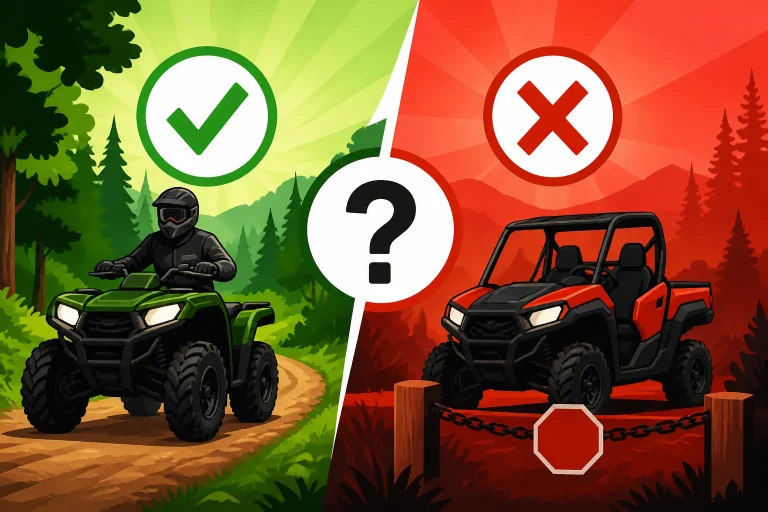
Most importantly, camping permission and riding permission are separate questions. Being allowed to pitch a tent does not give you permission to drive an ATV or UTV across every nearby clearing, forest road or trail. A route can be closed to motorized use, subject to a local restriction, or located on land you do not have permission to cross. Review What Free Use Means on Crown Land and Crown Land Ontario Riders May Use for more on the limits of public-land access.
A trail permit is also not a general Crown land access pass. Some organized trail systems require a permit even when a trail crosses public land; other routes may have different requirements. Check the rules for each route rather than assuming that a Crown land campsite or an Ontario registration permit covers your ride. Do You Need a Trail Permit on Ontario Crown Land? explains how the two kinds of access can differ.
Your machine’s legal requirements remain in effect while you ride. An Ontario-registered ATV or UTV, required insurance and any applicable equipment or road-use rules are separate from the permission to camp. See Ontario ATV Insurance Requirement and Ontario ATV Rules for Riding Crown Land before treating a remote route as an exception to ordinary riding rules.
Confirm the campsite and riding route before you leave
Good trip planning starts with two separate checks: one for the campsite and another for every part of the route. A campsite may be legal to occupy but difficult or unlawful to reach by ATV. Conversely, a route may be open to riding but lead past land where camping is restricted.
Use official land-use information to identify the land designation, access roads and posted restrictions. Look for closures, land-use notices and signs at the site as well as on the way in. Online maps can help with planning, but they may not show every temporary closure, recent change or local condition. If a boundary or route is uncertain, contact the responsible office or choose a clearly permitted alternative.
| What to check | Why it matters | Practical next step |
|---|---|---|
| Land designation | A provincial park, conservation reserve or other managed area may have different rules from general Crown land. | Confirm the designation and the rules for that location. |
| Camping eligibility | Residency and permit requirements can vary. | Check current requirements before travelling, especially if anyone in the group is not an Ontario resident. |
| Site restrictions | Closures, signs or local conditions can make a familiar site unavailable. | Check official notices and read signs when you arrive. |
| Vehicle access | A camping location being open does not guarantee motorized access to it. | Confirm that each road or trail on your planned route is open to your type of vehicle. |
| Trail permits | Organized trail systems may have their own access rules. | Check with the trail operator or club for the route you plan to use. |
| Fire conditions | Restrictions can change with local conditions and may apply to specific areas. | Check current fire rules and notices before lighting a fire. |
Keep your route conservative. A road shown on a map may be private, gated, closed or unsuitable for a vehicle, and an unmarked track is not proof that riding is permitted. Do not ride around a closure sign or bypass a gate. If your planned access route is blocked, turn around and use a confirmed alternative rather than cutting across unfamiliar land.
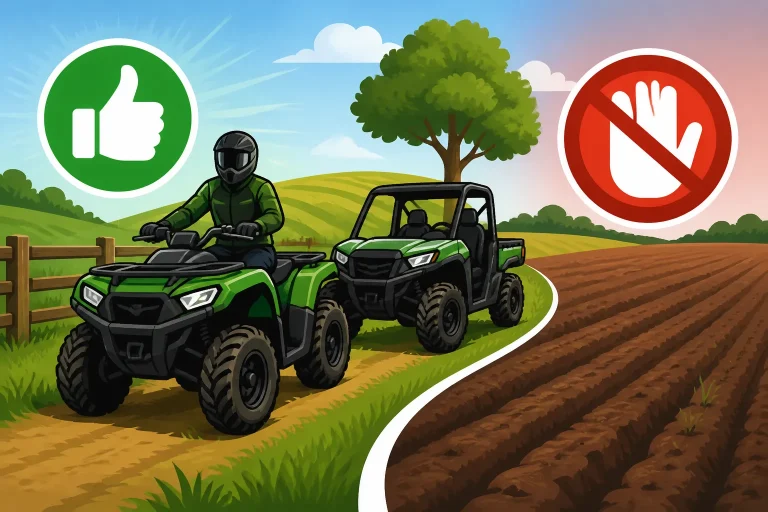
For a campsite far from a road, make sure your machine can reach it without leaving an authorized route. Do not widen a path, create a new track through brush or use a wet area as a shortcut. These choices can damage the land and create a route that other riders may mistake for an approved one. For a closer look at access limits and restrictions, see Where Crown Land Riding Is Restricted.
If you plan to park an ATV or UTV at a cottage, hunt camp or other base, check whether that particular property and its approach are open to the machine. A route used by local residents is not necessarily available to visitors. Ontario ATV Registration for a Cottage Machine covers registration considerations for a machine kept at a cottage; it does not replace checking land access.
Set up camp with the land and other users in mind
A low-impact campsite is easier to leave in good condition and less likely to affect other land users. Choose an established or previously disturbed site where camping is allowed, rather than clearing a new area. Keep vehicles on permitted roads or parking areas, and avoid driving across vegetation or close to shorelines just to reach a preferred tent spot.
Set up away from sensitive ground, waterways and places where your activity could disturb other users. Follow posted restrictions and any local direction about where to camp. Keep tents and gear out of access routes, and leave room for other permitted traffic to pass. If the site is busy or the ground is soft, move to a suitable alternative instead of expanding the campsite.
Plan for waste before you leave home. Carry out food packaging, cans, fishing line and other rubbish, including items that might otherwise blow away. Do not leave food or garbage behind, bury refuse, or assume that a fire will dispose of it safely. Pack out what you bring in, and leave the site as you would want to find it.
Treat campfires as conditional, not automatic. Fire rules can change with weather and local risk, and a restriction may apply even if a fire ring is already present. Check current notices and follow any local requirements for fire location, size and supervision. If fires are prohibited, use a permitted alternative for cooking or skip the fire. Before leaving, make sure any permitted fire is fully extinguished.
Fuel and vehicle maintenance need extra care in a remote campsite. Refuel away from flames, store fuel securely and prevent spills from reaching soil or water. Bring only what you can carry safely and manage responsibly; avoid leaving fuel containers at the site. For trip-specific considerations, see [Ontario Rules for Carrying Fuel].
Noise and timing matter, too. Keep engines off when you are not riding, avoid unnecessary revving, and respect nearby campers, residents and wildlife. Do not ride late simply because a route is remote. Local restrictions or landowner conditions may set limits, and wildlife activity can make travel less predictable. A quiet camp is also less likely to create conflict with people who are using the same area for other lawful activities.
Remember that public land may be used for purposes beyond recreation. You may encounter forestry work, hunting, trapping or other operations. Respect signs, equipment, work areas and access controls. If you come across an active operation or a route that seems unsafe, stop and choose another way rather than assuming the area is clear.
Prepare for a remote ATV or UTV trip
Remote travel leaves less room for last-minute fixes. Before departure, share your intended route and return plan with someone who is not joining the trip. Carry a map that can be used without mobile service, and know how to identify your location if you need help. A phone is useful, but do not count on continuous coverage.
Inspect the machine, tires, lights and basic safety equipment before loading it. Carry tools and supplies that match the vehicle and route, along with enough water, food and warm or weatherproof clothing for delays. A UTV may offer more storage than an ATV, but that does not remove the need to secure cargo and keep critical equipment reachable.
Decide in advance what you will do if the campsite is occupied, closed or difficult to reach. Choose a legal backup location or be prepared to leave the area. Do not solve a campsite problem by setting up on private land or riding an unapproved route. If conditions change, a shorter ride or an early turnaround is often the safer choice.
Use this pre-trip sequence:
- Confirm the land designation and whether camping is allowed at your intended location.
- Check whether you need a permit and whether any stay limits or local conditions apply.
- Verify that every road and trail on the route is open to your vehicle and that any required trail permit is in hand.
- Check current restrictions, including closures and fire rules, shortly before departure.
- Confirm your machine’s registration and insurance, then pack navigation, safety and emergency supplies.
- Tell someone where you are going, when you expect to return and what to do if you miss that check-in.
Crown land can offer a rewarding base for a ride, but access depends on the exact place and route, not just the word “public” on a map. Confirm both camping and motorized access, follow local restrictions, and leave the campsite and riding area in good condition. When a rule or boundary is uncertain, verify it before unloading the machine.
Disclaimer
This article is for general informational purposes only and does not constitute professional advice. Laws, prices and regulations vary by location and change over time. Consult a qualified professional for guidance on your specific situation.