Ontario Rules for Riding Farm Land
Riding an ATV or UTV on Ontario farm land can feel less complicated than taking it onto a road or trail, but “private farm” does not automatically mean “no rules.” The key questions are who has given permission, where the machine will travel, and whether it crosses onto public land or a road. Here’s how to sort out those boundaries before the ride.
Start With Permission and the Exact Property Boundary
If you own the farm, you can generally decide whether and where people may ride on your land. If you are a tenant, family member, farm worker, guest or recreational rider, get permission from the person who has authority over the property. A friendly invitation to ride in one field is not necessarily permission to use the laneway, woodlot, neighbouring property or a connecting trail.
Permission should be specific enough to prevent misunderstandings. Agree on which fields, tracks and access points are open, whether passengers are allowed, and when riding is permitted. A landowner may also set conditions, such as keeping away from livestock, avoiding soft ground or using a designated route. Those conditions can be stricter than the rules that apply under provincial law.
Do not assume a farm track is private simply because it looks rough, unpaved or little used. A lane may be a public road, an unopened road allowance, a shared access route or part of a trail network. If you are unsure, check with the landowner and, where relevant, the municipality before riding it. Ontario ATV Rules for Riding Private Property explains the difference between riding on private land and relying on permission to use a route.
Trespass rules still matter. Riding through a gate, across a field or along a woodlot edge without permission can create problems even if the route looks familiar or there are no “No Trespassing” signs. Do not assume that a trail permit, farm connection or previous access gives you continuing permission. For a fuller look at land access, see Ontario Trespass Rules for Riders.
Farm land also does not create a general exemption from other laws. Rules may still apply to activities such as hunting, carrying a firearm, damaging protected areas or riding on public land. The fact that a machine is used for farm work does not turn a Crown land route or public trail into private property.
Registration, Insurance and Trail Permits Depend on Where You Ride
The biggest practical distinction is between using a machine only on private land and taking it onto a road, public land or an organized trail. Rules that apply to public routes do not necessarily apply in the same way to a machine that stays entirely within a privately owned farm. But the words “farm use” or “farm machine” do not, by themselves, provide a blanket exemption.
If the ATV or UTV will be used only on private farm land, registration requirements tied to road or public-land use may not apply in the same way. If you plan to use a public road or public land, check whether the machine needs to be registered and plated before the ride. The details can depend on the location and how the route is classified. Ontario ATV Registration for a Farm Machine covers the registration question, while Is a Woodlot Quad Exempt From Ontario Registration? looks at a similar issue for machines kept off-road.
| Where you ride | What to check before setting out |
|---|---|
| Private farm land only | Permission, property boundaries, landowner conditions, machine condition and insurance coverage |
| Public road | Whether the road is open to the machine and whether registration, a plate, insurance, a valid licence and road equipment are required |
| Public land | Access restrictions, registration requirements, any local rules and whether a trail permit is needed |
| Organized or club trail | Whether the route is open, which trail permit applies, and whether your registration and insurance documents are in order |
Registration and a trail permit are not the same thing. A vehicle permit and plate relate to registering the machine for applicable use; a trail permit gives access to particular trail systems under their rules. A permit for one club area does not automatically grant access to every route in the province. If your farm ride connects to an organized trail, check the trail operator’s current requirements rather than assuming that permission from the farm owner is enough. Ontario ATV Trail Permits Explained provides more detail about that distinction.
Insurance needs the same location-by-location check. Compulsory insurance rules apply when an ORV is used in circumstances covered by Ontario’s road and public-use requirements. A private farm ride may be treated differently, but that does not mean the rider or landowner is protected from every loss. A farm or home policy may exclude the machine, the activity, a paid ride or damage to someone else’s property. Before lending a machine or inviting riders, ask the insurer what the policy covers and where it applies. Ontario ATV Insurance Requirement explains why coverage should be checked before riding.
A rider who leaves the farm for even a short stretch of road should not rely on the rules for private land. The route may bring registration, insurance, licensing, helmet and equipment requirements into play. A road crossing can also be subject to specific restrictions. See Ontario ATV Rules for Crossing a Highway before planning a route that crosses or follows a public road.
Riders, Passengers and Protective Gear
Private land may have different rules from a road or public trail, but it is not a reason to treat an ATV or UTV as a toy. Make sure each rider can reach the controls, understand how the machine responds and stop safely. A young rider should use a machine suited to their size and ability, with close supervision. Age restrictions can change depending on where the vehicle is being operated; do not assume that a child who may ride on a private farm can also use a public road or trail. For the distinction, see Ontario ATV Minimum Age Off-Road.
Passengers should only ride in a seat designed for them. Do not carry someone on a cargo rack, fender or improvised seat, and do not exceed the machine’s seating capacity. A passenger can shift the vehicle’s balance, particularly on a slope or uneven ground. UTV occupants should use the installed restraints as intended, and riders should follow the manufacturer’s instructions for the particular machine. Ontario ATV Passenger Rules covers passenger limits in more detail.
Helmet rules depend on where the machine is being operated. On a public road or public land, riders generally need to follow the applicable helmet requirements and any exceptions set out in law. A ride that stays on strictly private farm land may be treated differently, but a helmet remains sensible protection against rollovers, low branches and collisions. Landowners can make helmet use a condition of riding on their property, and insurance terms may also set expectations. When the route leaves the farm, check the public-route rules instead of relying on a private-property understanding.
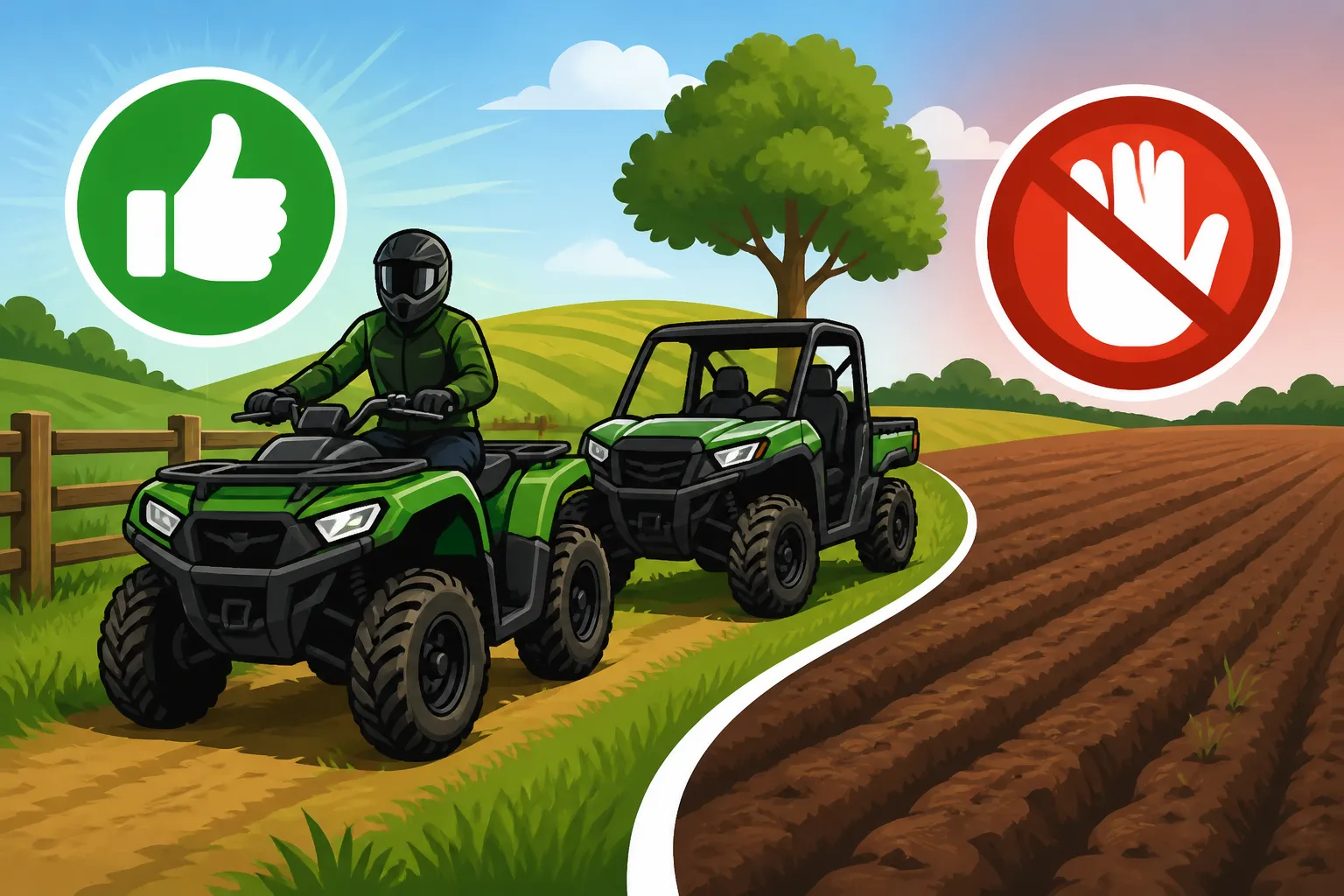
Farm tasks can add risks that are not obvious on a recreational trail. Haying, spraying, livestock moves, deliveries and harvesting can put tractors, trucks and people on the same tracks as the ATV. Set up clear times and routes so riders are not mixing with active work. Slow down near buildings, machinery, animals and blind corners. Avoid riding through crops or newly seeded ground unless the farm operator has specifically approved it.
Plan the Ride Around Farm Hazards and Route Changes
Before riding, walk or inspect the planned route if it is unfamiliar. Look for drainage ditches, culverts, wire, debris, hidden rocks, soft shoulders and steep banks. A field that looks firm from the edge can be saturated after rain, while ruts or crop rows can make a familiar route unstable. Keep a safe distance from ponds, manure pits, irrigation equipment and other hazards that may be difficult to see from the seat.
Set basic rules for the group before starting:
- Confirm exactly where riders may go and where the farm boundary lies.
- Identify who is responsible for supervising younger riders and guests.
- Agree on a speed appropriate for the surface, visibility and nearby work.
- Keep riders apart from active farm machinery and livestock.
- Make sure riders know how to stop, signal a problem and return to the meeting point.
- Recheck the route if weather, field work or access conditions have changed.
Do not use a private farm route as a shortcut onto a road, Crown land or a trail unless you have confirmed that the next section is open and that you meet its requirements. A landowner’s permission ends at the property boundary. Public land may have its own access restrictions, and a road may be closed to ORVs even when it appears to connect two farm lanes. Where a route is on Crown land, check the applicable access rules rather than assuming that all public land is open for riding. Ontario’s Public Lands Act Free Use Policy explains why free use does not mean unrestricted access.
Keep the machine in suitable condition for the ride. Check the brakes, throttle, tires, steering, lights and any seat belts or protective structures fitted to the vehicle. Carry only what can be secured safely, and do not attach loads that can shift or affect handling. If the ATV or UTV is being used for farm work, use attachments and towing setups designed for that purpose and follow the machine manufacturer’s operating limits.
Finally, make a clear plan for the transition from farm land to any other type of route. If the plan changes during the ride, stop and check permission, access and legal requirements before continuing. That pause is especially important at a gate, road crossing, trail junction or property line. The simplest rule is to treat each change in land type as a fresh check: private permission for the farm, and the relevant registration, insurance, permit and access rules for everywhere beyond it.
Disclaimer
This article is for general informational purposes only and does not constitute professional advice. Laws, prices and regulations vary by location and change over time. Consult a qualified professional for guidance on your specific situation.