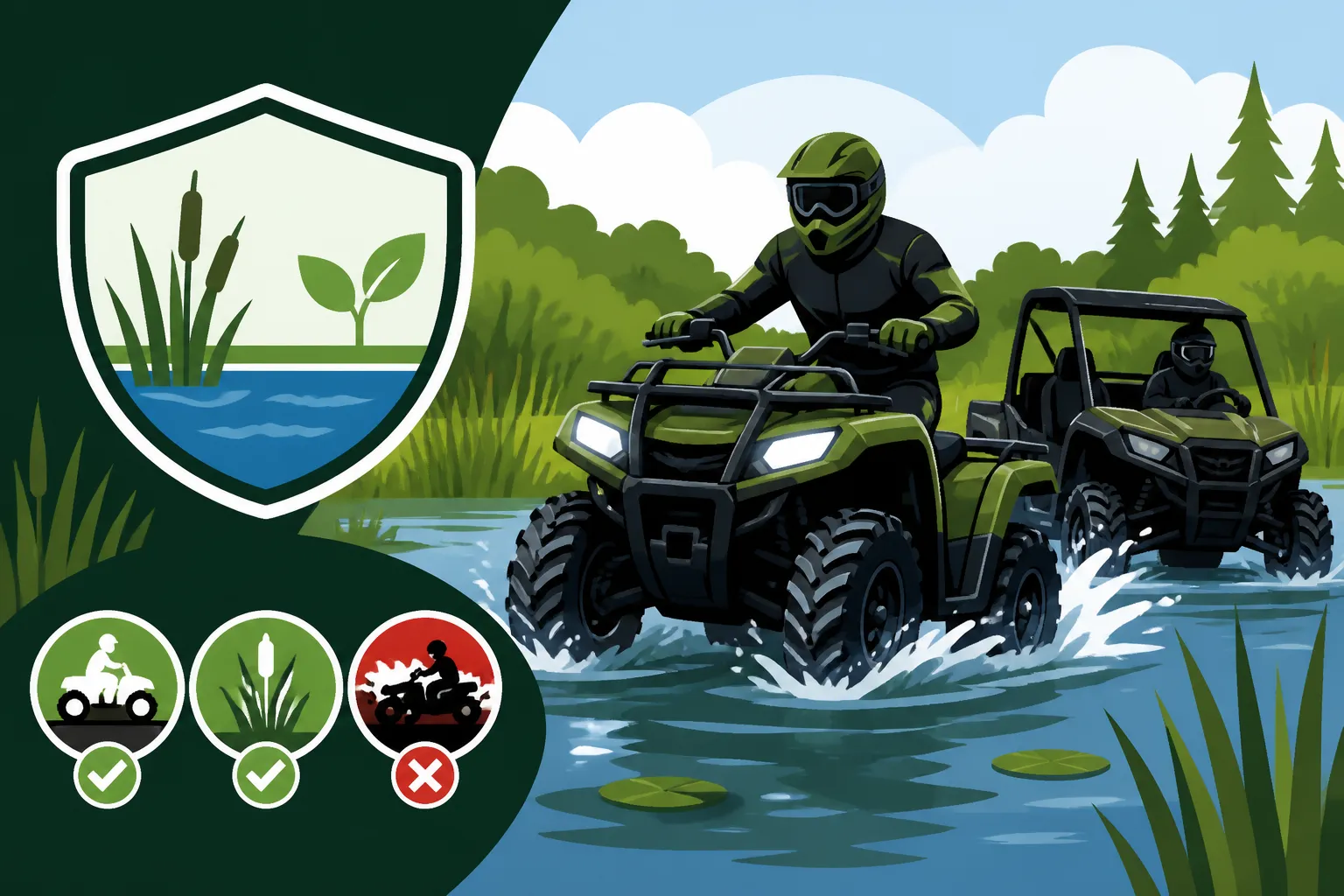
Ontario Rules for Riding a Wetland
Ontario wetland riding can be confusing: a track may look open, but that does not mean you have permission to drive through it. The rules depend on who manages the land, whether the route is authorized and what restrictions apply. Here’s how to check before you ride, and how to avoid damaging sensitive ground or getting caught in a legal dispute.
Ontario wetland riding rules depend on the land
There is no single permission that makes every wetland in Ontario open to ATVs and UTVs. A wetland might be on private property, Crown land, a conservation authority property, a provincial park or a trail network managed by a club. Each can have different rules.
The practical starting point is to identify the land and the route. A wet patch beside a trail is not automatically part of the trail. A visible tire track is not proof that the route is legal, current or open to motorized use. Even on land where some recreational riding is allowed, restrictions may apply to particular areas, roads, seasons or vehicle types.
| Where you are riding | What to check before entering |
|---|---|
| Private property | Get permission from the landowner for the specific route and use |
| Crown land | Check current land-use restrictions, closures, signs and access conditions |
| Club or managed trail | Stay on the marked route and follow the trail operator’s rules |
| Provincial park or conservation area | Check the managing authority’s rules; do not assume motorized riding is allowed |
| Wetland beside an authorized route | Do not leave the route to cross it unless that crossing is explicitly permitted |
A trail permit, vehicle registration or insurance policy does not give you access to every wetland. Those documents address separate requirements. A trail permit applies to the routes and areas covered by the relevant trail system; it does not override a landowner’s decision or a land manager’s closure. See Ontario ATV Trail Permits Explained and Ontario Crown Land Free Use Policy for more on the difference between riding access and general permit or land-use rules.
Wetlands include places such as marshes, swamps, bogs and fens. They can look firm at the edge and still contain saturated soil, hidden channels or soft pockets. Some are visibly wet for much of the year; others may appear dry during a hot spell. Surface appearance alone is not a reliable way to judge whether a route is open or safe.
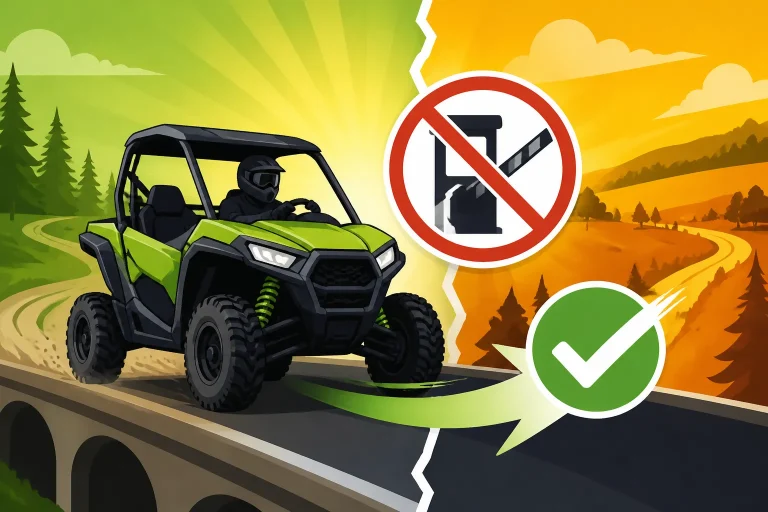
A route that crosses a wet area may be authorized as part of a managed trail, with the land manager’s approval and any required safeguards. That does not mean riders may widen the trail, go around a muddy section through the vegetation or make a new crossing. If the marked route is flooded or damaged, turn around and report the issue rather than making a detour through the wetland. The same principle applies to creeks and water crossings; Ontario Rules for Crossing a Creek covers those situations separately.
How rules change by land type
Crown land
Some Crown land is available for public recreation, but that does not mean every parcel or feature is open to motorized travel. Restrictions, closures, signs, land-use designations and local conditions can affect access. A wetland may also be within an area where motorized vehicles are restricted, or where a route is permitted only in a specific location.
Check current information for the particular area before riding. Look for signs at access points, road or trail closures, and any directions from the land manager. If you cannot confirm that motorized travel is permitted through the wetland, do not treat uncertainty as permission. Where Crown Land Riding Is Restricted explains why general access expectations do not settle the rules for every location.
Private land
On private property, ask the owner before riding. Permission to use a trail across a property does not necessarily include permission to leave it and cross a marsh or swamp. Make sure the permission covers the route you plan to take and the type of machine you will use.
A neighbour’s permission, an old tire track or a route shown on a map is not a substitute for the landowner’s consent. If a route passes through several properties, permission from one owner does not cover the others. The broader rules for permission and access are covered in Ontario Landowner Permission Rules.
Provincial parks and conservation areas
Do not assume that a wetland is available for ATV or UTV use just because it is on public land or near a road. A provincial park or conservation area may prohibit motorized travel, limit it to particular roads or trails, or have rules that apply to specific locations. Check the managing authority’s current rules and maps before entering. Ontario ATV Rules for Riding a Provincial Park and Ontario ATV Rules for Riding a Conservation Area provide more detail on those settings.
Club and managed trails
On a marked trail, remain on the authorized route. If a wetland crossing is part of that route, use only the designated line and follow posted signs or instructions. If the route is closed, do not ride around the closure through nearby wet ground.
A trail system’s permit or club membership is not an off-trail pass. Rules can also differ between neighbouring trail areas, so check the route and its operating status rather than assuming that a permit valid in one area covers every connecting path. For route-specific advice, see Ontario Rules for Riding Off the Trail and Does Your Permit Cover the Next Club’s District?.
Why riding through a wetland is a poor shortcut
A wetland can be damaged even when a machine crosses it quickly. Repeated tire traffic can break vegetation, churn saturated soil and create ruts that collect or redirect water. Once a rut forms, later riders may follow it or widen it, making the disturbance harder to contain. A route that seemed passable for one machine can turn into a deeper, broader track after several trips.
Wet ground also creates practical risks for the rider. A firm-looking surface can give way under a heavy machine. Water can conceal holes, roots, soft banks and changes in depth. Trying to recover a stuck ATV or UTV may cause further damage and put riders or helpers in danger. A winch can help with recovery in suitable situations, but it does not make an unauthorized crossing acceptable.
Wetland conditions can change quickly. Rain, snowmelt and seasonal water levels may turn a familiar route into a hazardous one. Frozen conditions are not automatic permission to cross, either: ice thickness and the ground beneath it can vary, and land-use restrictions still apply. A route that was open on a previous visit may be closed or unsuitable now.
The responsible choice is to stay on the authorized trail and turn back if it is flooded, blocked or too soft to travel without leaving the route. Do not create a new path around a puddle or a mud hole. If you are unsure whether the route itself is still open, contact the trail operator or land manager before continuing. Ontario Trail Conditions After Rain discusses why conditions can change and why a passable trail should not be assumed to be safe after wet weather.
Check before you ride and respond carefully on the trail
A little checking before the ride is easier than dealing with a stuck machine, a damaged route or a complaint about trespassing. Use this process when a planned route approaches a wetland or when you encounter one unexpectedly.
- Identify the land manager. Find out whether the route is on private land, Crown land, a managed trail or protected property. If you cannot tell, pause and verify rather than relying on a map line or tire tracks.
- Confirm that motorized use is allowed there. Check current signs, maps and rules from the owner, trail operator or managing authority. A route being open to hikers or other users does not establish that it is open to ATVs or UTVs.
- Check closures and current conditions. Look for seasonal restrictions, temporary closures and reports of flooding or trail damage. A route can be legally open but still unsafe or too soft to ride responsibly.
- Stay on the marked route. Do not cut through vegetation, use a wetland as a bypass or widen the trail to get around an obstacle. If the authorized line cannot be travelled without leaving it, turn back.
- Ask for permission where needed. On private land, get the owner’s permission for the actual route and activity. On managed land, ask the relevant operator or authority what is permitted.
- Report problems instead of making your own detour. Tell the trail operator or land manager about a washout, flooded section, missing sign or unsafe crossing. Give a clear location if you can do so safely.
If you realize that you have entered a wetland unintentionally, stop rather than continuing farther in. Avoid sudden turns that can widen the disturbed area. If it is safe and practical, retrace your route along the same line; do not attempt a risky recovery or cross deeper water simply to get out quickly. Contact the land manager or emergency services if someone is injured or the machine cannot be recovered safely.
Keep your route information usable offline if mobile coverage is uncertain, but remember that a map is a planning aid, not proof of permission. Compare it with signs and current information from the organization that manages the land. When route boundaries or access rights are unclear, choosing another trail is usually the safer option.
Disclaimer
This article is for general informational purposes only and does not constitute professional advice. Laws, prices and regulations vary by location and change over time. Consult a qualified professional for guidance on your specific situation.