Ontario Rules for a Guided Tour
A guided ATV or UTV tour can make it easier to ride unfamiliar trails, but having a guide does not automatically cover every permit, safety rule or insurance requirement. The rules depend on where the tour goes, the machine you ride and your role as driver or passenger. Here’s what to confirm before you book and what to expect on the ride.
What Ontario rules still apply on a guided tour
A guide can lead the group, explain the route and help with the machines. They cannot make an otherwise unlawful ride legal. Ontario’s rules still apply, and an operator may set stricter conditions than the law requires.
Start by asking where the tour will ride. A private course, a club trail, Crown land and a municipal road can involve different permissions and requirements. A ride may also move between more than one type of land. The tour operator should be able to explain the route and the rules for each part.
Age, licence and driver eligibility
Age rules depend on both the location and the activity. Ontario generally does not allow a person under 16 to operate an off-road vehicle on a road. Road riding also has licence requirements; a G1 licence is not enough for riding an ORV on a road where ORVs are permitted. See Ontario ATV Licence Requirements and Ontario ATV Minimum Age on a Road for more on those distinctions.
Off-road riding has different age rules. A rider under 12 may be allowed to operate an ORV in some circumstances under adult supervision, but that does not mean a tour company must accept young drivers. Operators can set their own minimum age, require a particular licence or insist that the driver be an adult. Review Ontario ATV Minimum Age Off-Road, then ask the tour company about its own minimums.
Do not assume that an adult booking the tour can simply take responsibility for every younger rider. The operator may need a parent or guardian to sign a waiver, attend the briefing or ride alongside the child. It may also limit which machines a younger participant can use.
Helmets and passengers
A helmet is a basic part of preparing for an ATV or UTV ride. Ontario has helmet requirements for many ORV rides, and a tour operator may require a helmet even in situations where a legal exception might apply. Ask whether a helmet is supplied, whether it must meet a particular safety standard and whether you may bring your own. The related rules are covered in Ontario ATV Helmet Law.
Passengers should ride only in a machine designed to carry them, using the intended seat and restraints. A passenger should not be added to a single-rider ATV just because there is room on the seat or rack. For a side-by-side, use the seat and seat belt provided by the manufacturer. The operator may have further age, height or passenger restrictions. If you are unsure whether a quad is built for two people, check Ontario ATV Rules for a Single-Rider Machine before treating it as a two-up ride.
Insurance and registration
A tour business may supply and insure its fleet, but do not treat that as a given. Ask who is responsible for the machine’s registration and insurance, what coverage applies during the ride and whether the coverage changes if a customer causes damage or breaks a rule. Insurance for operating on a road is not the same question as damage coverage for a rental machine. Ontario ATV Insurance Requirement explains why it is worth checking the details rather than relying on a general assurance that the tour is insured.
If a route includes a road, ask the operator how that section is handled. Road riding may bring additional requirements for the machine, the driver and the insurance. A guide’s presence does not replace a required licence, permit, registration or insurance.
Permits, trail access and reciprocity
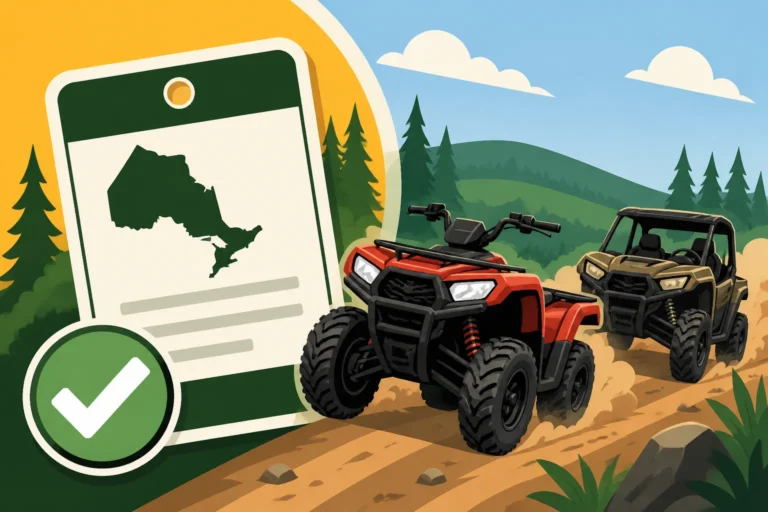
A reservation for a guided ride is not automatically a trail permit. The operator may include access in the tour price, arrange a group permit, ride on land it controls or use a trail system with its own rules. Those arrangements differ, so confirm them before you arrive.
Ask the operator which trails or properties the tour uses and whether your booking includes all required access fees or permits. If you are bringing your own machine, ask whether the same arrangement applies to your vehicle. A permit attached to a rental or operator’s fleet may not cover a privately owned machine.
The distinction matters especially on club trails. A trail permit may be required for individual riders or machines, while a guided business may have a separate arrangement with the landowner or trail organization. Do not assume that following a guide means you can ride any connected trail. Ontario ATV Trail Permits Explained outlines why access depends on the trail network, and Ontario Permits for an Organised Ride is useful when the tour is part of a larger group event.
Do Ontario permits work everywhere?
No single tour booking or trail pass should be assumed to cover every destination. A permit may be valid for a particular network, club area or property. It may not provide access to a different trail system just because the trails appear to connect on a map.
If the guided tour crosses into another club area, ask who has confirmed access there. If you plan to continue riding after the tour, check whether the permit covers the rest of your route and whether it is issued to the operator, the machine or an individual rider. The operator’s permission to guide a tour does not automatically extend to your own riding before or after it.
Reciprocity is also not something to guess at. A permit accepted on one trail system may not be recognized by another organization or in another province. Ask the operator to name the network covered by the tour rather than relying on a broad statement that the permit is valid “in Ontario.” For general background, see Ontario Trail Permit Reciprocity With the Maritimes.
What to ask before you book
Get clear answers to these questions in writing, especially if the tour includes more than one trail area:
| Question | Why it matters |
|---|---|
| Which trails, properties or roads are on the route? | Requirements may change between private land, club trails and roads. |
| Is access included in the booking? | A tour reservation may not cover every trail permit or land-use fee. |
| Does the permit cover the rental machine, my own machine or both? | Access arrangements may apply only to the operator’s fleet or a particular rider. |
| Will the route enter another club or trail network? | A pass accepted in one area may not work in the next. |
| Is any road riding planned? | Road sections can bring extra licence, insurance and equipment requirements. |
| What ages can drive or ride as passengers? | Legal minimums and operator policies can differ. |
| What does the tour’s insurance cover? | Liability coverage and damage to the rental are separate issues. |
If the operator cannot identify the trail system or explain how access is handled, pause before paying a deposit. A professional business should be able to tell you what its tour includes and what remains your responsibility.
Rental terms and operator rules
Tour operators often have policies that are more restrictive than the general legal minimum. They may require drivers to be older, ask for a full driver’s licence, prohibit passengers on certain machines or restrict access to muddy or challenging routes. These are business and safety conditions, not necessarily province-wide rules.
Read the booking terms before paying. Check the stated driver and passenger ages, what identification or licence to bring, whether the operator requires a credit card, and what happens if weather or trail conditions force a change. If a participant does not meet the operator’s criteria on arrival, the business may refuse to let them drive even if they believe they meet Ontario’s general rules.
Ask how the company distinguishes between a guided ride and a rental. On a guided tour, staff may control the route and pace, provide an orientation and require the group to stay together. With a self-guided rental, you may be responsible for navigation, trail access and following route restrictions without a guide beside you. The operator’s terms should say which service you are booking. See Ontario Rules for a Rented Machine for related rental considerations.
Damage deposits and waivers
A waiver does not cancel Ontario law or give permission to ride on a closed trail. It is a contract about the risks and responsibilities associated with the activity. Read it carefully, especially the sections about damage, deductibles, excluded conduct and responsibility for recovery or towing.
Ask what happens if the machine is damaged during ordinary use, tips over or becomes stuck. Find out whether the business offers an optional damage waiver and what that waiver does not cover. Do not assume that paying a deposit limits your total responsibility; the agreement may set out separate charges or exclusions.
Before setting off, take a careful look at the machine and point out existing damage. Make sure the guide explains how to report a mechanical problem and what to do if the group becomes separated. These small checks are more useful than relying on a vague promise that everything is included.
What the guide can and cannot do
A guide can brief the group, choose a suitable pace, explain trail etiquette and help participants understand the machine controls. The guide may also coordinate access with the trail organization or landowner. Those services do not replace each rider’s responsibility to follow instructions, wear required safety gear and stay on authorized routes.
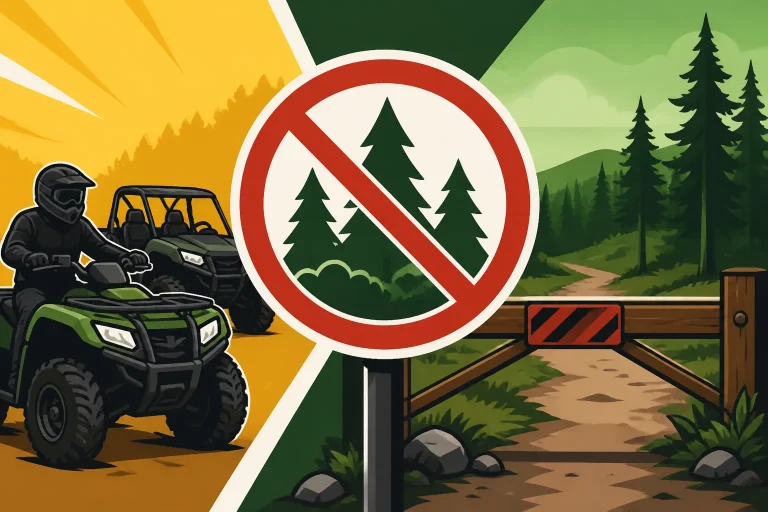
A guided tour also does not guarantee that every trail will be open or suitable on the day. Weather, maintenance, closures and land-use restrictions can change the route. Ask whether the operator has a backup plan and how it handles a closure. Never ride around a barrier or follow a route that the operator has not confirmed is open.
A practical checklist for tour day
A little preparation helps avoid arriving at the staging area only to discover that a driver cannot participate or a permit is missing. Confirm the details with the operator shortly before the tour, particularly if you booked well in advance.
- Confirm who may drive. Check each driver’s age, licence and any operator-specific eligibility requirements. If a young person is joining, verify whether they may drive or only ride as a passenger.
- Confirm passenger arrangements. Make sure the machine is designed for the number of people riding and that the operator allows the passenger’s age and size.
- Ask what access is included. Get the name of the trail system or property and confirm that the tour price covers required access. Ask separately about access for your own machine if you are not using the operator’s vehicle.
- Check road sections. If any part of the route uses a road, ask what legal requirements apply and whether the tour is set up to meet them.
- Clarify insurance and damage terms. Ask what coverage applies during the ride, what you could be charged for and whether any optional coverage is available.
- Follow equipment instructions. Use the helmet and other safety gear required by law and the operator. Wear clothing suitable for the weather, dust and possible mud.
- Listen to the briefing. Make sure you understand how to operate the machine, what signals the guide uses, how to keep a safe gap and what to do if you have a problem.
- Stay on the authorized route. Do not leave the group, enter a closed trail or assume the guide’s route gives you permission to ride elsewhere afterward.
For visitors bringing their own ATV or UTV, check that the machine’s registration, plate and insurance arrangements are appropriate for the places where it will be used. A trail permit does not replace vehicle registration, and registration does not give a rider permission to enter every trail. The operator should be able to explain access for the tour, but it is sensible to verify anything that is specific to your machine.
The key is to separate four things that are often bundled together in conversation: the tour booking, trail access, vehicle paperwork and insurance. A guided tour may take care of some of them, but the booking alone does not prove that all are covered. Get the route, participant rules and included permits clear before the ride, then follow the guide and stay within the authorized area.
Disclaimer
This article is for general informational purposes only and does not constitute professional advice. Laws, prices and regulations vary by location and change over time. Consult a qualified professional for guidance on your specific situation.