The Farm-Use Exemption in Ontario
It's incredibly frustrating when you're trying to manage the costs of running a farm, and then you're hit with significant taxes on equipment that's absolutely essential for your day-to-day operations. Many Ontario farmers wonder if they really have to pay the full Retail Sales Tax (RST) on their All-Terrain Vehicles (ATVs) or Utility Terrain Vehicles (UTVs) when these machines are strictly for farm work. This guide is here to shed light on Ontario's farm-use exemption for ORVs, helping you understand if your machine qualifies and how to claim that much-needed tax relief.
Understanding Ontario's Retail Sales Tax (RST) on ORVs
Let's face it, buying a new or even a used ATV or UTV in Ontario can come with a hefty price tag, and that's before you even get to the taxes. For many folks, especially those in the agricultural sector, every dollar counts, and understanding where your money goes is crucial. The Retail Sales Tax (RST) on off-road vehicles is a significant part of that equation, and it’s something every ORV owner, particularly farmers, needs to be aware of.
The Standard 13 Percent and Why It Hurts
When you purchase an off-road vehicle in Ontario, whether it’s a shiny new quad from a dealer or a pre-loved side-by-side from a private seller, you’re generally on the hook for the 13 percent Ontario Retail Sales Tax. This isn't the GST/HST you might be familiar with on most goods and services; this is a provincial tax specifically applied to certain items, including ORVs, snowmobiles, and private vehicle sales. It’s paid at the ServiceOntario counter when you register your machine, not to the seller directly, which can sometimes catch people by surprise.
For a farmer investing in a UTV that might cost tens of thousands of dollars, that 13 percent can translate into thousands of dollars in additional costs. It’s a substantial amount of capital that could otherwise be reinvested into the farm, put towards feed, equipment repairs, or other vital operational expenses. This is why the prospect of an exemption isn't just a bonus; for many, it's a critical component of their financial planning, making the difference between an affordable purchase and a stretched budget. You can learn more about [13 Percent RST on an Ontario ATV] in our other articles.
When RST Applies to Your ATV or UTV Purchase
The 13 percent RST applies to most ORV purchases in Ontario. This includes machines bought from registered dealerships, as well as those acquired through private sales between individuals. The tax is calculated on the purchase price you declare when you go to register your machine at ServiceOntario. If you’re buying a used machine from a private seller, this is often the moment of truth where you realize the full cost of getting that ATV or UTV legally on the "road" or trail.
It’s not just about the initial purchase either. If you receive an ORV as a gift from someone outside your immediate family, or if you bring an ORV into Ontario from another province or country, you’ll likely face the RST as well. The province wants to ensure that all off-road vehicles operating here contribute their fair share to provincial coffers, regardless of how they were acquired. However, for bona fide farmers, there’s a specific provision designed to ease this burden, acknowledging the essential role these vehicles play in agriculture. Understanding these rules is key to navigating the registration process successfully and avoiding any unexpected fees, especially if you're trying to figure out [Ontario RST on an ATV Purchase].
What Is the Farm-Use Exemption, Really?
The farm-use exemption for off-road vehicles in Ontario isn't just a rumour or a hopeful whisper; it's a legitimate provision under the Retail Sales Tax Act. However, like many government exemptions, it comes with specific definitions and criteria that you absolutely must meet. It's designed to support the agricultural community by reducing the tax burden on tools that are integral to their livelihood. It's not a blanket pass for anyone who lives in a rural area or has a large property; it's specifically for those engaged in the business of farming.
Defining "Farm Use" in Ontario's Context
When we talk about "farm use" in the context of this exemption, we're referring to activities directly related to the operation of a commercial farm. This means using your ATV or UTV for tasks such as moving feed to livestock, inspecting crops, repairing fences, transporting tools and supplies across fields, or even driving out to check on remote pastures. The key here is that the machine's primary purpose must be contributing to the agricultural enterprise. It's about efficiency and necessity in a farming operation.
What doesn't count as "farm use" in this context? Well, if you use your UTV for joyrides with the kids after the chores are done, or if your ATV is primarily for hunting on your property, or even if you use it for casual trail riding on weekends, those activities typically fall outside the strict definition of primary farm use for the exemption. The intent behind the exemption is clear: it's for equipment that helps run a farm as a business, not for recreational activities, even if those activities happen to occur on farm property. The distinction is crucial for successful exemption claims and is a core part of the [Ontario ATV Tax for a Farm Purchase] guidelines.
Eligible ORVs: Not Every Machine Qualifies
While the exemption applies broadly to ATVs and UTVs, it's essential to understand that the focus is on the use of the vehicle, not necessarily its specific make or model. Generally, any off-road vehicle that meets the definition of an ATV or UTV under Ontario's Off-Road Vehicles Act could qualify, provided it's primarily used for farming. This includes your standard quads, side-by-sides (ROVs), and even certain off-road motorcycles if their primary function is farm work.
However, the "eligible ORV" part of the equation is secondary to the "eligible use." You could have the most heavy-duty utility side-by-side on the market, but if it's primarily used to haul firewood for personal consumption rather than for a commercial logging operation associated with your farm, it likely wouldn't qualify for the exemption. The exemption isn't about the machine's capabilities; it's about the demonstrable and primary application of those capabilities in a recognized farming operation. This emphasis on usage is central to making a successful claim, and it's something ServiceOntario will scrutinize.
The Criteria for Qualifying for the Exemption
So, you're a farmer, and you use your ATV or UTV for genuine farm work. That's a great start, but there are specific criteria you need to meet to successfully claim the farm-use exemption. The province wants to ensure that this tax relief is going to legitimate agricultural operations, and not just anyone with a backyard garden. Understanding these requirements thoroughly will save you a lot of headache and potential disappointment at the ServiceOntario counter.
Proving You're a Bona Fide Farmer
This is perhaps the most critical hurdle: you need to demonstrate that you are engaged in farming as a business. What does "bona fide farmer" mean in Ontario? It generally refers to an individual or entity that is actively engaged in the production of agricultural products for sale, with the reasonable expectation of profit. This isn't about having a hobby farm or a few chickens for personal eggs. It's about commercial activity.
Evidence of being a bona fide farmer can include several things. You might need to show proof of registration with the Farm Business Registration (FBR) program, or provide your Farm Business Registration number. Other supporting documents could include income tax statements showing farm income and expenses, property tax bills indicating a farm classification, or receipts for the sale of agricultural products. ServiceOntario personnel are trained to verify these claims, so having your ducks in a row with clear documentation is paramount. They’re not trying to make things difficult, but they are ensuring the integrity of the tax system.
The "Primarily Used" for Farming Standard
Beyond being a bona fide farmer, the ATV or UTV itself must be "primarily used" in your farming operation. This isn't a 100% exclusive use requirement, but it means that the overwhelming majority of the machine's operating hours and purpose must be dedicated to farm-related tasks. If you use your UTV for farm work 70% of the time and for recreational trail riding 30% of the time, you might still qualify, as the primary use is clearly agricultural. However, if that ratio flips, or if the recreational use is substantial, you could run into problems.
Consider this hypothetical: you buy a side-by-side to haul feed and tools around your cattle farm. During planting and harvesting seasons, it's indispensable. In the off-season, you use it to check fences and move small equipment. But you also take it camping on Crown Land for two weeks in the summer, or use it for extensive hunting trips off-farm. In such a scenario, ServiceOntario might question whether its primary use truly aligns with the farming exemption. It's a judgment call often based on the evidence you provide and how compellingly you present your case.
What If You Also Ride Trails?
Many farmers live in rural areas with access to fantastic trail networks, and it's perfectly natural to want to enjoy those opportunities. So, what happens if your farm ATV is also your weekend trail machine? This is where the "primarily used" standard becomes critical. If you're a bona fide farmer, and your machine spends 80-90% of its working life tending to farm duties, then the occasional trail ride or family outing on the farm property shouldn't necessarily disqualify you from the exemption.
However, if your intent in purchasing the machine was to have a dual-purpose vehicle, with a significant amount of its use dedicated to recreation (even if it's on your farm property), then you might have trouble claiming the exemption. The spirit of the law is to relieve the tax burden on essential farm equipment, not on recreational vehicles that also happen to see some farm duty. If your machine is also hitting the [Ontario's OFATV Trail Network] frequently, you'll need to be clear about its predominant role. Always be prepared to justify your primary use with concrete examples of farm tasks, rather than focusing on its recreational capabilities.
The Application Process: Getting Your Exemption
Once you're confident that you meet the criteria for the farm-use exemption, the next step is actually claiming it. This isn't an automatic process; you need to proactively complete certain paperwork and present it correctly when you register your ORV. Missing a step or bringing incomplete documentation can lead to delays or, worse, being required to pay the full RST, which is exactly what you're trying to avoid.
Essential Paperwork: The Form and Your Proof
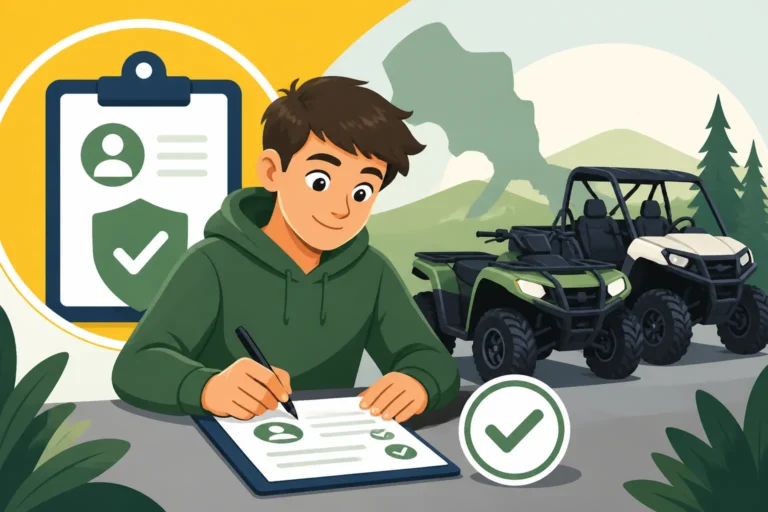
The cornerstone of claiming the farm-use exemption is typically the "Declaration of Farm Use" form (or a similar form provided by the Ministry of Finance). This form is where you formally declare that your ATV or UTV will be primarily used in a farming operation. It's a legally binding document, so it's vital to fill it out accurately and truthfully. You can often find these forms on the ServiceOntario website or request one directly at a ServiceOntario Centre.
In addition to this declaration, you'll need all the standard documents required for ORV registration, such as the original manufacturer's statement of origin (for a new machine) or the original [Ontario Vehicle Permit Explained] (for a used machine), and a proper bill of sale. For a used machine, ensuring you have a clear bill of sale, perhaps using a template from resources like LawDepot, can make the process smoother. Crucially, you'll also need to bring the proof that establishes you as a bona fide farmer, as discussed earlier. This might include your Farm Business Registration number, property tax assessments, or other documents demonstrating the commercial nature of your farming activities. Don't forget that if you're buying a used machine, you'll also need [Proving Ownership of an Ontario ATV].
Where and How to Submit Your Claim
You'll need to submit your farm-use exemption claim at a ServiceOntario Centre when you register your ATV or UTV. This isn't something you can do online or by mail after the fact. The ServiceOntario staff will review your documentation on the spot. It's a good idea to call ahead or check the ServiceOntario website for specific requirements and to see if you can book an appointment, as wait times can vary.
When you go, make sure you have all your original documents, including your driver's license or other valid identification. Be prepared to explain the nature of your farming operation and how the ORV will be primarily used for farm tasks. The ServiceOntario representative may ask questions to clarify your eligibility. Presenting a well-organized folder with all your paperwork, including the completed Declaration of Farm Use and your proof of bona fide farmer status, will greatly assist in a smooth process. They need to see a clear and consistent picture that your purchase qualifies for this specific tax relief.
| Exemption Criteria | Applies If… | Does Not Apply If… |
|---|---|---|
| Purchaser Status | You are a registered, bona fide commercial farmer (e.g., FBR number). | You have a hobby farm, large rural property, or use it for personal landscaping. |
| ORV Primary Use | The ORV's main purpose is integral to producing agricultural products for sale. | The ORV is mostly used for recreational riding, hunting, or non-farm hauling. |
| Documentation | You have a completed "Declaration of Farm Use" form and proof of farm business. | You lack the official form, or cannot prove commercial farming operations. |
| Associated Sales Tax | The 13% RST on the ORV is what you are seeking exemption from. | You are trying to avoid other taxes (e.g., GST/HST if applicable elsewhere). |
Common Pitfalls and Misconceptions
While the farm-use exemption is a fantastic benefit for eligible farmers, it's not without its complexities. There are several common misunderstandings and potential pitfalls that can trip up even the most well-intentioned individuals. Being aware of these can save you a lot of time, money, and frustration. The goal is to successfully navigate the system, not to find yourself explaining why you thought you qualified.
Don't Confuse It With Other Exemptions
One of the biggest mistakes people make is confusing the farm-use exemption for ORVs with other tax exemptions that exist for farmers or for other types of vehicles. For example, there are often exemptions for farm tractors or certain farm implements under different tax regulations. Similarly, there might be property tax exemptions for farm land. However, these are distinct from the Retail Sales Tax exemption for an ATV or UTV. The criteria and forms for each are unique, and you can't assume that qualifying for one automatically qualifies you for another.
Another common area of confusion can be with family gifts or estate transfers. Ontario does have exemptions for [Ontario ATV Tax on a Family Gift] or for [Ontario ATV Tax on an Estate Transfer], where the 13% RST might not apply, but these are based on the relationship between the giver and receiver, not on the use of the vehicle. While a farm ATV could be transferred as a family gift, that would be a separate exemption claim based on different criteria. Always ensure you are claiming the correct exemption for your specific situation.
Consequences of Misrepresenting Your Use
Attempting to claim the farm-use exemption when you don't legitimately qualify, or misrepresenting the primary use of your ORV, can lead to serious consequences. ServiceOntario, and ultimately the Ministry of Finance, takes these declarations seriously. The form you sign is a legal document, and providing false or misleading information can result in penalties.
If it's discovered that you falsely claimed the exemption, you could be required to pay the full 13 percent RST, along with interest and potentially significant fines. Furthermore, such actions could have broader implications, including investigations into other tax matters. It's simply not worth the risk to stretch the truth. If your ATV or UTV truly isn't primarily used for a commercial farming operation, it's better to accept the tax than to face the penalties for misrepresentation. Honesty and transparency are always the best policy when dealing with government regulations.
Beyond the Exemption: Other Important Considerations for Farm ORVs
Securing the farm-use exemption for your ATV or UTV is a great step, but it's just one part of responsibly owning and operating an off-road vehicle in Ontario. Even with the tax relief, there are other crucial requirements and best practices that farm owners need to follow to ensure safety, legality, and smooth operations. These considerations are just as important as the tax exemption itself.
Registration, Plates, and Insurance Basics
First and foremost, even if your ORV is exclusively used on your farm property, it still needs to be registered with ServiceOntario. This means obtaining an [Ontario ORV Permit Cost] and displaying an [Ontario ORV Plates and Where They Mount]. While some might think that because it stays on private land, it's exempt from registration, that's not the case for most ORVs in Ontario. The registration creates a record of ownership and helps prevent theft.
Secondly, and critically, all off-road vehicles in Ontario require mandatory insurance. This isn't just a suggestion; it's a legal requirement, whether you're riding on public trails, municipal roads where permitted, or even solely on your own farm property. An ATV or UTV, even when used for farm work, can cause accidents resulting in injuries or property damage. [Insurance and Ontario ORV Registration] is non-negotiable and provides vital protection. Make sure your farm insurance policy specifically covers your ORV for its intended use, whether that's agricultural, recreational, or a blend of both.
Safe Practices and Local By-laws
Even on private farm property, safety should be paramount. Always ensure that anyone operating the ATV or UTV is adequately trained, wears an approved helmet, and understands the machine's capabilities and limitations. Farm work can often involve challenging terrain, heavy loads, and unpredictable situations. Following manufacturer guidelines, performing regular maintenance, and never carrying more passengers than the machine is designed for are essential.
Furthermore, while your farm-use exemption primarily concerns provincial sales tax, you must still be mindful of any local municipal by-laws that might apply to ORV use on or near your property. Some municipalities have specific rules about noise, hours of operation, or even how close you can operate an ORV to neighbouring properties, even if it's on your own land. If you ever plan to take your farm ORV off your property, even just to cross a road or access a different parcel of land, you'll need to understand the [Ontario Rules for Riding Farm Land] and [Ontario Rules for a Machine Kept at a Cottage]. Always check with your local municipal office to ensure full compliance and avoid any unwelcome surprises.
Disclaimer
This article is for general informational purposes only and does not constitute professional advice. Laws, prices and regulations vary by location and change over time. Consult a qualified professional for guidance on your specific situation.