Ontario ATV Rules for a Machine Over 1,000cc
It's incredibly frustrating when you've invested in a powerful, high-displacement ATV or UTV, perhaps something over 1,000cc, only to discover that Ontario's road-riding rules aren't always clear-cut when it comes to bigger machines. You might assume more power means more restrictions, or perhaps that it’s automatically classified differently, leading to a lot of confusion about what's actually street legal. This guide will help clarify the specific rules and classifications that apply to your robust off-road vehicle when you want to take it on Ontario's municipal roads.
The Classification Challenge: Understanding Ontario's ORV Categories for Large Machines
When you're dealing with an ATV or UTV sporting an engine north of 1,000cc, it's easy to fall into the trap of thinking that raw displacement is the primary factor in how Ontario classifies your machine for road use. However, the reality is far more nuanced, and often, it's the physical dimensions and design of your vehicle that truly dictate its legal status on public roads. This can be a source of real head-scratching for riders, especially those who own a powerful side-by-side and are trying to understand why it might be treated differently than a traditional quad with similar engine power.
ATV, MPV, ROV: What's the Difference for Larger Machines?
Ontario's Off-Road Vehicles Act and its associated regulations categorize off-road vehicles into several distinct classes, and understanding these is crucial for anyone with a larger machine. A traditional "ATV" (All-Terrain Vehicle) is generally a four-wheeled vehicle designed for a single rider, or sometimes two riders in a tandem configuration. These machines, even with engines well over 1,000cc, usually fit within the basic ATV definition if they meet other criteria like weight and width. You might have a beastly 1000cc quad, and it would still largely be considered an ATV under the regulations, fitting into [The ATV Class Under Ontario Regulation 316/03].
Then we move into the realm of "MPV" (Multi-Purpose Off-Highway Vehicles) and "ROV" (Recreational Off-Highway Vehicles). These are where many of the larger 1,000cc+ machines, particularly side-by-sides (SxSs), often find themselves. An MPV generally refers to a utility-focused vehicle, often heavier and designed for work, which can include some larger UTVs. The specific weight limits for MPVs are important, as detailed in [Ontario's MPV Class and Its Weight Limit]. An ROV, on the other hand, is specifically defined by its seating, steering wheel, and roll-over protection, essentially capturing most modern side-by-sides. It's often the ROV category that poses the most confusion for larger machines because their design naturally pushes against some of the more traditional ATV definitions, even if the engine size itself isn't the sole determining factor.
The key takeaway here is that while your 1,000cc engine definitely brings a lot of power to the table, the government looks more at the overall package. Is it a straddle-seat vehicle with handlebars? That's typically an ATV. Does it have a steering wheel, side-by-side seating, and seatbelts? That's almost certainly an ROV, and the regulations for these two types can differ significantly when it comes to road use, especially concerning dimensions and occupant requirements. It’s not just about the roar of the engine; it's about the entire design.
Why Engine Size Isn't the Only Factor for Road Legality
This might come as a surprise to many, but the actual cubic centimetre (cc) rating of your engine is often less of a gatekeeper for road legality in Ontario than other physical characteristics of your machine. While some jurisdictions might impose limits based on engine size, Ontario's framework for allowing ORVs on public roads focuses more on weight, width, and how many passengers it's designed to carry safely. So, a powerful 1,000cc ATV might navigate the regulations for road use more easily than a 1,000cc side-by-side, purely because of its dimensions and seating arrangement.
The frustration here is completely understandable. You buy a powerful machine, naturally assuming the engine is the biggest hurdle. However, Ontario's rules are more concerned with how the vehicle interacts with other road users and fits within existing road infrastructure. For instance, the sheer physical size of many high-performance side-by-sides can quickly push them into categories with stricter or different requirements. A machine that is inherently wider or heavier due to its robust design and passenger capacity will face different considerations for road use than a narrower, lighter, single-rider quad, regardless of whether both share a 1000cc engine.
This emphasis on dimensions and design is why you'll find regulations like [Ontario's MPV Class and Its Weight Limit] and [Ontario's ROV Class and Its Engine Cap] focusing on these aspects. It's not about how fast your 1,000cc can go; it’s about whether it can safely and practically operate on a shared roadway without posing undue risk due to its bulk or passenger configuration. Therefore, when assessing your over-1,000cc machine for road use, put aside the engine size for a moment and instead grab a tape measure and count your seats.
Weight, Width, and Seating: The Real Road-Riding Deciders
When it comes to getting your powerful 1,000cc+ ORV onto Ontario's roads, it's not the horsepower that will get you a ticket, but often the physical dimensions and how many people you're trying to carry. Many riders assume that because their machine is capable off-road, it should be just as capable on the pavement, but the provincial regulations look at things through a different lens, primarily concerned with safety and fitting into existing traffic norms. This can be a rude awakening for those with wider, multi-passenger machines.
The Critical Width Limit: Why 2.03 Metres Matters So Much
For many owners of larger UTVs, particularly those well over 1,000cc, the 2.03-metre width limit is often the most significant hurdle for road legality. Ontario Regulation 316/03 specifies that an ORV, to be operated on a highway, cannot exceed a width of 2.03 metres. For a traditional quad, even a large 1,000cc model, this is rarely an issue. Most ATVs are designed to be relatively narrow for nimble trail riding. However, modern side-by-sides, especially sport models or those equipped with aftermarket modifications, can easily push past this threshold.
Consider a popular sport UTV like a Can-Am Maverick or a Polaris RZR; many of these machines, even in their stock form, hover around or exceed the 64-inch mark (which is roughly 1.63 metres) or even 72 inches (1.83 metres). Add wider tires, offset wheels, or a SuperATV lift kit with extended A-arms, and you could quickly find yourself over the 2.03-metre (approximately 80-inch) limit. This is why [Why Width Is Capped at 2.03 Metres] is such a crucial piece of regulation. If your machine is wider than this, it simply isn't permitted on Ontario highways, regardless of its engine size or how well-equipped it is otherwise.
This rule exists for a reason: to ensure ORVs can safely share the road with other vehicles without encroaching too much on lanes or shoulders. A UTV that's too wide can become a hazard, particularly on narrower rural roads or when passing oncoming traffic. So, before you even think about hitting the pavement with your impressive 1,000cc side-by-side, grab that tape measure and make sure you're compliant. It’s a small step that can save you a significant fine and a lot of disappointment.
Weight and Seating Configurations: MPV vs. ROV on the Road
Beyond width, the weight and seating configuration of your over-1,000cc machine also play a massive role in its classification and road-riding permissions. As we discussed, a traditional ATV, even with a huge engine, typically falls under the "ATV class" for road use. These are generally single-rider machines, or two-up models where a passenger sits behind the driver. Their weight, while substantial, rarely exceeds the specific limits that would push them into different regulatory buckets for road use.
However, once you move into the realm of side-by-sides – particularly those powerful 1,000cc+ models that can weigh significantly more and carry multiple passengers – you're almost certainly dealing with an "ROV" (Recreational Off-Highway Vehicle). ROVs are defined by their steering wheel, side-by-side seating, and factory-installed roll-over protective structures (ROPS) and seat belts. Because they are designed for multiple occupants, the regulations treat them differently, placing a strong emphasis on occupant protection, as outlined in [Seat Belts and Occupant Protection in Ontario] and [Roll-Over Protection on an Ontario ROV]. This means if your 1,000cc machine has two or more bucket seats and seatbelts, you’re looking at ROV rules.
It's also important to remember the speed limits that apply to all ORVs on municipal roads. Whether you have a nimble quad or a heavy-duty side-by-side, the rules remain consistent: 20 km/h on roads with a posted limit of 50 km/h or less, and 50 km/h on roads with a posted limit greater than 50 km/h. This is detailed in [Ontario's 20 and 50 km/h Speed Limits]. So, while your 1,000cc engine can easily achieve highway speeds, the law restricts all ORVs to much slower paces on open roads, regardless of their impressive power. The distinction here isn't about top speed; it's about the vehicle's inherent design for occupant safety and how that fits within the road network.
Here's a quick comparison of how key physical attributes impact road legality for different ORV classes in Ontario:
| Feature | ATV (typically Single/Two-Up Quad) | ROV (Side-by-Side/UTV) | Impact for 1,000cc+ Machines |
|---|---|---|---|
| Engine Size | Any size (e.g., 1000cc+) | Any size (e.g., 1000cc+) | Not the primary limiting factor. Focus on dimensions. |
| Seating | Straddle-style | Side-by-side, bucket seats | ROVs require seatbelts and ROPS for all occupants. |
| Steering | Handlebars | Steering wheel | Defines ATV vs. ROV class. |
| Max Width | Generally under 2.03m | Often close to/over 2.03m | Critical for ROVs. Wider machines are illegal on roads. [Why Width Is Capped at 2.03 Metres] is key. |
| Weight | Varies, usually within limits | Often heavier, impacting classification | Relevant for MPV class definition, less so for pure ROV. |
| Speed Limit | 20 km/h or 50 km/h on roads | 20 km/h or 50 km/h on roads | Same for all ORVs, regardless of engine power. |
Equipping Your Big Machine for Ontario's Open Roads
So, you've confirmed your over-1,000cc machine meets the width and classification requirements for road use. That's a huge step! But it's far from the only one. Ontario has a specific list of mandatory equipment that any ORV must have to be considered road-legal, and your powerful machine is no exception. Beyond the physical add-ons, there's also a whole layer of paperwork, licensing, and local rules that can trip up even the most prepared rider. Neglecting any of these details could lead to fines, even if your machine itself is technically compliant.
Mandatory Equipment for Any Road-Legal ORV
Regardless of whether you're riding a nimble 450cc quad or a beastly 1,000cc side-by-side, if it’s on a municipal road, it must meet certain equipment standards. These aren't optional extras; they're essential safety features designed to make your ORV visible and controllable in a road environment. One of the first things you'll need to check is your lighting. Your machine must have working headlights and tail lights, particularly if you plan to ride during dawn, dusk, or night. Remember, just because your trails lights are bright doesn't mean they meet road standards.
Next up, mirrors. You need at least one mirror that's securely mounted and gives you a clear view to the rear. Many off-road machines come with small, non-functional mirrors or none at all, so this is often an area where riders need to make an upgrade. A horn is also mandatory – a simple, functional device for signalling your presence. And, crucially, your muffler must be in good working order. Overly loud exhausts or modified systems that don't meet noise regulations are a common reason for being pulled over. Details like these are covered under regulations like [Ontario ATV Lighting Requirements], [Ontario ATV Mirror Requirements], and [Ontario ATV Muffler Rules]. Even if your 1,000cc engine sounds incredible with an aftermarket exhaust, if it's too loud for the road, it's a no-go. Riders often turn to reputable brands like SuperATV for high-quality, compliant accessories to ensure their machines are up to snuff for both trail and road.
Finally, while not strictly equipment on the machine, all riders and passengers must wear an approved helmet with the chin strap fastened. This is a non-negotiable safety requirement for all ORVs operating on public roads, and it applies equally to the driver of a 1000cc machine as it does to any other rider. It's about ensuring everyone's safety on shared roadways, regardless of the vehicle's power or size.
Licence, Insurance, and Local Bylaws: The Paperwork Puzzle
Even with your 1,000cc machine perfectly equipped and dimensionally compliant, you still need to get your ducks in a row with the paperwork. The first critical piece is your driver's licence. In Ontario, you need at least a G2 or M2 licence to operate an ORV on roads where it's permitted. A G1 or M1 simply won't cut it. This is a common point of confusion, and [Ontario's G2 and M2 Licence Requirement] clarifies this. Don't assume your provisional licence is enough, especially when riding a powerful machine.
Equally important is insurance. You absolutely must have valid motor vehicle liability insurance for your ORV, even if you’re only riding it on approved municipal roads for short distances. Carrying proof of this insurance is mandatory, and not having it can result in significant fines. This requirement is highlighted in [Ontario's Mandatory ORV Insurance]. Many riders integrate their ORV insurance with an existing auto policy or seek specialized coverage from a broker familiar with off-road vehicles.
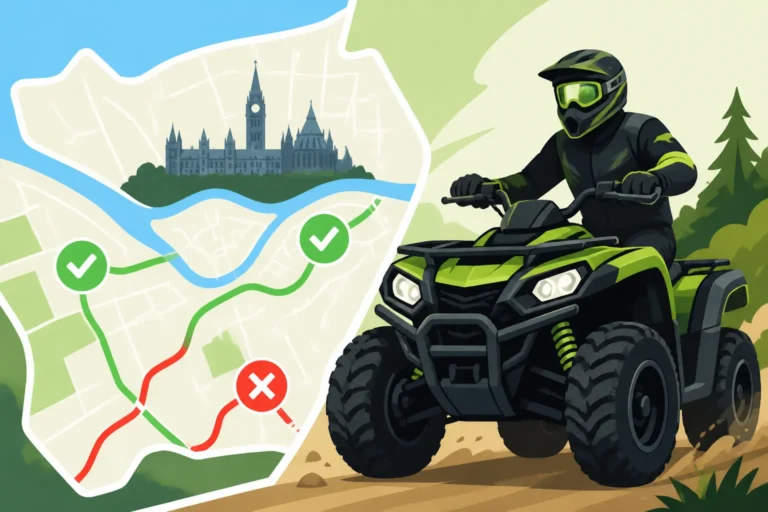
Lastly, and this is where many riders get caught out, you must, must check the local municipal bylaws of the area you intend to ride. Ontario allows municipalities to decide which of their roads (if any) are open to ORV traffic, and under what conditions. Just because a road might seem quiet or connect to a trail system doesn't mean it's open. A 1,000cc machine is still subject to these local rules. Always consult [Checking a Township's ORV By-law] for the specific municipality. You can usually find this information on the township's website or by calling their municipal office. It would be a shame to have your high-powered machine, perhaps kitted out with all the latest SuperATV gear, be perfectly legal in theory, only to receive a ticket because you didn't check if that specific stretch of road was open to ORVs. Understanding these rules ensures your powerful machine can be enjoyed legally and safely.
Disclaimer
This article is for general informational purposes only and does not constitute professional advice. Laws, prices and regulations vary by location and change over time. Consult a qualified professional for guidance on your specific situation.