An M2 Instead of a G2
There's a common misconception among off-road vehicle enthusiasts in Ontario that if your ATV or side-by-side looks and feels more like a car, or if you're just riding it a short distance on a municipal road, your regular G2 or full G driver's licence will be perfectly sufficient. However, this often isn't the case, leading to confusion, frustration, and potential fines. This guide will meticulously break down Ontario's licensing requirements, particularly the distinction between an M2 and a G2, to clarify what you truly need to legally operate your ORV on public roads.
Ontario's Licensing Landscape for Off-Road Vehicles
Navigating the rules for off-road vehicles (ORVs) on Ontario roads can feel like sifting through a stack of legal documents written in a foreign language. It's not just about having a licence; it's about having the right licence for the right vehicle in the right place. Many riders assume that if they can drive a car, they can handle an ATV on the road, but the province often sees these machines through a different lens, primarily due to their design and operation.
The Basics of G2 and M2 Licences
Let's start with the fundamentals of what these licences actually permit you to do. A G-class licence, which includes the G1, G2, and full G, is what most Ontarians hold for operating passenger vehicles like cars, vans, and light trucks. The G2 is an intermediate stage, allowing you to drive unsupervised with certain restrictions, like zero blood alcohol and specific passenger limits for younger drivers. It's designed for vehicles that typically have a steering wheel, foot pedals, and an enclosed or semi-enclosed cab, vehicles that largely operate as a cohesive unit with consistent controls.
On the flip side, the M-class licence (M1, M2, and full M) is specifically for motorcycles and motor tricycles. An M2 licence, like the G2, is an intermediate stage that allows you to operate motorcycles or motor tricycles with certain restrictions, usually involving a graduated licensing period. This class is designed for vehicles that require different balance, control inputs, and operational skills compared to a car. Think handlebars, body lean, and a fundamentally open riding position. The key distinction here is not just about the vehicle's shape, but the skill set required to operate it safely and predictably, especially in mixed traffic environments.
When a G-Class Licence Might Apply and When It Doesn't
Now, this is where the waters get murky for many ORV owners. The Ontario Highway Traffic Act (HTA) defines certain vehicles as "motor vehicles" that can be operated on a G-class licence. For traditional ATVs (quads) and dirt bikes, which inherently have handlebars, straddle seats, and require balance, a G-class licence is almost never applicable for road use. These machines are fundamentally considered "off-road motorcycles" or "all-terrain vehicles" under the Off-Road Vehicles Act, and their operation on public roads, where permitted, typically falls under the M-class. You can't just slap a licence plate on your quad and expect your G2 to cover you on the pavement; it’s a recipe for a ticket and potentially much worse if there’s an incident.
However, there's a subtle exception that sometimes causes confusion, particularly with larger side-by-sides (ROVs or UTVs). Ontario Regulation 316/03, which governs ORV use on highways, specifies that an ROV (a type of ORV) that is equipped with a steering wheel, has a minimum of two designated seating positions, and meets certain weight and width criteria may be operated by a G2 or full G licence holder if the municipality has a by-law permitting its use on specific roads and if the machine is equipped with all the necessary road-legal features (lights, mirrors, etc.). This is a very specific carve-out for particular ROV designs, which often resemble small utility vehicles more than traditional ATVs. This specific allowance does not extend to traditional ATVs or off-road motorcycles, which always require an M-class licence for road use. It's a critical distinction and often the source of much misunderstanding. [Ontario's G2 and M2 Licence Requirement] delves further into this.
The Case for the M-Class Licence
For the vast majority of ATVs and off-road motorcycles that people ride recreationally in Ontario, an M-class licence (M2 or full M) is the default and required qualification for road access. This includes almost all single-rider quads, three-wheelers, and dirt bikes. The provincial government categorizes these vehicles as demanding similar operational skills to a motorcycle, hence the motorcycle licensing requirement. Even if you're only traversing a short stretch of road to get from one trail section to another, or moving your machine to a gas station, the M-class licence is crucial. This is particularly true for smaller, more agile machines that require significant body English and counter-steering, much like a traditional motorcycle.
This requirement often surprises riders who come from jurisdictions with different rules, or those who primarily ride off-road and seldom encounter paved surfaces. But the moment your tires touch a public road, even if it's just a municipal road that's been opened up to ORV use, you are subject to the Highway Traffic Act, and that means having the appropriate licence. Without it, you’re not just risking a fine; you’re riding uninsured from a legal standpoint, which can have catastrophic financial consequences if you're involved in an accident. [The Licence Ontario Requires on a Road] outlines these requirements in more detail.
Understanding the Specifics: ATVs, ROVs, and Road Use
To really get to grips with what licence you need, we have to look closer at how Ontario defines and treats different types of off-road vehicles when they venture onto the pavement. It's not a one-size-fits-all situation, and the nuances are incredibly important.
Classifying Your Machine for Licensing
Ontario's Off-Road Vehicles Act (ORVA) broadly defines Off-Road Vehicles (ORVs) and then categorizes them further, which impacts their road-legal status and, crucially, the licence needed to operate them.
- ATV (All-Terrain Vehicle): This is your traditional quad, typically designed for one rider, with handlebars, a straddle seat, and four wheels. For road use, these almost always require an M-class licence. They're seen as a type of motorcycle in terms of handling and operator skill.
- ROV (Recreational Off-Highway Vehicle): This category often includes side-by-sides (SxS or UTVs). These vehicles are generally wider, have a steering wheel, bucket seats, and often seat belts and roll-over protection. They can be equipped for multiple passengers. This is the category where the potential for G-class licence use exists, but only if they meet very specific criteria (steering wheel, minimum two seats, specific weight/width) and are operating on a road where a municipal by-law specifically permits ROV use. Even then, an ROV must be properly equipped for road use with things like functional headlights, taillights, brake lights, mirrors, and often turn signals. Many manufacturers, like those designing products for SuperATV, offer aftermarket accessories that can help ROVs meet these equipment standards, but fitting the parts doesn't change the underlying licence requirement.
- Off-Road Motorcycle: This refers to dirt bikes. Like ATVs, they are almost exclusively M-class licence machines for any public road use. [Where an Off-Road Motorcycle Fits in Ontario] has more details.
It's vital to know your machine's classification. Don't assume. Check your owner's manual or registration documents. A side-by-side might look like a small car, but if it doesn't meet the precise definition of an ROV for which a G-class is permitted, you'll still need an M-class licence to operate it on the road. The provincial rules are very clear about what constitutes an ATV, ROV, or off-road motorcycle, and these classifications are what dictate the licensing requirements, not just your perception of the vehicle.
Road Restrictions and Licence Requirements
The ability to even ride your ORV on a public road in Ontario is heavily restricted, regardless of your licence. Generally, ORVs are only allowed on specific municipal roads (not provincial highways like the 400-series) where the local municipality has passed a by-law permitting their use. Even on these roads, strict speed limits apply: 20 km/h where the posted limit is 50 km/h or less, and 50 km/h where the posted limit is greater than 50 km/h. These limits are in place to enhance safety, as ORVs are not designed for high-speed road travel or sharing lanes with fast-moving traffic. [Ontario ATV Rules on a Municipal Road] provides further details.
For most ATVs and off-road motorcycles, when permitted on these municipal roads, the operator must hold an M2 or full M licence. For the specific type of ROV that might qualify for a G2/G licence, all the same road use restrictions (by-law permitting, speed limits, proper equipment) still apply. So, while an ROV operator might potentially use a G-class licence, they are still limited to very specific roads and conditions. It's not a free pass to drive a side-by-side anywhere a car can go. Furthermore, all riders and passengers must wear an approved motorcycle helmet, even if the ROV has a roll cage and seatbelts. [Approved Motorcycle Helmets in Ontario] is crucial reading for all riders.
The Role of Municipal By-laws
This is perhaps the most significant piece of the puzzle. Ontario gives municipalities the authority to decide if and where ORVs can operate on their roads. This means that rules can vary wildly from one town or township to the next. You might be able to ride your ATV on municipal roads in one area with an M2, but cross into the next municipality, and those roads might be entirely closed to ORVs, or they might have different licensing stipulations for specific types of machines. This patchwork of regulations can be a headache for riders.
Therefore, before planning any road section into your ORV route, you must check the specific municipal by-laws for that area. Websites for local municipalities often publish these by-laws, or you can contact their by-law enforcement offices. A by-law will clarify which roads (if any) are open to ORVs, what types of ORVs are permitted (ATV, ROV, Off-Road Motorcycle), and any specific conditions or hours of operation. If an ROV is explicitly mentioned in a by-law as being operable with a G-class licence, that's your green light, assuming all other criteria are met. Without such a by-law, and for all traditional ATVs and dirt bikes, the M-class licence is usually the only option for road legal operation. [How an Ontario Municipality Opens a Road] further explains this process.
Here’s a quick overview of ORV classes and their typical licence requirements for road use in Ontario:
| ORV Classification (Under ORVA) | Typical Vehicle Examples | Primary Licence for Road Use (Where Permitted) | Notes on G-Class Applicability |
|---|---|---|---|
| ATV (All-Terrain Vehicle) | Quads, Four-wheelers, Three-wheelers | M2 or Full M | Almost always M-class; G-class generally NOT applicable. |
| ROV (Recreational Off-Highway Vehicle) | Side-by-sides (SxS), UTVs, Multi-purpose vehicles | M2 or Full M (often) | G2 or Full G may apply IF specific design criteria (steering wheel, 2+ seats) are met AND municipal by-law specifically permits it. |
| Off-Road Motorcycle | Dirt bikes, Enduro bikes (off-road setup) | M2 or Full M | Always M-class; G-class NOT applicable. |
Practical Advice and Avoiding Fines
Understanding the legalities is one thing; putting it into practice and staying on the right side of the law is another. The goal isn't just to ride, but to ride safely and legally, avoiding the costly and frustrating consequences of non-compliance.
Getting Your M2 or Full M
If you plan on riding your ATV or off-road motorcycle on any public road in Ontario, the most straightforward and universally applicable solution is to obtain an M-class licence. This typically involves a graduated licensing process:
- M1 Permit: Pass a written knowledge test. This allows you to ride under very strict conditions (e.g., daytime only, no passengers, specific speed/road restrictions).
- M2 Licence: After a waiting period (often 60 days if you take a course, longer if not) and successfully completing an M2 road test (or an approved safety course), you get your M2. This offers more freedom but still has some restrictions.
- Full M Licence: After another waiting period (usually 22 months with an approved course, or 30 months without) and a final M road test, you'll earn your full M licence.
Taking an approved motorcycle safety course is highly recommended. Not only can it reduce the waiting time between M1 and M2, but it also provides invaluable training for safe operation, which is critical given the inherent risks of riding an ORV, especially in a mixed-traffic environment. This isn't just about passing a test; it's about developing the skills to be a confident and safe rider.
What an Officer Checks Roadside
When a police officer pulls you over on your ORV, they're not just making conversation; they're verifying several key pieces of information. You'll need to present:
- Your Driver's Licence: This is where the M2 vs. G2 discussion becomes real. For most ATVs, if you don't have an M-class licence, you're in trouble. Even for an ROV where a G-class might apply, if the local by-law doesn't permit it, or if your machine doesn't meet the specific ROV definition, your G2 won't save you.
- Proof of ORV Registration (Permit): Your vehicle must be properly registered with ServiceOntario, and you need to carry your [The Ontario Vehicle Permit Explained] (or a true copy).
- Proof of Insurance: Like any other motor vehicle, your ORV must be insured, and you need to have valid proof of insurance. [Ontario ATV Insurance Requirements] are quite specific.
- Helmet: You and any passengers must be wearing an approved motorcycle helmet, properly fastened.
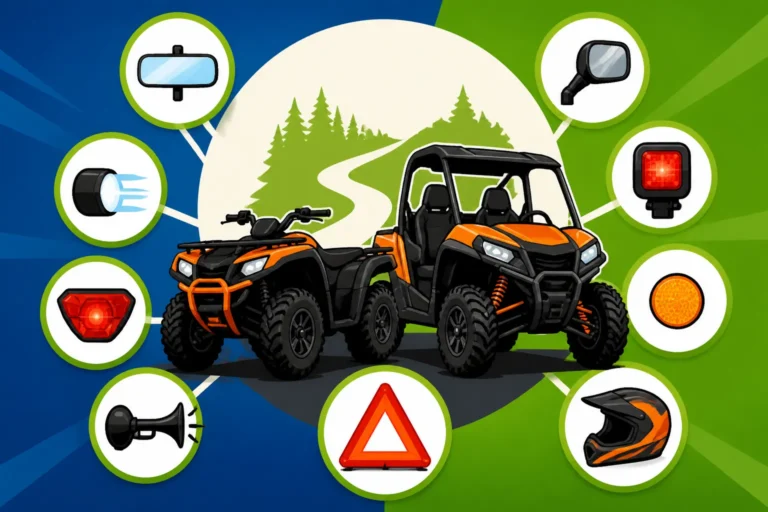
- Vehicle Equipment: The officer will check if your ORV is equipped with all the necessary road-legal features: working headlights, taillights, brake lights, mirrors, and often turn signals, depending on the by-law and vehicle type. Aftermarket parts from companies like SuperATV can help meet these requirements, but the onus is on you to ensure everything is installed correctly and functional.
Being prepared with all these documents and ensuring your machine is compliant is the best way to avoid unnecessary stops and fines. Remember, officers are primarily concerned with safety and compliance, and providing all documentation readily can help make the interaction smooth.
The Consequences of Improper Licensing
Riding an ORV on a public road without the correct licence can lead to significant penalties. Fines for operating a motor vehicle without a valid licence can be substantial, often in the hundreds of dollars, plus court costs and victim surcharge fees. Beyond the immediate financial hit, there are other, more serious consequences. [Ontario Fines for No ATV Insurance] can be astronomical, potentially reaching into the tens of thousands of dollars for uninsured operation.
Perhaps most critically, if you are involved in an accident while improperly licensed, your insurance company may deny coverage, leaving you personally liable for damages, injuries, and legal costs. This could easily run into hundreds of thousands or even millions of dollars, a financial burden that can be devastating. It's simply not worth the risk. The small investment of time and money in getting the correct M-class licence (or verifying that your specific ROV configuration and local by-law genuinely permit G-class operation) pales in comparison to the potential legal and financial fallout of riding without it. Always prioritize safety and legality; it protects you, your passengers, and others on the road.
Disclaimer
This article is for general informational purposes only and does not constitute professional advice. Laws, prices and regulations vary by location and change over time. Consult a qualified professional for guidance on your specific situation.