Ontario ATV Licence Requirements
It can feel like navigating a maze when you're trying to understand exactly what kind of licence you need to legally ride your ATV or UTV in Ontario, especially when the rules differ depending on whether you're on a private trail or a public road. This comprehensive guide is here to clarify all the essential licence requirements for off-road vehicle (ORV) enthusiasts, ensuring you can hit the trails or roads confidently and compliantly.
Demystifying Ontario's Licence Requirements for ORV Riders
Let's face it, the world of ORV regulations can be a bit opaque. You've got different rules for different types of machines, various places you can ride, and a whole spectrum of licence classes. It's enough to make your head spin, and nobody wants to be pulled over and find out they're not properly licensed for the fun they're having. Understanding the foundational licence requirements is the first crucial step to enjoying Ontario's vast network of trails and roads safely and legally.
The G2 or M2: Your Essential Permit for Public Road Access
If your vision of a perfect day includes riding your ATV or UTV on a municipal road in Ontario – perhaps to get from your cottage to a trail system, or simply to access a local gas station – then you absolutely need to hold a valid G2, M2, or higher-class driver's licence. This isn't just a suggestion; it's a legal requirement. Think of it this way: just as you wouldn't drive your car on the highway without a proper licence, the same applies to operating an ORV on public roadways. This requirement ensures that you've passed the necessary tests and demonstrated a baseline level of competence and knowledge for operating a motor vehicle.
For many riders, this means having either a Class G2 licence, which is the intermediate stage of Ontario's graduated licensing system for cars, vans, and small trucks, or a Class M2 licence, which is the intermediate stage for motorcycles. Both of these signify that you've moved past the initial learning phase and have some proven experience behind the wheel or handlebars. Without at least a G2 or M2, you're not legally permitted to operate your ATV or UTV on any road that's open to ORVs, even if that road has a very low speed limit. An officer performing a routine check, or even responding to a minor incident, will verify your licence, and not having the correct class can lead to significant fines. This is a critical piece of information for anyone looking to understand [Ontario's G2 and M2 Licence Requirement].
Why a G1 Just Won't Cut It on Ontario Roads
Many new drivers in Ontario start with a G1 licence, which allows them to drive a car with certain restrictions, like having a fully licensed driver with them. However, when it comes to ATVs and UTVs on public roads, a G1 licence simply isn't sufficient, and frankly, it doesn't even make practical sense. The restrictions that come with a G1, such as needing an accompanying fully licensed driver with at least four years of driving experience, are simply not compatible with the nature of ORV riding. Imagine trying to explain to a police officer that your friend, who's riding their own ATV beside you, counts as your "accompanying licensed driver." It won't fly.
The rationale behind this rule is safety and the unique operational aspects of ORVs. While a G1 prepares you for a car, ATVs and UTVs handle differently, particularly on paved surfaces. They have a higher centre of gravity, different braking characteristics, and can be less stable than a car. Ontario law wants to ensure that anyone operating these machines on shared public roads has progressed beyond the absolute beginner stage of driving. So, if you're currently holding only a G1 and dreaming of cruising down an open municipal road on your quad, you'll need to upgrade your licence first. For more details on this specific restriction, you might find [Can You Ride an ATV in Ontario With a G1?] particularly helpful.
Minimum Age Rules: On the Trail Versus Public Roads
Ontario's regulations around minimum age for ORV operation can be a bit nuanced, as they distinguish between riding on private property or designated trails and riding on public roads. It's a common point of confusion for families, especially those with younger riders eager to get out there. The province aims to balance encouraging safe recreational use with protecting young people and other road users.
For instance, children as young as 12 can operate an ATV off-road in Ontario, provided they are supervised by an adult. This allows for supervised learning and recreation on private land or within designated trail systems that specifically permit younger riders. However, the moment that ATV or UTV touches a municipal road where ORVs are permitted, the age requirement jumps significantly. On public roads, you must be at least 16 years old and hold that valid G2, M2, or higher-class licence we discussed earlier. This means a 14-year-old who's perfectly competent on a private trail, even with proper supervision, cannot legally operate that same machine on a road, even for a short distance. This distinction is crucial for parents and guardians to understand to avoid legal trouble. Understanding [Ontario ATV Minimum Age On a Road] versus [Ontario ATV Minimum Age Off-Road] is vital for all riders, regardless of age.
| Licence Class | ATV/UTV Road Use | ATV/UTV Off-Road Use (Trails/Private Land) | Key Restrictions/Notes |
|---|---|---|---|
| G1 | Not Permitted | Permitted (if 12+, supervised off-road) | Cannot operate on public roads; supervision needed off-road for minors. |
| G2 | Permitted | Permitted | Standard passenger vehicle licence, allows ORV road use. |
| G | Permitted | Permitted | Full passenger vehicle licence, allows ORV road use. |
| M2 | Permitted | Permitted | Standard motorcycle licence, allows ORV road use. |
| M | Permitted | Permitted | Full motorcycle licence, allows ORV road use. |
Navigating Specifics: Machine Types, Passengers, and Visiting Riders
The world of ORVs is diverse, encompassing everything from agile two-wheel dirt bikes to powerful side-by-sides. While the general licence principles for road use apply across the board, there are subtle differences in how these machines are classified and what that means for riders and passengers. Furthermore, if you're hosting friends from out of province, their licence considerations become another layer of complexity.
Licence Rules for ATVs, UTVs, and Off-Road Motorcycles
When it comes to the required licence for operating on public roads, Ontario generally doesn't differentiate between an ATV (All-Terrain Vehicle), a UTV (Utility Terrain Vehicle, often called a side-by-side or ROV – Recreational Off-road Vehicle), or an off-road motorcycle. The consistent requirement for road use is that the operator must hold a valid G2, M2, or higher-class driver's licence. This applies whether you're on a single-rider quad, a two-seater side-by-side like those SuperATV makes accessories for, or a dirt bike that meets the province's definitions for road-legal off-road motorcycles. The critical factor is that you are operating a motor vehicle on a public roadway.
However, while the licence class remains consistent, other regulations specific to the machine type still apply. For example, UTVs often have different rules regarding occupant protection, seatbelts, and width restrictions when operating on roads. ATVs have rules about single riders versus carrying passengers. So, while your G2 or M2 covers the "who" for road operation, you still need to be acutely aware of the "what" – meaning, the specific rules for your particular machine. If you're riding a UTV, it's particularly important to review [Ontario UTV Road Rules] to ensure full compliance.
Carrying Passengers: Who Needs a Licence?
This is another area where many riders get tripped up. The licence requirement is for the operator of the ORV, not necessarily for the passenger. If you're driving a two-up ATV or a UTV capable of carrying passengers, you, as the driver, must hold the appropriate G2/M2 or higher licence. Your passenger, however, does not need to possess a driver's licence to ride along.
That being said, there are strict rules about who can be a passenger and how they can be carried. Single-rider ATVs are exactly that: designed for one rider only. Attempting to squeeze a passenger onto a single-rider machine is not only illegal but extremely dangerous, significantly affecting the machine's balance and handling. For machines designed to carry a passenger, like a two-up quad or a side-by-side, passengers must be able to sit with their feet on the footrests or floorboards and hold onto the handholds. Age limits may also apply, particularly for younger children. It's crucial to always refer to [Ontario ATV Passenger Rules] to ensure everyone on your machine is riding safely and legally, regardless of whether they have a licence themselves.
What If You're an Out-of-Province Rider?
Ontario welcomes ORV enthusiasts from other provinces and countries, but it's important to understand the licence requirements for visitors. Generally, if you're visiting Ontario and wish to operate your ORV (or a rented one) on roads or designated trails, you must possess a valid driver's licence from your home jurisdiction that is equivalent to an Ontario G2, M2, or higher. This means if you're from Alberta, for example, your Class 5 driver's licence would typically be accepted as it's equivalent to an Ontario G licence.
The key is that your home province or state's licence must permit you to operate a similar class of vehicle. So, if your licence back home only allows you to drive a car, and your jurisdiction has a separate motorcycle or off-road vehicle endorsement, you would need that endorsement to be legal on an ORV in Ontario. Always carry your valid licence with you, as well as proof of ownership and insurance, just as you would in your home province. An officer doing a roadside check will be looking for these documents, and not having the correct, equivalent licence can lead to problems, even if you’re just visiting for a short ride.
Beyond the Licence: Other Legal Must-Haves for Ontario ORV Use
While having the correct driver's licence is absolutely foundational for legal ORV operation on Ontario roads, it's only one piece of the puzzle. There are several other critical requirements that every rider must meet to ensure they are fully compliant with provincial laws. Neglecting any of these can negate the benefit of having a proper licence and lead to penalties.
Mandatory Insurance: A Non-Negotiable Requirement
Just like any other motor vehicle operating on public roads, your ATV or UTV must be insured. This isn't optional; it's a mandatory requirement under Ontario law, even if you're only planning to ride on designated trails or private property. A basic motor vehicle liability policy is required, providing coverage for potential damages or injuries that could occur while operating your ORV. Imagine a scenario where you're riding responsibly, but an unforeseen event causes an accident – without insurance, you could be facing astronomical costs.
Many riders assume their existing car insurance policy will cover their ORV, but this is rarely the case. ORVs typically require a separate policy or an endorsement added to an existing recreational vehicle policy. It's always best to speak directly with your insurance provider to confirm you have adequate coverage for your specific machine and intended use. Carrying proof of this insurance with you at all times when riding is also essential, as an officer will certainly ask for it during any stop. Failing to produce proof of insurance can lead to severe fines and even the impoundment of your machine. This is a critical item to review, and you can find more information about it here: [Ontario ATV Insurance Requirement].
Your Ontario Vehicle Permit: Proving Ownership and Registration
Beyond your personal licence and insurance, the ORV itself needs to be properly registered and permitted with the province. This means obtaining an Ontario Vehicle Permit (often still called a "plate" or "registration") for your ATV or UTV. This permit serves as official documentation of your ownership and ensures your machine is registered in the provincial system. It's a one-time registration process for ORVs in Ontario, unlike snowmobiles which have annual renewals.
When you purchase a new or used ORV, you generally have a limited time to register it at a ServiceOntario centre. The permit will contain details about your machine, including its Vehicle Identification Number (VIN), make, model, and year. You'll also receive a licence plate that must be properly affixed to your ORV. Carrying a copy of your Ontario Vehicle Permit on every ride is just as important as carrying your driver's licence and insurance card. If an officer stops you and your machine isn't registered, or you can't produce the permit, you'll be facing fines. To understand this requirement fully, delve into [The Ontario Vehicle Permit Explained].
Equipped for the Road: Safety Gear and Machine Modifications
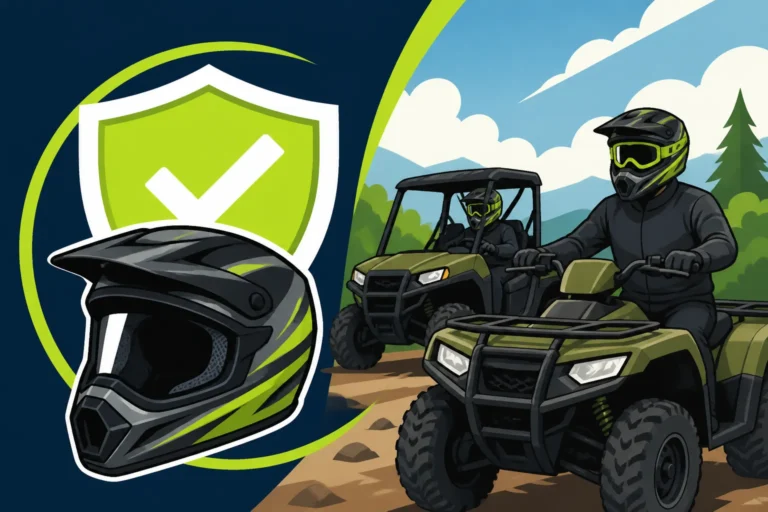
Even with the right licence, insurance, and registration, your ORV and your personal gear must meet specific standards if you intend to ride on public roads. This isn't strictly about licensing, but it's part of the comprehensive legal framework for road-legal ORV use. For starters, an approved helmet is mandatory for all riders and passengers on public roads, and this isn't just any helmet – it must meet specific safety standards. You can read more about what's required here: [Ontario ATV Helmet Law].
Furthermore, your ORV itself needs to be equipped with certain features to be deemed road-legal. This can include proper lighting (headlights, tail lights, brake lights), mirrors, a horn, and an adequate muffler. Many aftermarket parts, including lift kits or specialized tires, which might be great for extreme off-road adventures from companies like SuperATV, might need careful consideration to ensure they still comply with road-legal specifications. If you plan to ride on municipal roads, always check the specific by-laws of that municipality, as some might have additional requirements beyond provincial rules. An officer performing a roadside check, as detailed in [What an Ontario Officer Checks Roadside], will not only look at your documents but also the condition and equipment of your machine. Riding an improperly equipped ORV on a road, even with the right licence, can lead to fines, just as not having insurance can result in [Ontario Fines for No ATV Insurance]. Always be prepared.
Disclaimer
This article is for general informational purposes only and does not constitute professional advice. Laws, prices and regulations vary by location and change over time. Consult a qualified professional for guidance on your specific situation.