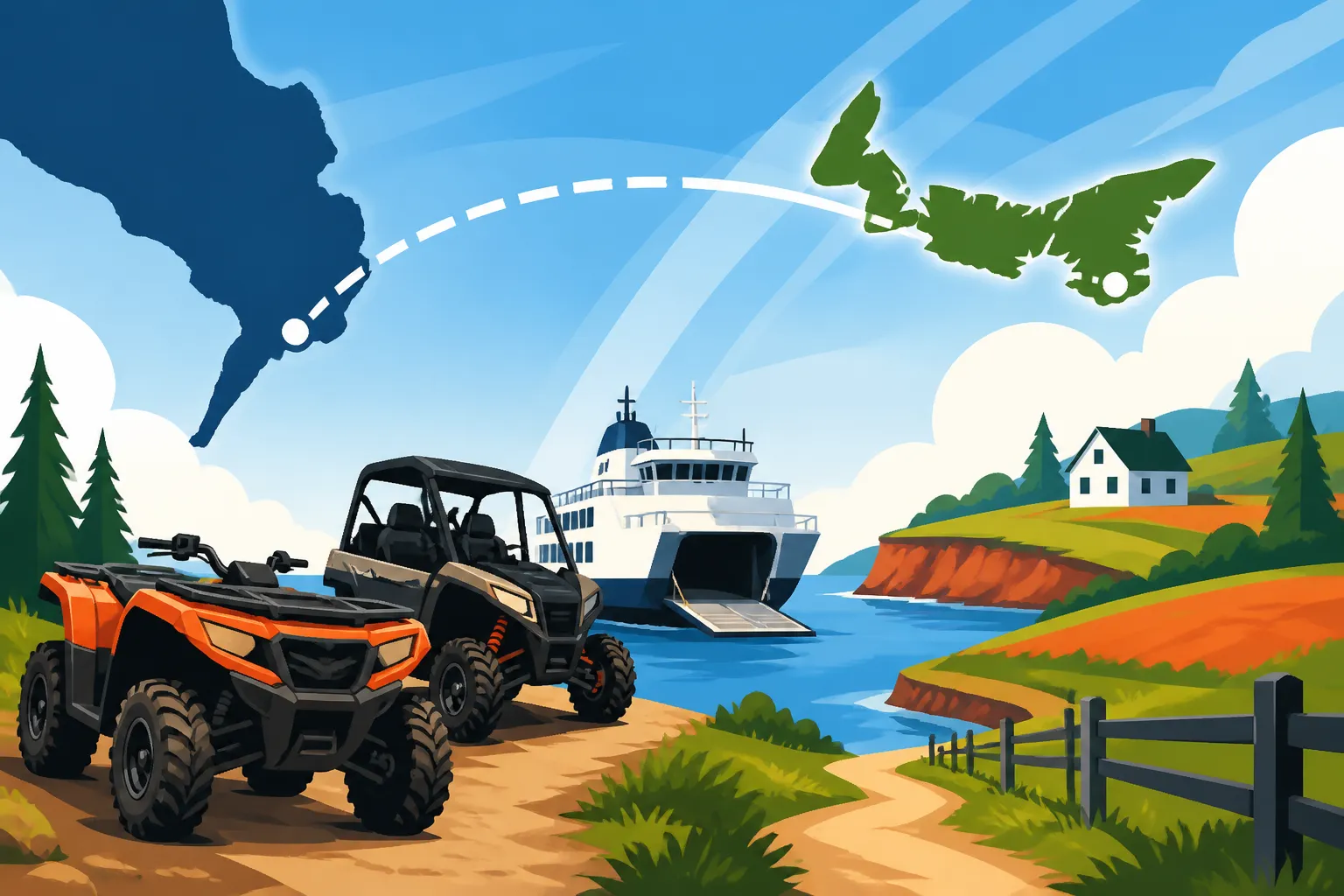
Crossing to Prince Edward Island
Crossing to Prince Edward Island with an Ontario ATV can be simpler if your trail permit is recognized there, but reciprocity is not a blanket licence to ride anywhere. The key is to confirm which Ontario permit you hold, where it is accepted, and what separate registration, insurance, and local trail rules apply before you travel.
Does an Ontario ATV permit work in Prince Edward Island?
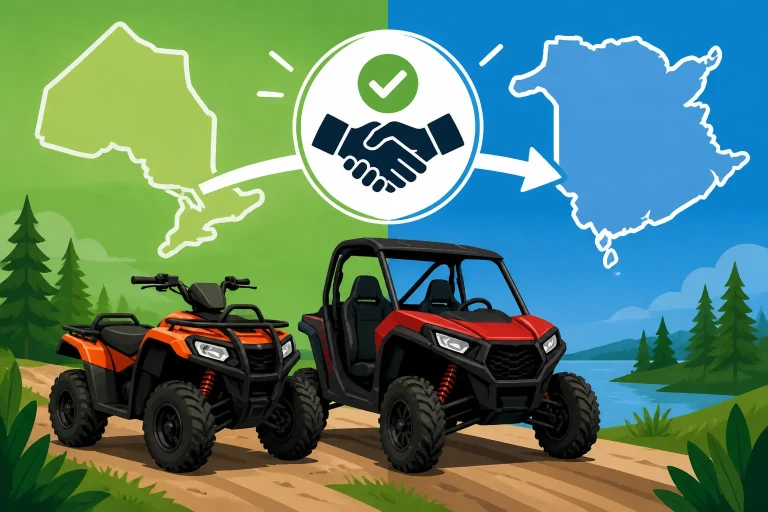
Ontario trail-permit reciprocity can allow an eligible Ontario permit holder to ride on participating Prince Edward Island trails without buying a separate permit for that same access. That recognition is useful, but it does not automatically make every Ontario permit valid everywhere in PEI or replace the rules that apply to your machine and the places you ride.
Start by identifying the permit correctly. An Ontario vehicle permit and plate are different from an Ontario trail permit. The vehicle permit is tied to registration and ownership; a trail permit is for access to a trail system under the permit issuer’s terms. Reciprocity concerns trail access, not registration. For the distinction, see Ontario ATV Trail Permits Explained.
| What you have | What it generally relates to | What to confirm for PEI |
|---|---|---|
| Ontario ORV registration and plate | The machine’s registration and identification | Whether your registration and plate meet PEI requirements for the riding you plan to do |
| Ontario trail permit | Access to participating trails under the permit’s terms | Whether your exact permit type is recognized in PEI and which trails participate |
| Ontario insurance policy | Liability and other coverage set out by your policy | Whether coverage applies to your machine and planned use in PEI |
| Club membership | Membership benefits or local club access | Whether it includes a trail permit or has any separate PEI benefit |
An Ontario permit being honoured in Prince Edward Island is a reciprocity arrangement, not a transfer of Ontario rules to another province. For a general overview of the participating jurisdictions, see Which Provinces Take an Ontario Permit and Ontario Permits Honoured in Prince Edward Island. Before departure, confirm the current terms with the organization that issued your permit and the PEI trail organization responsible for the routes you intend to use. Ask specifically whether your permit type qualifies, rather than relying only on the fact that you bought an Ontario permit.
That distinction matters if you hold a short-term pass, a club-specific pass, or a permit issued through a different organization. A statement that “Ontario permits are accepted” may refer to a qualifying annual permit or a particular reciprocal arrangement. It may not cover every pass, every user, or every trail. If you are unsure whether your permit is still valid, check its expiry or validity terms as explained in Does an Ontario ATV Permit Expire?.
What reciprocity does and does not cover
A reciprocal trail permit can help with one part of the trip: permission to use trails that accept it. It does not give you unrestricted access to the province, turn a closed route into an open one, or replace the laws that apply to your ATV or UTV.
Think of the trip as involving separate permissions and requirements:
- Trail access: Is the route open to your machine, and does the trail organization accept your permit?
- Machine registration: Is the ATV or UTV properly registered for use where you intend to ride?
- Insurance: Does your policy meet the applicable requirements and cover the way you will use the machine?
- Local rules: Are there restrictions on machine type, access, hours, speed, passengers, or equipment?
- Land access: Is the route a permitted trail, or does it cross land where you need separate permission?
A permit can solve only the trail-access question. If a route is closed, privately controlled, or restricted to a particular class of machine, reciprocity does not override that restriction. Nor should a permit be treated as permission to ride on roads, unmarked paths, or any convenient route between trail sections. Confirm the status of each route with the relevant PEI authority or trail organization.
Registration and insurance deserve separate attention. An Ontario trail pass does not register your machine, and it does not act as proof of insurance. If you need a refresher on the Ontario side, Ontario’s Mandatory ORV Insurance explains why trail access and insurance are separate issues for Ontario riders. Before you leave, contact your insurer and ask whether your policy applies to the trip, including the type of riding and machine you have planned. Carry the proof your insurer provides and keep it accessible.
The machine’s registration may also matter even when the purpose of the trip is trail riding. Reciprocity for a trail permit does not establish that PEI accepts every registration arrangement or equipment setup. If your machine is registered in Ontario and you are unsure what that means when riding in another province, see Ontario ATV Registration for an Out-of-Province Machine. Then verify PEI’s current requirements for visiting riders with an official provincial source or the organization managing the trail.
Prepare your machine and documents before travelling
The easiest way to avoid a problem at a trailhead is to resolve questions at home, while you still have time to contact the permit issuer, insurer, and trail organization. Do not assume the permit sticker alone will answer every question. Keep the original documents or acceptable proof available, and check the conditions attached to each one.
Use this checklist before loading your machine:
- Read the permit terms. Check the name of the issuer, permit type, validity dates, machine or rider limits, and any stated restrictions. If a club membership and a trail pass are separate products, confirm which one you actually purchased.
- Ask about PEI recognition. Give the permit issuer the exact permit type and ask whether it is accepted in PEI. Then confirm with the PEI trail organization that the trails you plan to ride participate in the arrangement.
- Confirm registration requirements. Check that the machine’s registration and plate are in order and ask what a visiting Ontario rider must carry or display in PEI.
- Confirm insurance. Ask your insurer about coverage in PEI and for your intended use. Check whether the policy covers the actual machine and any passengers or other circumstances relevant to your trip.
- Check the routes, not just the province. Identify the trail system you expect to use, confirm it is open, and ask whether it has local permits, seasonal closures, or machine restrictions.
- Pack proof in a usable form. Bring your trail permit information, registration documents, and insurance proof. Keep them protected from water and accessible during the ride.
The paperwork should match the machine you are bringing. If you plan to take a UTV, confirm that the trail system accepts that kind of machine; recognition of a permit does not necessarily mean every trail is suitable or open to every vehicle class. The same applies to modified machines or equipment that may affect permitted use. If you are travelling with more than one machine, check whether each one needs its own permit or registration rather than assuming one permit covers the group.
Keep a copy of the permit issuer’s reciprocity information or confirmation, but do not rely on a screenshot that is out of date or too vague to identify your permit. Save the contact details for the relevant trail organization, and note any conditions they give you. This is especially helpful if you will be riding outside a staffed office’s hours or travelling between different trail areas.
Plan for local rules and the return trip
A smooth border-to-trail plan has two parts: getting to PEI with the machine, and knowing what you may do once you arrive. Your Ontario permit may be recognized for eligible trails, but the route, the trail operator, and PEI’s own requirements still determine what is allowed.
Check the trail organization’s current information shortly before your ride. Trail access can change with weather, maintenance, landowner arrangements, seasonal closures, or local restrictions. Ask whether the permit is accepted on the specific trails you intend to use, whether the system has separate access conditions, and what to do if a route is closed. If your itinerary crosses several trail systems, confirm each one rather than assuming a single reciprocal permit applies uniformly across the province.
Be especially careful when a trail route meets a public road or passes through a community. Trail authorization is not the same as permission to ride on a road. Do not use a road shoulder, roadside ditch, or connecting lane as an informal link unless the applicable rules clearly allow it. Ask the local authority or trail organization how riders are expected to move between trail sections.
The same caution applies to private land. A marked trail or a route shown on an old map does not necessarily guarantee current access. Follow posted signs, stay on authorized routes, and get permission where required. If local instructions conflict with a general statement about reciprocity, follow the current instructions for the trail and contact the responsible organization before riding.
A useful way to organize the trip is to keep a short record with:
- the name of your Ontario permit issuer and the permit type;
- the PEI trail system or systems you plan to use;
- confirmation that the permit is accepted for those trails;
- your registration and insurance contact information; and
- any local closures, machine restrictions, or access conditions.
If something changes during the trip, pause and verify the new route before proceeding. A detour can cross a different land parcel, trail system, or road, each with its own rules. The safest assumption is that reciprocity helps with access only where the arrangement applies; it does not remove the need to check current local directions.
Before leaving PEI, check whether your permit’s validity continues through your planned riding dates and whether you will need separate authorization for any additional trail system. On the return trip, keep your Ontario registration and insurance documents together with your machine’s other paperwork. That small amount of preparation reduces the risk of arriving at a trailhead with a permit that is valid in Ontario but not accepted for the particular PEI ride you had in mind.
Disclaimer
This article is for general informational purposes only and does not constitute professional advice. Laws, prices and regulations vary by location and change over time. Consult a qualified professional for guidance on your specific situation.