Ontario ATV Passenger Rules
It's an age-old desire for many of us who love hitting the trails or cruising quiet country roads on our ATVs: sharing that exhilaration with someone special. Whether it's your child, your partner, or a friend, the idea of having a passenger along for the ride can be incredibly appealing. But here in Ontario, the rules about carrying passengers on ATVs and UTVs aren't just suggestions; they're legal requirements designed to keep everyone safe. Navigating these rules can feel like trying to find your way through a dense forest without a map, leaving many riders scratching their heads and wondering if they're even allowed to have a co-pilot. This guide is here to clear the mud, explaining exactly who can ride with you and under what conditions, both on and off Ontario's diverse landscapes.
The Core Distinction: Single-Rider Versus Designed for Passengers
Let's start with the absolute most critical piece of information when it comes to carrying passengers: the machine itself. Not all ATVs are created equal when it comes to passenger capacity, and trying to make a single-rider machine do double duty is not only illegal but incredibly dangerous.
What "Designed for Passengers" Really Means
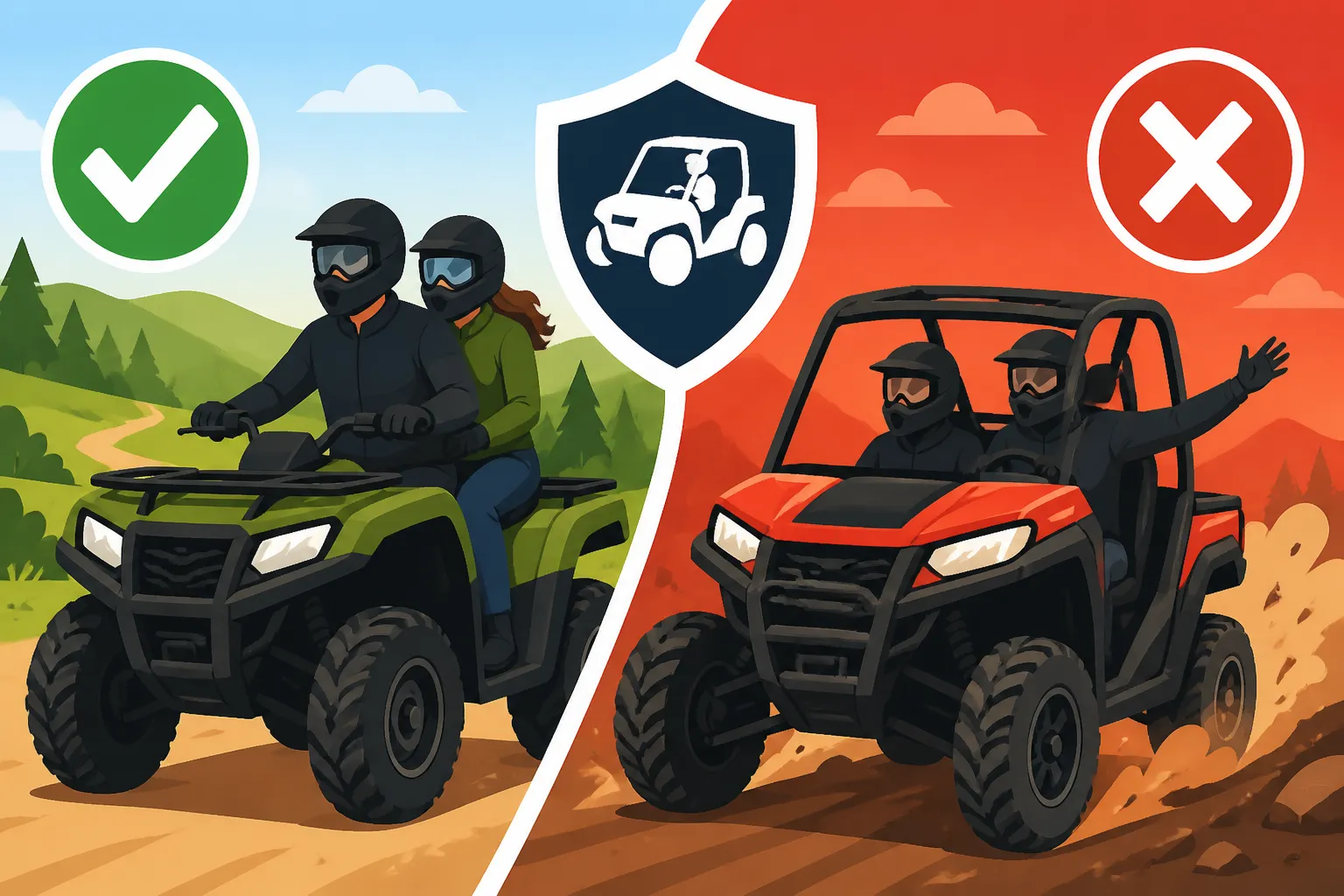
When Ontario's regulations, and indeed ATV manufacturers, talk about a machine being "designed for passengers," they're not just hinting that it has a slightly longer seat. This isn't about convenience; it's about engineering and safety. A proper two-up ATV, or a multi-passenger UTV, is built from the ground up to safely accommodate the weight, balance, and dynamics of more than one person.
Think about it: a two-up ATV will have a visibly longer seat, often contoured to provide support for the passenger. Critically, it will also feature dedicated handholds for the passenger to grip firmly and separate, secure footrests that allow them to maintain balance and stability without interfering with the driver's operation. These aren't flimsy add-ons; they are integrated components of the machine's design, carefully placed to ensure the passenger remains secure and doesn't shift the centre of gravity in an unpredictable way, which could lead to a rollover or loss of control. Ignoring these design features is like trying to fit a square peg in a round hole – it just doesn't work safely.
The Single-Rider Quad Dilemma
Despite the clear design intentions of manufacturers, many riders still find themselves with a single-rider quad and the urge to "just squeeze someone on for a short ride." Perhaps it's a child who really wants to experience the thrill, or a friend who just wants a taste of the action. However, this is where the empathy meets the hard reality: trying to carry a passenger on an ATV that's explicitly designed for only one operator is a recipe for disaster and is strictly prohibited under the Off-Road Vehicles Act in Ontario.
When you try to fit two people on a single-rider quad, several critical safety issues immediately arise. First, there's the lack of proper seating and support. The passenger will either be perched precariously behind the driver, with nowhere secure to hold on and no dedicated footrests, or they'll be crammed in front, obstructing the driver's view and ability to manoeuvre. This severely compromises the rider's ability to shift their weight, a fundamental skill for controlling an ATV, especially when navigating turns, bumps, or inclines. The increased weight, poorly distributed, makes the machine far less stable, significantly increasing the risk of rollovers. Not to mention, if an accident were to occur, your insurance company might very well deny your claim if you were operating the machine outside of its intended design, leaving you on the hook for potentially devastating medical and damage costs. It's a risk simply not worth taking.
Passenger Rules on Ontario's Public Roads
When you venture onto a municipal road that has been opened to ORVs, the rules for carrying passengers become even more defined and are strictly enforced. Here, the safety of not just those on your machine but also other road users is paramount.
Who Can Ride As a Passenger on a Road-Legal ATV/UTV?
First and foremost, whether on an ATV or a UTV, the machine must be specifically designed by the manufacturer to carry a passenger. For ATVs, this means a "two-up" model with a stretched seat, proper passenger handholds, and separate footrests. For UTVs (Side-by-Sides), this means dedicated seating for each occupant with appropriate seatbelts. If your ATV is a single-rider model, carrying a passenger on a public road is absolutely prohibited, full stop.
Ontario's regulations don't specify a minimum age for a passenger on an ORV operating on a public road, but the overarching safety principle still applies: the passenger must be able to sit securely, reach the footrests, and hold onto the handholds (if applicable for an ATV) throughout the ride. Common sense and safety dictate that very young children who cannot meet these physical requirements should not be passengers. The driver, if operating an ATV or UTV on a road, must hold at least a G2 or M2 licence, ensuring they have the necessary road driving experience and knowledge. This requirement directly impacts passenger safety, as an inexperienced driver poses a greater risk to everyone on board.
Specific Requirements for UTV/Side-by-Side Passengers
UTVs, or Side-by-Sides, often appear more accommodating for passengers due to their car-like seating arrangement. However, they also come with their own set of stringent requirements when used on Ontario's public roads. As the province classifies these machines as Recreational Off-road Vehicles (ROVs), they are subject to particular safety standards, especially when carrying multiple occupants.
Every passenger in a UTV on an Ontario road must occupy a designated seating position and wear a seatbelt. These vehicles are designed with roll-over protective structures (ROPS), and the seatbelts are critical to keeping occupants safely within this protective cage in the event of a tip or rollover. Additionally, many UTVs have doors or nets that are part of their safety system, and these must be properly closed or secured while the vehicle is in motion. Unlike ATVs, which require passengers to actively hold on, UTV passengers primarily rely on the vehicle's structural integrity and restraint systems. [Ontario UTV Road Rules] and [Ontario Side-by-Side Road Rules] detail these requirements, underscoring that while UTVs offer a different kind of riding experience, they demand strict adherence to their unique safety protocols for passengers.
Equipment and Safety for Road Passengers
Beyond the machine itself, specific equipment and safety practices are mandatory for any passenger riding on an ATV or UTV on an Ontario public road. The most prominent, and non-negotiable, requirement is an approved motorcycle helmet. Just like the driver, every passenger must wear a helmet that meets the safety standards outlined in the Highway Traffic Act and its regulations. This isn't just a suggestion; it's a critical piece of safety gear that can literally be the difference between life and death in an accident. [Approved Motorcycle Helmets in Ontario] provides more detailed information on what constitutes an approved helmet.
Beyond helmets, while not explicitly legislated, common sense dictates that passengers should wear appropriate attire, including sturdy footwear that protects the ankles, long pants, and a long-sleeved shirt or jacket. This protects against scrapes, abrasions, and flying debris. The driver also bears a significant responsibility for their passenger's safety. This includes ensuring the passenger is properly seated and equipped, instructing them on where and how to hold on (for ATVs), and driving defensively, taking into account the added weight and altered dynamics of carrying a passenger. It's about being a responsible operator, not just a driver. [Can a Child Ride Passenger on an Ontario Road?] is a great resource to explore this further.
Passenger Rules for Off-Road Riding: Trails and Private Land
Moving away from the pavement, the rules for carrying passengers off-road, on designated trails, Crown land, or private property, often feel a little less rigid. However, the fundamental safety principles and the "designed for passengers" rule remain critically important, even if the specific legislation might seem less prescriptive in certain contexts.
Off-Road Riding on Club Trails and Crown Land
Many of Ontario's fantastic multi-use trails are maintained by clubs under the umbrella of organizations like the OFATV (Ontario Federation of ATV Clubs). When riding on these club trails, or even on Crown land where ORVs are permitted, the general rule regarding the machine's design still applies: if your ATV is a single-rider model, it's not meant to carry a passenger, regardless of whether you're on a road or a trail. While a trail patroller might not issue a fine for an unregistered passenger, they will certainly be concerned about safety and might remind you of the rules and risks.
Club trails often have their own specific by-laws or etiquette guidelines which, while not always legal statutes, are put in place for the safety and enjoyment of all riders. Carrying an unauthorized passenger on a single-rider ATV violates the spirit of safe riding and can put both occupants at severe risk on uneven terrain. The OFATV trail permit covers the machine and its approved operator, but it doesn't grant permission to operate unsafely or outside of the manufacturer's design specifications for passenger capacity. Even on Crown land, where the Public Lands Act allows for "free use" of ORVs in many areas, common sense and the inherent dangers of carrying a passenger on an unsuitable machine dictate the same safety warnings. You can learn more about where you can ride off-road at [Ontario ATV Rules for Riding Crown Land].
Riding on Private Property
Private property often feels like the Wild West of ATV riding, with many believing "anything goes." While landowners have the right to set their own rules for their property, and provincial regulations regarding road use generally don't apply, this doesn't create a free pass for unsafe practices, especially concerning passengers. The "designed for passengers" rule should still be the golden standard, even on your own land.
The biggest concern on private property shifts from legal fines to direct liability and injury risk. If an accident occurs with a passenger on a single-rider ATV, the landowner (who might also be the operator) could face significant civil liability. More importantly, the risk of serious injury is just as real, if not more so, when riding on private land, which can often be less maintained or have more unpredictable obstacles than designated trails. This environment is an excellent place to teach young, aspiring riders how to operate their own appropriately sized machine under strict supervision, adhering to [Ontario ATV Minimum Age Off-Road] for operators, but it's not a place to ignore fundamental passenger safety for those who are not operating.
Age and Supervision for Young Passengers (Off-Road)
While no specific age minimum for passengers exists off-road, safety and the law are very clear about young operators. When it comes to children as passengers, the "designed for two" rule is paramount. A child should only ride as a passenger on an ATV that is specifically designed for two-up riding, or in a UTV with a seatbelt, and they must be physically capable of sitting securely, reaching footrests, and holding on (for ATVs).
Supervision is key, but it doesn't negate the need for the right equipment. You might be the most attentive parent or guardian, but if the machine isn't built for a passenger, you're still putting the child at undue risk. It's often safer and more educational for children to learn to ride their own youth-sized ATV in a controlled environment, under direct supervision, once they meet the minimum age of twelve for unsupervised riding on private property, or even younger with direct, hands-on instruction. This ensures they develop their own riding skills safely, rather than being a passive, vulnerable passenger on a machine not designed for them.
Insurance, Liability, and What Happens When Things Go Wrong
Understanding the passenger rules isn't just about avoiding a ticket; it's profoundly about safety and mitigating devastating financial and personal consequences if an accident occurs. Ignorance of the rules offers no protection when it comes to insurance claims and legal liability.
The Critical Role of Insurance
In Ontario, mandatory insurance for all ORVs is a non-negotiable requirement, whether you're riding on roads, trails, or even your own private property. This insurance is your primary line of defense in the event of an accident, covering things like liability for injuries to others or damage to property. However, the fine print of your policy is critical, especially when passengers are involved.
Many insurance policies are written with the understanding that the machine will be operated as per its manufacturer's specifications and in compliance with provincial law. If you're found to be carrying a passenger on an ATV specifically designed for a single rider, you're operating the machine outside of its intended and legal parameters. In such a scenario, your insurance company could very well deny your claim, leaving you personally responsible for all damages, medical bills, and legal fees. This isn't just about a broken fender; it could be hundreds of thousands, even millions, of dollars in costs if someone is seriously injured. Always, always check with your insurance provider about your coverage, especially if you plan to carry passengers on an approved two-up machine. They can confirm exactly what your policy covers and under what conditions. [Ontario ATV Insurance Requirements] delves deeper into what you need to know about ORV insurance.
Legal Consequences of Non-Compliance
Beyond the immediate safety risks and potential insurance headaches, violating Ontario's ATV passenger rules carries direct legal consequences. If caught by law enforcement carrying an unauthorized passenger on a single-rider ATV, you can face significant fines under the Off-Road Vehicles Act. These aren't just minor slaps on the wrist; they can be substantial, making that "short ride" an incredibly expensive one.
But the monetary fines are often the least of the worries. In the event of a serious accident where a passenger is injured, and you were operating the machine illegally (e.g., with an unauthorized passenger, without proper safety gear, or while impaired), the legal repercussions can escalate dramatically. You could face criminal charges, especially if negligence is proven, leading to jail time, hefty fines, and a permanent criminal record. This isn't just about "getting caught"; it's about the profound responsibility you assume when operating any vehicle, especially when carrying a passenger whose safety is entirely in your hands. It's a stark reminder that these rules exist to protect everyone involved, and the consequences for ignoring them are severe.
Accessories for Safer Passenger Riding
For those fortunate enough to own an ATV or UTV that is legitimately designed for multiple occupants, there are certainly aftermarket accessories that can enhance the safety and comfort of your passengers. Things like improved backrests, more ergonomic handholds, or even better footwell guards for UTVs can make a significant difference in the passenger experience. Brands like SuperATV offer a wide range of robust aftermarket parts, from protective doors and windshields for UTVs to more durable storage solutions that can free up space for passenger comfort.
It's crucial to reiterate, however, that these accessories are for enhancing safety and comfort on machines already designed for passengers. No aftermarket product can magically convert a single-rider ATV into a safe, legal two-up machine. Adding a flimsy seat pad or a makeshift set of footpegs to a single-rider quad does not change its fundamental design or its legal classification. Such modifications will not protect you from fines, legal liability, or, most importantly, the severe risk of injury to your passenger. Always prioritize the machine's original design and legal requirements before considering any accessory purchases, and ensure any additions are properly installed and don't compromise the vehicle's integrity or balance.
Here's a quick comparison of single-rider versus two-up ATVs and multi-passenger UTVs:
| Feature/Category | Single-Rider ATV (Not for Passengers) | Two-Up ATV (Designed for Passengers) | UTV/Side-by-Side (Designed for Passengers) |
|---|---|---|---|
| Passenger Capacity | Strictly One Operator | One Operator + One Passenger | One Operator + Multiple Passengers (2-6 typically) |
| Seat Design | Short, single seat for one rider | Long, extended seat for two, often stepped/contoured | Bucket seats or bench seats |
| Passenger Footrests | None (only operator footpegs) | Dedicated, separate footrests for passenger | Floorboards with footwells for all passengers |
| Passenger Handholds | None | Integrated handholds for passenger (grips, backrest) | Dash-mounted grab handles, doors/nets |
| Weight Distribution | Optimized for single operator | Engineered for balanced weight of two occupants | Engineered for balanced weight of multiple occupants |
| Road Legal in Ontario | Only with approved single operator (no passenger) | Yes, with approved operator and passenger | Yes, with approved operator and all passengers belted |
| Key Safety Feature | Operator skill & balance | Stable design, passenger support system | Seatbelts, ROPS (Roll-Over Protective Structure) |
| Insurance Impact | Unauthorized passenger can void coverage | Typically covered if operated legally and safely | Typically covered if operated legally and safely |
Remember, making responsible choices about passengers isn't just about following rules; it's about ensuring everyone who joins you on your adventures comes home safely.
Disclaimer
This article is for general informational purposes only and does not constitute professional advice. Laws, prices and regulations vary by location and change over time. Consult a qualified professional for guidance on your specific situation.