Ontario ATV Plate for a Three-Wheeler
Navigating the world of off-road vehicle (ORV) registration in Ontario can feel like trying to ride a trail blindfolded sometimes, especially when you own something a little less common, like a three-wheeler. Many owners of these unique machines wonder not only how to register them, but perhaps even more specifically, where on earth that crucial licence plate is supposed to go. This guide is here to shed light on the specific requirements for getting your three-wheeler properly plated and ready for the trails of Ontario, ensuring you understand exactly what's needed for compliance.
Understanding Three-Wheelers in Ontario's ORV Landscape
Three-wheelers, often affectionately called "trikes" or "ATCs" (All-Terrain Cycles), hold a special place in the hearts of many riders. They represent an earlier era of off-road adventure, and while their prevalence on the market has decreased, many are still loved and ridden across Ontario. However, their unique design means their registration and plating can sometimes differ subtly from their four-wheeled counterparts.
A Blast from the Past: The Unique Status of Three-Wheelers Today
For those of us who grew up in the 70s and 80s, the three-wheeler was the quintessential off-road machine. They were agile, powerful, and offered a thrilling ride. While manufacturing largely ceased due to safety concerns and the rise of the quad, many older models are still meticulously maintained and enjoyed. This means that a lot of the three-wheelers being registered today are used machines, sometimes with a more complicated ownership history than a brand-new side-by-side. You might be inheriting one, buying it from a long-time owner, or even bringing one in from another province. This historical context sometimes adds a layer of complexity to proving ownership and understanding how it fits into today's regulatory framework.
The province still recognizes these machines, even if they aren't rolling off assembly lines anymore. They fall squarely under the umbrella of "Off-Road Vehicles" as defined by the Off-Road Vehicles Act (ORVA), which means they are subject to the same general rules regarding registration, insurance, and safe operation as any other ATV or UTV. Don't let their vintage appeal make you think they operate under a different set of laws. They're part of the ORV family, and that comes with specific responsibilities.
Official Classification: Why Your Trike Is an ORV
In Ontario, the law is pretty clear: if it's an off-road vehicle primarily designed for recreational use on unpaved surfaces, it's an ORV. This applies whether it has three wheels, four wheels, or is a side-by-side. The key is its intended purpose and design. For registration purposes, ServiceOntario doesn't differentiate between a three-wheeler and a conventional quad in terms of the fundamental requirement for a permit and a plate. Both need to be registered, and both receive the same type of permit and plate.
Where some confusion can arise is if someone tries to classify it as an "off-road motorcycle" or something similar. While a three-wheeler shares characteristics with a motorcycle (handlebar steering, straddle seating), Ontario's ORVA has distinct categories. A conventional dirt bike is an "off-road motorcycle," but a three-wheeler, with its wider stance and often larger engine, is generally treated as an "all-terrain vehicle" or similar ORV classification for registration. This classification is crucial because it directly impacts things like plate placement, which we'll delve into next. Rest assured, your three-wheeler can be registered, and there's a straightforward process for it.
Where Does That Plate Go? Navigating the Rules for Three-Wheelers
This is often the million-dollar question for three-wheeler owners. Unlike most four-wheeled ATVs, which almost universally mount their plate on the rear, the unique design of a three-wheeler, particularly its exposed front end, often leads to different requirements for plate display to ensure optimal visibility.
The Specifics of Front-Mounting for Visibility
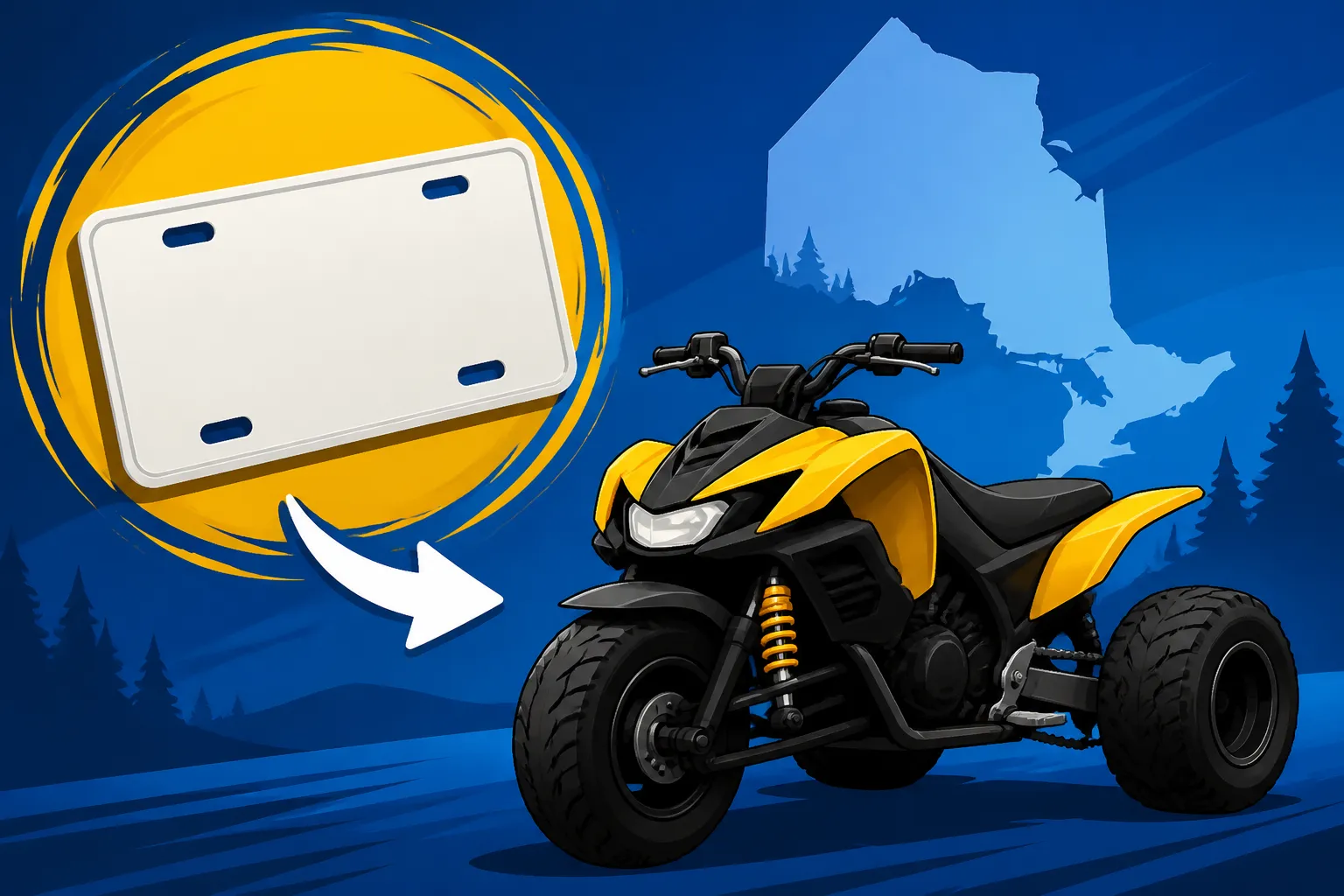
For three-wheeled ORVs in Ontario, the licence plate is specifically required to be displayed on the front of the vehicle. This is a crucial distinction and one that often catches new or returning three-wheeler owners off guard, especially if they're used to plating quads. The reason for this rule is primarily visibility. Given the typically wide, often open rear of many three-wheelers, and the possibility of cargo or accessories obscuring a rear-mounted plate, the front provides a more consistent and unobstructed location for identification.
When you receive your standard Ontario ORV plate, which is typically a rectangular white plate with green lettering, your primary task will be to find a secure and visible spot on the front of your machine. This could be on the front rack, the handlebars, or a dedicated bracket. The key is that it must be clearly visible and legible from the front of the vehicle. An officer approaching from the front or side needs to be able to quickly identify the plate number without obstruction. You can find more details on this in [Ontario ORV Plates and Where They Mount] and [Ontario ATV Plate Placement Rules].
Practical Considerations for Secure and Legal Display
Mounting a plate on the front of a three-wheeler requires a bit of thought. These machines are designed for rough terrain, which means your plate needs to be securely attached to withstand vibrations, impacts, and mud.
Here are a few practical tips:
- Choose a sturdy location: Avoid flimsy plastic parts. Look for a metal rack, a frame member, or a solid part of the bodywork.
- Use robust hardware: Don't just use zip ties or thin screws. Opt for bolts, nuts, and lock washers to ensure the plate doesn't rattle loose on bumpy trails. Some riders even reinforce their mounting points with small metal plates for added durability.
- Consider a dedicated bracket: Many aftermarket companies make universal licence plate brackets that can be adapted to fit various ORVs. These can help position the plate for optimal visibility while protecting it from accidental damage.
- Angle for visibility: Ensure the plate is angled such that it's easily read from a reasonable distance. It shouldn't be too low to the ground where it gets covered in mud immediately, nor should it be angled sharply upwards or downwards.
- Protection from trail debris: While it needs to be visible, try to mount it in a location where it's somewhat shielded from direct impacts from branches or rocks. A slight recess or behind a sturdy bumper can offer some protection.
- Regular checks: Make it a habit to check your plate's security before and after rides. It's easy for nuts to vibrate loose, especially on older machines. A lost plate means an unregistered machine, and that can lead to fines. If you do lose it, the process for [Replacing a Lost Ontario ORV Plate] is fairly straightforward.
Remember, the goal is not just to have a plate, but to have it displayed correctly and securely so that it can perform its function of identifying your vehicle.
What Happens If Your Plate Isn't Visible?
Riding with an improperly displayed or obscured plate is essentially the same as riding without one in the eyes of the law. An Ontario Provincial Police (OPP) officer or local by-law enforcement officer needs to be able to clearly see your plate to identify your vehicle. If it's covered in mud, bent beyond recognition, or simply not mounted in the correct, visible location, you could face consequences.
These consequences can range from a warning to a fine, and in more severe cases, could lead to your ride being cut short. Officers patrol trails, roads (where ORVs are permitted), and public lands, and they frequently check for proper registration and visible plates. It's a fundamental part of ensuring accountability and safety on the trails. Don't let a simple oversight about plate placement turn a fun day of riding into an expensive headache. Always ensure your plate is clean, legible, and mounted securely and correctly on the front of your three-wheeler.
Beyond the Plate: Full Registration for Your Ontario Trike
While the plate is a visible symbol of registration, the process involves more than just bolting metal to your machine. There's paperwork, fees, and other legal requirements that ensure your three-wheeler is fully compliant with Ontario law.
Gathering Your Ownership Documents (and LawDepot's Role)
Before you can even think about getting a plate, you need to prove that the three-wheeler actually belongs to you. This is a critical step, especially when dealing with older, used machines where original paperwork might be scarce or lost. You'll need to head to a ServiceOntario centre, and they won't proceed without proof of ownership.
Here's what you'll typically need:
- Bill of Sale: This is arguably the most important document. It must clearly state the seller's name and address, your name and address, the date of sale, the purchase price, and a detailed description of the three-wheeler, including its Vehicle Identification Number (VIN). If you're buying a used trike, insist on a comprehensive bill of sale. For private sales, if you're concerned about having a legally sound document, services like LawDepot can provide customizable bill of sale templates that ensure all necessary information is included. This can be especially helpful if you're dealing with a seller who isn't familiar with formal sales documents. [Ontario ATV Bill of Sale Requirements] outlines what's needed.
- Previous Owner's Ontario Vehicle Permit (or proof of out-of-province registration): If the three-wheeler was previously registered in Ontario, the seller should provide you with the "Vehicle Portion" of the green Ontario Vehicle Permit, signed over to you. This acts as proof that the vehicle was legitimately owned and registered. If you're bringing an ORV in from another province, you'll need the equivalent registration document from that jurisdiction.
- Proof of Identity: Your valid driver's licence or other government-issued photo ID is required.
- Odometer Reading: Be prepared to provide the current odometer reading (if your trike has one).
- VIN (Vehicle Identification Number): This unique 17-digit number (or shorter for older vehicles) is crucial for identification. Ensure it matches on all your documents. You can also run a [Ontario ATV VIN Check Before Buying] to ensure the machine isn't stolen or has any liens against it.
In situations where a formal bill of sale is needed, especially in a private transaction, utilizing a resource like LawDepot can give both buyer and seller peace of mind. Their templates can help ensure that all legal necessities are covered, protecting both parties and streamlining the registration process by presenting clear, official documentation to ServiceOntario.
The ServiceOntario Visit: What to Expect
Once you have all your documents in order, a trip to ServiceOntario is the next step. While you can often book an appointment online to save time, walk-ins are usually accepted.
Here’s a general overview of what happens:
- Present Documents: Hand over your bill of sale, the previous owner's signed-over permit (if applicable), and your identification.
- Verify Information: The ServiceOntario representative will review your documents, verify the VIN, and input the vehicle's details into the system. They may ask questions about the purchase price, especially to calculate any applicable Retail Sales Tax (RST).
- Pay Fees: You'll pay the one-time registration fee for the ORV permit and any applicable sales tax. Ontario imposes a 13% Retail Sales Tax (RST) on the purchase price of used ORVs from private sellers, which you pay directly to ServiceOntario, not the seller. Even if you generated your bill of sale using LawDepot, the tax calculation will happen at the counter. For more on this, see [13 Percent RST on an Ontario ATV] and [Ontario RST Paid at the Counter, Not to the Seller].
- Receive Permit and Plate: Once everything is processed and paid, you'll be issued a new Ontario Vehicle Permit for your three-wheeler and a brand-new licence plate. This permit is your official proof of ownership and registration for the ORV.
It's important to remember that Ontario ORV registration is a one-time process; there are [No Annual Renewal for an Ontario ORV], which is a nice perk for owners. You pay once, and as long as you maintain ownership, the registration remains valid.
Don't Forget Insurance and Rider Requirements
Having a registered ORV and a plate is only part of the equation. In Ontario, mandatory insurance is a non-negotiable requirement for all ORVs, including three-wheelers, whether you ride on public roads, trails, or even private property that isn't your own. This is a critical point that many riders sometimes overlook or misunderstand. Your ORV must be covered by a motor vehicle liability insurance policy. You don't need to present proof of insurance at the time of registration at ServiceOntario, but you absolutely need it before you put a wheel on any trail or road. Failing to have insurance can result in significant fines. [Ontario ATV Insurance Requirements] covers this in detail.
Additionally, remember that operating a three-wheeler in Ontario comes with specific rider requirements, including:
- Licence: If riding on a public road where permitted, you'll need at least a G2 driver's licence or an M2 motorcycle licence.
- Helmet: An approved motorcycle helmet with the chin strap fastened is mandatory for all riders and passengers on public land and roads.
- Age Limits: Specific age requirements apply for operating ORVs, especially for younger riders and depending on the type of terrain (private property vs. public trails).
Always prioritize safety and ensure you and any passengers are properly equipped and legally qualified to ride.
Common Pitfalls and Smart Tips for Three-Wheeler Owners
Even with a clear understanding of the rules, there are specific situations and common mistakes that three-wheeler owners might encounter. Being prepared can save you a lot of hassle.
Buying a Used Trike: What to Watch For
Many three-wheelers in Ontario are older, used machines, making the purchase process a bit more involved than buying new. Here are some smart tips to avoid common pitfalls:
- Verify the VIN: Always check the VIN on the machine against the VIN on the ownership documents. Ensure they match exactly. If the VIN is defaced or unreadable, walk away – it could be stolen or have a dubious history. A tool like a [Ontario ATV VIN Check Before Buying] can uncover past issues.
- Demand a Proper Bill of Sale: Even if it’s a friendly transaction, a formal bill of sale is your best friend. As mentioned, services like LawDepot can provide templates that ensure all the necessary legal information is captured, including purchase price, date, and seller/buyer details. This protects you in case of any disputes and is essential for ServiceOntario. Don't rely on a quick handwritten note that might omit crucial information.
- Lien Check: Before handing over any money, perform a lien check (PPSA search) to ensure there's no outstanding debt against the three-wheeler. You don't want to buy a machine only to find out it can be repossessed. [Ontario ATV Lien Check Before Buying] is a must-read.
- Previous Permit: The seller should always provide the "Vehicle Portion" of the Ontario Vehicle Permit, signed over to you. If they claim to have lost it, they need to get a replacement before they can legally transfer ownership to you. Do not accept a story about a "missing permit"; insist on the proper paperwork.
- Condition of the Machine: Beyond the paperwork, thoroughly inspect the physical condition of the three-wheeler. Older machines can have hidden issues. Check the frame for cracks, tires for wear, brakes, suspension, and engine. A pre-purchase inspection by a qualified mechanic can be a wise investment.
Maintaining Your Registration: It's Simpler Than You Think
One of the great advantages of ORV registration in Ontario, including for your three-wheeler, is its simplicity once the initial registration is complete.
- No Annual Renewals: Unlike car licence plates or snowmobile permits, your Ontario ORV permit does not require annual renewal or a sticker. Once you've registered and paid the one-time fee, you're good to go as long as you own the machine and keep the permit. This is why you often hear [No Annual Renewal for an Ontario ORV].
- Keep Your Permit Safe: Your Ontario Vehicle Permit is your proof of ownership. You should carry a true copy of it (a high-quality photocopy or digital image on your phone) when you ride. The original should be stored securely at home. If you lose it, you'll need to apply for a replacement at ServiceOntario, which may incur a small fee. [Keeping Your ORV Permit Dry on a Wet Ride] offers practical advice.
- Address Changes: If you move, remember to update your address on your ORV permit. This is a quick and free process at ServiceOntario.
- Plate Care: Keep your plate clean and visible. Mud and grime can accumulate quickly on the trails, especially on the front of a three-wheeler. A quick wipe down before each ride ensures your plate is always legible and avoids any potential issues with law enforcement.
Owning and riding a three-wheeler in Ontario can be an incredibly rewarding experience. By understanding and adhering to the specific registration and plating rules, particularly the front-mounting requirement for the licence plate, you ensure that your unique machine is ready for any adventure the trails of Ontario have to offer, without any unnecessary legal worries.
Disclaimer
This article is for general informational purposes only and does not constitute professional advice. Laws, prices and regulations vary by location and change over time. Consult a qualified professional for guidance on your specific situation.