Ontario’s 20 and 50 km/h Speed Limits
Navigating the rules and regulations for riding your ATV or UTV on Ontario's roads can feel like trying to solve a complex puzzle, especially when it comes to understanding the specific speed limits. It's incredibly frustrating to think you're doing everything right, only to realize you've misunderstood a crucial detail. This guide is here to untangle the intricacies of Ontario's 20 km/h and 50 km/h speed limits for off-road vehicles, helping you understand precisely where and when these rules apply so you can ride legally and confidently.
Understanding Ontario's Speed Limit Framework for ORVs
Ontario's approach to allowing Off-Road Vehicles (ORVs) on public roads is unique, and it’s certainly not a one-size-fits-all situation. Unlike cars, which pretty much follow the posted speed limit unless otherwise specified, ORVs operate under a distinct set of rules, particularly when it comes to how fast you can go. This often leads to confusion, as riders might assume that if a road is open to ORVs, they can travel at the standard posted speed. Unfortunately, that's rarely the case, and misunderstanding this can lead to serious fines or even accidents. The provincial legislation, specifically the Off-Road Vehicles Act (ORVA), alongside municipal by-laws, carves out very specific speed parameters for ATVs, UTVs, and dirt bikes on shared roadways.
The Basic Rules: 20 km/h on Certain Roads
You're probably used to seeing speed limit signs in 10 km/h increments – 50, 60, 80, 100 km/h. So, when you hear "20 km/h," it can feel incredibly slow, almost like you're barely moving. But this specific speed limit is a critical safety measure, particularly when ORVs are interacting with high-traffic areas or crossing major arteries. The 20 km/h rule primarily applies when ORVs are using a highway (which, in Ontario's legal definition, includes almost any public road) where the posted speed limit for other vehicles is greater than 50 km/h. It also applies when you're crossing a controlled access highway, like a provincial King's Highway.
Imagine you're trying to connect two sections of trail that are bisected by a busy two-lane highway, perhaps even one of those regional roads that are still incredibly fast-moving. You pull up to the shoulder, signal your intent, and prepare to cross. Even if that highway has a posted speed limit of 80 or 90 km/h, your ATV or UTV is restricted to a maximum of 20 km/h while you're actually on the travelled portion of that higher-speed road. This isn't just about reducing your impact on the flow of traffic; it's fundamentally about giving you more time to react, to see other vehicles, and for them to see you, especially when you're making a sudden, slow movement across a fast-moving stream of cars. It's a moment-by-moment assessment that demands full attention, and that slower speed is your best friend for safety.
The Elevated Limit: 50 km/h on Other Roads
Now, let's talk about the slightly less restrictive, but still specific, 50 km/h limit. This is the maximum speed an ORV can attain on most municipal roads that have been officially opened to ORV use via a local by-law. The key here is "municipal roads" and "by-law." This means that before you even think about hitting 50 km/h, you need to ensure the road you're on has been designated for ORV access by the local township, municipality, or county. These are typically smaller, less travelled roads, often connecting communities or linking up to larger trail networks. You'll frequently find these roads in rural areas, small towns, or cottage country.
Consider you're riding with friends and you've just come off a fantastic trail run. The next section of the trail is a few kilometres away, and the local by-law in Strong Township allows you to use a specific municipal road to bridge the gap. If that road has a posted speed limit of 50 km/h or less for regular traffic, your ORV can also travel up to 50 km/h. However, and this is crucial, if that same municipal road has a posted limit of 60 km/h or 80 km/h for cars, your ORV is still capped at 50 km/h. You don't automatically get to go the higher posted speed. It's a common trap many riders fall into – seeing an 80 km/h sign and assuming they can match it. Always remember: 50 km/h is your ORV's maximum on these designated municipal roads, unless the posted limit for all vehicles is even lower.
Why Two Different Limits? The Purpose Behind the Rules
It's natural to wonder why these two distinct speed limits exist. Why not just one, or why not simply defer to the posted speed limit like cars do? The rationale is multifaceted, deeply rooted in safety, road infrastructure, and the desire to balance the enjoyment of ORV riding with the safety of all road users. The core issue is that ORVs, while fun and capable off-road, are not designed in the same way as street vehicles. They have different handling characteristics, braking distances, and visibility profiles. [The ATV Class Under Ontario Regulation 316/03] outlines some of these differences.
The 20 km/h limit is primarily a safety buffer. When you're crossing a major highway or navigating a road with a very high posted speed limit, the risk of a severe collision increases dramatically. By forcing ORVs to slow down, the provincial government aims to minimize the speed differential between ORVs and other vehicles, giving both ORV riders and other drivers more time to see, react, and avoid potential hazards. It's about reducing the kinetic energy involved in a potential impact and increasing reaction time. The faster a vehicle is moving, the less time there is to respond to unexpected situations.
The 50 km/h limit, on the other hand, is a pragmatic compromise. It allows ORV riders to travel at a reasonable pace on less busy municipal roads, facilitating access to trails, local businesses, or even a friend's cottage. This speed is generally considered safer for ORVs on roads not designed for high-speed travel, where visibility might be reduced, or where you might encounter unexpected turns or gravel sections. It acknowledges the need for ORVs to connect to networks without posing an undue risk to themselves or others. It also recognizes that many of these municipal roads have lower traffic volumes and are often shared with cyclists, pedestrians, and farm equipment, for whom higher ORV speeds could be very disruptive or dangerous.
Where the 20 km/h Rule Kicks In
Understanding when and where the 20 km/h rule applies is paramount for any ORV enthusiast riding in Ontario. It's not just a suggestion; it's a legal requirement that can carry significant penalties if ignored. Many riders assume that once a road is "open" to ORVs, they can treat it like any other vehicle, but the 20 km/h limit is a glaring exception to that mindset, specifically designed for higher-risk scenarios. This distinction often trips up even experienced riders, leading to unnecessary interactions with law enforcement.
Crossing King's Highways and Main Roads
One of the most common situations where you'll encounter the 20 km/h limit is when you need to cross a King's Highway or any provincial highway (like Highways 11, 17, 60, or 28), or even a major regional road that carries a high volume of fast-moving traffic. These are arteries that are simply not designed for the sustained travel of ORVs, and generally, ORVs are prohibited from travelling along them. However, for the sake of trail connectivity, the law makes an allowance for crossing these highways. This is a critical point for safety and planning your route, especially when using trail systems that may be bisected by such roads.
Imagine you're navigating the [Voyageur Multi-Use Trail] near Mattawa, and a section requires you to briefly cross Highway 17. Even though Highway 17 has speed limits that typically range from 80 to 100 km/h, your ATV or UTV must slow down to a maximum of 20 km/h the moment your tires touch the paved surface of that highway. This slow speed is not just for your benefit; it's for the benefit of every other driver on that road. It gives them ample time to see your ORV, which can often be smaller and less visible than other vehicles, especially in varying light conditions. The brief moment you spend crossing is a high-risk manoeuvre, and the reduced speed is a non-negotiable safety buffer. It's about minimizing the time you're exposed to fast-moving traffic while maximizing your ability to observe and react to unforeseen circumstances.
Unopened and Unassumed Road Allowances
Ontario has a vast network of what are often called "road allowances" or "concession roads." These are strips of land, typically 66 feet wide (about 20 metres), reserved for public roadways but not always developed or maintained as such. Many of these exist on maps but are simply overgrown trails, old farm lanes, or even just lines on a survey plan that cut through forests or fields. [Riding an Unassumed Road] can be a unique experience. While many ORV riders use these allowances as de facto trails, particularly on Crown Land, their legal status for ORV operation can be tricky, and the 20 km/h rule often applies.
If an unopened or unassumed road allowance is technically considered part of the "highway" system under the ORVA (even if it's just two ruts in the mud), and it's located in an area where the hypothetical posted speed limit for that type of road would be over 50 km/h (e.g., a rural area where nearby roads are 80 km/h), your ORV would be subject to the 20 km/h limit. This scenario is less about interacting with high-speed traffic and more about the inherent nature of these underdeveloped paths. They are often rough, unpredictable, and can have hidden hazards like washouts, fallen trees, or deep mud. The 20 km/h limit, in this context, becomes a practical speed for navigating challenging terrain safely, even if you're unlikely to encounter other vehicles. It's a provincial overlay meant to regulate how ORVs interact with these often ambiguous strips of land, ensuring a baseline level of safety regardless of their physical condition.
Roads with Posted Limits Above 50 km/h
This is perhaps the most common source of confusion and frustration for ORV riders. You’re on a rural road, maybe a county road that connects two small towns, and you see a big, bold sign: "Speed Limit 80 km/h." Your natural inclination is to accelerate, to keep up with the flow of traffic, especially if the road seems clear and well-maintained. However, for ORVs, the rules are different. If that road has a posted speed limit for conventional vehicles that is above 50 km/h, your ORV is strictly limited to 20 km/h, regardless of whether a municipality has opened it for ORV use. This means you’ll be travelling significantly slower than the vast majority of other vehicles, which requires heightened awareness and defensive driving.
Consider a scenario where the municipality of Bluewater has opened a specific section of a county road for ORV access, but that road is generally posted at 80 km/h. While you are legally allowed to be on that road, you must restrict your speed to 20 km/h. This can feel like crawling, especially when cars and trucks are zipping past at quadruple your speed. The justification for this limit is rooted in the safety characteristics of ORVs. Their stability, braking, and overall road manners are not equivalent to those of a passenger car, especially at higher speeds. They are more susceptible to crosswinds, less forgiving of sudden steering inputs, and often have a higher centre of gravity. The 20 km/h limit is a safeguard, acknowledging these inherent differences and attempting to mitigate the risks associated with mixing slow-moving, off-road biased vehicles with fast-moving, on-road designed vehicles. It’s a frustrating but necessary rule to ensure everyone's safety on multi-use roads.
Navigating the 50 km/h Speed Zone
While the 20 km/h limit often feels restrictive, the 50 km/h zone offers a bit more freedom, allowing for more efficient travel between trail segments or through small communities. However, just like with the lower limit, there are crucial conditions and understandings that must be in place. It’s not simply a matter of finding any road with a 50 km/h sign and assuming you can open up your throttle. The power to permit ORV use and set these conditions largely rests with local municipal governments, and their decisions dictate your riding experience.
Municipal Roads Opened by By-law
The vast majority of roads where you can legally travel at up to 50 km/h on your ORV are municipal roads that have been specifically designated for ORV use through a local by-law. This is a critical distinction. A road might look like any other local road, but if the municipality hasn't passed a by-law permitting ORVs, you simply can't ride there legally, regardless of the speed you maintain. These by-laws are the legal framework that opens up these roads, and they often come with their own set of specific rules, including operating hours, seasonal restrictions, and even specific routes that are allowed. [How an Ontario Municipality Opts In] is an important piece of the puzzle here.
Take, for example, a municipality like Kirkland Lake, which has opened up certain streets to connect riders to the trailhead, or Greater Napanee with its by-law. These municipalities have gone through a process, likely consulting with local residents, police, and trail associations, to determine which roads are suitable for ORV traffic. When you're riding in such an area, and the posted speed limit for that road is 50 km/h or less, your ORV can also travel at up to 50 km/h. It's empowering to be able to ride your machine from a local diner directly to the trail system, but that privilege comes with the responsibility of knowing the local rules. Always check the specific municipal by-law for the area you plan to ride in; a quick search on the municipality's website can often provide the relevant details, or trail associations usually have maps highlighting permitted routes.
Understanding the Posted Speed Limit Interaction
Here's another point that can sometimes be tricky: the 50 km/h limit for ORVs is a maximum allowed speed on designated municipal roads. It does not override any lower posted speed limits. This means if you're on a municipal road that has been opened for ORV use, but that road has a posted speed limit of, say, 30 km/h (perhaps it's a school zone or a residential area with heavy pedestrian traffic), you must adhere to that 30 km/h limit, not the 50 km/h ORV maximum. The 50 km/h is your ceiling, but the posted signs for all vehicles take precedence if they are lower.
Think about riding through a small village where the general speed limit is 50 km/h, and ORVs are permitted. You might be enjoying the ride, but then you enter a school zone clearly marked at 30 km/h. Even though your ORV could technically go 50 km/h on that road outside the school hours, within that specific zone, you must slow down to 30 km/h. This is about shared responsibility and respecting the safety of vulnerable road users. It’s not just about avoiding a ticket; it’s about protecting children and pedestrians who might not expect an ORV to be moving faster than the posted limit. Always keep an eye out for standard speed limit signs, even on roads you know are open to ORVs, as these can change rapidly, especially when passing through different sections of a community.
Designated Sections and Connector Routes
Municipalities often utilize the 50 km/h speed limit to create essential connector routes, allowing riders to link different trail systems, access fuel and services, or simply get from their lodging to the nearest trailhead. These designated sections are crucial for creating a cohesive and enjoyable riding experience, turning isolated trail segments into a broader network. Without these road connections, many of Ontario's fantastic trail opportunities, like those offered by the [OFATV Trail Network], would be much harder to access and enjoy.
Picture yourself on a multi-day trip, perhaps exploring the vast [Haliburton's 1,000 Kilometres] network. You might ride miles of dedicated trails, but then need to use a short stretch of municipal road to get from one section of trail to another, or to reach a gas station in a nearby town. These designated road sections, where you can travel up to 50 km/h, are the lifeblood of interconnected trail riding. They are carefully chosen by the municipality to be roads with lower traffic volumes, good sightlines, and minimal impact on residents. Often, you'll see specific signage indicating that ORVs are permitted, reinforcing the by-law's stipulations. It's a testament to the collaborative efforts between trail associations, local businesses, and municipal governments to make Ontario a premier destination for off-road enthusiasts. These routes allow riders to extend their adventures, turning short rides into multi-day excursions that explore more of Ontario's beautiful landscapes, all while adhering to sensible speed limits designed for safety and integration.
The "Where" Matters More Than Just the "How Fast"
When it comes to riding your ORV on Ontario roads, simply knowing the 20 km/h and 50 km/h limits is only half the battle. The true complexity, and the source of most confusion, lies in understanding where these rules apply. It's a patchwork quilt of regulations, with municipal by-laws acting as the primary determinant for local road access. Without a solid grasp of these geographical and jurisdictional nuances, even adhering strictly to the speed limits won't keep you on the right side of the law.
The Importance of Municipal By-laws
This point cannot be stressed enough: whether you can even be on a particular municipal road with your ORV, and at what speed, is almost entirely dependent on the local municipality's by-laws. The provincial Off-Road Vehicles Act sets the overarching framework and the maximum speeds, but it's the individual cities, towns, and townships that decide if and where ORVs can operate on their roads. This means that a road that's open to ORVs in one township might be strictly prohibited just across the municipal boundary in the next. It’s incredibly frustrating for riders who just want to enjoy their machines without becoming legal scholars, but it’s the reality of the system.
Imagine planning a weekend ride with friends, crossing through a few different municipal jurisdictions. In one, you might find [Middlesex Centre By-law 2021-010] opens several roads at 50 km/h. You cruise along, feeling confident. But then, as you cross into the next township, which might not have an equivalent by-law, suddenly those roads are off-limits. If you continue to ride there, you're trespassing or operating illegally, even if you're going a polite 20 km/h. This is why [Checking a Township's ORV By-law] is not just a good idea, it's essential. Many riders simply don't realize this nuanced local control, assuming provincial rules mean blanket access. Always do your homework before you trailer your machine or head out on a long ride. The consequences of not doing so can range from a polite warning to a hefty fine, or even having your machine towed.
Prohibited Highways and Exemptions
While municipalities have the power to open their roads, there are certain categories of roads that are generally off-limits to ORVs, regardless of local by-laws. Primarily, these are the major provincial highways, often referred to as King's Highways or the 400-series highways. These are high-speed, multi-lane arteries designed for efficient, long-distance travel, and ORVs simply do not belong on them, save for very specific and brief crossing scenarios (where the 20 km/h rule applies). There's no municipal by-law that can magically open up Highway 401 or the QEW to ATV traffic. [Why Ontario's 400-Series Highways Stay Closed] highlights the inherent dangers and legal restrictions.
There are very, very limited exceptions for some provincial highways, usually in Northern Ontario, where specific sections may be designated as open to ORVs. Even then, these are rare and typically subject to strict conditions. The general rule of thumb is: if it's a major highway, assume you can't ride on it. This prohibition isn't meant to be a nuisance; it's a matter of extreme safety. The speed differential, the lack of shoulders, and the high volume of traffic on these highways make ORV operation inherently dangerous. Planning your routes to avoid these prohibited areas is crucial, often requiring you to use legal municipal connector roads or designated trail systems instead.
Seasonal and Time-of-Day Restrictions
Adding another layer of complexity to the "where" are the potential seasonal and time-of-day restrictions that some municipal by-laws might impose. It's not uncommon for a municipality to open roads to ORVs only during certain months of the year, or only between specific hours of the day. These restrictions are usually put in place due to environmental concerns, residential noise complaints, or conflicts with other seasonal road users.
For example, a township might allow ORV use on its roads from May 1st to November 30th, but close them for the winter months due to snow and ice conditions, or to avoid damaging thawing roads in spring. Other by-laws might permit ORVs only between dawn and dusk, restricting night riding to minimize noise impact on residential areas. [Township Roads That Close to ATVs Every Spring] is a very real consideration. This means that even if you know a road is open to ORVs, you need to check if your planned ride falls within the permitted window. Ignoring these restrictions, even if you’re riding at the correct speed, can still result in fines or charges. It's just another reminder that ORV riding on roads is a privilege, not an inherent right, and it comes with specific responsibilities to community and environment.
Essential Equipment and Rider Requirements
Beyond merely adhering to the prescribed speed limits, operating your ATV or UTV on Ontario roads requires a comprehensive understanding of the associated equipment and rider requirements. The speed limits are just one piece of the puzzle; your machine needs to be properly equipped and you, as the operator, must meet certain qualifications. Neglecting these other elements, even if you're meticulously sticking to 20 or 50 km/h, can still lead to fines, safety hazards, and invalidate your insurance. This is where the rubber truly meets the road, so to speak, in making your ORV street legal.
Beyond Speed: Other Road-Legal Necessities
When you bring an off-road machine onto a public road, it suddenly has to meet many of the same basic safety standards as a car or motorcycle. Your ORV needs to be clearly visible, able to signal its intentions, and capable of operating safely in mixed traffic. This means equipping your machine with a suite of functional components that might not be necessary for purely off-road use. For instance, proper lighting is non-negotiable. This includes functional headlights, taillights, and brake lights. You also need a horn, a muffler in good working order (no excessively loud aftermarket exhausts!), and a working speedometer.
Mirrors are also critical for road safety. While many ATVs come with basic mirrors, ensuring they are properly adjusted and provide adequate rear visibility is essential, especially when you're contending with faster-moving traffic. Some riders opt for aftermarket mirrors, perhaps from brands like SuperATV, that offer greater adjustability or a wider field of view. These upgrades can significantly enhance your awareness of your surroundings. Turn signals, while not always factory standard on all ORVs, are also required for road use to clearly indicate your intentions to other drivers. Having all these components in proper working order isn't just about avoiding a ticket; it's fundamental to your safety and the safety of everyone else on the road. [Equipment Ontario Requires on a Road-Legal ORV] covers these in detail.
Licence and Age Requirements for Road Use
Just as you need a driver's licence to operate a car on the road, you need the appropriate licence to operate an ORV on designated Ontario roads. It's not enough to simply own the machine; you need to be a qualified operator. For road use, an ORV operator must hold at least a valid G2 class driver's licence or an M2 class motorcycle licence. This means that a G1 licence (learner's permit for cars) is insufficient for road riding, as it requires you to be accompanied by a fully licensed driver, a condition that doesn't practically apply to ORV operation. Similarly, an M1 (motorcycle learner's permit) is also not sufficient.
Furthermore, there are age requirements. While you can ride an ORV off-road on private property at a younger age (with supervision), the minimum age for operating an ORV on a public road in Ontario is 16, and you must possess that G2 or M2 licence. This ensures that operators have attained a certain level of maturity and have undergone some formal driver training before navigating the complexities of public roadways. It's a critical safety measure that acknowledges the risks of mixing ORVs with other vehicles. [Ontario's G2 and M2 Licence Requirement] and [The Licence Ontario Requires on a Road] delve deeper into these crucial prerequisites. Ignoring these licensing and age rules is not just a minor infraction; it can lead to severe legal consequences, including fines and the impoundment of your vehicle.
Machine Classification and Dimensions
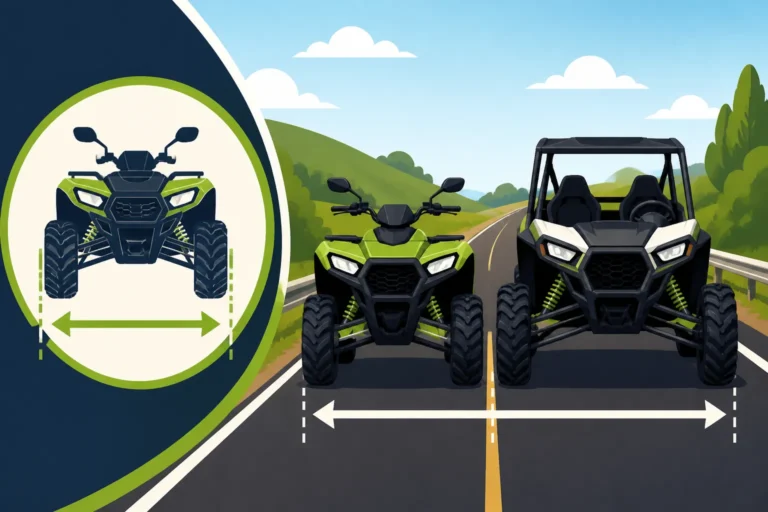
Not all off-road machines are created equal in the eyes of Ontario law when it comes to road use. The specific class of your ORV (e.g., ATV, ROV/UTV, Off-Road Motorcycle) and its physical dimensions (width and weight) play a significant role in determining where and how it can be legally operated on roads. The provincial regulations classify ORVs into different categories, and each category has specific parameters that must be met for road access. For instance, the general rule is that an ORV (including ATVs and UTVs) used on roads cannot exceed 2.03 metres (80 inches) in width. This [Ontario ATV Width Limit for Road Use] is crucial, especially for many wider side-by-sides that are becoming increasingly popular.
If your UTV, for example, is equipped with a wider suspension kit or wider tires (perhaps from SuperATV) that push its overall width past the 2.03-metre limit, it would be illegal to operate on public roads, even if all other conditions (speed, equipment, licence) are met. Similarly, there are weight restrictions that define what constitutes an ORV for road purposes. This classification system ensures that vehicles deemed road-legal possess a minimum standard of manageability and don't pose undue risks due to their size or bulk. Always know the exact specifications of your machine and verify them against Ontario's ORV road-use regulations. It’s a detail that many riders overlook, only to be surprised when pulled over for a machine that is technically too wide or heavy for road operation.
Common Misconceptions and Safety Considerations
Despite the clear legislation and guidelines, misunderstandings about ORV road use in Ontario persist, particularly regarding speed limits. These misconceptions aren't just minor errors; they can lead to dangerous situations, severe fines, and even invalid insurance coverage. As an ORV rider, it’s not enough to simply know the rules; you must also understand the common pitfalls and prioritize safety above all else, recognizing that ORVs behave differently on pavement than they do on dirt.
The "Posted Limit" Fallacy for ORVs
One of the most pervasive and dangerous misconceptions is the idea that if a road is open to ORVs, you can simply drive at the posted speed limit for that road, just like a car. This is absolutely incorrect, as we've discussed, and it's a critical point that can land riders in serious trouble. The 20 km/h and 50 km/h limits for ORVs are absolute maximums, regardless of whether the posted speed limit for other vehicles is higher.
Consider a rural road in a municipality that has been opened for ORV use, with a posted speed limit of 80 km/h for cars and trucks. An ORV rider, perhaps mistakenly assuming they can match the posted limit, might accelerate to 80 km/h. This is a clear violation of the ORVA, which would cap the ORV's speed at 50 km/h on such a road (if the primary limit is 50 km/h for the road in question and the posted limit is 80 km/h). Even worse, if that same 80 km/h road were a major highway that only allowed ORV crossing, the limit would be 20 km/h. This "posted limit" fallacy creates significant speed differentials between ORVs and other vehicles, increasing the risk of collisions. It’s imperative to remember that ORVs have their own maximum speed limits on roads, which are almost always lower than the limits for conventional vehicles. Always defer to the ORV-specific limits, not the signs intended for cars.
Shared Roadway Responsibilities
When you operate an ORV on an Ontario road, you are sharing that space with a diverse range of other users: cars, trucks, motorcycles, bicycles, pedestrians, and even farm equipment. This shared environment demands a high degree of responsibility, courtesy, and defensive driving. It's not just about obeying the speed limits; it's about being a predictable, visible, and respectful road user. Other drivers might not be accustomed to seeing ORVs on the road, or they might underestimate your speed or intentions.
To enhance safety, always ensure your lights are on, even during the day, to maximize your visibility. Use clear hand signals (if your machine isn't equipped with turn signals or if they're obscured by mud). Maintain a safe following distance from other vehicles, and be prepared for sudden stops or changes in traffic flow. Eye-catching accessories like an LED whip light or additional reflective tape, especially on the rear of your machine, can also help. Equipping your machine with road-specific tires, as opposed to aggressive mud tires, can also significantly improve traction, braking, and handling on paved surfaces, making your ride safer and more comfortable. While SuperATV might be known for off-road performance, they also offer tires and accessories that can enhance the road-worthiness and safety of your machine. Remember, you are an ambassador for the ORV community every time you ride on a public road, and responsible behaviour helps ensure continued access for all.
Enforcement and Penalties for Non-Compliance
Disregarding Ontario’s ORV speed limits and other road-use regulations can lead to more than just a stern talking-to. Law enforcement takes these rules seriously, and the penalties for non-compliance can be significant, ranging from substantial fines to the impoundment of your machine. Officers will not only check your speed but also your licence, insurance, registration, and whether your machine meets the required equipment standards for road use.
If you're caught exceeding the 20 km/h or 50 km/h limits, you could face fines similar to those for speeding in a conventional vehicle. But the penalties don't stop there. Riding an unregistered ORV, operating without valid insurance, or lacking the proper licence can result in even heftier fines. For instance, [Ontario Fines for No ATV Insurance] can be thousands of dollars, not to mention the legal consequences if you're involved in an accident without coverage. An officer might also issue a ticket for equipment violations, such as missing mirrors or non-functional lights. In severe cases, especially for repeat offenders or dangerous driving, your ORV could be impounded, leaving you with significant towing and storage fees on top of the fines. These penalties are designed to deter unsafe and illegal ORV operation on public roads and emphasize the importance of understanding and following all regulations. Always carry your permit and proof of insurance, and be ready to present them if requested by an officer.
Practical Tips for Riding on Ontario Roads
Riding your ATV or UTV on Ontario's roads can be an incredibly rewarding experience, offering crucial links to spectacular trails and convenient access to services. However, to truly enjoy it without stress or legal issues, you need a proactive and responsible approach. It's about more than just dodging fines; it's about ensuring a safe, enjoyable, and sustainable riding future for everyone. Think of yourself as a careful planner and a considerate road user.
Plan Your Route Carefully
Before you even think about putting your ORV on a public road, meticulous route planning is your best friend. Don't just assume a road is open or that you know the speed limits for ORVs on it. This is where a little research upfront can save you a lot of headache (and potential fines) down the line. Many trail organizations, like OFATV, provide excellent [Ontario ATV Trail Maps] that clearly mark which municipal roads are open to ORVs and what conditions apply.
Make it a habit to check the websites of the municipalities you plan to traverse. Look for their ORV by-laws – they are often publicly available and will outline specific road allowances, operating hours, and any unique restrictions. If you're unsure, a quick call to the municipal office can clarify things. Mapping out your route in advance allows you to identify legal connector roads, plan for sections where you'll need to slow down to 20 km/h (e.g., highway crossings), and avoid roads that are completely off-limits. This kind of planning also helps you determine fuel stops, emergency services, and even places to eat, turning a potentially stressful ride into a seamless adventure.
Be Visible, Be Predictable
When you're sharing the road with vehicles that are often much larger and faster than your ORV, visibility and predictability become paramount. Your safety hinges on other drivers seeing you and understanding your intentions. Don't assume they've seen you; ride as if you're invisible and actively work to make yourself seen.
Always operate with your headlights and taillights on, even during bright daylight. Consider adding extra reflective tape to your machine or wearing bright, high-contrast riding gear. Use hand signals clearly and well in advance of turns or stops, even if your machine has functional turn signals. Drive in a consistent, predictable manner, maintaining a steady speed (within the legal limits, of course) and avoiding sudden, erratic movements. When crossing roads or making turns, take an extra moment to make eye contact with other drivers if possible, to confirm they've seen you. Remember, ORVs have unique handling characteristics, and being predictable helps other drivers anticipate your movements, significantly reducing the risk of a collision.
Consider Your Tires and Accessories
While your ORV is built for rugged off-road conditions, riding on pavement introduces a different set of demands on your machine, especially your tires. Aggressive, deep-lugged mud tires, while fantastic in the muck, can be loud, wear quickly, and offer less grip on hard surfaces, affecting braking and handling. If you plan on frequently using municipal roads, consider tires designed with a more road-friendly tread pattern. These hybrid tires offer a better balance of off-road traction and on-road comfort, longevity, and safety. They'll also typically be much quieter, making for a more pleasant ride for you and less disturbance for residents.
Beyond tires, a range of accessories can significantly enhance your ORV's road-worthiness. We've already mentioned mirrors and turn signals. Well-placed, functional mirrors, perhaps from a brand like SuperATV, can dramatically improve your situational awareness. A clear, properly mounted license plate (which is a requirement for road use) ensures your machine is identifiable. Some riders also choose to add a small horn for safety, even if their machine has one integrated. Ensuring all lights are bright and free of mud is also vital. Investing in these details isn't just about compliance; it's about proactively enhancing your safety and comfort for those crucial road sections that connect you to the heart of Ontario's incredible off-road landscape.
| Speed Limit for ORVs | Conditions for Application | Common Scenarios | Relevant Road Types |
|---|---|---|---|
| 20 km/h | Posted speed limit for other vehicles is greater than 50 km/h. | Crossing provincial highways (e.g., Highway 11, Highway 17). | King's Highways, major provincial roads, roads posted above 50 km/h. |
| On unopened or unassumed road allowances where hypothetical speed limit for cars is > 50 km/h. | Navigating rough, undeveloped concession roads in rural areas. | Undesignated road allowances, high-speed rural routes. | |
| 50 km/h | On municipal roads explicitly opened by by-law for ORV use. | Riding through a small town like Kirkland Lake or Strong Township. | Local streets, county roads, designated connector routes within municipalities. |
| Maximum speed, but must adhere to lower posted limits (e.g., school zones). | Passing through a 40 km/h school zone on an otherwise 50 km/h ORV-permitted road. | Residential streets, school zones, areas with reduced posted limits for all vehicles. |
Disclaimer
This article is for general informational purposes only and does not constitute professional advice. Laws, prices and regulations vary by location and change over time. Consult a qualified professional for guidance on your specific situation.