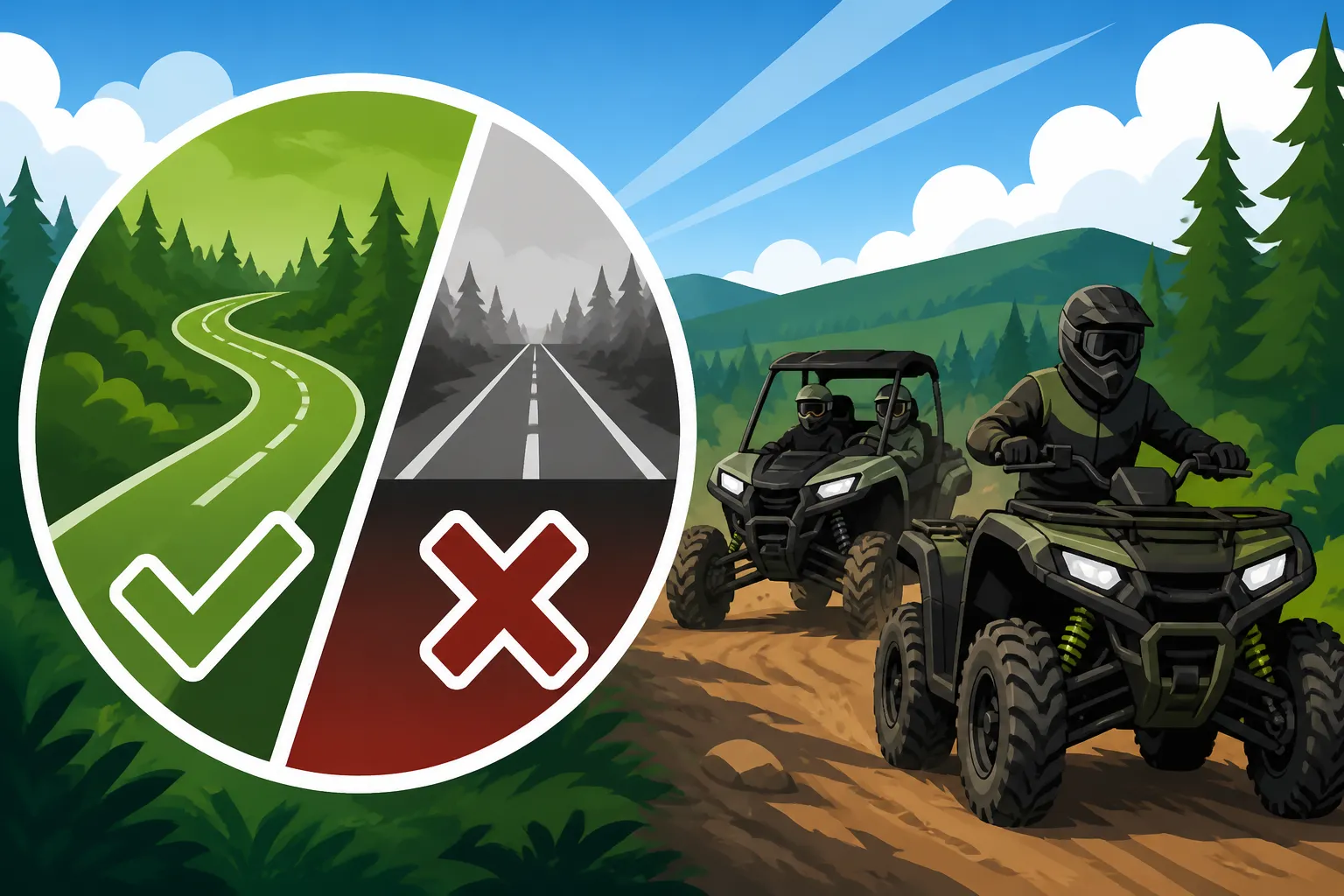
Parts of Highway 11 Open to Quads
It can be incredibly frustrating for ATV and UTV riders across Ontario to look at a map, see a provincial highway that seems like the perfect connection between two trail systems or a shortcut to a fuel stop, and then immediately assume it's completely off-limits. The truth about riding your quad or side-by-side on sections of major provincial arteries like Highway 11 isn't always black and white. This guide is here to untangle the complexities and clarify the very specific, often limited, circumstances under which parts of Highway 11 might genuinely be accessible to off-road vehicles.
The General Rule: Provincial Highways Are Usually Off-Limits
Let's start with the hard truth that can often feel like a roadblock for riders: most provincial highways in Ontario, including the vast majority of Highway 11, are generally off-limits to off-road vehicles. This isn't just a suggestion; it's a fundamental aspect of the province's Off-Road Vehicles Act and its associated regulations. You can't just hop on your quad and cruise down the shoulder of Highway 11 like it's a county road in a rural township that has opted in. That kind of open-ended access simply doesn't exist for most of these high-speed thoroughfares.
Imagine the chaos and danger if ATVs and UTVs, designed for rugged terrain and often lacking the speed or protective features of cars, were freely mixing with heavy truck traffic and vehicles travelling at 100 km/h. It’s a recipe for disaster, and the provincial regulations are designed with everyone’s safety in mind. The sheer speed and volume of traffic on most sections of Highway 11 mean it's an environment ill-suited for the typical operation of an ORV. This is why you'll find most of these roads listed among the [Ontario Highways Closed to ORVs].
Why the Default is 'Closed'
The primary reason for this widespread prohibition on provincial highways boils down to safety. Off-road vehicles, while incredibly fun and capable in their intended environments, are inherently different from passenger cars and commercial trucks. They have different braking characteristics, acceleration profiles, and levels of occupant protection. Trying to integrate these machines into high-speed, high-volume traffic corridors creates significant risks for ORV riders and other motorists alike.
Consider the visual aspect: an ATV or UTV might not be as readily seen in a rearview mirror or peripheral vision as a full-sized vehicle, especially in adverse weather or at dusk. Then there's the speed differential; even a road-legal ORV, limited to 50 km/h in most permissible road settings, would be a slow-moving hazard on a highway where the posted limit is 90 or 100 km/h. This isn't about discouraging riders; it's about preventing serious accidents. The rules are in place to try and create the safest riding environment possible for everyone, whether you're behind the handlebars of a quad or the wheel of a minivan.
The Role of Ontario Regulation 316/03
The legal framework for all of this largely rests on Ontario Regulation 316/03, which falls under the Off-Road Vehicles Act. This regulation is the playbook that dictates where and how ORVs can be operated on Ontario roads. It outlines the types of machines that qualify, the equipment they need to be road-legal, and crucially, the specific conditions under which they can travel on public roadways.
While the regulation broadly restricts ORVs from provincial highways, it also creates the pathways for exceptions. It empowers municipalities to pass by-laws to open roads under their jurisdiction, and it specifies certain provincial highway segments where ORVs are permitted. Without delving into all the legal jargon, understand that 316/03 is the provincial voice on ORV road use, and any permissible travel on or crossing of Highway 11 must ultimately be in line with its provisions or specific municipal by-laws enabled by it. It’s the foundational document that sets the stage for where we can and cannot ride.
Navigating the Exceptions: Where Highway 11 Becomes Accessible
Despite the general prohibition, there are indeed very specific and limited circumstances where parts of Highway 11 might be accessible to ORVs. These exceptions are often born out of necessity, such as connecting established trail systems or allowing riders to reach essential services in communities bisected by the highway. It’s not about joyriding on the highway itself, but rather about strategic access.
Schedule B: The Designated Open Sections
One of the most important places to look for permissible use of provincial highways like Highway 11 is "Schedule B" of Ontario Regulation 316/03. This schedule is a crucial list because it explicitly identifies certain, often short, segments of provincial highways where ORVs are permitted to operate. These are not open invitations for long-distance highway travel, but rather carefully chosen corridors that serve a specific purpose, usually linking trail systems or allowing passage through a community.
For Highway 11, specifically in Northern Ontario, there are indeed such segments. These typically involve stretches where the highway passes through a town or village, the speed limit is significantly reduced (often to 50 km/h or less), and there's a clear need for ORV access to connect the community or local trail networks. For instance, you might find a section of Highway 11 open for a few kilometers as it goes through a small town, allowing riders to get from one side of the community to another, or to access a gas station or restaurant. It's essential to remember that even on these designated segments, the ORV-specific speed limits (20 km/h or 50 km/h depending on the road and circumstances) still apply, not the posted highway speed. Always consult the most current version of O. Reg 316/03 and any local municipal by-laws to confirm the exact boundaries and conditions of these rare exceptions.
Municipal Opt-In and Local By-Laws
Beyond Schedule B, municipalities also play a significant role in determining ORV access on roads within their jurisdiction. Under Ontario Regulation 316/03, municipal councils have the power to pass by-laws that permit ORV use on roads under their control. This is often referred to as a municipality "opting in." This process is how you get places like Greater Napanee or Strong Township creating their own rules for ORV use within their boundaries. [How an Ontario Municipality Opts In] is a good read on this.
Now, how does this apply to Highway 11, which is generally a provincial highway? It's a nuanced situation. While the Ministry of Transportation (MTO) maintains most of Highway 11, there can be very short sections, particularly within established town limits, where a municipality might exercise some jurisdiction or where an agreement allows for specific ORV use. For example, a town's by-law might permit ORV use on all roads within its municipal boundary where the speed limit is 50 km/h or less, and if a segment of Highway 11 happens to fit those criteria as it passes through the town, it could theoretically be included. However, this is exceptionally rare for major provincial highways, and any such provision would need to be explicitly stated and agreed upon.
The critical takeaway here is that you cannot assume. If you're eyeing a stretch of Highway 11 that seems to go through a town, your first step must be to diligently [Checking a Township's ORV By-law]. Look for specific mentions of provincial highways or a blanket statement that explicitly covers all roads fitting certain criteria. Never ride on Highway 11 based on a hunch or what someone told you; always verify with official sources.
Crossing Provincial Highways
Even where riding on Highway 11 is strictly prohibited, the ability to cross it is often a necessity for riders. Imagine a vast trail network on one side of the highway and another fantastic system on the other. Without the ability to cross, these networks become effectively disconnected. Fortunately, Ontario's regulations do provide for the legal crossing of provincial highways, including Highway 11, under specific conditions.
Generally, ORVs are permitted to cross a highway at an intersection where at least one of the intersecting roads is open to ORV traffic. The key is that the crossing must be done at a right angle to the highway, and you must proceed directly across without driving along the highway itself, even for a short distance. You must also yield to all traffic on the highway. Think of it as crossing a busy street on foot; you don't walk along it, you cross directly and safely. All the usual rules of the road apply: stop signs, traffic lights, and watching for other vehicles. [Ontario ATV Rules for Crossing a Highway] delves into this in more detail, but the essence is a quick, direct, and safe passage.
What to Remember When Riding on or Near Highway 11
So, you've identified a rare, legal section of Highway 11 for ORV use, or you're planning a crossing. Fantastic! But your responsibilities don't end there. Operating an ORV on any public road, especially one with "Highway" in its name, comes with a heightened need for awareness, proper equipment, and strict adherence to the rules. Don’t cut corners here; it’s about your safety and the safety of everyone else on the road.
Essential Gear and Requirements
Before you even think about putting a wheel on a road that's part of the provincial highway system, even a designated segment or for a simple crossing, your machine needs to be absolutely road-legal. This isn't optional, and it's a detail an officer will certainly check. You'll need working headlights, tail lights, and brake lights – don't rely on basic trail lights. Mirrors are mandatory, usually two, to give you a clear view of traffic behind you. Turn signals, or clearly indicated hand signals, are also a must. And, of course, a proper, approved helmet for both driver and any passenger is non-negotiable.
Beyond the machine, you, as the rider, need to be properly licensed (at least a G2 or M2 for road use) and have valid insurance. [Ontario ATV Insurance Requirement] and [Ontario ATV Licence Requirements] are crucial topics to review. When outfitting your machine for road use, reliable accessories are key. Things like robust mirrors, turn signals, and proper lighting are crucial, and you might find heavy-duty options from brands like SuperATV that stand up to both road and trail conditions. They can also offer secure mounting solutions for your [Ontario ORV Plates and Where They Mount], ensuring your plate is visible and won't rattle loose on a bumpy approach to a paved section.
Speed Limits and Safe Operation
Even on those permissible sections of Highway 11, you are not operating at highway speeds. Off-road vehicles on designated road sections in Ontario are subject to strict speed limits: 20 km/h where the posted limit is 50 km/h or less, and 50 km/h where the posted limit is greater than 50 km/h. This means that if you're on a section of Highway 11 that normally has a 70 km/h limit (unlikely but possible in a built-up area), you're still capped at 50 km/h. If it’s a 40 km/h zone, you're at 20 km/h. There’s no ambiguity here. [Ontario ATV Speed Limit on Roads] provides more detail.
When you're sharing the road with other vehicles, especially on a provincial highway, maintain ample following distance, signal your turns well in advance, and always be aware of your surroundings. Remember, ORVs are a smaller presence on the road, and other drivers might not be expecting you. Ensure your machine is well-maintained, with good tires, brakes, and a properly functioning muffler.
Always Verify Local Rules
This cannot be stressed enough: always verify the local rules before you ride. The information about specific open sections of Highway 11 (or any road for that matter) can change. Municipal by-laws are periodically updated, and provincial regulations can be amended. Relying on outdated information or hearsay is a quick way to find yourself facing fines or, worse, involved in an accident.
How do you verify?
- Official Sources: Consult the current version of Ontario Regulation 316/03 for Schedule B.
- Municipal Websites: Check the official websites of the townships or municipalities you plan to ride through. Look for their "Off-Road Vehicle By-law" or similar documents.
- Local ORV Clubs: These clubs are often excellent resources for current trail and road access information, as they work closely with municipalities and the province.
- Direct Inquiry: If in doubt, contact the municipal clerk's office or the local OPP detachment for clarification.
Having durable parts and accessories for your machine, perhaps from a brand like SuperATV, means you can confidently tackle diverse terrain, including any short road sections you encounter. But even the best-equipped machine is no substitute for knowing the rules of the road.
The Bigger Picture: Connecting Trails and Trail Towns
While the idea of riding Highway 11 on your quad might seem daunting, the existence of even small, designated open sections or legal crossings is incredibly significant. These aren't just isolated allowances; they're vital connectors that enhance the entire ORV experience in Ontario, helping to weave together vast trail networks and open up new possibilities for exploration.
Importance for Trail Connectivity
Think of these open highway sections, no matter how short, as the critical links in a chain. Without them, what might be thousands of kilometers of amazing trails could remain fragmented. A short run on a designated part of Highway 11 could be the only way to get from the extensive [HATVA and Ontario's Haliburton Network] to another fantastic system further north. Or it could be the bridge that allows you to loop back to your starting point, turning two out-and-back rides into one glorious, long adventure.
These connections are essential for multi-day trips and for riders who want to explore beyond a single club's boundaries. They transform regional trail systems into truly interconnected networks, unlocking a much larger playground for off-road enthusiasts. Planning your route carefully using [Ontario ATV Trail Maps] and apps like QuadON becomes even more important to identify these crucial road links.
Planning Your Route
Effective route planning is paramount when you're dealing with segments of provincial highways. You can't just wing it. Before you head out, pull up your digital or paper maps and meticulously plot your course, identifying every single road section, even for short crossings. Confirm the legality of each segment by cross-referencing with official by-laws and Schedule B of O. Reg 316/03.
Consider logistics: where can you safely pull off a main highway to access a trail? Are there designated staging areas or safe parking options near these road sections? Are there fuel stops or amenities accessible from these legal segments? Knowing the answers to these questions in advance makes for a much smoother and safer ride. Ensuring your ORV is properly equipped for any road sections is paramount, and companies like SuperATV offer a range of products designed to enhance safety and compliance, from lighting kits to sturdy mirrors.
Respecting the Rules and Other Road Users
Finally, whether you're on a dirt trail or a legally open section of Highway 11, the core principle remains the same: respect the rules, respect the land, and respect other users. When you're on a public road, you are sharing that space with drivers who might not be familiar with ORVs or accustomed to seeing them on a highway. Your behavior directly impacts the perception of all ORV riders.
Ride predictably, maintain safe speeds, and be courteous. Adhere strictly to the helmet laws, insurance requirements, and licensing regulations. Every responsible action you take helps to build a positive reputation for the ORV community and can even encourage more municipalities to consider opening up connecting roads for riders. From sturdy winches to reliable lighting and protective components, investing in quality gear, perhaps from SuperATV, ensures your machine is ready for whatever the Ontario trails – and those rare highway sections – throw at you.
| Feature | General Provincial Highways (e.g., Most of Highway 11) | Designated Schedule B Sections / Municipal By-law Sections of Highway 11 |
|---|---|---|
| ORV Travel | Generally Prohibited | Permitted Under Specific, Limited Conditions |
| Speed Limit | Standard highway speeds (80-100+ km/h) | ORV-specific limits (20 km/h or 50 km/h) apply |
| Primary Use | High-speed vehicular traffic | Connect trails, access amenities within specific town boundaries |
| Legal Authority | Provincial (Off-Road Vehicles Act default) | Provincial (O. Reg 316/03 Schedule B) OR Municipal By-law |
| Required Equipment | Not applicable for ORV travel | Full road-legal equipment (lights, mirrors, insurance, proper plate, etc.) |
| Checking Rules | Default is no ORVs; crossing may be permitted. | Crucial: Always consult O. Reg 316/03 Schedule B and current local by-laws |
| Rider Licence Req. | Not applicable for ORV travel | G2/M2 minimum |
| Insurance Req. | Not applicable for ORV travel | Mandatory |
| Primary Safety Concern | High-speed traffic integration | Navigating mixed traffic safely, adhering to ORV speed limits |
| Example Use Case | Crossing only, rarely for travel | Short passages through small towns to connect trail segments |
Disclaimer
This article is for general informational purposes only and does not constitute professional advice. Laws, prices and regulations vary by location and change over time. Consult a qualified professional for guidance on your specific situation.