Registering a Quad Bought Off a Farm
Buying an ATV or UTV directly from a farm can feel like a fantastic deal, but when it comes to registration, you might find yourself scratching your head over paperwork, or the lack thereof. Many farm machines have a history that doesn't include formal dealership transactions or meticulous record-keeping, leaving you with questions about how to get that coveted green permit and plate. This guide will walk you through the often-unconventional path of registering a quad purchased directly off a farm in Ontario.
The Unique Challenges of Buying an ATV Off a Farm
When you buy a quad from a farm, you're often dealing with a machine that has lived a working life, maybe never seeing a formal trail or public road. This means its administrative history can be a bit sparse, which can present a few hurdles when you try to make it legal for your own adventures. It’s not like buying from a dealership where all the paperwork is neatly processed for you.
Lack of Formal Documentation
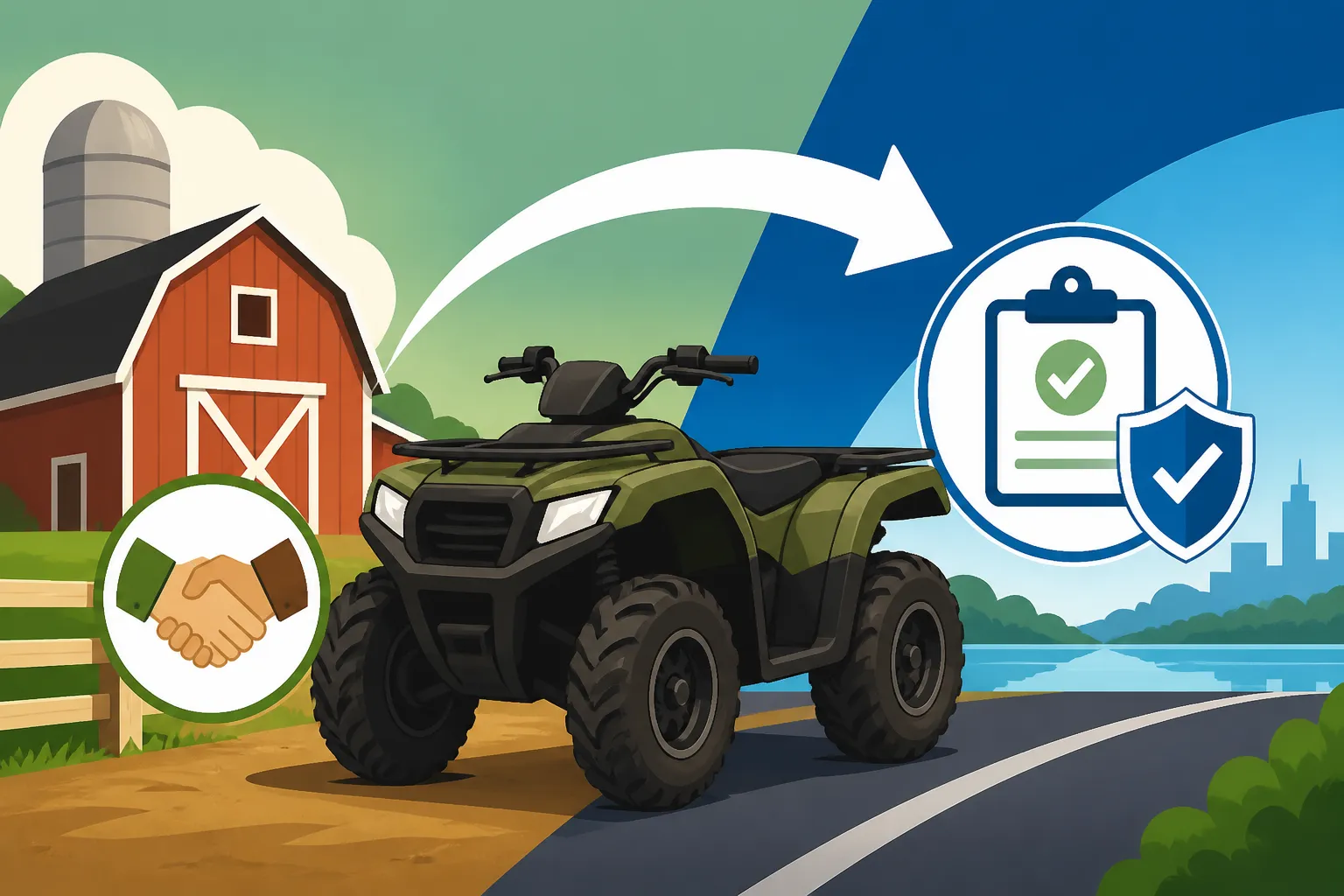
One of the biggest frustrations many buyers face is the absence of a proper bill of sale or previous ownership documents. Farmers might have bought their ATV decades ago, perhaps from another farmer, with nothing more than a handshake and a scribbled receipt on a napkin – if even that. This informal transaction culture, while charming, becomes a headache when ServiceOntario asks for clear proof of purchase and a traceable ownership history. You might find yourself with a machine you truly own, but struggle to prove it on paper.
Often, these machines were used exclusively on private property, meaning the previous owner never had a reason to register them in the first place. This isn't necessarily a red flag about the machine's legality; it simply means you're the first one to take it through the formal registration process. This situation demands a bit more proactive effort on your part to ensure you have everything ServiceOntario needs to issue you an [Ontario Vehicle Permit Explained] and a plate.
Proving Ownership and Value
Another common challenge is establishing a clear chain of ownership, especially if the quad has changed hands multiple times within the farming community without formal records. ServiceOntario needs to be sure that the person selling you the ATV had the legal right to do so. Without a previous permit in the seller's name or a clean bill of sale from a recognized previous owner, you might encounter some questions. It’s a bit like detective work, trying to piece together the history of your new-to-you machine.
Furthermore, determining the purchase price for Retail Sales Tax (RST) can be tricky. While the province charges [13 Percent RST on an Ontario ATV] based on the purchase price, if you paid cash and got an informal receipt, or if the value was part of a larger farm deal, articulating a clear, defensible price can be difficult. The good news is that for private sales, Ontario doesn't typically rely on a "Red Book" value like with cars, but you still need to declare a reasonable price.
Essential Paperwork for Farm-Bought ATVs
Even if you're buying a quad that’s been chugging along on a farm for years, there are still some key pieces of paperwork you'll need, or need to create, to ensure a smooth registration process. Don't let the informal nature of the sale deter you; with the right approach, you can still get your machine road-ready and trail-legal.
The All-Important Bill of Sale
A solid bill of sale is your best friend when registering any privately bought ATV, especially one from a farm. Ideally, this document should clearly state the buyer's full name and address, the seller's full name and address, the date of sale, the purchase price, and a detailed description of the ATV including its make, model, year, and crucially, its Vehicle Identification Number (VIN). Even if it’s handwritten, all this information should be present and legible. For those who want to ensure their bill of sale is airtight and covers all necessary legal bases, online platforms like LawDepot offer customizable templates that can be incredibly helpful for private transactions, ensuring you don’t miss any critical details.
If you receive a bill of sale that's missing crucial information, don't be afraid to ask the seller to complete it. It's in both your interests to have a clear record. Remember, this document is your primary proof of purchase and a key piece in proving your ownership to ServiceOntario. Without it, you’re trying to register a machine you can't definitively prove you purchased, which can lead to significant delays and complications. A comprehensive bill of sale simplifies the process immensely, especially when you're dealing with a machine that hasn't seen the inside of a ServiceOntario centre before.
Verifying the Vehicle Identification Number VIN
The VIN is the unique identifier for your ATV, much like a serial number, and it’s absolutely critical for registration. Before you even finalize the purchase, locate the VIN on the machine. It’s typically stamped into the frame, often near the front suspension, under the seat, or on one of the main frame rails. Make sure it's clear, readable, and matches any documentation the seller might provide. A faded or unreadable VIN can be a major roadblock to registration.
If you're having trouble locating the VIN or if it appears damaged, don't ignore it. It’s essential for ServiceOntario to identify the machine properly and to perform checks to ensure it hasn't been reported stolen. Taking a photo of the VIN can be a good idea, both for your records and to bring to ServiceOntario. A quick [Ontario ATV VIN Check Before Buying] is also highly recommended to prevent any future headaches related to its history. This step is non-negotiable for a smooth registration.
Your Own Identification
This one might seem obvious, but it's worth a mention. When you go to ServiceOntario, you'll need to bring your personal identification. This typically includes your valid Ontario driver's licence and potentially another form of ID to prove your address. The individual registering the ATV must be at least 16 years old to hold an [Ontario ORV Permit].
Ensure your identification is current and accurately reflects your legal name and address. Any discrepancies can cause delays. ServiceOntario needs to verify who you are to issue the permit in your name, linking you legally to the machine. Think of it as the final puzzle piece – proving the machine, proving the ownership, and proving yourself.
Navigating ServiceOntario for Farm Machine Registration
Once you have your paperwork in order, it's time to visit ServiceOntario. While the process is generally straightforward for a typical ATV purchase, registering a farm-bought machine might require you to be a bit more prepared for questions, especially regarding the machine's history and purchase details.
What to Expect at the Counter
When you arrive at ServiceOntario, you’ll typically present your bill of sale, your personal identification, and any other supporting documents you might have. The service representative will input the VIN, your details, and the purchase information. They will then calculate the [Ontario ATV Registration Cost] and the Retail Sales Tax (RST) based on the declared purchase price. Remember that Ontario enforces [Six Days From Purchase in Ontario] to register your machine, so don't delay your visit.
Be ready to clearly articulate the circumstances of your purchase, particularly if the bill of sale is handwritten or if the machine has no prior registration history. Explaining that it was a farm-bought machine, potentially never registered for public use before, helps the representative understand the context. They might ask for more details about how you verified ownership if there's no previous permit. Having a clear, concise story ready, backed by any documentation, makes the process smoother.
Declaring the Purchase Price for RST
The Retail Sales Tax (RST) on an ATV purchased from a private seller in Ontario is 13% of the purchase price. When you register a quad bought off a farm, you'll declare the price you paid for the machine. It's crucial to be honest and realistic with this figure. While there's no "Red Book" to dictate a minimum value, ServiceOntario staff are trained to spot unusually low declared prices. If the declared value seems disproportionately low for the make, model, and year of the ATV, they might question it and could request further evidence or apply a market value assessment.
It's always best to have a credible purchase price noted on your bill of sale. If the ATV was part of a larger transaction, like buying a farm or a package deal with other equipment, make sure your bill of sale clearly allocates a specific value to the ATV. This avoids confusion and helps ensure you pay the correct [Ontario RST Paid at the Counter, Not to the Seller]. Paying the RST is a mandatory part of the registration process before you can get your plate.
What Happens if You Have Minimal Documentation?
Sometimes, despite your best efforts, you might find yourself with very little formal paperwork for a farm-bought ATV. This can be a daunting situation, but it's not always a dead end. ServiceOntario does have provisions for these circumstances, though it will require extra steps on your part.
The Statutory Declaration Route
If you truly have no formal bill of sale, or if the documentation is so sparse that ServiceOntario won't accept it, you might need to provide a sworn Statutory Declaration. This is a legal document where you declare, under oath, the details of the purchase, including who you bought it from, when, for how much, and why you don't have a formal bill of sale. It's essentially your sworn testimony about the transaction. For drafting such a document, resources like LawDepot can be invaluable, providing templates that ensure all legal requirements are met for a statutory declaration.
You'll need to have this declaration commissioned by a Commissioner for Taking Affidavits, which can often be done at a ServiceOntario centre (check beforehand if they offer this service) or by a lawyer or paralegal. This step demonstrates your good faith and provides a legal record of the transaction in the absence of traditional documents. It’s a more involved process, but it’s often the necessary path to [Proving Ownership of an Ontario ATV] when records are scarce.
Dealing with Missing or Unreadable VINs
A missing or unreadable VIN is perhaps the most challenging hurdle. Without a clear VIN, ServiceOntario cannot properly identify the machine, verify its history, or issue a permit. In such cases, they may refer you to a law enforcement agency (like the OPP) for a VIN verification or to determine if a new VIN needs to be assigned. This can be a lengthy process and underscores the importance of checking the VIN thoroughly before purchase.
If the VIN is simply obscured by dirt or rust, a careful cleaning might reveal it. But if it's genuinely gone or defaced, you'll be looking at a significant roadblock. This is where a detailed [Ontario ATV VIN Check Before Buying] becomes critical. If you're looking at a machine with no VIN, or a suspicious VIN, it's a huge red flag and often best to walk away unless you're prepared for potential legal and registration headaches.
The Importance of Due Diligence
Before you hand over any money for a farm-bought ATV, it’s always wise to perform some due diligence, even if the deal feels informal. Beyond checking the VIN, consider doing a [Ontario ATV Lien Check Before Buying] to ensure there are no outstanding debts against the machine. While less common for older farm quads, it’s still a possibility. Asking the seller for any old insurance slips or previous permit documents, even if expired, can also help establish a paper trail.
Ultimately, while buying an ATV off a farm can be a great way to find a solid machine, it places more responsibility on you, the buyer, to gather and prepare the necessary documentation for registration. By understanding these challenges and preparing for them, you can navigate the process successfully and enjoy your new-to-you quad on Ontario's trails.
| Document Type | Ideal Scenario (Dealer/Formal Sale) | Farm-Bought Scenario (Minimal Documentation) |
|---|---|---|
| Bill of Sale | Formal, printed, detailed, includes all parties & VIN. | Handwritten, potentially brief, may require buyer to complete details. |
| Previous Permit | Provided by seller, in their name, easily transferred. | Non-existent (if never registered), or outdated/in another name. |
| Proof of Ownership | Clear chain of title, previous permit, comprehensive bill of sale. | Relies heavily on a detailed bill of sale or Statutory Declaration. |
| VIN Verification | Clearly visible, clean, matches paperwork. | May be dirty, rusty, or challenging to locate; needs careful inspection. |
| Retail Sales Tax (RST) | Based on clear purchase price from invoice. | Declared by buyer based on agreed price; may be questioned if too low. |
| Buyer Identification | Valid Driver's Licence and secondary ID. | Valid Driver's Licence and secondary ID (consistent requirement). |
Disclaimer
This article is for general informational purposes only and does not constitute professional advice. Laws, prices and regulations vary by location and change over time. Consult a qualified professional for guidance on your specific situation.