Unopened Road Allowances and Access
One of the most head-scratching aspects of riding an ATV or UTV in Ontario has to be figuring out where you're actually allowed to go. You see all these old lines on maps, sometimes a barely visible track in the bush, and you wonder: "Is this a public path? Can I ride my quad down it?" This confusion often centers around something called an "unopened road allowance," and let me tell you, it's a common source of frustration for many riders who just want to explore responsibly. This guide is here to untangle the mystery of unopened road allowances, clarify the rules (or lack thereof), and give you the realistic lowdown on accessing them with your off-road vehicle in Ontario.
What Exactly is an Unopened Road Allowance?
It sounds pretty official, doesn't it? "Road allowance." But then you add "unopened," and suddenly it's as clear as mud. Don't worry, you're not alone in feeling baffled. Many of us have peered at old maps or property deeds and seen these dashed lines, wondering if they hold the key to a hidden trail or just lead to a dead end of confusion.
The Historical Context and Original Intent
Let's rewind a bit to the early days of land surveying in Ontario. When townships were first being laid out, especially in the 18th and 19th centuries, it was common practice to designate strips of land for future roads. These strips were typically 66 feet (one chain) wide and ran between concession blocks and across lots. The idea was to ensure that as the population grew and settlement expanded, there would be readily available public access to properties and towns. They were literally "allowed" for roads, even if no road was ever built on them at that time.
Think of it as urban planning before there were any cities. The surveyors didn't know exactly where people would settle or which paths would become major routes, so they created a grid of potential access points. Many of these allowances eventually did become the paved or gravel roads we use today. But just as many, especially in more rural or rugged areas, simply remained as surveyed lines on paper, never seeing a grader, a layer of asphalt, or even regular vehicle traffic. They might be overgrown with trees, turn into a swamp, or simply fade into the natural landscape.
Legal Status and Ownership
Here's where it gets interesting and often, well, complicated. Unlike a private piece of land owned by an individual, or a fully developed road that is clearly under municipal or provincial jurisdiction, an unopened road allowance sits in a bit of a legal limbo. Generally speaking, these allowances are still owned by the local municipality (the township, city, or county) in which they are located, or sometimes by the Crown (the provincial government), particularly in unorganized territories. They are, in essence, public lands, but with a specific designation.
The crucial distinction lies between "assumed" and "unassumed" roads. An "assumed" road is one that the municipality has taken responsibility for maintaining. They plow it in winter, repair potholes, and generally treat it like any other public road. An "unassumed" road, on the other hand, is still an unopened road allowance that the municipality has not assumed responsibility for maintaining. This is the key difference that impacts how you can use them.
Even though it's publicly owned, an unopened road allowance doesn't automatically grant public access for all uses. Its status as "unopened" or "unassumed" means the municipality hasn't formally declared it open for vehicular traffic, and it certainly hasn't invested in making it safe or passable for such. This is a critical point that many riders misunderstand, often leading to accidental trespass or fines. The municipality holds the title, but that doesn't mean it's a free-for-all trail. For a deeper dive, you might find [Riding an Unassumed Road] helpful.
Riding ORVs on Unopened Road Allowances: The Nuances
So, now that we know what they are, the burning question is: can we ride our ATVs and UTVs on them? The answer, unfortunately, isn't a simple yes or no. It’s a classic Ontario "it depends," largely dictated by local rules and conditions. This is where many riders get into trouble, assuming that because it's technically "public" land, it's fair game.
The Default Position: Usually Not Permitted
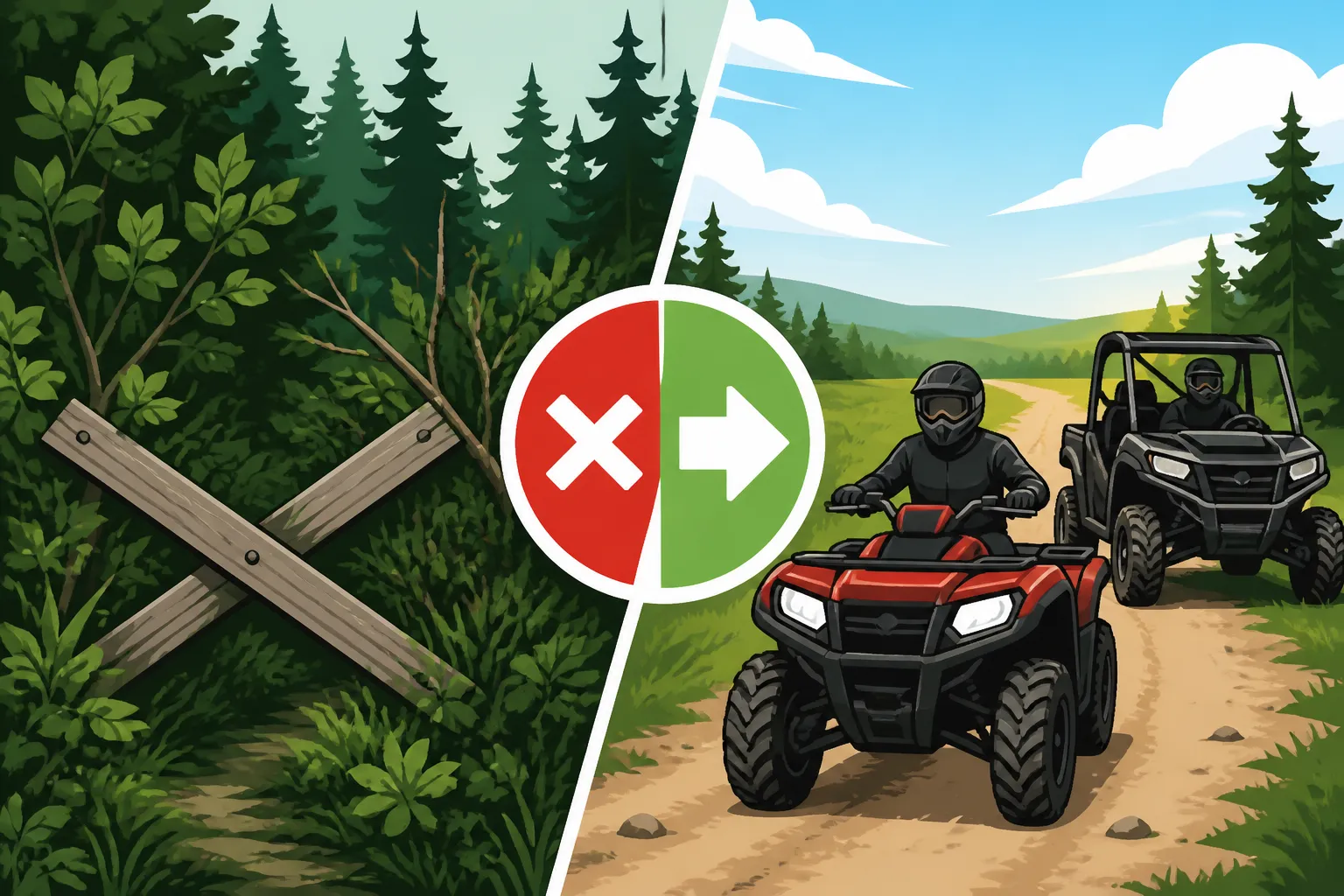
Let's get this straight from the outset: the default position in Ontario is that unopened road allowances are not automatically open for ORV travel. Just because it’s a public allowance on paper doesn’t mean it’s a public trail. The fact that a municipality owns it means they also control its use. If they haven't explicitly opened it for ORV use, then riding on it is generally prohibited, even if it looks like a perfect trail. This is a subtle but incredibly important distinction. Without a by-law or clear signage from the municipality stating otherwise, you should assume it's closed to ORVs.
Many riders mistakenly think that the [Public Lands Act Free Use Policy] grants them unrestricted access to all Crown or municipally owned land. While that Act does allow free access for recreational activities on many public lands, it doesn't automatically override local municipal control over specific land designations like unopened road allowances. Municipalities have the power to create by-laws that regulate traffic, including ORV traffic, on any land they own, including these allowances. So, even if it feels like you're in the middle of nowhere, local rules still apply. Ignoring these local rules can lead to fines and strained relationships with landowners and local communities.
When Access Might Be Permitted (and How)
Despite the general restriction, there are indeed situations where riding an ORV on an unopened road allowance is permitted. This is where your homework comes in! The key is always explicit permission or designation.
- Specific Municipal By-laws: The most common way an unopened road allowance becomes legal for ORV use is when a municipality passes a by-law specifically opening certain allowances or sections of them to ORVs. These by-laws will outline the specific allowances, operating hours, speed limits, and any other conditions. For example, a township might open an allowance to connect two existing trail systems, or to allow residents to access their properties. If you're looking for specifics, checking [Checking a Township's ORV By-law] is your best bet. Always look for official signage on the allowance itself, but remember that signage isn't always perfectly maintained, so a by-law is the definitive source.
- Connecting to Private Property: Sometimes, an unopened road allowance might be the only practical access point to a private property, like a remote cottage or hunting camp. In such cases, the property owner might have an arrangement with the municipality, or historical use might be recognized. However, this doesn't automatically grant broader public access. If you're using an allowance to reach your own property, ensure you understand the local rules or have direct permission from the municipality if needed.
- Part of an Organized Trail System: In some areas, ATV or multi-use trail clubs (like those under the OFATV umbrella) have worked with municipalities to integrate sections of unopened road allowances into their official trail networks. In these instances, the allowance is generally signed as part of the trail, and your valid trail permit covers your use. This is a great example of how collaboration can open up riding opportunities responsibly.
- "Unassumed Roads" with Private Agreements: In some older, more rural areas, there might be "unassumed roads" that have historically been used by landowners for access, even if the municipality has never formally maintained them. If you’re not a landowner with existing access rights, riding these would typically require explicit permission from the adjacent landowners or the municipality. Without such permission, you could easily be trespassing. For more information on this, refer to [Riding a Road Allowance].
The takeaway here is that you cannot simply assume an unopened road allowance is fair game. Always confirm its status with the local municipality. Without clear authorization, riding on them could be considered illegal trespassing, leading to fines and potential legal issues. [Ontario ATV Trespass Rules] are serious, and ignorance of the by-law is not an excuse.
Here's a quick comparison of different land types regarding ORV access:
| Land Type | General ORV Access Status | Key Determining Factor | Considerations for Riders |
|---|---|---|---|
| Assumed Public Road | Generally permitted if by-law allows (specific conditions apply: speed, helmet, licence) | Municipal by-law opening roads to ORVs, [Ontario UTV Road Rules] | Requires proper registration, insurance, helmet, licence, and adherence to speed/equipment rules. Check local by-laws carefully. |
| Unopened Road Allowance | NOT generally permitted by default | Explicit municipal by-law opening specific allowances for ORVs, or specific landowner access agreements with municipality. | Assume closed unless explicitly stated otherwise. Research local by-laws thoroughly. Avoid accidental trespass. |
| Crown Land (General) | Generally permitted under [Public Lands Act Free Use Policy] (with caveats) | Specific restrictions (e.g., provincial parks, conservation reserves, logging roads, environmental protection). | Respect environmental rules, avoid sensitive areas, be aware of hunting seasons. Some Crown land is still off-limits. |
| Private Property | Only permitted with express permission from the landowner | Landowner's direct consent. | Always ask permission! Even if it's a family member's land, make sure everyone is clear on the rules. Avoid [Ontario ATV Trespass Rules]. |
| OFATV/HATVA/EOTA Trails | Permitted with a valid trail permit | Trail club membership/permit and adherence to trail rules. | Support the trail system! Always have your permit displayed and follow trail etiquette. |
Practical Considerations and Due Diligence for Riders
So, you've done your research, checked the by-laws, and perhaps you've found an unopened road allowance that is indeed open for ORV use in your area. That's fantastic! But before you hit the throttle, there are still some very important practical considerations to keep in mind. Just because it's legally accessible doesn't mean it's an easy ride, or that you can forget your responsibilities.
Researching Local By-Laws and Maps
This cannot be stressed enough: do your homework! Every municipality in Ontario has its own set of by-laws, and what's permitted in one township might be strictly prohibited in the next. The best starting point is always the municipal office or their official website. Look for by-laws pertaining to "Off-Road Vehicles" or "ATVs/UTVs." They will often have maps that illustrate which roads, including sometimes unopened allowances, are open for ORV travel.
Identifying these allowances on the ground can be incredibly challenging. They often lack clear signage, can be overgrown, or might even be partially built upon. Relying solely on a GPS map might not be enough; try to cross-reference with official municipal maps if possible. Sometimes, a quick call to the municipal clerk's office can clarify a lot of confusion, especially if you have specific coordinates or a property address in mind. Remember that even if a gate is open or there's a visible track, it doesn't automatically mean it's a legal route. Due diligence is your best friend here.
Safety, Environmental Impact, and Responsibility
Even when an unopened road allowance is legally accessible, it's crucial to remember that it's unopened for a reason. These aren't maintained trails. They can be rough, rocky, washed out, swampy, or blocked by fallen trees. What looks like a straight line on a map could be a major challenge in reality. Always ride with caution, at appropriate speeds, and assume the terrain will be unpredictable. [Ontario ATV Insurance Requirements] are not just for road riding; they're vital for any off-road adventure, especially on unmaintained routes where accidents are more likely.
Beyond your personal safety, consider your environmental impact. These allowances, because they are often undeveloped, can run through sensitive ecosystems, wetlands, or areas important for wildlife. Stick to established tracks if they exist, avoid creating new trails, and practice "tread lightly" principles. Don't disturb vegetation, don't leave trash, and be mindful of noise levels, especially if you're near residential areas or wildlife habitats. We share the land with others, and responsible riding helps ensure these areas remain accessible for everyone in the future. Respect for the land is paramount, just as it is when following [Ontario Rules for Riding Crown Land].
Equipping Your Machine for Unpredictable Terrain
Given the potentially rugged and unmaintained nature of unopened road allowances, proper preparation of your ATV or UTV is key. This isn't the place for a leisurely cruise on a stock machine if you're venturing into truly wild sections. You need to ensure your vehicle is up to the task.
- Tires: Consider upgrading to aggressive, puncture-resistant tires. Standard tires might struggle with rocks, roots, and mud you're likely to encounter.
- Suspension: A good suspension system is crucial for comfort and control over rough terrain. If your stock suspension isn't cutting it, aftermarket shocks can make a world of difference.
- Underbody Protection: Skid plates are highly recommended. Exposed components like A-arms, differentials, and the engine itself are vulnerable to impacts from rocks and stumps. Companies like SuperATV offer a fantastic range of heavy-duty skid plates and rock sliders that can save you a lot of headache and expense in repairs. They understand that off-road means off-road and build gear to take a beating.
- Winch and Recovery Gear: A winch is practically essential for solo riding in remote, unmaintained areas. You never know when you might get stuck in a bog or need to clear a fallen tree. Pair it with a recovery strap, shackles, and a tree saver.
- Navigation: While you should always have a paper map and compass as backup, a reliable GPS unit or a smartphone with offline mapping capabilities is incredibly useful for navigating these less-defined routes. Mark your entry and exit points and any tricky sections.
- Emergency Kit: Always carry a basic tool kit, first-aid kit, fire extinguisher, and a way to communicate (satellite messenger if out of cell range).
Venturing onto an unopened road allowance, even a legally sanctioned one, means venturing into a less predictable environment. Your machine, your gear, and your riding skills need to be prepared for anything. Investing in quality accessories from reputable brands like SuperATV can significantly enhance your safety and the longevity of your machine in these demanding conditions. Always remember that for any ORV activity in Ontario, having adequate insurance is not just a good idea, it's the law. This protection is especially critical when you're exploring less-traveled paths where unexpected hazards are common.
Disclaimer
This article is for general informational purposes only and does not constitute professional advice. Laws, prices and regulations vary by location and change over time. Consult a qualified professional for guidance on your specific situation.