Volunteering Instead of Paying
Volunteering Instead of Paying
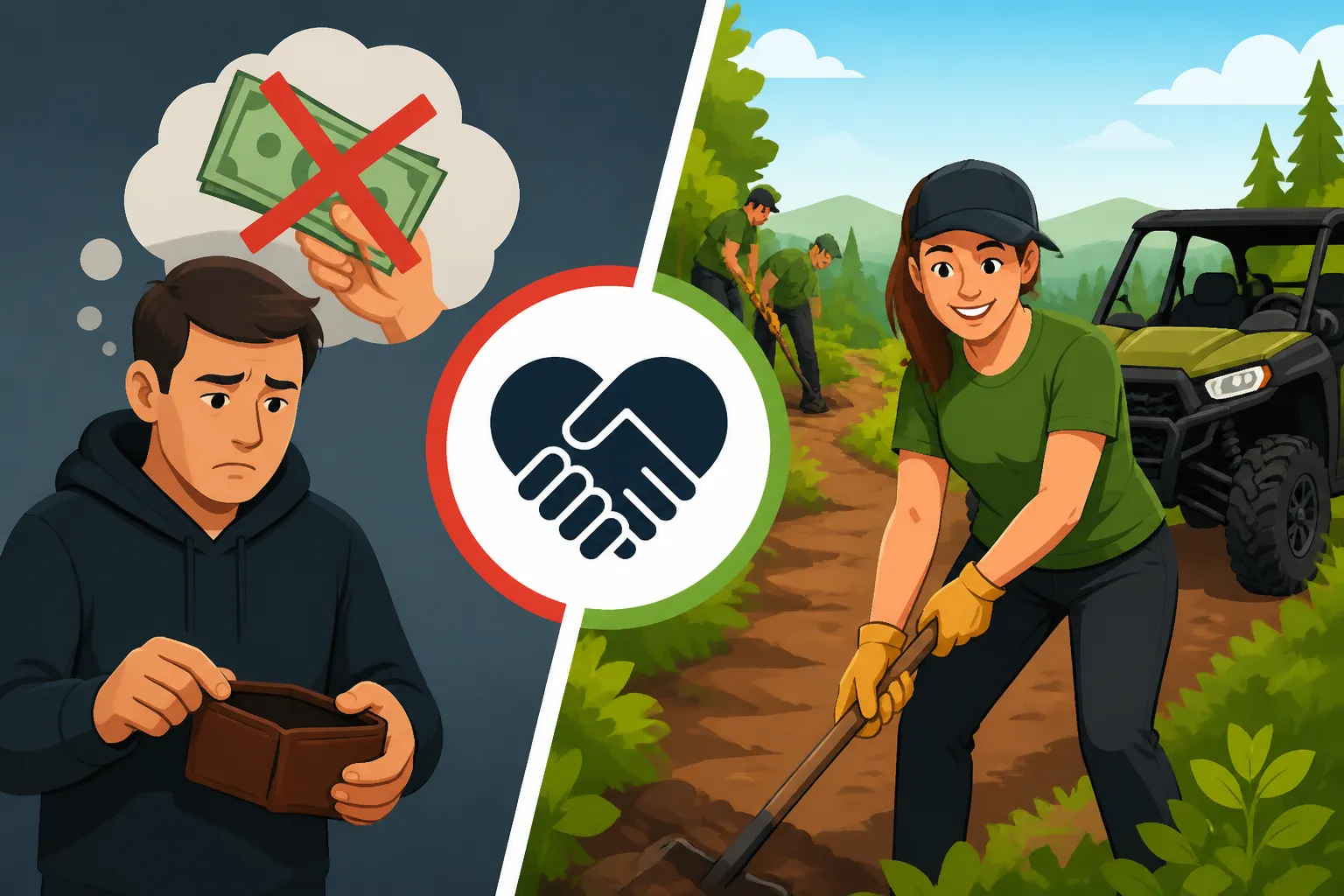
If you ride Ontario ATV trails, volunteering may seem like a practical way to support the people who maintain them—and perhaps avoid buying a trail permit. The key distinction is that helping a club and having permission to ride are not automatically the same thing. Here’s how to check whether a volunteer arrangement includes trail access, and what to confirm before you head out.
Can volunteering replace an Ontario trail permit?
Usually, you should not assume that volunteering replaces a required trail permit. Trail access depends on the rules for the specific trail system and the permit or pass its operator requires. A club may welcome volunteers, but that alone does not necessarily give you permission to ride its trails.
That difference can be easy to miss because a permit and club involvement are often connected. A trail permit may direct support to a club, while a club membership may offer additional ways to take part. But the two are not automatically interchangeable. See Ontario Club Membership Versus a Trail Permit and Club Membership Versus a Bare Permit for the distinction.
A club might offer a particular benefit to volunteers, such as a reduced permit cost or an arrangement tied to a work day. Whether it does, and what conditions apply, are matters to confirm with that club. Do not rely on a general understanding, an old social media post, or another rider’s experience as proof that your own volunteer hours count toward access.
| What you do | What it may support | What it does not automatically provide |
|---|---|---|
| Join a trail work day | Trail maintenance and club operations | Permission to ride |
| Become a club member | Club participation and any membership benefits offered | A trail permit, unless the club clearly includes one |
| Volunteer at an event | Event setup, safety, or organization | Access to trails outside the event’s terms |
| Buy a trail permit | Access under the applicable permit and trail rules | Permission to ride closed trails or ignore local restrictions |
Before riding, identify which organization manages the trails you plan to use and ask what proof of access it accepts. A permit for one trail network may not be accepted by another, and a volunteer role with one club does not necessarily cover a neighbouring system. The rules for reciprocity are separate from volunteer arrangements; Ontario Trail Permit Reciprocity With the Maritimes explains why it is important to check where a permit is recognized rather than assume it travels everywhere.
Also keep trail access separate from registration, insurance, and land-use rules. A trail permit does not replace the legal requirements for operating your ATV or UTV, and a volunteer agreement does not change them. If you are unsure what a particular pass covers, ask the trail operator before riding.
What volunteer work may involve
Ontario ATV clubs rely on people for more than clearing brush. Depending on the club’s needs and the season, volunteers may help with trail maintenance, signage, event support, communications, mapping, fundraising, or administrative tasks. The work can be hands-on or done away from the trail.
The range of tasks matters when you are asking about a possible exchange. A club may need help with a specific project but have no volunteer-to-permit arrangement. Another may have a defined volunteer benefit but require particular tasks, training, or a minimum commitment. Neither possibility should be presumed.
A club may also distinguish between volunteering for a club and buying an individual permit. Membership can create a relationship with the organization, but it may not itself authorize riding. For a closer look at potential membership benefits, see What a Club Membership Adds. Treat any stated benefit as specific to the club offering it, not as a province-wide rule.
Before accepting a task, get clear on what the club needs and what, if anything, it provides in return. Useful questions include:
- What work is expected, and who will supervise it?
- Does the work require a particular date, location, or number of hours?
- Is a permit included, discounted, or not part of the arrangement?
- If a permit is included, which trails does it cover?
- Does it apply to one rider, one machine, or another defined situation?
- Is the benefit available immediately, or only after the work is completed?
- What happens if weather, trail conditions, or another issue cancels the work day?
- How will the club confirm that you have permission to ride?
If the answer is that volunteering “should be enough,” ask for clarification before relying on it. A clear response from the club or trail operator is more useful than an informal assumption. Keep any confirmation, such as an email or written volunteer policy, so you can refer to the terms if a question comes up.
A volunteer role may also come with safety requirements. Trail work can involve tools, vehicles, uneven ground, traffic, or changing weather. Follow the organizer’s instructions, use the required protective equipment, and do not operate equipment unless you are authorized and capable of doing so. Volunteering should be a safe, organized contribution—not an excuse to enter a closed work area or ride a section that the club has not opened.
How to confirm whether a volunteer arrangement includes access
The simplest way to avoid a problem is to confirm the arrangement with the organization responsible for the trails, before doing the work and before riding. A volunteer coordinator may know about club participation, while a permit seller or trail operator can confirm what is accepted as proof of access. If those are different organizations, check with both.
Use a short, specific question rather than asking only whether volunteers get “free riding.” For example: “If I complete this volunteer task, will I have a valid permit for these trails, and what proof should I carry?” This makes it easier to clarify the scope and avoid confusing club membership with trail access.
Work through the following steps:
- Name the trail system. Confirm the exact network or club area you want to ride. A broad answer about “Ontario trails” may not apply to the specific route.
- Describe the volunteer role. Ask whether the task is a formal club activity and whether the club has a written policy about any permit benefit.
- Confirm the conditions. Check whether the benefit depends on hours worked, attendance, completion of a task, or another requirement.
- Ask what proof you will receive. Find out whether you will get a permit, a pass, a receipt, written authorization, or no riding credential.
- Check where it is valid. Confirm the trails and dates it covers, and whether any neighbouring club requires a separate pass.
- Verify before setting out. If details are unclear, contact the trail operator again and buy the required permit rather than risk riding without valid access.
You can also check how and where the permit is sold. Where to Buy an Ontario ATV Trail Permit is useful when you need to identify the right purchase channel, while Ontario’s Separate Club Passes helps explain why a pass for one system may not cover another. If you are going with an organized group or event, ask whether the organizer has arranged access for participants; do not assume that volunteering at the event means your personal riding is covered. See Ontario Permits for an Organised Ride for that separate question.
A permit or volunteer benefit also does not guarantee that every trail is open on the day you ride. Seasonal closures, weather, maintenance, and local restrictions can affect access. Check conditions and closures with the trail operator before leaving; Ontario Trail Conditions Before You Ride covers why that check matters.
When paying is the clearer choice
If you want to ride soon and the volunteer arrangement is not confirmed, buying the required permit is the more dependable option. It gives you a clear basis for access, subject to the permit’s conditions and current trail rules. Volunteering can still be worthwhile, but treat it as a separate way to support the club unless the club expressly confirms that it includes a valid riding credential.
Paying may be especially straightforward if you are visiting from outside the area, riding with a group, or planning to cross between trail systems. In those cases, check each operator’s requirements rather than relying on a volunteer role at one club to cover the whole trip. The club or permit provider can tell you whether a separate pass is needed.
There is one important distinction: some public land may be available to riders under rules that differ from club trail systems. That does not mean volunteering gives access, nor does it mean every unmarked trail is open. Land ownership, restrictions, signs, and local rules all matter. Ontario’s Free Use Policy for Riders and What Free Use Means on Crown Land explain why free use of some Crown land should not be treated as a substitute for permission on a maintained club trail. The applicable rules can change with location and activity, so verify the route before riding.
Volunteering and paying for a permit are not competing ways to prove that trails matter. A permit supports organized trail access under the operator’s system; volunteer time helps with the work that keeps a network usable. You can do both, and sometimes a club may offer a formal arrangement that connects them. The practical rule is simple: volunteer because you want to contribute, but ride only after confirming what authorizes access.
Disclaimer
This article is for general informational purposes only and does not constitute professional advice. Laws, prices and regulations vary by location and change over time. Consult a qualified professional for guidance on your specific situation.