Why Ontario Asks for No Certificate
Ontario does not generally require ATV or UTV riders to hold a safety-course certificate before riding. That can make the rules seem simpler than they are: age limits, road-use requirements, insurance, trail access and operator policies still matter. Here’s what the missing certificate requirement means—and what to check before you ride.
Why Ontario does not require a general rider certificate
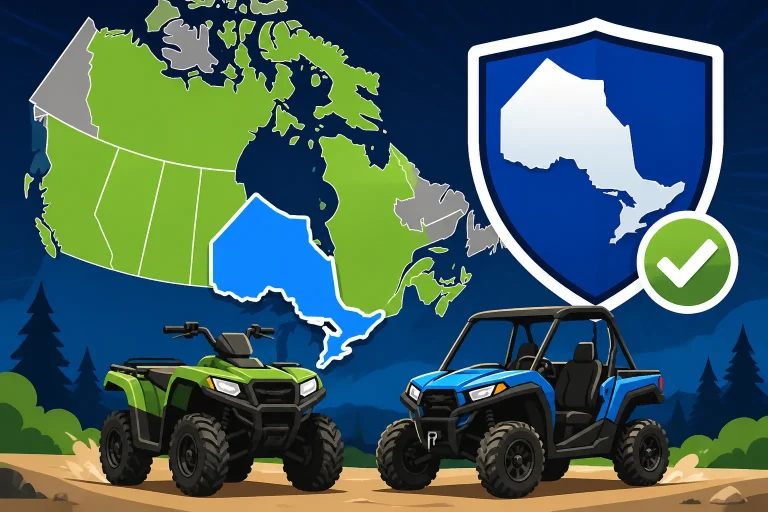
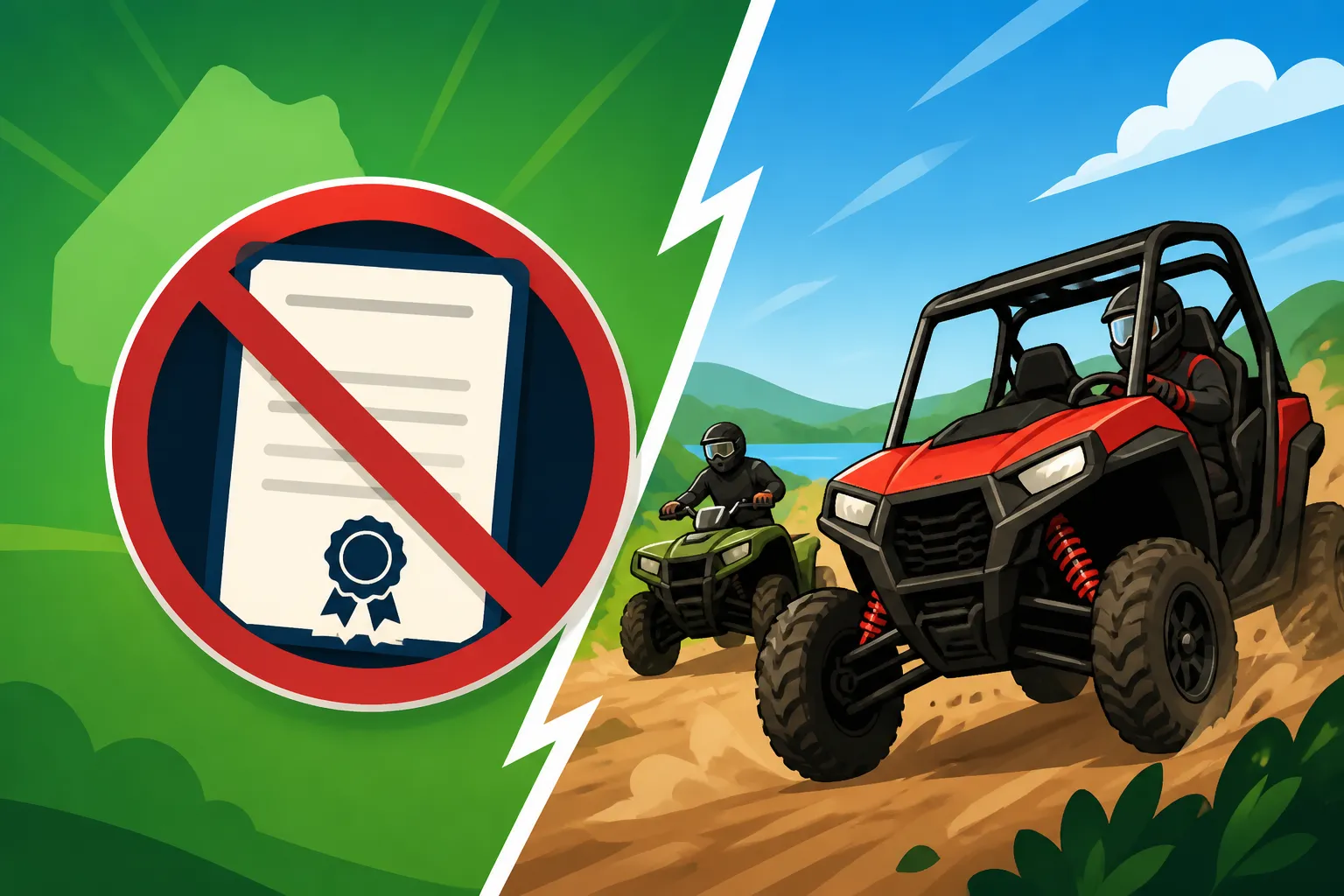
Ontario does not make completion of a formal ATV or UTV safety course a general legal prerequisite for operating an off-road vehicle. In other words, a rider is not automatically barred from riding simply because they cannot show a course certificate.
That is different from saying training is unnecessary or that every rider can use every machine in every place. Ontario’s rules focus on matters such as who may operate a vehicle, where it may be ridden, required equipment and insurance. A riding course can help build the skills to meet those responsibilities, but it is not a universal gatekeeping document.
The province offers Ready To RideON as a voluntary learning resource. It can help new riders understand safety and riding basics, but completing it does not replace legal requirements such as a driver’s licence for certain road use, insurance or permission to access private property. Nor should a rider assume that taking a course grants access to a trail or changes a machine’s registration status.
There is also a practical reason not to treat one certificate as a complete safety solution: ATVs and UTVs vary widely. A small youth-sized quad, a full-sized four-wheel-drive ATV and a side-by-side have different controls, handling and passenger arrangements. A course may provide a useful foundation, but riders still need to understand the specific machine they will use and follow its operating instructions.
For a broader look at the province’s approach to optional training, see Ontario Rider Training and Why It Is Voluntary. If you want a direct answer about the legal requirement, Is an ATV Safety Course Required in Ontario? covers that question in more detail.
| What you are checking | Is a general training certificate the key requirement? | What to check instead |
|---|---|---|
| Riding off-road | No general course certificate is required simply to ride | Age rules, supervision, land access, equipment and insurance |
| Riding on a road where ORVs are permitted | No general ATV course certificate | Driver’s licence class, vehicle eligibility, road rules and insurance |
| Using an organized trail | Usually not a province-wide certificate requirement | The trail system’s permit, access and local rules |
| Renting or joining a guided ride | Not necessarily | The operator’s minimum age, licence, instruction and waiver conditions |
| Learning to ride safely | A certificate is not the only way to learn | Training, practice in a suitable area and familiarity with the machine |
The table is a starting point, not a substitute for checking the rules that apply to a particular ride. Municipal bylaws, property owners, trail organizations and rental operators may set conditions beyond the province-wide baseline.
What the absence of a certificate requirement does not change
No course certificate does not mean “no rules.” Riders still need to meet the requirements that apply to their age, vehicle, location and type of use. Those requirements are separate from training and can apply whether someone is experienced or has never taken a course.
Age and supervision still matter
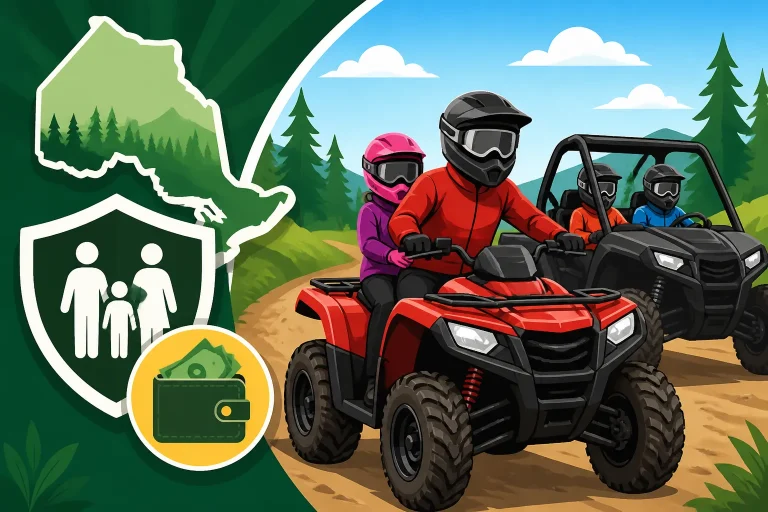
Ontario sets minimum-age and supervision rules for young ORV riders. The details depend on where the machine is being operated and the circumstances. A child’s age alone does not answer whether they can ride a particular ATV or UTV: the location, the type of vehicle and applicable supervision rules also matter.
Before allowing a young person to ride, check the relevant age rules and choose a machine suited to their size and ability. A completion certificate would not override a legal age restriction or make an unsuitable machine safe. For the age rules that apply off-road, see Ontario ATV Minimum Age Off-Road.
Road use has separate requirements
Riding on a road is not the same as riding on private land or an off-road trail. Some Ontario roads may allow certain off-road vehicles, subject to provincial and municipal rules. Where road use is permitted, the rider and machine may need to meet requirements that do not apply in the same way to an off-road-only ride.
A safety course certificate is not a replacement for the required driver’s licence, road-legal equipment, insurance or municipal permission. A road can also be closed to ORVs even when a nearby road is open. Check the rules for the specific route before setting out. Ontario ATV Licence Requirements explains the licence question, while Ontario ATV Rules on a Municipal Road looks at local-road use.
Insurance remains a separate obligation
Training does not take the place of insurance. Ontario’s requirements depend on the type of use and where the machine is operated, so confirm what applies to your ride and keep proof with you when required. If you are uncertain whether your policy covers a particular trail or road, ask your insurer rather than relying on a course provider or another rider’s experience.
See Ontario’s Mandatory ORV Insurance for more on the insurance rules. A course certificate is not proof of coverage, and proof of coverage does not show that a rider has been trained.
Trail access depends on the trail system
A provincial training certificate is not the same thing as a trail permit. Riders may need a permit or other authorization for a particular trail network, and access conditions can vary between clubs and properties. A permit does not certify riding ability; it grants access under the terms that apply to that trail system.
Check the rules for the exact network you plan to use, including whether permits are recognized across club areas. Ontario ATV Trail Permits Explained is a useful starting point. Also verify local closures and trail conditions before travelling, because a permit does not authorize riding on a closed trail or outside the permitted route.
When training is worth taking even if it is optional
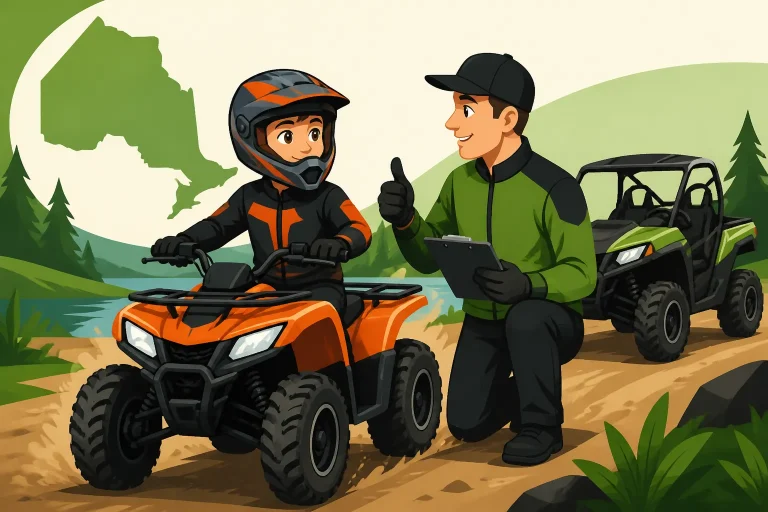
A course can be valuable even when the law does not demand a certificate. New riders may benefit from structured instruction on controls, starting and stopping, turning, braking, terrain and safe spacing. Someone moving from a small ATV to a larger machine—or from a quad to a side-by-side—may also need time to adjust to different handling and controls.
Training is especially worth considering when:
- The rider is new to off-road vehicles or returning after a long break.
- The machine is heavier, more powerful or more complex than one they have used before.
- A young rider is learning how to make safe decisions around adults and other vehicles.
- The planned route includes unfamiliar terrain, hills, mud, rocks or narrow trails.
- The rider expects to carry a passenger or operate a side-by-side with seat belts and other occupant protections.
- The group wants a consistent safety briefing before a longer ride.
Look for instruction that matches the vehicle and riding conditions, rather than choosing a course solely because it provides a certificate. Ask what machines are covered, whether the instruction includes practical riding, and what skills participants will practise. A short online lesson may be useful for learning general concepts, but it is not the same as supervised practice on the machine you intend to operate.
Build familiarity gradually. Start in a suitable, permitted area with enough space to practise basic control. Read the owner’s manual, learn how the machine responds to braking and turning, and avoid increasing speed or terrain difficulty before the rider is ready. A certificate cannot guarantee good judgment, and experience alone does not prevent mistakes. Safe riding depends on preparation, attention and choices made throughout the ride.
How to prepare without treating a certificate as a pass
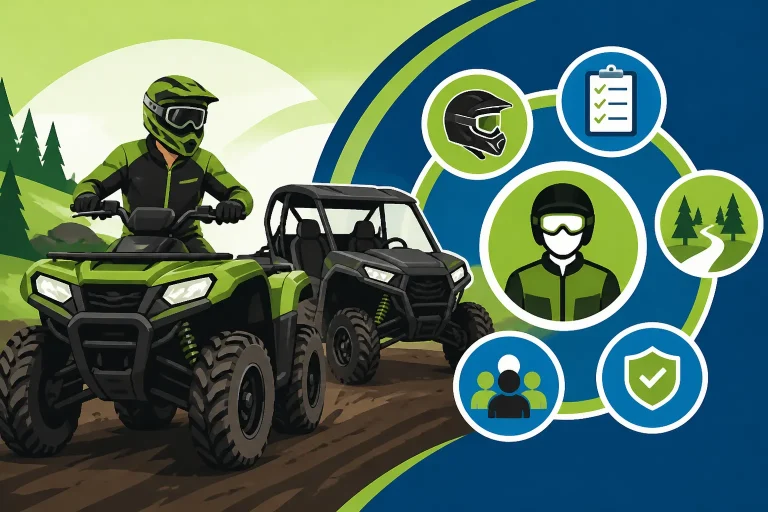
Use a simple pre-ride check to cover the questions a course certificate cannot answer for you. The aim is to confirm that the rider, vehicle and route are all appropriate.
- Identify the vehicle and its intended use. Confirm whether it is an ATV or UTV and understand the seating and passenger limits. Do not assume that a passenger can ride on a machine designed for one person.
- Check rider eligibility. Confirm age, supervision and any licence requirements for the place you plan to ride. If a road forms part of the route, check road-use rules as well as off-road rules.
- Confirm access. Get permission for private land and check whether the intended trail is open to your vehicle. A route visible on a map is not necessarily a route you are allowed to ride.
- Verify registration and insurance. Make sure the machine’s documents and coverage are appropriate for the planned use. A training record does not replace either.
- Check protective gear and vehicle condition. Use a properly fitted helmet where required, and inspect the machine’s controls, tires, lights and other relevant equipment before leaving.
- Set a realistic plan. Match the ride’s length and terrain to the least experienced person in the group. Share the route, agree on stops and keep the group together.
- Ask about additional conditions. Trail groups, rental companies, tour operators and landowners can have their own requirements. Confirm them before travelling rather than assuming that the province’s lack of a certificate mandate settles the issue.
For rentals and guided rides, the operator may require an orientation, a minimum age, a particular licence or other conditions. Those are not proof that Ontario has made a training certificate mandatory for all riders; they are conditions of that specific service. Review them before booking. Ontario Rules for a Rented Machine and Ontario Rules for a Guided Tour explain why requirements can differ by operator.
The practical takeaway is straightforward: Ontario does not generally ask every ATV or UTV rider to show a safety-course certificate, but riders are still responsible for meeting the rules that do apply. Training can make a ride safer and more confidence-building, especially for beginners, without being a substitute for checking age, access, licences, insurance or trail conditions.
Disclaimer
This article is for general informational purposes only and does not constitute professional advice. Laws, prices and regulations vary by location and change over time. Consult a qualified professional for guidance on your specific situation.