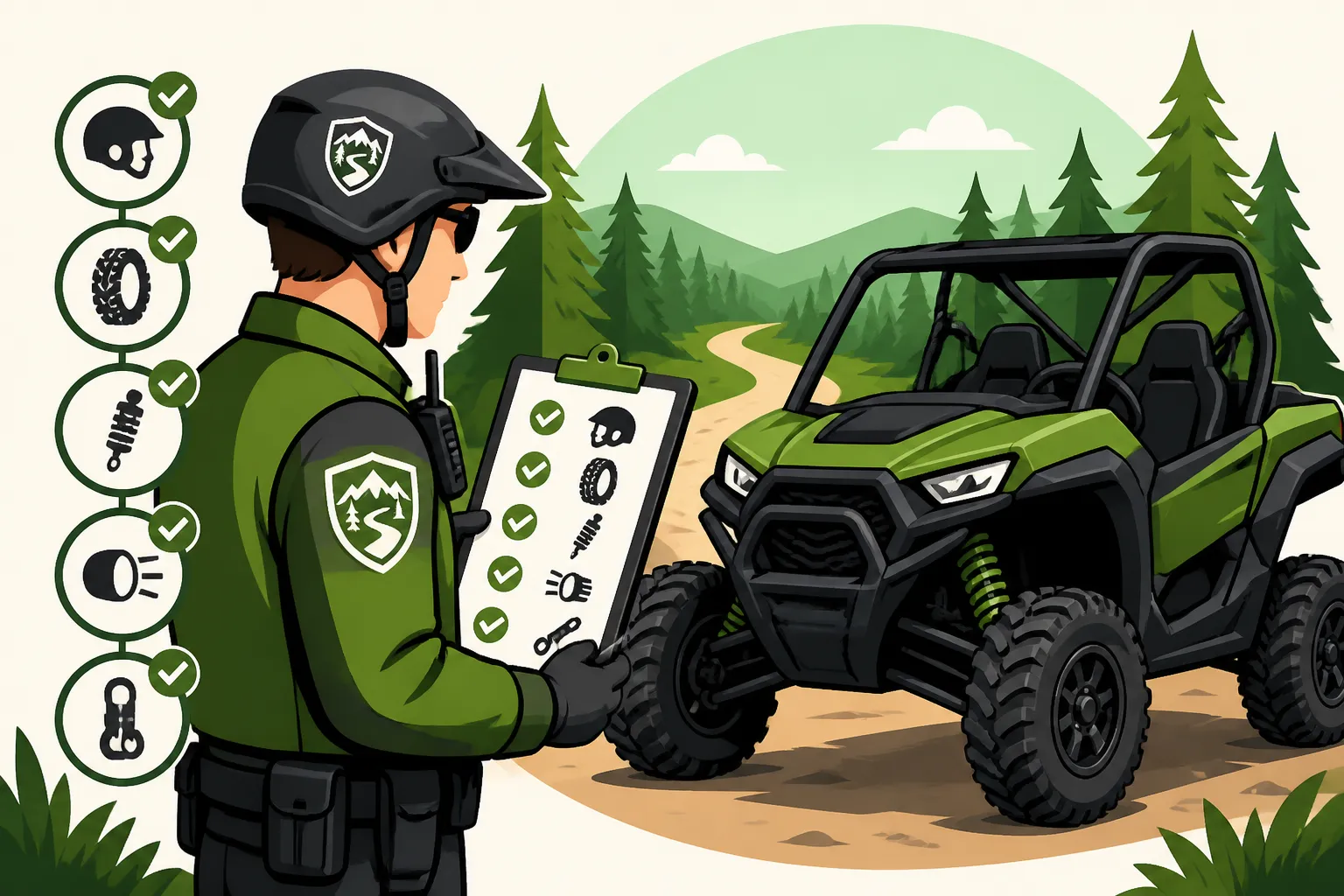
What a Trail Patroller Checks
A trail patroller’s stop can feel uncertain if you are not sure what they can ask to see. On Ontario ATV and UTV trails, checks often focus on whether your permit is valid for that trail, whether it is displayed as required, and whether you are following local rules. Knowing what to carry—and what a patrol check does not replace—makes it easier to be prepared.
What a trail patroller is checking
A trail patroller is generally there to support trail use, not to act as a substitute for a police officer or government enforcement officer. The role and authority can vary by trail organization and location. Some patrols focus on permits, trail conditions and rider information; others may report concerns or hazards to the club or the appropriate authority.
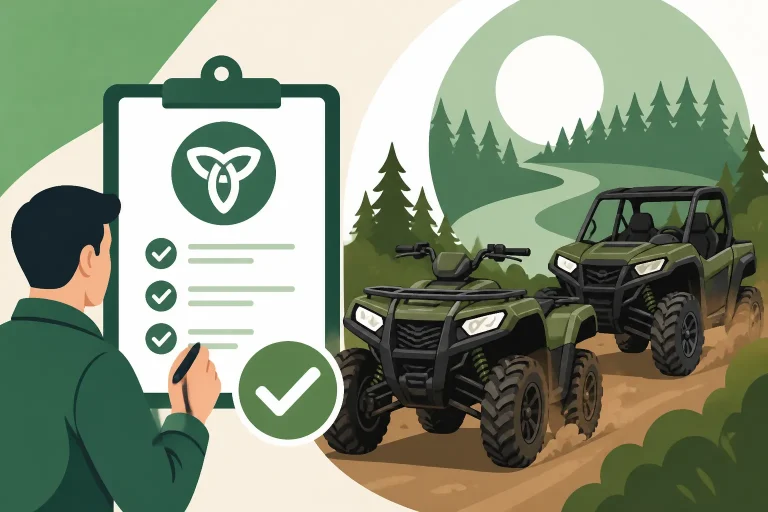
There is no single checklist that applies to every trail in Ontario. A patroller may check:
- Whether you have a permit accepted on the trail you are riding
- Whether the permit is current and covers the machine or rider as required
- Whether a physical permit sticker is displayed in the required place
- Whether you are on an open, authorized route
- Whether your riding is safe and consistent with posted or club rules
A permit check is not the same as a roadside inspection. Trail patrols do not necessarily check every registration or insurance document, and a patrol interaction does not replace your responsibility to meet legal requirements. For the distinction between a trail pass and the vehicle’s provincial paperwork, see Ontario ATV Trail Permits Explained and Registering an ATV in Ontario.
If someone asks to see your permit, stay calm, stop in a safe place and show the proof you have available. If you are unsure whether the person is an authorized patroller, you can politely ask which club or organization they represent. Avoid arguing on a narrow trail or blocking other riders while you sort out a question.
Permit, sticker and proof
The first practical question is whether your permit is valid for the trail you are using. Ontario has multiple trail organizations and access arrangements. A pass for one system does not automatically mean you can ride every club’s trails. Before crossing into another district, check the participating club’s current requirements. Does Your Permit Cover the Next Club’s District? explains why checking the next area matters, while Ontario’s Separate Club Passes covers situations where a separate pass may be needed.
A patroller may look at the permit itself, the information displayed on a phone, or a sticker on the machine, depending on the permit system and the club’s rules. Do not assume that a screenshot, email receipt or sticker alone will satisfy every trail organization. Check the permit provider’s instructions before setting out. For practical details, see Showing a Permit on a Phone, What an OFATV Trail Permit Sticker Looks Like and Where the Sticker Goes.
| What may be checked | What to have ready | What to verify before riding |
|---|---|---|
| Permit validity | Permit confirmation or other accepted proof | The permit is current for your planned ride |
| Trail coverage | Permit details and the route you intend to use | The club or trail district accepts your permit |
| Sticker display | Machine with its permit sticker, if required | The sticker is attached where the provider specifies |
| Machine covered | Permit and machine details | The permit covers the machine being ridden |
| Local access | Trail map or club information | The route is open and authorized that day |
If you rely on a digital permit, save the confirmation somewhere you can open it without a strong signal. A phone can lose battery, get wet or fail to load a message in a dead zone. Carry a charged phone and, where the permit provider accepts it, keep an offline copy or printed proof as a backup. A backup is useful, but it does not change the provider’s requirements. Keeping Your ORV Permit Dry on a Wet Ride has related tips for protecting permit information on the trail.
Make sure the permit is associated with the machine you are riding if the rules require that. This is especially worth checking when machines are shared among family members, one rider has changed vehicles, or a group has more than one permit. Do not rely on another rider’s pass without confirming that it covers your machine and your route.
A trail permit is also different from Ontario vehicle registration. If a machine is required to be registered for its use, a trail pass does not replace its vehicle permit or plate. Likewise, registration does not automatically grant permission to ride on a club trail. Keep the two requirements separate in your planning. Carrying Permit and Insurance Together explains why it helps to have the relevant documents accessible, while Ontario ATV Registration Paperwork covers registration documents.
Route access and riding conduct
A patroller may be checking more than the permit. A valid pass does not make a closed trail open, authorize riding on private land, or override a local restriction. Temporary closures can follow rain, maintenance, logging activity or other conditions. Check the club’s trail notices before leaving, and pay attention to signs and markers once you are riding. For a pre-ride routine, see Ontario Trail Conditions Before You Ride.
Stay on the marked route. Cutting around a barrier, making a new path or riding into a closed section can damage the trail and create access problems for everyone. If you find a blocked or damaged trail, do not assume you can detour across nearby property. Stop and check the club’s directions or choose another authorized route.
Patrollers may also observe riding behaviour that affects safety or other trail users. That can include excessive speed for conditions, unsafe passing, failure to follow signs, or conduct that damages the trail. On a shared route, reduce speed when approaching people, other riders, workers or animals. Give others room and follow any posted right-of-way instructions.
Remember that trail rules and road rules are not interchangeable. A trail permit does not authorize a machine to use a municipal road, and being allowed on one road does not mean all nearby roads are open. Road access is shaped by local rules and the route involved. Check the municipal requirements separately if your ride includes roads; Ontario ATV Rules on a Municipal Road explains that distinction.
A patroller may point out a problem or report it to the club or another authority. If a concern involves a suspected legal violation, the person’s role matters: a trail patrol interaction is not automatically the same as an official enforcement stop. Follow a reasonable safety direction, avoid escalating the situation, and ask the relevant club or authority for clarification afterward if you remain unsure.
How to be ready for a patrol check
A few minutes of preparation can prevent a long stop at the trailhead or on the route.
- Confirm the trail and permit match. Check the club or trail organization responsible for each part of your planned route. If you will cross into another district, verify its requirements rather than assuming your current pass is accepted.
- Check the permit instructions. Confirm whether proof must be displayed on the machine, shown digitally, or carried in another form. Follow the provider’s sticker-placement directions if a sticker is part of the permit.
- Keep proof easy to reach. Store digital confirmation so it is available offline if possible. Keep any required paper documents protected from water and mud.
- Check closures and local notices. Trail status can change. Look for current club updates and obey signs and barriers on the route.
- Carry other required documents separately. Registration and insurance requirements are distinct from a trail permit. Check what applies to your machine and riding location, and keep documents accessible when required.
- Make the stop safe. Pull over where there is room, avoid stopping on a blind corner, and make sure your machine and group are not blocking the trail.
If a patroller says your permit is not accepted, ask which requirement appears to be missing and which organization manages that section. It may be a display issue, a permit-coverage question or a route-access problem. If the matter cannot be resolved on the trail, record the club or trail location and contact the permit provider later. Do not continue into an area you have reason to believe is closed or outside your permitted access.
The most useful mindset is to treat a patrol check as a quick confirmation that your ride is properly covered and the trail is being used as intended. A valid permit, clear proof, attention to local notices and respectful riding make that interaction straightforward—and help protect continued access for Ontario ATV and UTV riders.
Disclaimer
This article is for general informational purposes only and does not constitute professional advice. Laws, prices and regulations vary by location and change over time. Consult a qualified professional for guidance on your specific situation.