Ontario ATV Rules for Towing a Trailer
One of the handiest things about owning an ATV or UTV in Ontario is its utility – whether you're hauling firewood, lugging tools to a remote worksite, or bringing gear for a camping trip. But before you hitch up that trailer and hit the trail or the back forty, it's absolutely crucial to understand the specific rules and safety guidelines around towing in our beautiful province. This guide will walk you through everything you need to know to tow safely and legally, saving you from potential fines or, worse, serious accidents.
The Basics of Towing with an ORV in Ontario
It's tempting to think that since your ATV or UTV is a powerful machine, it can just tow anything you throw behind it. But the reality is far more nuanced, especially when you consider legal obligations and the sheer physics of towing. You've got to respect both your machine and the regulations in place to ensure everyone's safety.
What the Law Says About Towing
When it comes to towing a trailer with an off-road vehicle (ORV) in Ontario, the primary legislation to consider is the [The Off-Road Vehicles Act and Ontario Riders] (ORVA). While the ORVA primarily deals with the operation of the ORV itself, its spirit extends to how these machines are used, including towing. Generally, the ORVA doesn't explicitly detail every single aspect of trailer towing behind an ORV in the same way it might for a car on a highway. However, the overarching principle is safe and responsible operation, and this absolutely includes ensuring your towed load does not create a hazard.
This means that while you might not find a specific statute saying "thou shalt not tow a red trailer on a Tuesday," an officer can still ticket you for operating unsafely if your trailer is too large, too heavy, improperly secured, or lacks essential safety features like lights or proper hitches. The onus is always on the operator to ensure their entire setup, including the trailer, is fit for purpose and won't endanger themselves or others. You're expected to use common sense and good judgment, which sometimes feels like a tall order when you just want to get the job done!
Understanding Your Machine's Towing Capacity
This is perhaps the most critical practical consideration when planning to tow with your ATV or UTV. Every off-road vehicle, whether it's a nimble sport quad or a heavy-duty utility UTV, has a manufacturer-specified towing capacity. This figure isn't just a suggestion; it's a hard limit based on the vehicle's engine power, chassis strength, braking capability, and suspension design. Exceeding this limit is not only incredibly dangerous but can also void your warranty and put undue stress on every component of your machine, from the engine and transmission to the brakes and frame.
Before you even think about attaching a trailer, dig out your owner's manual. It will clearly state the maximum towing capacity, often breaking it down into towed weight and tongue weight (the downward force the trailer exerts on the hitch). Ignore these numbers at your peril. Overloading can lead to loss of control, especially on hills or during braking, and can cause premature wear and tear on your vehicle, leading to expensive repairs. It's truly not worth the risk, even if you just need to move something "a little bit further." For heavy-duty applications, a robust hitch from a company like SuperATV can certainly help with the connection to the machine, but it won't magically increase your ATV's inherent towing capacity. Always stick to what your manufacturer advises.
Specific Requirements for Trailers and Connections
Once you understand your ORV's limitations, the next step is to ensure your trailer and its connection points are up to snuff. This isn't just about functionality; it's about making sure your setup is stable, visible, and secure. Skipping steps here is an open invitation for trouble, whether it's a broken hitch, a lost load, or an encounter with law enforcement.
Essential Trailer Components and Features
Any trailer you hitch behind your ATV or UTV should be designed for the task. This means more than just a flatbed with wheels. First and foremost, you need a robust hitch connection that matches your ORV's receiver. Many ATVs and UTVs come standard with a 2-inch receiver, allowing for various ball mounts and pintle hitches. Ensure the hitch ball's weight rating exceeds your loaded trailer's gross weight. Safety chains are also non-negotiable; they provide a crucial backup connection in case the primary hitch fails. These should always be crossed under the tongue and attached securely to your ORV's frame or designated points.
Beyond the hitch, consider the trailer's brakes and lighting. While smaller, lighter trailers used strictly off-road might get away without their own braking system, anything substantial, especially if it approaches your ORV's towing limit, should ideally have its own brakes. These could be surge brakes or electric brakes, depending on the trailer type. Lighting is also paramount, particularly if you're ever venturing onto controlled trails or crossing roads. Tail lights, brake lights, and turn signals are essential for visibility, especially if your load obstructs your ORV's own lights. You'll need a proper wiring harness to connect these to your ORV's electrical system. Aftermarket solutions, like durable lighting kits you might find from a brand like SuperATV, can be a great way to ensure your trailer is visible and compliant.
Proper Hitching and Load Distribution
Connecting your trailer correctly and distributing its load properly are foundational to safe towing. First, make sure your hitch receiver and ball are free of dirt and debris. Secure the hitch pin with a cotter pin or clip – don't ever rely on friction alone. Attach your safety chains, ensuring they have enough slack to allow for turns but aren't dragging on the ground. You want just enough slack that if the primary hitch disconnects, the chains can cradle the tongue without it hitting the ground before you can stop.
Next, load distribution. This is often overlooked but incredibly important. Aim for about 10-15% of your total trailer weight to be on the tongue (the part resting on your hitch). Too much tongue weight can overload your ORV's rear suspension, affecting steering and braking. Too little tongue weight can cause the trailer to sway violently, leading to a loss of control, especially at higher speeds or on uneven terrain. Always load the heaviest items over the trailer's axle, or slightly forward of it. Secure everything firmly with straps or ropes to prevent shifting during transit. A load that shifts can dramatically alter handling and stability, potentially causing the trailer to jackknife or even flip.
Where You Can (and Can't) Tow a Trailer
This is where the Ontario regulations get particularly specific, and it's easy to get caught out if you're not paying close attention. The rules for towing a trailer vary dramatically depending on where you're riding, and assuming one set of rules applies everywhere is a recipe for trouble.
Towing on Private Property and Designated Trails
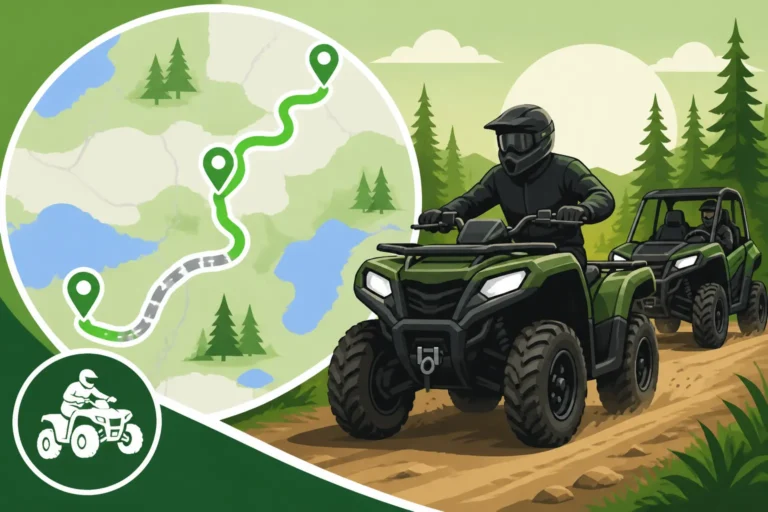
On your own private property, with the landowner's permission, the rules are generally much more relaxed. You still need to adhere to safe operating practices and your machine's towing capacity, but you won't typically face legal repercussions from the province regarding specific trailer requirements. However, if you're riding on club trails, like those maintained by [Ontario's OFATV Trail Network], the situation changes. These trails often have their own specific by-laws or guidelines regarding trailers, typically focusing on size, weight, and general safety. You might find restrictions on how wide a trailer can be to fit through gates or over bridges, or rules requiring certain lights. Always check with the specific trail club before heading out with a trailer.
The same general principle applies to Crown Land. While Crown Land often permits ORV use, this "free use" doesn't mean "anything goes." [Ontario ATV Rules for Riding Crown Land] dictate responsible use, and towing a trailer should always align with minimizing environmental impact and ensuring safety. Again, while specific trailer dimensions might not be legislated for Crown Land, operating a setup that is clearly unsafe or causing undue damage would fall under general unsafe operation or environmental protection laws. Always use common sense and ensure your trailer is designed for the rough terrain you'll likely encounter.
Towing on Public Roads and Highways
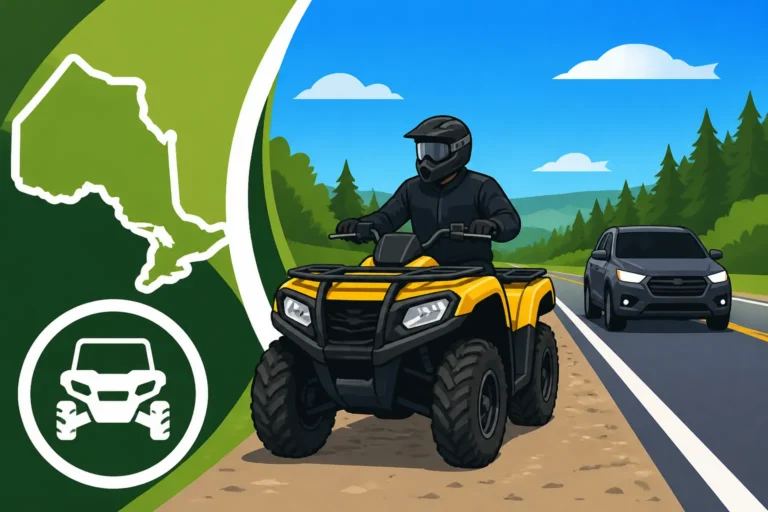
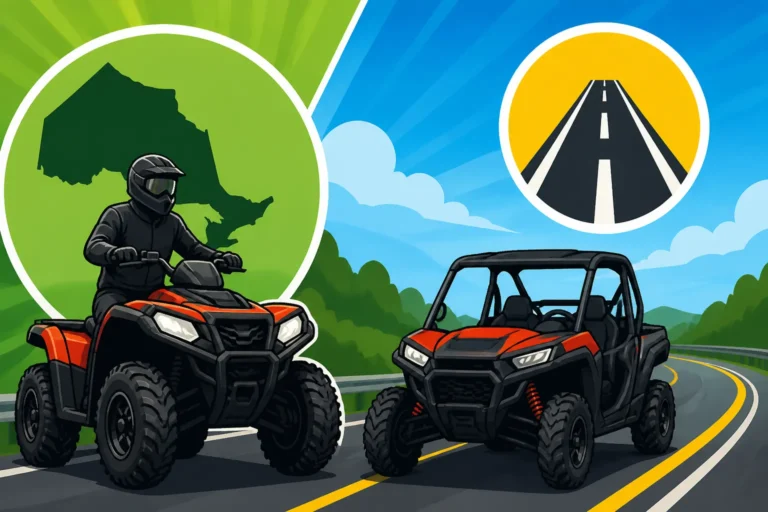
This is where the biggest misconceptions and potential legal pitfalls lie. For the vast majority of ATVs and UTVs in Ontario, towing a trailer on a public road or highway is either heavily restricted or outright prohibited. While some municipalities have opened certain roads to ORVs, these by-laws almost exclusively focus on the ORV itself and rarely extend to towing a trailer. If you refer to [Ontario ATV Rules on a Municipal Road], you'll see that even the ability to ride an ORV on a municipal road is conditional, and adding a trailer usually complicates matters significantly.
Highways are virtually completely off-limits. [Ontario Highways Closed to ORVs] means you cannot operate an ORV on them, let alone tow a trailer. Even where an ORV is permitted to cross a road, this is typically for direct crossings, not for travelling distances with a towed load. The reason for these strict rules is simple: ATVs and UTVs are not designed for highway speeds or for the complexities of road traffic while towing. Their braking systems, suspension, and stability are optimized for off-road environments, making them inherently unsafe for road towing. Trying to navigate busy roads with a trailer behind your ORV will likely land you a hefty fine and could put you and others in severe danger. If you need to move your ATV or UTV and its trailer over a distance on public roads, the only legal and safe way is to load both onto a larger road-legal trailer towed by a truck.
Safety Considerations and Best Practices
Towing anything with an ORV adds a layer of complexity and potential danger. Even if you've got all your legal ducks in a row and your equipment is top-notch, ignoring fundamental safety practices can quickly turn a productive outing into a disaster. Being prepared and vigilant is key.
Pre-Ride Checks and Maintenance
Before every ride where you plan to tow a trailer, a thorough pre-ride inspection is essential. This isn't just a quick glance; it's a methodical check of every component that impacts towing. Start with your ATV or UTV: check tire pressures (they might need to be at the higher end of the recommended range for towing), ensure all fluid levels are good, and verify your brakes are working perfectly. Remember, stopping power decreases significantly when you're pushing or pulling extra weight.
Next, move to the trailer. Inspect the tires for proper inflation, tread wear, and any damage. Check the wheel bearings for play or noise. Ensure all lights are functioning correctly – tail, brake, and turn signals – and that the wiring harness is securely connected and not dragging. Verify your hitch connection is tight, the hitch pin is secured, and safety chains are properly attached. Finally, double-check that your load is distributed correctly and securely fastened. A comprehensive checklist can be a lifesaver, helping you prevent issues before they become hazards.
| Component | Check Item | Status (Y/N/NA) | Notes |
|---|---|---|---|
| ATV/UTV | Tire Pressure (Higher end for towing) | ||
| Brake Function (Front/Rear) | Adequate stopping power for extra weight | ||
| Fluid Levels (Oil, Coolant) | Ensure optimal performance under load | ||
| Suspension Condition (Rear particularly) | Sagging or excessive bounce indicates overload or wear | ||
| Trailer | Tire Pressure (Correct PSI) | Inspect for cuts, bulges, and adequate tread | |
| Wheel Bearings (No play or grinding noise) | |||
| Lights (Tail, Brake, Turn) | All functioning, wiring secure and undamaged | ||
| Hitch Connection (Secure pin, no looseness) | Match ball size, check coupler latch | ||
| Safety Chains (Crossed, proper slack) | Attached to ORV frame, not just bumper | ||
| Load Security (Strapped, no shifting) | Heaviest items over axle, even distribution | ||
| Tongue Weight (10-15% of total trailer wt.) | Not too heavy on ORV rear, not too light (swaying) |
Driving Techniques When Towing
Once you're moving, your driving style needs to adapt significantly. The most important rule? Slow down. Your stopping distances will increase dramatically, and your ability to maneuver quickly will be compromised. Drive at a reduced speed, especially over rough terrain, through turns, or when approaching obstacles. You'll need more time to react to unexpected situations.
When turning, remember that the trailer will track inside your ORV's path. This means you need to take wider turns to prevent the trailer from hitting trees, rocks, or dropping into ditches. Be extra cautious on inclines and declines. Going uphill, you might need to drop to a lower gear to maintain momentum without straining your engine. Going downhill, engine braking is your best friend. Use a low gear and apply brakes gently and intermittently to avoid overheating them. Avoid sudden stops or rapid acceleration. Smooth, deliberate inputs are the name of the game. Always be aware of your surroundings and the trailer's position, especially when backing up, which is a whole new skill in itself! Just like ensuring you have proper [Ontario ATV Insurance Requirements] for your machine, being acutely aware of your altered driving dynamics when towing is paramount for safety.
Disclaimer
This article is for general informational purposes only and does not constitute professional advice. Laws, prices and regulations vary by location and change over time. Consult a qualified professional for guidance on your specific situation.